Bitchat: Offline Messaging Over Bluetooth Mesh and Nostr

This article was translated from Japanese with AI. Read the original (日本語) · Report a translation issue
Today's article features a range of people and protocols closely tied to Bitcoin, but it isn't directly about Bitcoin. It's about censorship resistance.
Bitcoin is designed to be extremely robust in order to maximize censorship resistance. Because miners compete with one another, it's practically impossible to keep a particular transaction out of the blockchain. And because a Bitcoin node is relatively lightweight to run, anyone can spin one up and verify payments or broadcast transactions directly, so no participant is in a position to censor.
Censorship resistance, in other words, is one of Bitcoin's core ideas. At one point, an extreme version of this even became a topic of discussion: can Bitcoin still be used if the internet is shut down? Here's the article from that time:
インターネットの遮断でビットコインは分裂するのか?
数日前、ツイッター上にロシアが国内外のインターネット接続を遮断するというデマが流れました。これに際して、仮想通貨クラスタの多くが「ビットコインがフォークするかも」「インターネットの遮断にはさすがに対応できないか」といった感想をコメントしていましたが、国家の力を過大評価しつつ、P2Pネットワークの堅牢性を過小評価していると感じたので、僭越ながら自分の評論をここに書いておきます。 インターネットの遮断 上記のシナリオの前提条件として「ロシア政府が国内外のインターネット通信を遮断できる」ということと、「それによって国内外のビットコインノードが一切通信できなくなる」という結果が必要ですが、この前提にいくつか問題があります。 まず、ロシア政府が大規模な混乱なくインターネット遮断を行えるのか、という問題があります。例えば、外国にホスティングされているサーバーやクラウドに依存したソフトウェアは動かなくなるため、よほど準備をしても思わぬところで大きな混乱が生じるなどしそうです。 それでもインターネット遮断を行う国家はときどきあります。例えば今年1月には、カザフスタンでの反政府デモに対する鎮圧
 加藤 規新

If you live in Japan, an internet shutdown can feel like a purely hypothetical scenario, but they do happen from time to time in developing countries with unstable political situations. The past six months alone have seen the following cases:
Nepal: In October 2025, after the lavish overseas lifestyles of children of the elite sparked outrage on social media, the government blocked access to social media. Young people took to the streets in protest, and the death toll rose above 70.
Uganda: In January 2026, ahead of a presidential election in which the incumbent was seeking a seventh term, the government went ahead with an internet shutdown.
Iran: In January 2026, amid ongoing anti-government protests in which the government's crackdown left anywhere from 3,000 dead (according to the government) to more than 12,000 (according to opposition media), the internet was shut down for more than two weeks. Even Starlink signals are being jammed.
Each of these countries shut down the internet, but they have one more thing in common: in all of them, a messaging app called Bitchat suddenly found itself in the spotlight. Today I'll explain the background behind Bitchat, an app that keeps working even when the internet is cut off, and why building Nostr into it makes it more powerful than similar apps that came before.
What Is Bitchat? An Overview and How It's Being Used
Put simply, Bitchat is an offline, peer-to-peer messaging app that uses a Bluetooth mesh network linking the devices of the people using it. Instead of going over the internet, messages are passed along from user to user among devices within Bluetooth Low Energy (BLE) range, which reaches roughly 10–50 meters.
bitchat
Official website
Because a message hops from device to device, it can in theory reach someone any number of kilometers away, as long as there is a chain of users along the route who are each within BLE range of one another.
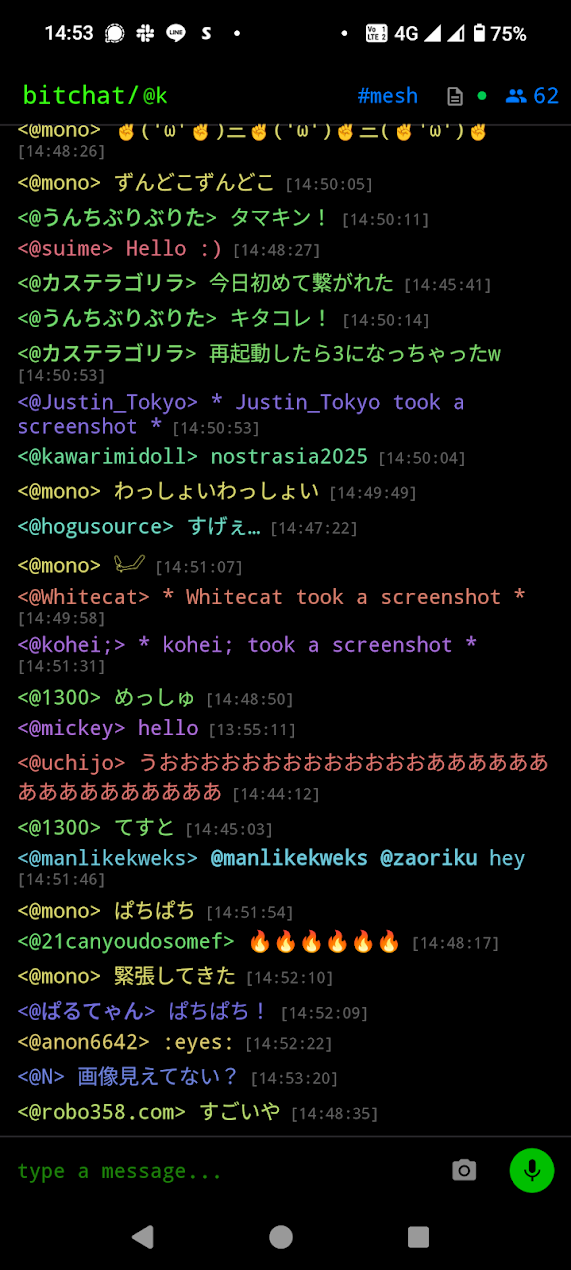
Since this system doesn't depend on the internet, it's useful for groups in the same place, such as political protests or music festivals, to communicate when the internet is down, or when you deliberately want local communication that's isolated from the internet. On top of that, IDs can be disposable and direct messages are end-to-end encrypted, so it's reasonably usable for anonymity as well.
💡
Tap the username in the top-left corner of the Bitchat app three times, and your current ID is erased and a new one is issued.
Bitchat also has online chat rooms that use Nostr. When you have an internet connection, you can join wide-area channels called Geohash Channels, covering radii of 200 m, 1.2 km, 4.9 km, 39.1 km and 1,250 km. You can even join channels for regions other than where you actually are.
💡
Geohash is a protocol that divides the Earth's surface into areas labeled with characters. For example, xn77 is the Tokyo metropolitan area and xn77h01 is the Imperial Palace: the more characters you add, the more precise the location. Trying it out on this site is the quickest way to understand it.
This means it can also serve as a kind of local bulletin board for a fairly wide area. That said, perhaps because Bitchat doesn't have all that many users, the Geohash Channels, which require the internet, don't seem very active. You can check channel activity on the map below.
Bitmap - Bitchat Heat Map
Real-time monitoring and visualization of ephemeral Nostr events with geospatial analysis and hacker-style interface.


Naturally, offline peer-to-peer usage over BLE is by its nature impossible to observe from outside, so it's hard to measure, but the Bitchat app itself has been downloaded more than 1 million times on Google Play. The App Store doesn't publish download counts, but in terms of reviews it has about one-sixth as many as Google Play. Perhaps that's because Android devices are probably dominant in the countries mentioned at the start.
It's not an app you'd use every day, but under certain conditions it offers a value nothing else can.
Jack Dorsey Is Behind It
As it happens, the app is backed by Jack Dorsey, founder of Block and a familiar name in the Bitcoin world. Dorsey himself develops the iOS version, while the Android version is developed by calle, a Bitcoin developer involved in eCash development. Bitchat has drawn a lot of attention in a short time, but it was released only recently, in July 2025.
Why Did Jack Dorsey Build Bitchat?
It's fairly well known that Jack Dorsey is interested in Bitcoin, Nostr and social media. So you might see Bitchat as simply another project along those lines.
In fact, though, Dorsey was interested in censorship-resistant social networks even before Twitter, and Bitchat is actually closer to his underlying philosophy. There's a clue in an article about Twitter's origins by @Dom, one of the company's founding members.
Did Twitter Grow Out of an Activist SMS Tool?
In its early days, Twitter was conceived as a product that added group functionality to text messaging (SMS on feature phones). Group chats are taken for granted today, but they were hard to do on the feature phones of that era. (I think another factor is that SMS was the norm in the US and Europe, unlike Japan, where even feature phones had email.)
One precedent that fellow founding members @Rabble and @Blaine studied and discussed internally was an SMS tool called TxTMob. TxTMob was essentially an SMS version of a mailing list: when users joined a group, they received every SMS sent to that group, and they could also send messages out themselves. TxTMob was reportedly used as a means of communication among protesters at the 2004 Democratic and Republican National Conventions in the US and during Ukraine's Orange Revolution.
TxTMob fell out of use as alternatives spread, but given how many articles trace Twitter's roots back to TxTMob, there's little doubt the founders were strongly influenced by it.
💡
Incidentally, @Blaine wanted Twitter to be a decentralized protocol rather than a company, clashed with the company's direction, and was fired in 2008, while @Rabble is now deeply absorbed in developing Nostr and Bitchat. It's fair to say the Twitter team had quite a few members with strong individual-sovereignty and activist leanings.
Also Useful as Infrastructure During Disasters
Twitter continued to serve as communication infrastructure in emergencies. For people in Japan, the most familiar example is the 2011 Great East Japan Earthquake.
In Japan, the custom of sending New Year's greeting texts and making New Year's calls has long made it hard to get a call through around New Year's. But after the 2011 earthquake, people came to recognize that when a major quake hits, the flood of calls checking on loved ones can make phone calls useless as a means of communication, and a movement arose seeking alternative ways to stay in touch. This was also when LINE exploded in popularity, but Twitter was used just as much to share information during the disaster.
💡
In 2023, after Twitter was rebranded as X, paid API access threatened to shut down earthquake alert accounts, and the outcry from users was so loud that Elon Musk reversed course.
Uncensorable Communication Is a Powerful Ally for Citizens
Around the same time, the Arab Spring was a major movement around the world. I was in high school then, and I remember watching citizens gather in Cairo's Tahrir Square on Al Jazeera almost every night and discussing it with friends over Skype. Those anti-government protesters were also using Twitter to communicate.
After stepping away from running Twitter in 2021, Jack Dorsey revealed that Twitter had been under pressure from governments around the world, and he has since supported the development of the decentralized social networks Nostr and Bluesky. That, too, comes from his belief that if a social network's protocol layer can't be controlled by a company like Twitter, then pressuring that company can no longer be expected to achieve censorship.
Given that history of Jack Dorsey and Twitter, I think it was only natural that he would build a censorship-resistant messaging app that can be used for anti-government activism even offline.
How Bitchat Differs from Similar Apps of the Past
I've already touched briefly on how Bitchat works, but for details, see the white paper hosted on GitHub. Basically, it takes messages similar to Nostr's, encrypts them with the Noise Protocol Framework, and delivers them over BLE using an efficient gossip protocol.
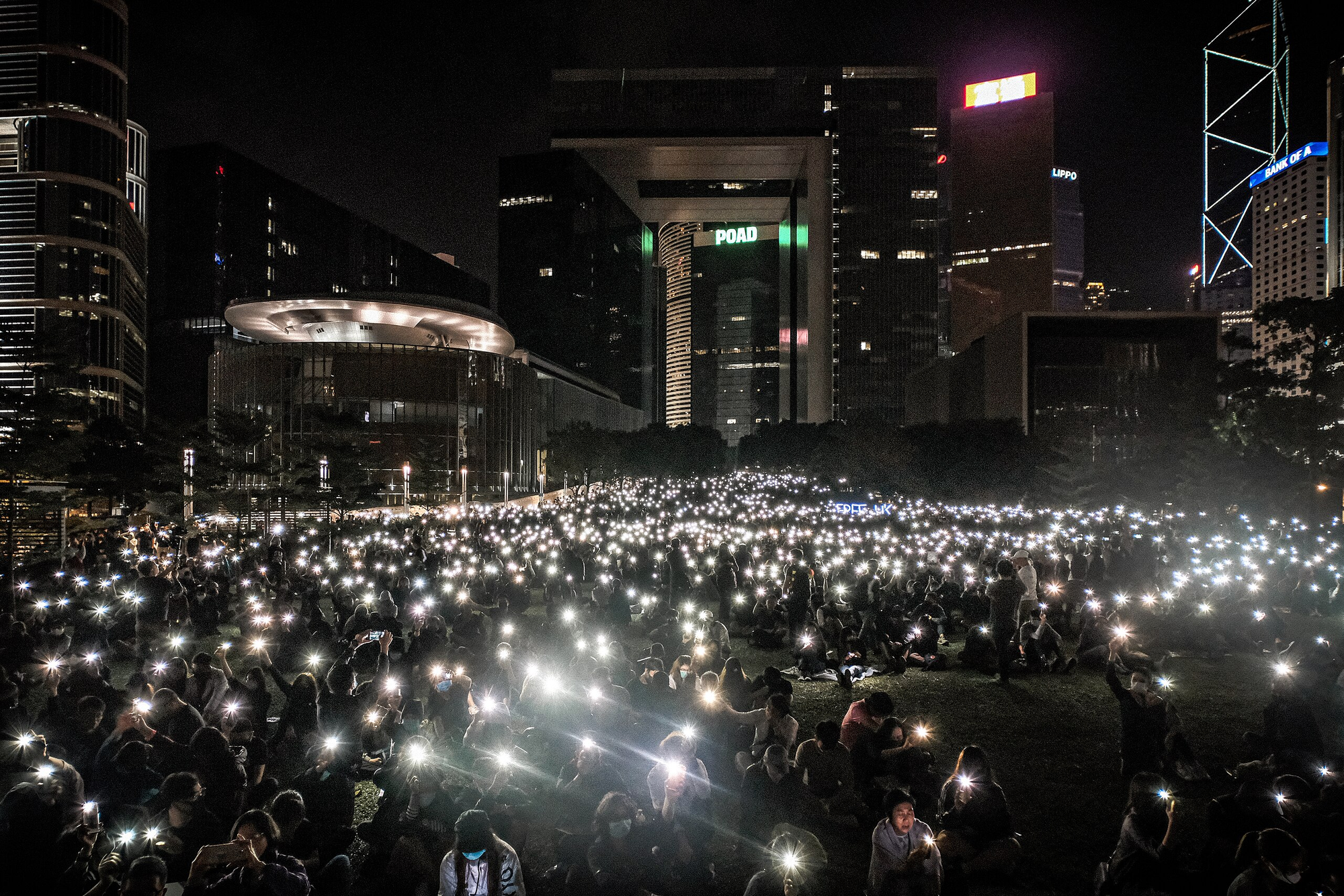
Apps designed to spread messages over a BLE mesh network have existed for more than 10 years. Representative examples are FireChat, used during the 2014 anti-government protests in Hong Kong, and Bridgefy, used during the 2019 anti-government protests there.
Because these apps let people share information anonymously and offline without going through the internet, they were an important technology for pushing back against the Hong Kong government (and the Chinese government), with its formidable surveillance capabilities.
So is Bitchat just a rehash of these apps? Actually, it has some real advantages.
Bitchat uses the same message format as Nostr not only for its internet-based Geohash Channels but also for local messages exchanged over BLE. This makes it highly interoperable.
For example, even during an internet shutdown, it's common for a small number of people to still be able to get online: they might have Starlink, use a foreign mobile carrier, belong to the privileged elite, or be within range of signals from a neighboring country. In that case, Bitchat users who have a route to that person might be able to have them bridge the mesh network to the internet and communicate with the outside world via Nostr.
The internet isn't the only technology available, either. LoRa, a long-range wireless technology, can carry signals several kilometers, so LoRa-capable devices might bridge local mesh networks together to reach distant communities, or even connect to the internet further down the line. Some users have already built a bridge between Bitchat and LoRa:
Bridging Bitchat and MeshCore: Resilient Communication When You Need It Most
TLDR: To bridge Bitchat and MeshCore, use this bridge code, you can flash a release binary directly. A mesh network is a decentralized communication system where devices relay messages for each other. Unlike traditional networks that depend on central infrastructure like cell towers or internet s
 Skip to the content
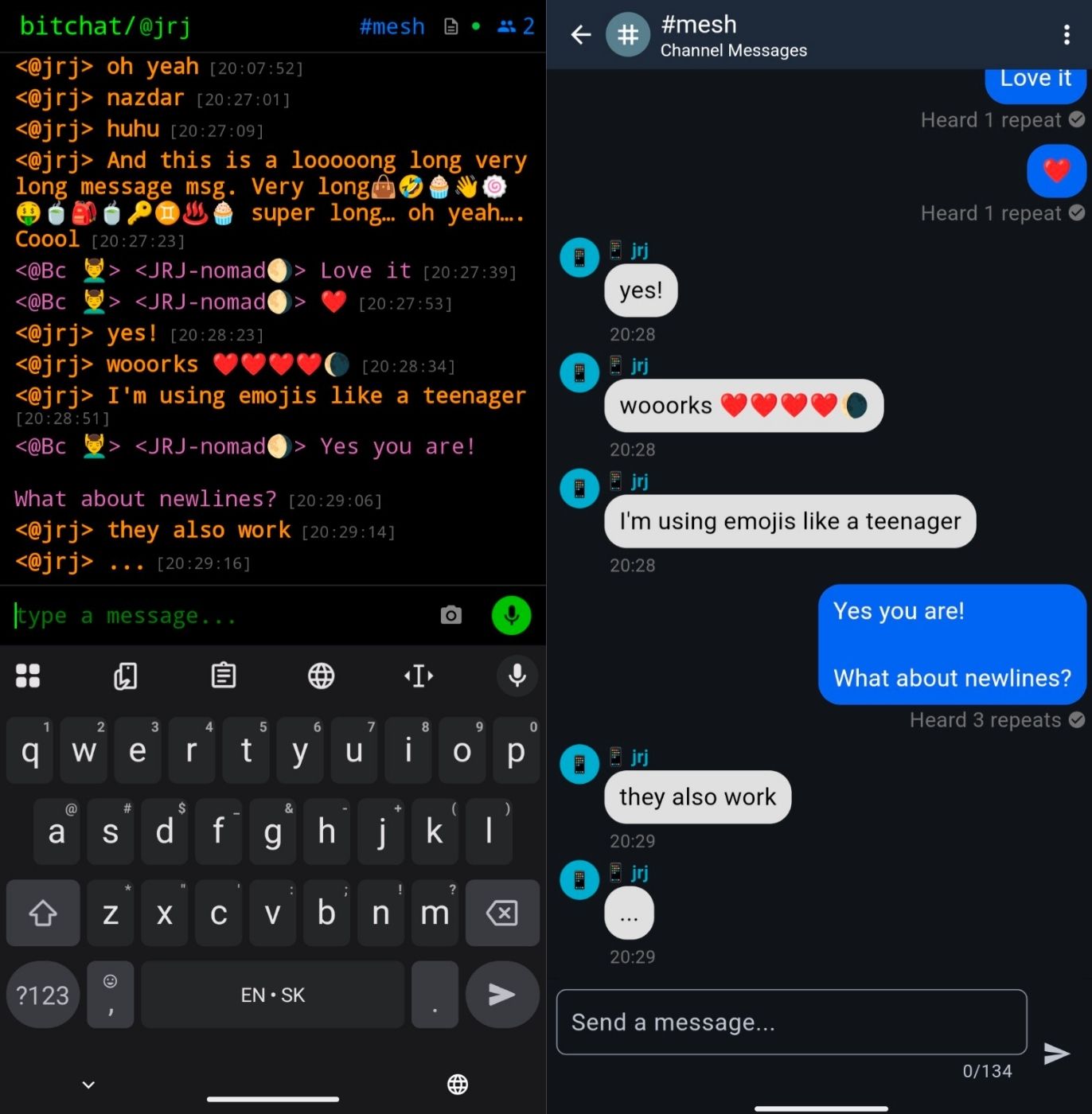
Once technologies like this become widespread, authoritarian regimes around the world will no longer be able to resort to internet shutdowns so easily. Perhaps Bitchat, a combination of BLE and Nostr, reflects Jack Dorsey's conviction that in an information society, it's wrong for communication to require permission, and his desire to build infrastructure that can't be censored.
And since Bitcoin is a permissionless protocol for transferring value, it benefits directly from greater censorship resistance in communication. In that sense, too, I find Bitchat genuinely inspiring.