What Is Cashu? Blind Signatures, Ecash and Bitcoin Privacy

This article was translated from Japanese with AI. Read the original (日本語) · Report a translation issue
Have you heard of Cashu? It has been coming up a lot lately in discussions about privacy and Bitcoin scaling.
You may associate it with any number of things: a Bitcoin-backed token, something that needs no account, something that works offline, or a way to pay in bitcoin when calling an LLM. But for all the different aspects people picture, explaining what Cashu actually is turns out to be very difficult, because it requires some background in cryptography.
On top of that, some people assume "Cashu = Bitcoin" and think of it as one of Bitcoin's Layer 2 technologies. It is certainly related to Lightning, but as you read on, I recommend keeping one premise in the back of your mind: "Cashu ≠ Bitcoin."
This article gives a comprehensive explanation of Cashu, from the background knowledge you need to understand it to how it works, how to use it, and which services support it.
David Chaum's Blind Signatures (1982)
At the heart of Cashu are blind signatures, which David Chaum presented in 1982 at the international cryptography conference Crypto '82.
A blind signature is a scheme in which the signer signs something without seeing its contents. It is easy to understand if you picture an envelope lined with carbon paper.
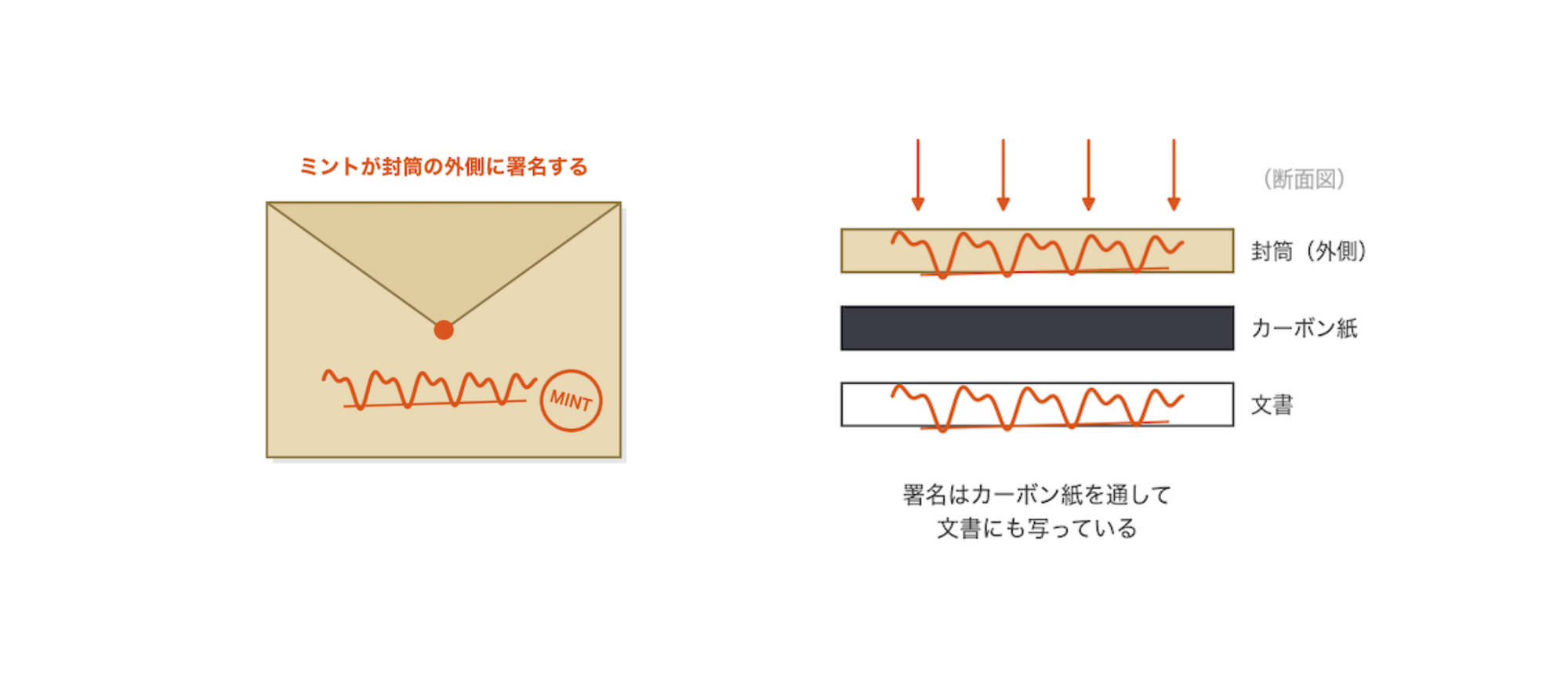
By signing the envelope, the signer can sign the document itself without ever seeing it, which makes the scheme useful for applications such as anonymous voting. Applying this scheme to money handled by a central issuer is known as Chaumian ecash, and it made sender anonymity possible.
💡
DigiCash, the company David Chaum founded, was the first to implement the concept of Chaumian ecash, and its electronic cash system was called "eCash."
eCash was first offered by a bank in St. Louis in the United States and was trialed at banks abroad, including Deutsche Bank, attracting about 5,000 users and 300 merchants. It never caught on, however, and DigiCash went bankrupt in 1998.
The diagram below explains how Chaumian ecash achieved sender anonymity.
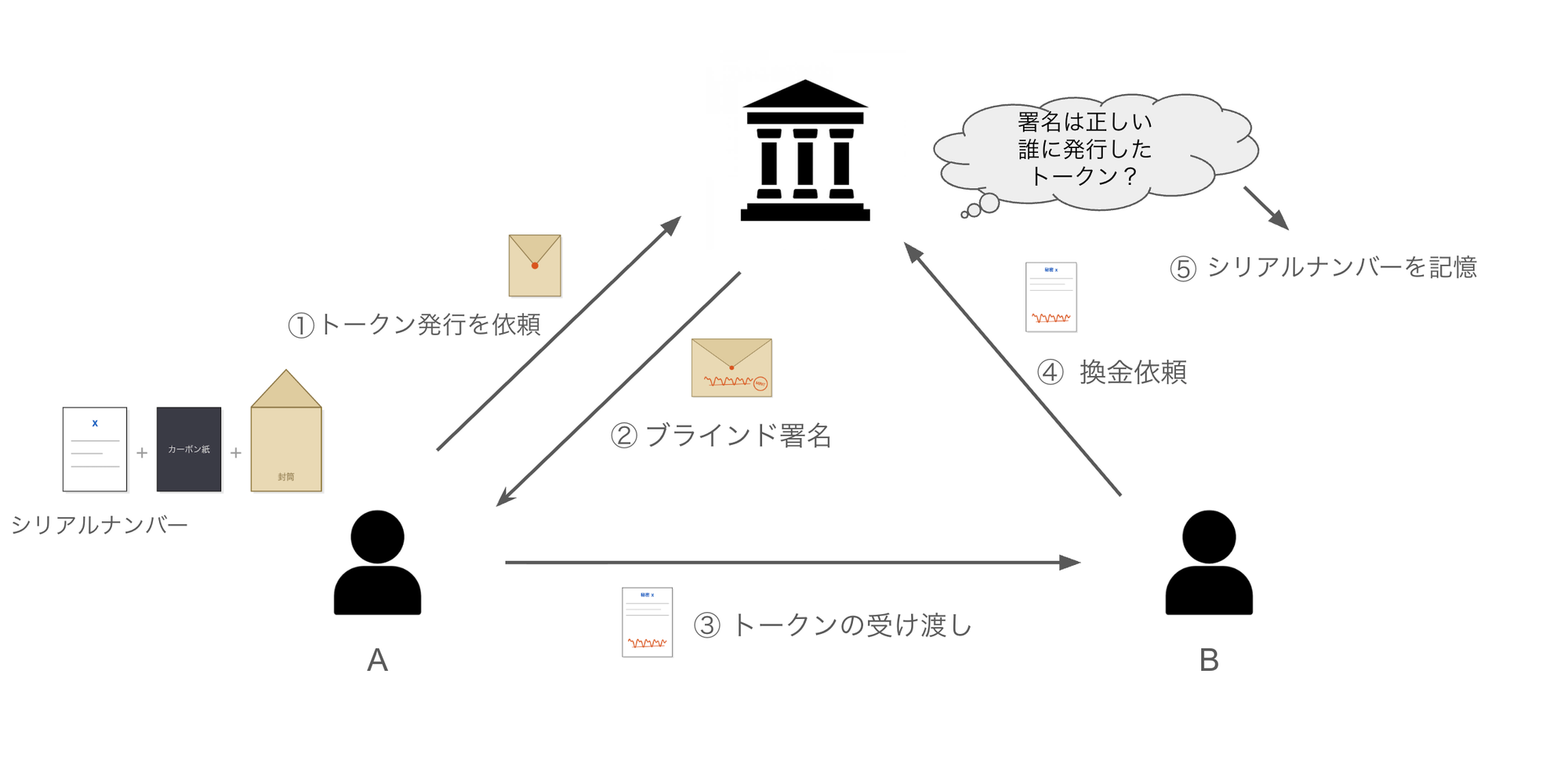
① User A creates a random serial number (a 256-bit random number) and asks the issuer to issue a token
② The issuer applies a blind signature
③ User A hands the token to User B
④ User B sends the token to the issuer to redeem it
⑤ The issuer checks the signature to verify that the token is valid, then records the serial number. At this point, the issuer has no way of knowing whom the token was originally issued to
When the issuer receives a redemption request, it cannot match the token against its issuance records, so it cannot establish any link between User A and the token. On the other hand, if the same serial number is presented for redemption twice, the issuer can detect it, which prevents double spends.
💡
The blind signatures David Chaum proposed were built on RSA, but RSA was covered by a US patent, so using it required a license.
That is why, in 1996, David Wagner proposed a scheme without RSA on the cypherpunk mailing list, and it became the prototype for today's Cashu.
The original post (archived): Chaumian ecash without RSA
Incidentally, when the RSA patent expired, a party was held in San Francisco.
What Cashu Is and How It Works
Cashu is an open source Chaumian ecash protocol that runs on Bitcoin and the Lightning Network. That should make it clear why "Cashu ≠ Bitcoin."
It was developed by an anonymous person known as calle (callebtc), who in addition to creating Cashu also developed the Android version of Bitchat, a messaging app that uses a Bluetooth mesh network, and is known as one of the members of Bitcoin Red Team, whose activities came to light in 2026.
The protocol specification is documented under the name NUTs (Notation, Usage, and Terminology), a play on cashew nuts, and there is a reference implementation written in Python called Nutshell, as well as development tools in Rust such as the CDK (Cashu Development Kit).
In essence, the issuer, called a "mint," issues tokens (bearer tokens) by applying blind signatures, backed by bitcoin it holds on the Lightning Network. Because it holds the backing bitcoin, the mint is a custodian.
One clever design choice in the main implementations is that tokens are issued in power-of-two denominations.
For example, if User A has 13 sats of tokens issued, they are issued as separate tokens of 8 sats, 4 sats and 1 sat. This is because if arbitrary amounts could be issued, an unusual amount would make it possible to link a token at issuance with the same token at redemption.
💡
The mint holds a separate public and private key pair for each denomination, and it tells the amount of a token presented for redemption by which key signed it.
The more tokens are issued in these power-of-two denominations, the larger the anonymity set. So when choosing which mint to connect to, picking one with many users matters for anonymity.
How to Use Cashu
Here I'll walk through the basics using Cashu.me, one of the major wallets, as an example.
Choosing a Mint
In most Cashu-compatible wallets, the first thing you do is choose a mint. Pick one you feel comfortable entrusting your bitcoin to. As in the attached screenshot, the wallet shows a list of mints with their popularity and reviews, so you can choose from that list or enter a URL yourself to look one up.
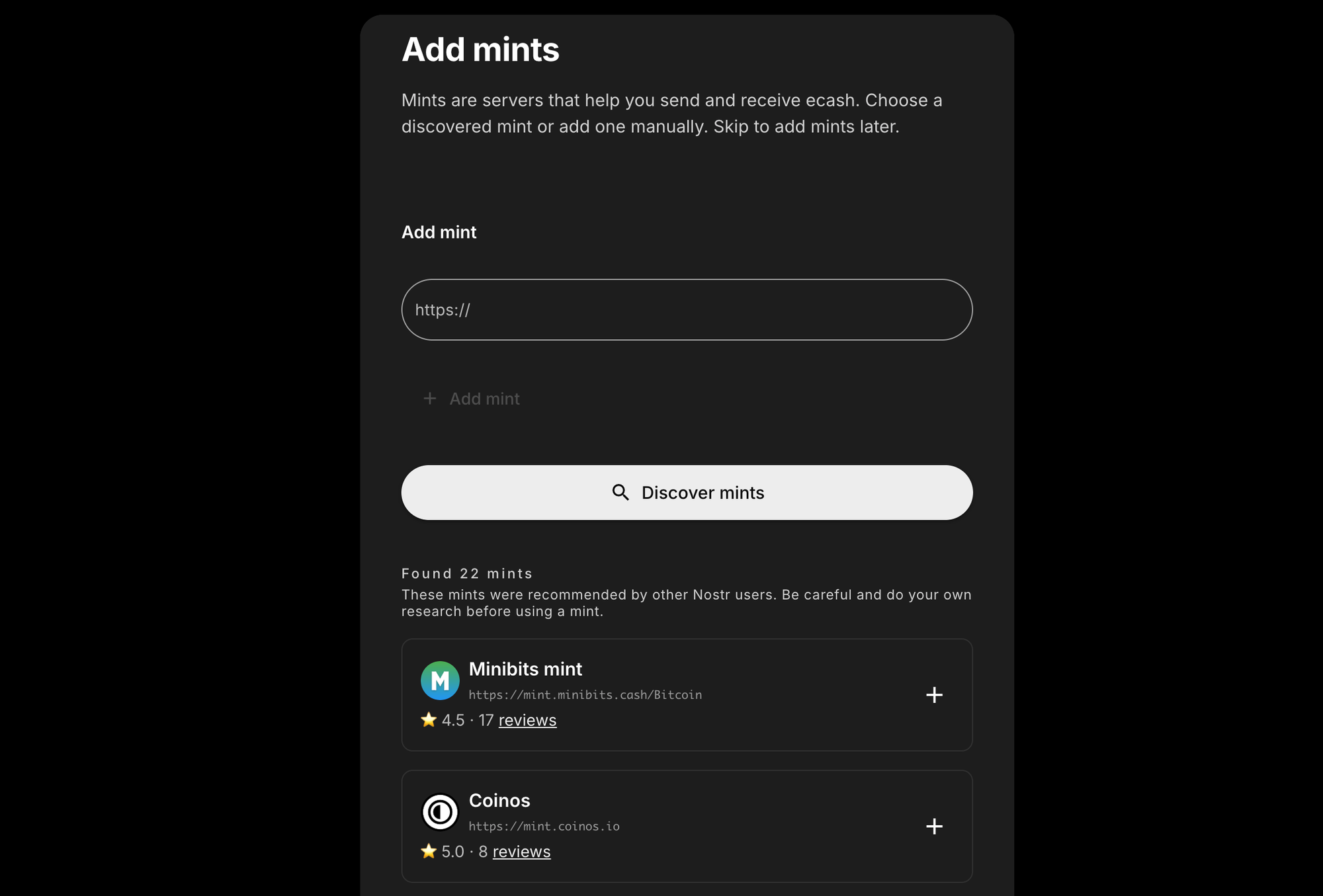
To repeat: if anonymity is a priority, it's important to choose a mint with many users (because that makes the anonymity set larger).
Receiving Ecash (Tokens)
The UI is almost the same as the Bitcoin wallets you're probably already using.
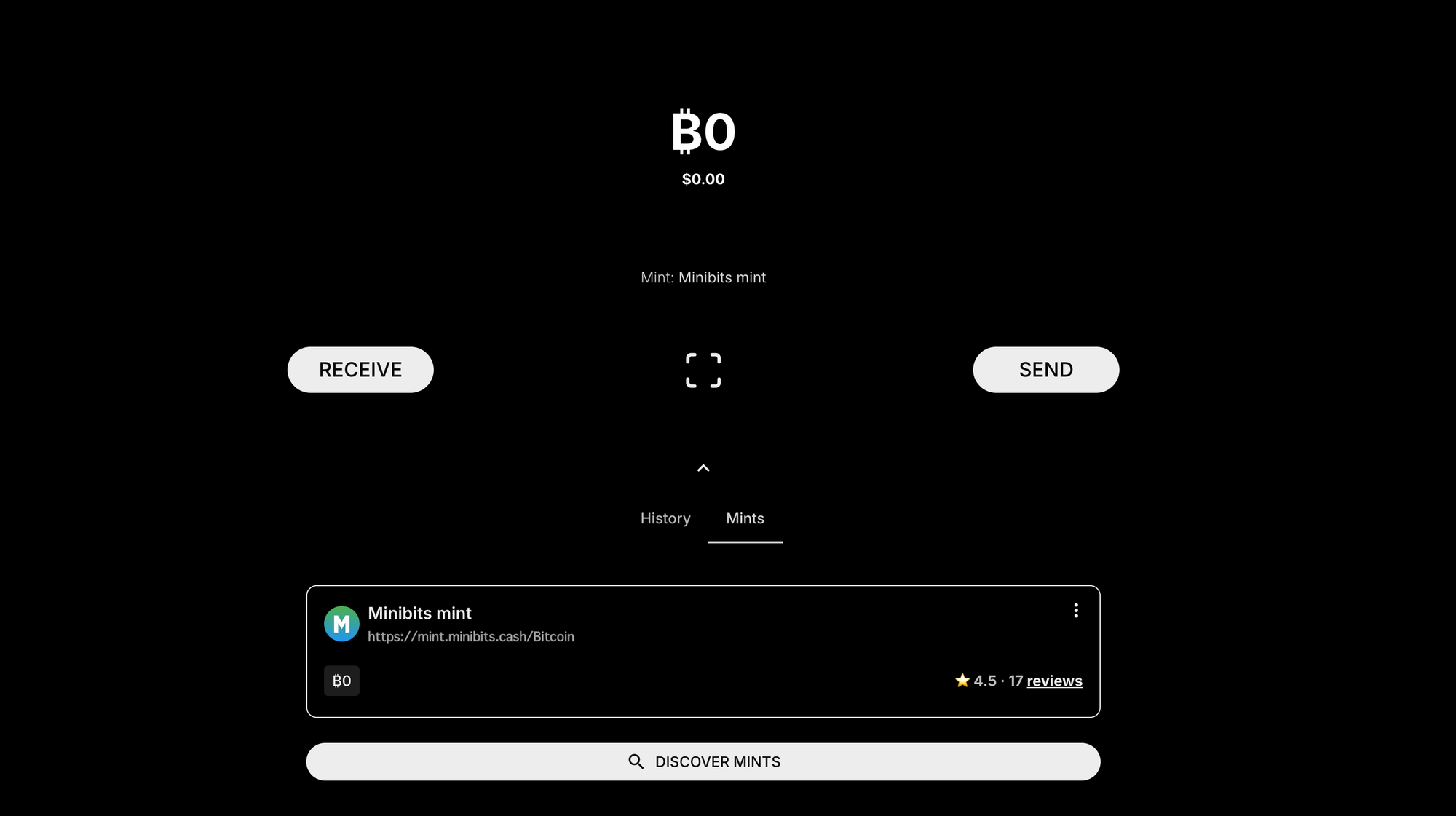
In Cashu, tokens are called Ecash. To receive Ecash, follow the on-screen prompts and select RECEIVE. Since you receive Ecash in exchange for your own bitcoin, you then choose whether to deposit via Lightning or on-chain (some wallets don't support on-chain).
This time I chose to deposit via Lightning.
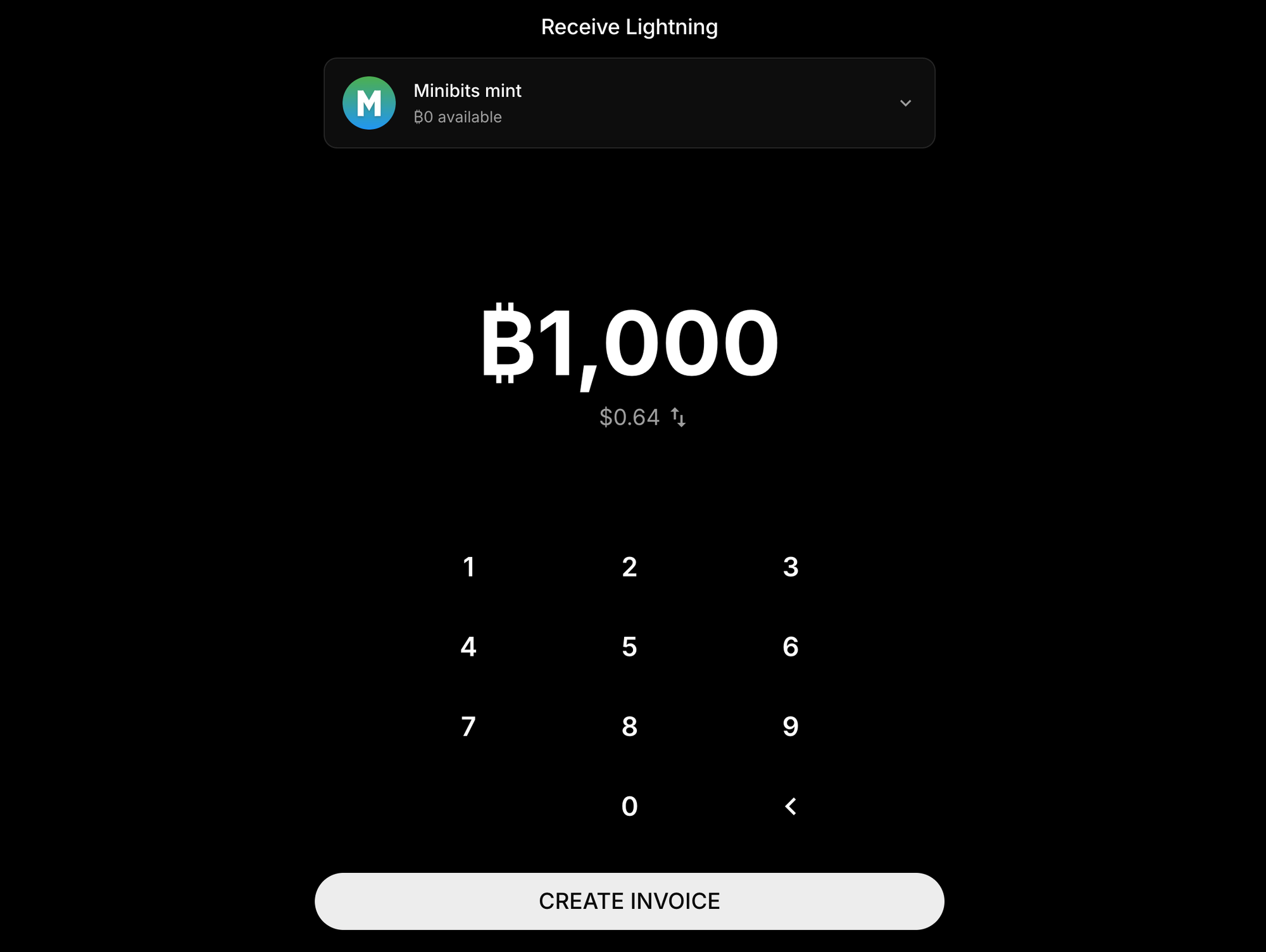
Enter an amount to generate an invoice, then scan the QR code and send the payment, and you'll receive Ecash.
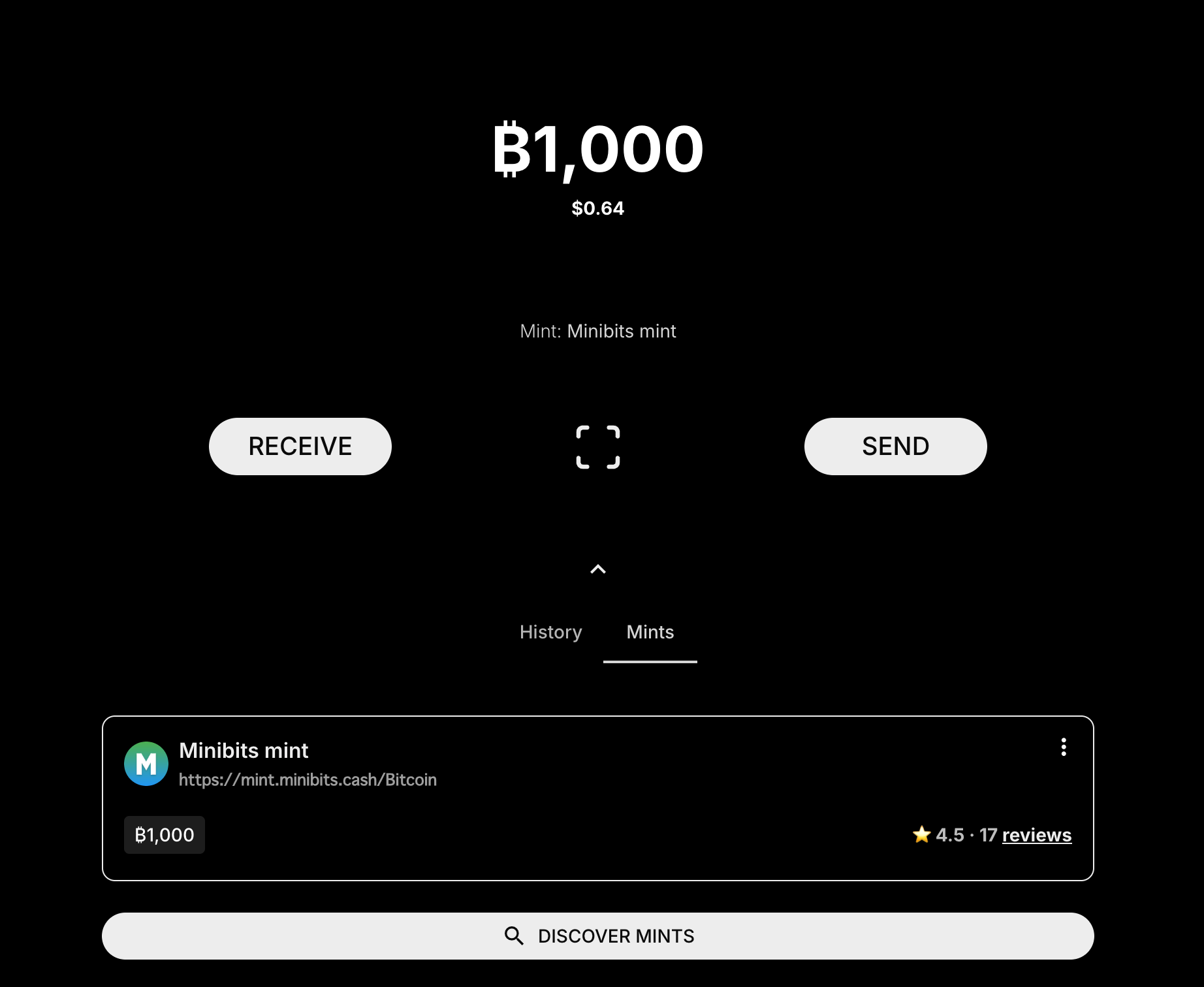
I was able to deposit 1,000 sats worth of Ecash. Behind the scenes the wallet and the mint are communicating, but as you can see, from the user's point of view the UX is almost no different from using an ordinary Bitcoin wallet.
Tapping SEND lets you send it as Ecash, or send bitcoin via Lightning or on-chain. (When you send via Lightning or on-chain, the mint automatically converts the tokens into bitcoin and sends the payment on your behalf.)
The Three Roles of a Mint
A mint has three main roles:
- Mint (issuance): issues new tokens when a user deposits bitcoin
- Swap (exchange): exchanges old tokens for new ones
- Melt (redemption): pays out bitcoin in exchange for tokens
It may help to think of a mint as a bank that issues notes convertible into bitcoin.
Just as in everyday life you trust a bank when you deposit yen with it, a mint also requires trust. And just as there have been cases where people could not withdraw their yen from a bank, a mint could also become unable to pay out bitcoin, so it's best to use it for small payments.
The Scope and Advantages of Cashu's Anonymity
I explained that blind signatures prevent issued tokens from being linked to redeemed ones, but that doesn't mean you get complete anonymity. Here is an overview of what information a mint can and cannot obtain.
| What the mint can see | What the mint cannot see |
|---|---|
| Total amounts issued and redeemed | Who holds which tokens |
| When issuance and redemption took place | How many times a token has changed hands |
| Lightning invoice details at issuance and redemption | Links between issuance and redemption |
| Total transaction volume per period | Individual users' balances and histories |
The core of Cashu's privacy is "sender anonymity." The mint knows how many tokens it issued against which invoice, but it cannot trace where those tokens go afterward. And since no account is needed in the first place, it's hard to even tie the recipient of an issuance to an individual (though there are setups that link it to a Nostr public key).
Another major advantage seems to be that payments within the same mint settle instantly without needing a blockchain. When passing tokens to someone on a different mint, you can also send the payment over the Lightning node the mint operates, so there's no need for the tedious channel management or for acquiring inbound liquidity that Lightning requires.
On top of that, you can write a token on paper and hand it over physically, or copy and paste it and send it through some other medium. In other words, Cashu makes possible offline transfers, something Lightning could not do.
Risks of Using Cashu
Because Cashu is custodial, you have to place a certain amount of trust in the mint.
The risks users need to consider are that the mint might not redeem tokens for bitcoin, and that when you receive tokens, the sender might double spend them because they kept a copy.
For the latter, swapping the tokens you receive for new ones invalidates any copy the sender holds, so it's recommended to swap tokens as soon as possible after receiving them.
The Cashu Ecosystem
8 Cashu-Compatible Wallets
The main Cashu-compatible wallets are:
- Minibits (iOS / Android): a mobile wallet with offline payments and Nostr integration
- Cashu.me (browser / iOS / Android): the official wallet, serving as something of a reference
- eNuts (iOS / Android): a new version is being developed with coco, a TypeScript library
- Macadamia (iOS): an iOS wallet written in Swift, with an iMessage extension
- Sovran (iOS): a wallet for iOS
- Nutstash (browser): supports multiple mints and can send and receive via Nostr
- Zeus (iOS / Android): a wallet for advanced Bitcoiners that now supports Cashu
- Numo (Android): has point-of-sale features and can integrate with BTCPay Server, making it handy for use in shops
3 Services That Accept Cashu
Here are three hand-picked services where you can use Cashu.
Athenut (Privacy-Focused Web Search Engine)
Athenut is a privacy-focused web search engine. Its distinguishing feature is that it wraps the API of Kagi Search, a paid search engine, and lets you pay with Cashu.
There are many benefits to using a paid search engine, but the starting point is that regular search engines rank ads and promotions at the top for the sake of advertisers. Kagi Search is designed around the philosophy that "search results should serve users, not advertisers," and its big advantages are less noise, a focus on privacy (your searches aren't used for profiling or advertising), and results you can customize to your own needs.
Athenut: Privacy-preserving Web Search Powered by Kagi & Cashu
Athenut is a privacy-friendly pay-per-query web search engine powered by Kagi and Cashu.
 EZ
Routstr (Decentralized AI Inference Marketplace)
In a nutshell, Routstr is a decentralized OpenRouter you can pay for with bitcoin. It lets you use a variety of AI models through a single OpenAI-compatible API, and the main difference from OpenRouter is that it's a no-KYC, decentralized marketplace made up of independent operators.
Other notable features are that you can pay with Lightning or Cashu, and that it's open source.
A previous article touched briefly on Routstr, so check it out as well.
【2026年最新】OpenClaw × ビットコイン匿名セットアップ|No KYCでAIエージェントを動かす方法
OpenClawをNo KYC寄りにセットアップする方法を解説。LNVPS(Nostrログイン×Lightning決済)でVPSを立て、Routstr(Lightning/Cashu)で推論APIを匿名寄りに運用。Signal連携まで紹介。
 三倉 大司
Bitchat (Messaging App That Works Without the Internet)
Bitchat is a messaging app that works without an internet connection, announced in July 2025 by Twitter co-founder Jack Dorsey.
The basic idea is that phones connect to each other over Bluetooth, forming a mesh network that delivers messages.
Thanks to calle, the creator of Cashu, the Android version of Bitchat can now handle Cashu tokens, so you can send tokens as messages (redeeming them requires an external wallet and an internet connection).
Bitchat has also been covered in a separate article, so take a look if you're interested.
インターネット遮断国家で話題のメッセージアプリBitchat | NostrとBLEの組み合わせが強い理由
イラン、ウガンダ、ネパールなど世界中でインターネット遮断や反政府デモを機に注目されているオフラインメッセージアプリのBitchatについて、支援者ジャック・ドーシーの思想や来歴、P2P通信とNostrの相性に注目して解説します。
 加藤 規新
Conclusion
Cashu is a Chaumian ecash protocol built on David Chaum's blind signatures. It runs on Bitcoin and Lightning, but Cashu itself is not Bitcoin. Because the mint cannot link issued tokens to redeemed ones, the sender's anonymity is preserved. It also enables instant payments and offline transfers.
On the other hand, Cashu is custodial. It's best to choose a trustworthy mint with many users and use it for small payments.
Bitcoin Research Lab has also published earlier articles explaining Cashu and related services, so if you'd like to understand it in more depth, take a look at the articles below as well.
Chaumian eCashを扱うエコシステムがCashuを中心に活発化
本稿でも2021年夏に紹介したFedimintはその後も着々と支持を集めており、特にフェデレーション型ではない通常のカストディによるChaumian eCashエコシステムが成長し続けています。カストディと引き換えにプライバシーとスケーラビリティを実現するFedimint及びChaumian eCashについては下記の記事をご覧ください。 Federated Chaumian Mintsで分散カストディアル・ライトニングウォレットビットコインのレイヤー2はライトニングネットワーク以外にもいくつか出てきていたり、提案されています。そのうちの1つとして、Federated Chaumian Mintsというものが少し話題になっていたので、それがどういうもので、何ができるのかを調べてみました。 https://fedimint.org CHAUMIAN MINTとは ビットコインが誕生する前にも、いわゆる仮想通貨というものは実験されていました。新しいものから遡ると、代表的なものではE-gold、Liberty Reserve、Digicash (Ecash)などが挙げられます。特に、公開鍵
 加藤 規新

Cashu AddressはNostrユーザーにZapを受け取れるシンプルなウォレットを提供する
今週新しく見つけたサービスに、nostrで利用する公開鍵(npub)をユーザー名としたカストディ型のLightning Addressサーバーがありました。このサービスの特徴の1つは送付されたsatsをユーザーが指定したChaumian Mint上のE-cashとして保管し、出金時にはこれを移転するというところです。 npub.cashとしてローンチしているこのサービスですが、ウェブサイトに最低限の説明が書いてある程度のアーリーな段階ですので利用自体は自己責任でお願いします。本質的にWallet Of Satoshiの利用と出金方法以外はほとんど変わりませんが、Fedimintとの合体によって化ける可能性も感じました。 今日はそんなCashu Addressについて説明します。 ・Cashuとは ・Cashu AddressはLightning Address+Cashu Tokensが融合した形 ・カストディアルなCashuによるスケーリングの役割 Cashuとは ビットコイン以前にも様々なデジタルマネーの試みがなされていました。その中の1つに、暗号学者David C
 加藤 規新