Block's Proto: The US-Made Bitcoin Miner Challenging Bitmain

This article was translated from Japanese with AI. Read the original (日本語) · Report a translation issue
When people worry about how decentralized mining is, the usual concern is the concentration of mining pools. Further upstream, though, the production of ASICs, the machines used for mining, is dominated by China's Bitmain, which holds about 80% of the market. Of course, simply making and selling ASICs as an ordinary business is more profitable (than attacking Bitcoin), but it also means there is a risk that the production facilities could be commandeered under government pressure.
Bitmain also has close ties to many mining pools, so it could make that problem worse as well.
In August, Block finally announced Proto, its US-made mining hardware. How will it set itself apart from Bitmain's machines, which have become the industry standard? In this article, we look at the strategies of the ASIC challengers that came before Proto, and at Proto's own strategy.
Homepage
Proto is decentralizing bitcoin mining by increasing access to tools for builders. We believe this is the best way to create a stronger, more resilient network.


• Even with Bitmain far out in front, MicroBT and other companies have kept up the fight
• Proto takes lessons from data centers and proposes a new approach to profitability
• It also provides the surrounding software as open source, committing to better operations
Even with Bitmain far out in front, MicroBT and others have kept up the fight
As mentioned at the start, Bitmain dominates the global market for Bitcoin mining ASICs; the ASIC inside the Bitaxe, for example, is made by Bitmain. Because its machines are so common, there is a thriving secondhand and repair market for them, and they serve as the benchmark in profitability calculations.
That doesn't mean other companies aren't going after the top spot. MicroBT's Whatsminer series is generally more expensive than Bitmain's Antminer series, but it is often said to be more reliable. Since reliability can affect the maintenance fees (charges for dealing with breakdowns) that hosting providers impose, MicroBT may in some cases be able to compete on cost over the machine's full lifecycle.
Bitcoin And Crypto ASIC Miner Profitability
Weekly updates on the prices, and profitability of Bitcoin and Crypto Miner models, sourced from thousands of datapoints across the ASIC Miner brokers

ASIC performance comparison. Antminer (Bitmain) clearly has a much faster release cycle.
Blockstream acquired Spondoolies, a manufacturer from the early days of the ASIC era, in 2021, and has said it will spin out the ASIC it is developing into a separate company and raise additional funding. ASICs often run in harsh environments and have relatively high failure rates, and the aim is reportedly to seize on that by offering highly reliable ASICs (meaning less downtime and lower maintenance costs).
Companies are working hard like this to break Bitmain's hold on the huge ASIC industry, but for now none of them comes anywhere close.
💡
One of Bitmain's strengths is that it offers miners a range of financial services, including ASIC leasing, which gives it a major advantage when it comes to getting customers to adopt its machines.
Proto takes lessons from data centers and proposes a new approach to profitability
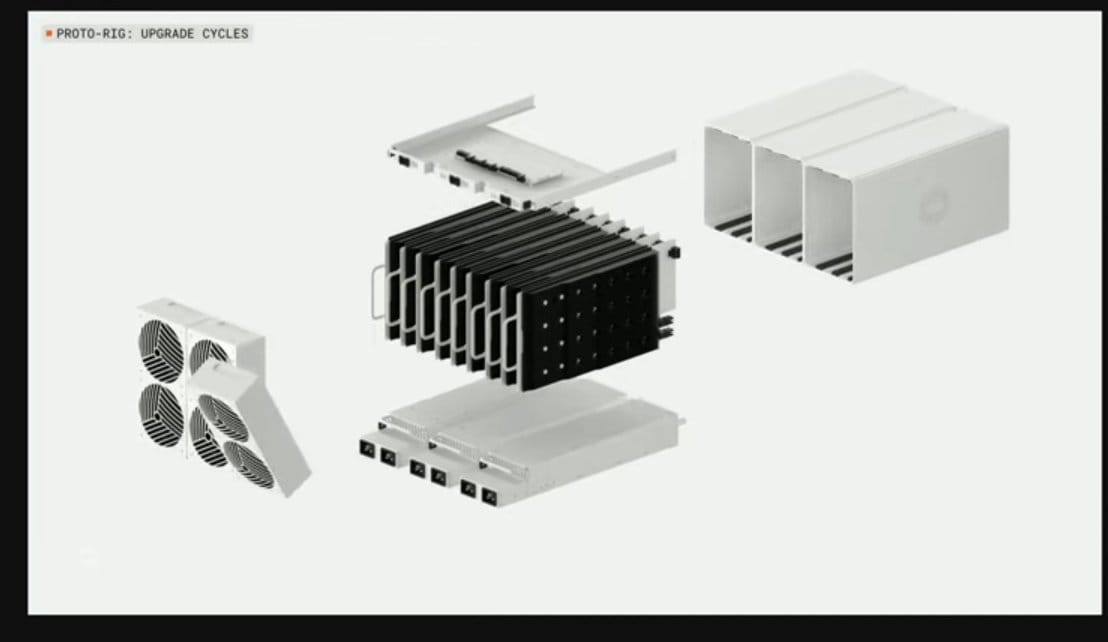
The defining features of Block's newly announced Proto are its modular structure and high-density design.
According to Block, data centers around the world have spent decades working out how to run huge numbers of servers efficiently, whereas the mining ASIC industry has focused too heavily on power efficiency and has not put enough thought into the form of the machines themselves. With Proto, Block says it set out to improve total cost efficiency over the lifecycle, using a modular design to reduce downtime and upgrade costs, and increasing hardware density.
It does seem true that existing ASICs were designed to be thrown away once they reached the end of a generation after 3–5 years, and weren't really designed with removal or disassembly for repairs in mind. Simply being able to swap out the hash boards carrying outdated ASICs, or the power supply modules, individually, without tools and without taking the machine off the rack, should cut upgrade and operating costs considerably. The 50% increase in hardware density also saves rack space. I think it's fair to understand this as: even if the upfront cost is somewhat higher, you can expect to recoup it over the long term.
Proto Rig looks clean. Reminds me of beautifully designed Swedish telecom hardware. pic.twitter.com/4F3fLSPw6Q
— Erik (@uxerik_) August 14, 2025
From a miner's point of view, however, this also means betting that Proto will keep producing competitive ASICs over several generations. Because module swaps are the basis of the cost savings, if Proto fails to produce a competitive ASIC in the next generation, miners will face a tough decision about whether to cut their losses on all their Proto modules (the initial investment they made expecting to recoup it through cost savings).
It will be interesting to see how many miners take up this proposition. For now, it appears to be rolling out in Core Scientific's data centers in the US.
💡
I'm not an expert on this, but for miners based in the US, or for machines run in US mining data centers, tariff-related factors could provide a bit of a tailwind as well.
It also provides the surrounding software as open source, committing to better operations
On the software side, Proto is also offering a management tool called Fleet as free, open-source software.
Brian Stegall, Proto's lead designer, told Bitcoin Magazine that existing mining facilities monitor and operate their hardware with a patchwork of different software and web-based tools, which is very outdated, and that Proto Fleet brings all of that together into a single tool suited to the present day.
It's not a silver bullet for the decentralization problem with mining pools, but Proto also supports Stratum V2, which has many other benefits, out of the box, making it a very modern piece of mining hardware on the software side too.
Stratum V2は本当にマイニングプールの検閲耐性を改善するのか?
マイニングの話題になると、少なくともここ数年は規制や検閲という部分に関する関心が高まっている実感があります。マイナーがマイニングプールに接続する現状ではプール側が検閲を行えるのではないか、いくつかの大手マイニングプールが検閲を行うと実質的にネットワーク全体が検閲をしているのと同じ状況にならないか、といった疑問です。 ビットコインの検閲耐性はマイニングプール間、マイナー間の競争によってこれまで守られてきました。経済合理性を欠く検閲行為は検閲をしないマイナーへの報酬増加に繋がり、マイナーは検閲を行わないプールへと移動することが予想できます。これ自体はかなり強力な理屈で、ビットコインにおけるProof of Workのイノベーションの1つです。 他方、マイニングプールが大きな影響力を持っていることを認識し、その影響力の根源であるブロックテンプレートの作成を個別のマイナーも行えるようにしようという発想もあります。時折話題に上がるStratum V2プロトコルにそのような機能が盛り込まれています。 果たしてStratum V2プロトコルはマイニングプールの影響力を押さえることができるのか、
 加藤 規新

For more on Stratum V2, see our earlier article.
Summary
• Proto is a competitive US-made ASIC with a modular structure and efficient use of space that should reduce upgrade and maintenance costs when run "in a data center" and "over several generations"
• From a miner's perspective, the biggest drawback may be that getting the benefits requires committing to Proto products well into the future
• The surrounding software has been modernized as well, and Proto may become a player that helps the mining industry mature
Personally, I find Proto's design very appealing, and if they ever release a home mining product like the Bitaxe, I'd love to try it. I suspect, though, that such a product wouldn't fit well with Proto's design philosophy, which assumes operation in data centers.