Proof of Useful Work: Lessons From 10 Mining Projects

This article was translated from Japanese with AI. Read the original (日本語) · Report a translation issue
Bitcoin mining performs an enormous number of hash computations and uses a huge amount of electricity.
How wonderful would it be if mining's computing resources could go toward cancer research, protein analysis, or training AI models? The more wasteful someone thinks Bitcoin is, the more this idea probably resonates.
On May 7, 2026, a tweet by Koji Higashi drew a lot of attention.
これをビットコインと言います https://t.co/NrNHQ6D4pA
— Koji Higashi (@Coin_and_Peace) May 7, 2026
In response, a number of posts questioned whether Bitcoin's computation has any point, such as "Bitcoin runs on meaningless hash computations, so if you made them meaningful, wouldn't you get something better than Bitcoin?" and "LLM computation is more worthwhile than SHA256."
In fact, developers and researchers around the world have had the same thought, and a variety of projects have launched since around 2013. This article looks at 10 projects that tried to put mining computation to useful work. Needless to say, it is not meant as a recommendation for any altcoin.
I'm not against trying, but knowing what has been tried before puts you in a better position to try something new. At the end, I'll also discuss the structural problems with building useful computation into a blockchain in the first place.
Attempts to use mining for scientific computing
When people think of useful computation, contributing to science is probably the first thing that comes to mind. There have been numerous attempts at this since around 2013.
- Primecoin (2013)
- Riecoin (2014)
- Gridcoin (2013–)
- Curecoin and FoldingCoin (2014)
- Coinami (2016)
Here is what each project was about.
Primecoin (2013)
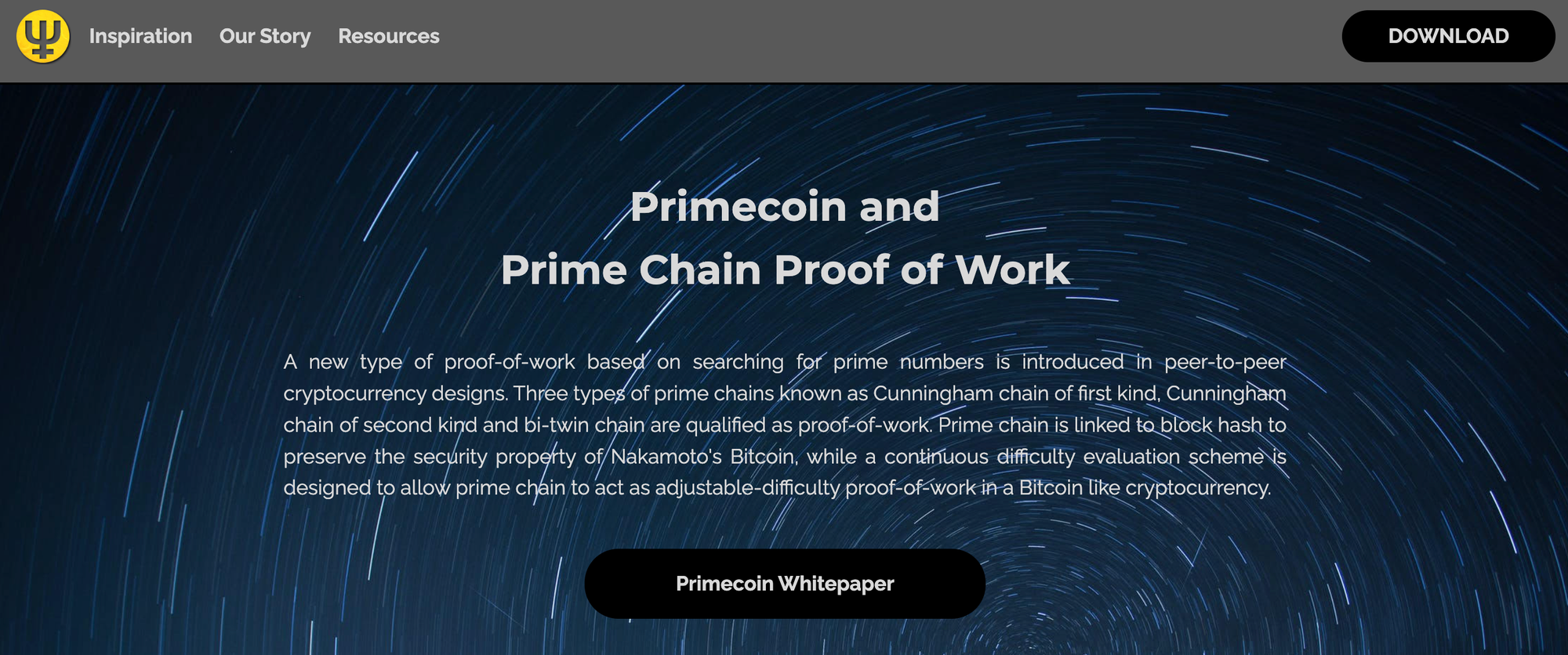
Primecoin, launched in July 2013, was an attempt to put mining power toward searching for prime numbers. Its developer went by the handle Sunny King.
The mechanism is close to Bitcoin's: miners compete to produce blocks. But where Bitcoin computes hashes, Primecoin searches for chains of primes that follow a specific pattern.
💡
One example is a chain where doubling the previous prime and adding 1 gives the next prime: 2 → 5 (2×2+1) → 11 (5×2+1) → 23 (11×2+1) → 47 (23×2+1). A chain that has been found can be verified with a Fermat test, and difficulty can be adjusted by changing the required chain length.
However, the chains miners can search for are limited to those starting from a multiple of the current block's hash. It is not a system that lets mathematicians freely explore the areas they want to study. primes.zone, a site run by a community member, recorded 4,599,221 chains and 47,334,011 primes, but it has since shut down.
I also could not find any record of the primes it discovered being used in mathematical research. Without any record of real use, I think Bitcoin's hash computation is the simpler rule design.
Primecoin still produces a block roughly every minute, and CoinMarketCap shows it trading on two exchanges.
Riecoin (2014)

Riecoin, launched in 2014, was another project that tried to use prime numbers for mining, like Primecoin. Where Primecoin looks for chains of primes linked by a specific rule, Riecoin looks for clusters of primes packed together in a fixed pattern (constellations). One example is a set of seven primes lined up at very close intervals.
It was said that this might offer clues toward disproving the Riemann hypothesis, an unsolved problem about the distribution of primes, but it drew only limited recognition from mathematicians. It also shares Primecoin's structural problem: keeping difficulty stable requires capping the size of the primes being found.
Riecoin is still running, and there is a Constellation Explorer where you can browse the prime constellations it has found.
Gridcoin (2013–)

Gridcoin is designed as a proof of stake (PoS) blockchain with rewards for contributing to scientific computing layered on top. Through a platform called BOINC (Berkeley Open Infrastructure for Network Computing), users receive additional coin rewards based on how much they contribute to more than 30 projects, including cancer research, protein analysis, and space exploration.
To receive research rewards, however, you must first buy GRC and participate in staking. Put another way, someone who wants to contribute to science can't get rewarded without buying GRC first.
In addition, contributions to BOINC are measured by credits issued by the BOINC project servers, which Gridcoin simply accepts as is. The Gridcoin network itself has no way to verify them. Because falsely reporting your contribution doesn't break consensus, the system is vulnerable.
On top of that, BOINC has been running since 2002, and most of its achievements, such as published papers, were accumulated before Gridcoin existed.
Curecoin and FoldingCoin (2014)

Curecoin and FoldingCoin were both projects that offered rewards for participating in Folding@home, a protein folding simulation project that originated at Stanford University. As with Gridcoin, the blockchain itself has no way to verify how much each participant contributed.
- Curecoin: a PoS chain that adds rewards for contributing to Folding@home
- FoldingCoin: no chain of its own; a Counterparty token on Bitcoin, distributed monthly according to contributions to Folding@home
Then in 2020, DeepMind's AlphaFold2 used AI to all but solve the protein structure prediction problem, and more than 200 million structures were released for free. Folding@home has since shifted its focus to dynamic simulations and is still running, but one of the main problems it originally set out to tackle was solved by AI through an entirely different method.
Both projects depended entirely on an external platform, Folding@home, and had no say over what to compute. Curecoin still has an official website, but trading is close to zero. FoldingCoin's website no longer works, and the project has effectively ended.
Coinami (2016)

Coinami proposed using the mapping of DNA data generated by next-generation sequencers as proof of work. A research team at Bilkent University in Turkey published it on arXiv at a time when the computational cost of genome analysis was skyrocketing.
Under this scheme, miners download DNA data from an authority's server, map it to a reference genome, and return the results. Those results serve as the proof of work used to produce blocks.
By the protocol's design, however, a central authority that supplies and manages the DNA data is indispensable, which is incompatible with decentralization. A prototype was released, but it never launched as an actual cryptocurrency and never went beyond a paper.
Attempts to use mining for AI
Here are two attempts to direct mining toward AI-related computation.
- Coin.AI (2019)
- Bittensor (TAO, 2021–)
Coin.AI (2019)
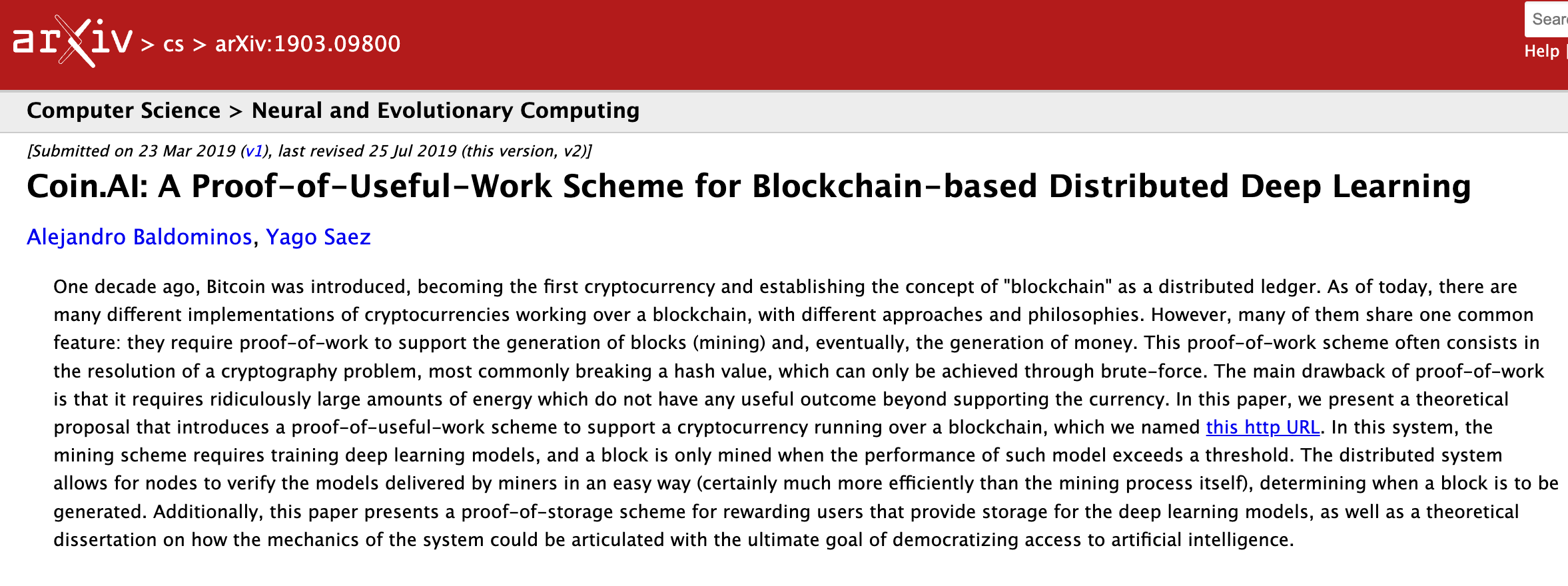
Coin.AI was a concept for using deep learning model training as proof of work, described in a paper published on arXiv by researchers at Carlos III University of Madrid in Spain. Under its design, a block could be mined by producing an AI model that exceeded a certain accuracy, and it set out with the goal of "democratizing AI."
It had two problems.
- Problem 1: It needs a mechanism to supply the network with the problems for models to train on. As with Coinami, this means depending on a central authority to define the problems.
- Problem 2: The amount of computation required varies enormously by problem type, which makes difficulty adjustment hard.
It was published as a paper but was never implemented or launched.
Bittensor (TAO, 2021–)

Bittensor promotes "Proof of Intelligence," where rewards are earned based on the quality of AI model inference, and it is actually running as a decentralized AI service protocol. Miners run AI inference on GPUs, and validators evaluate the quality of their output and allocate TAO accordingly. Developers access AI inference through an API and pay according to usage, in TAO or fiat currency.
It has the largest market capitalization of the projects covered here and has grown into a service that people actually use, with its 128 subnets recording $43 million in revenue in the first quarter of 2026 alone. However, the blockchain's security relies on "Yuma Consensus," which is based on stake weighting, so contributions to AI are separate from consensus. Subsidies from token issuance also reach $52 million a year for the top subnet alone, and revenue still does not exceed subsidies.
For those who think LLM computation is more worthwhile than SHA256, Bittensor is one answer that already exists. As a bonus, TAO has a maximum supply of 21 million and halvings. Maybe it really is "Bitcoin 2.0," doing meaningful computation! If you have time to criticize Bitcoin for its meaningless computation, perhaps contributing to Bittensor would make the world a better place.
That said, Bittensor's purpose is AI inference infrastructure, which is fundamentally different from Bitcoin's goal of serving as money. "Useful computation" itself appears to be the goal.
Demand for AI inference also depends on outside markets. If technological change shrinks demand or creates oversupply, miners will leave en masse. Just as AlphaFold2 solved protein structure prediction by a method other than distributed computing, there is always a risk that "useful" computation loses its usefulness.
Attempts promoting "Proof of Useful Work (PoUW)"
In recent years, more and more projects have adopted the label "Proof of Useful Work (PoUW)."
PoUW views proof of work's hash computations as "meaningless computation" that serves no purpose beyond consensus, and aims to replace them with computation that adds value in the real world, such as scientific simulations.
The term PoUW first appeared academically in the 2017 paper "Proofs of Useful Work" by Ball, Rosen, Sabin, and Vasudevan, which proposed using computational problems such as Orthogonal Vectors, All-Pairs Shortest Path, and 3SUM as a blockchain's proof of work.
Here are two examples.
- Internet Computer (ICP, 2021–)
- Flux (2018–)
Internet Computer (ICP, 2021–)

Internet Computer is a blockchain that aims to be a decentralized cloud. It was developed by the DFINITY Foundation, founded in 2016, and launched in May 2021. Its official wiki also describes it as "Proof of Useful Work": nodes run apps and web services by executing smart contracts called canisters. The project aims to replace cloud computing services like AWS with decentralized nodes.
However, nodes are not open for anyone to join. They are vetted and appointed by a DAO called the NNS (Network Nervous System). Since the network runs apps that real users rely on, the service can't function if node quality is poor. Useful computation comes with responsibility for quality control, and the project seems to have chosen a permissioned design to guarantee that responsibility.
In this way, PoUW inevitably introduces some degree of centralization: guaranteeing useful computation requires management, and management leads to centralization.
Flux (2018–)

Flux is decentralized cloud infrastructure that aims to replace centralized cloud services like AWS. It started out under the name ZelCash using GPU-based proof of work, but moved to PoUW v2 in October 2025.
PoUW v2 eliminated GPU mining, so only FluxNodes, which handle actual application workloads, participate in block production. They receive usage fees for handling tasks such as video encoding, AI model inference, and web app hosting, and those fees make up part of their rewards. Because real-world use is directly tied to the blockchain, it is arguably less dependent on outside economies than the other examples.
It does have proof of stake–like aspects, though. Running a node requires locking up FLUX as collateral, and the more you lock up, the higher the tier you can join and the larger your rewards. The structure still favors those who concentrate capital. Block rewards (token issuance) also still carry a lot of weight, and with such a short track record, it's unclear whether usage fees alone can make nodes profitable.
Doubts about building useful computation into a blockchain at all
The idea of "running a blockchain on useful computation" intuitively feels better than Bitcoin. But looking back at the attempts since 2013, I believe there are structural problems with including useful computation.
"Useful computation" comes with the following entanglements.
- Evaluating usefulness
- Guaranteeing usefulness
- External demand for that usefulness
Evaluating usefulness
Bitcoin's proof of work searches for a hash lower than a value called the target. Whether a hash is "lower" is evaluated the same way by everyone, so it can be done by a program.
Whether something is "useful," however, differs from person to person, so a separate evaluator is needed. I believe human judgment is a factor that invites centralization and the emergence of authorities down the line.
Preventing centralization requires decentralizing that authority. For fair decentralization, staking is used to weight the authority (Bittensor, for example, has validators evaluate quality). You could say that evaluating usefulness creates a governance problem.
Guaranteeing usefulness
When usefulness is the goal, the design has to guarantee that usefulness without fail. As a result, guaranteeing quality ends up requiring a permissioned system like Internet Computer's.
In addition, sustaining useful computation requires continually supplying suitable problems, and if the problem supplier is a specific entity, it becomes a single point of failure or a source of centralization.
This ties into evaluating usefulness as well: the state of "this is useful" has to be maintained, and maintaining it costs the evaluators and gatekeepers something, which calls for a separate incentive design. The variables multiply and the system grows complex.
External demand for that usefulness
When a project is strongly focused on usefulness, its economy comes to depend on delivering value to outsiders, and as that demand rises and falls, the willingness of miners and other participants becomes unstable.
The biggest problem is the risk of usefulness becoming obsolete. Just as AlphaFold2 solved protein structure prediction with a different approach, a problem may be solved by means other than raw computing power, and the usefulness disappears.
What is "useful" today will not necessarily remain "useful" in the future. If it becomes obsolete, a new useful computation has to be found, so in the long run, depending on usefulness is itself a risk. Even if LLM computation is useful today, there is no guarantee it will be in the future.
One view is that Bitcoin mining is useful in a sense, having driven demand for and advances in GPUs and the use of renewable energy. However, the purpose of Bitcoin mining is to produce blocks and process transactions; contributing to GPU development or renewable energy is not the purpose.
Conclusion: Useful computation can become a long-term risk
Since 2013, there has been a long line of attempts to give mining computation meaning, from prime numbers to proteins, DNA, and deep learning. Some were serious proposals from top researchers.
It may be premature to judge now, but I believe there is still no well-designed system that incorporates useful computation and outdoes Bitcoin as a strict upgrade. To begin with, once the computation has a use, the project's sense of purpose is already different.
I also discussed the risks of incorporating useful computation. Evaluating and guaranteeing usefulness can create additional costs and centralization. And if a project depends on usefulness, there is always the risk that a different approach solves the problem, the usefulness disappears, and the ecosystem collapses.
This article introduced projects that incorporated useful computation. In a future article, I plan to look at what dynamics would come into play and what concerns would arise if Bitcoin's mining computation were useful, as well as the conditions for proof of work.