Are Quantum Computers a Threat to Bitcoin? WebX 2026 Recap

This article was translated from Japanese with AI. Read the original (日本語) · Report a translation issue
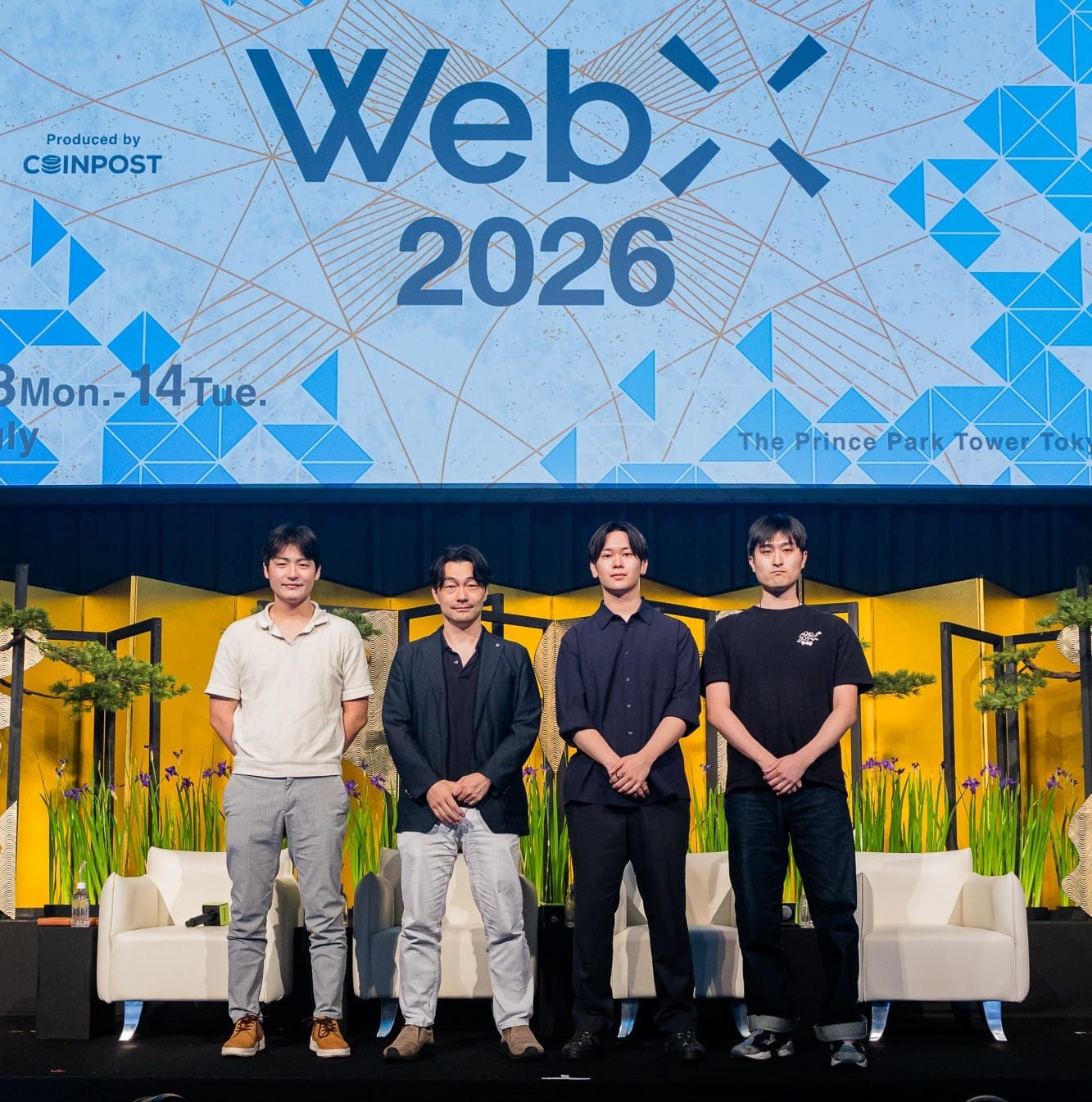
WebX, a Web3 conference, was held over two days on July 13 and 14, 2026, and I took part as a speaker on one of its panel discussions.
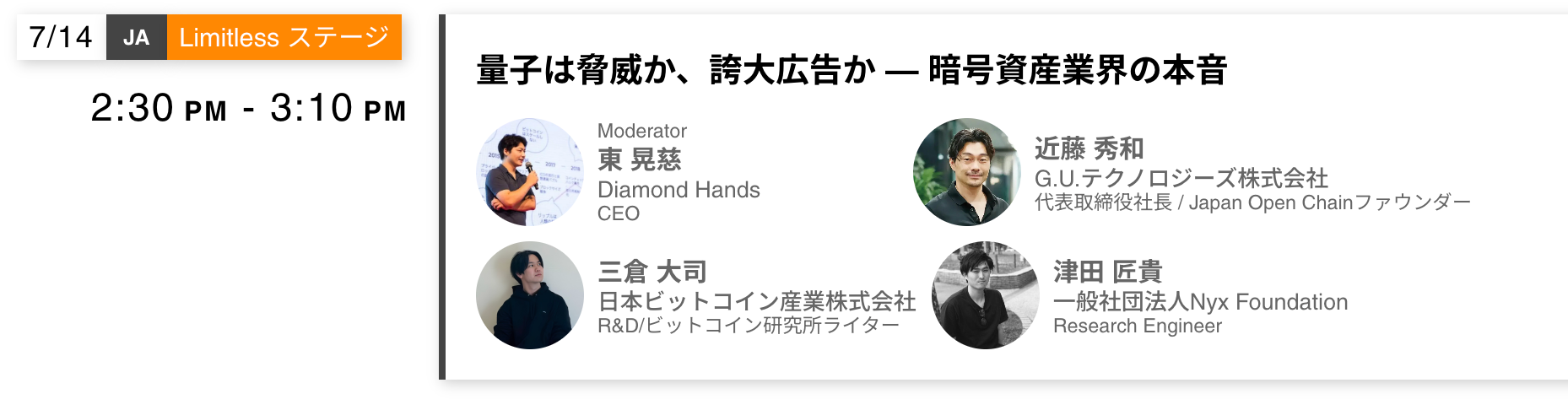
The panel's theme was "Quantum: Threat or Hype? What the Crypto Industry Really Thinks," and we debated the realistic risks posed by the coming generation of quantum computers from the perspectives of Bitcoin, Ethereum, and blockchain companies.
In this post, I look back on WebX, covering what I said in the session and going into more detail on the points I didn't have time to fully explain.
Please bear in mind that this is my personal view, so it may lean toward Bitcoin.
What Is a Quantum Computer?
The session opened with a discussion of what a quantum computer actually is.
A quantum computer is a type of computer that performs calculations using the physical laws of the microscopic world, namely quantum mechanics. In the quantum computing world, the computers we use every day are called "classical computers" to distinguish them. As you know, classical computers compute using binary 0s and 1s, whereas quantum computers compute using quantum bits (qubits) that hold 0 and 1 at the same time, a state known as superposition.
With only 40 minutes for the panel, I couldn't explain this in much detail, so I'll add some background here.
In quantum mechanics, quanta are said to have a dual nature: they behave both as particles and as waves. Light, for example, is described as a collection of particles of light (photons), and at the same time as a wave, namely an electromagnetic wave.
Quantum computers exploit the wave nature of quanta, using "interference" to manipulate probabilities and perform calculations. They also make use of other phenomena unique to quantum mechanics, such as "entanglement" and the "no-cloning theorem," but I'll skip those here to keep this from getting too long.
I previously wrote an introductory article on quantum computers explaining why quantum computing is not parallel computing, so please read that as well.
量子コンピュータとは?万能な並列計算機ではない5つの理由
量子コンピュータは「並列計算マシン」ではありません。測定で1つの答えしか得られない、ノークローン定理、量子干渉の仕組みなど、5つの理由から量子コンピュータの本質を解説。万能な計算機という誤解を解きます。
 三倉 大司
The Scope of Quantum Computing Risk
One of my personal goals for this talk was to explain accurately how far the risks from quantum computers actually extend. What comes to mind when you hear phrases like "quantum computers breaking encryption" or "quantum supremacy"?
"Quantum computers will crack Bitcoin, and that will be the end of it."
I still see claims like this on social media. But isn't this exactly the kind of FUD (fear, uncertainty, and doubt) that comes from hype?
As an aside, there is plenty of FUD around Bitcoin, and I hope the following article helps clear some of it up.
ビットコインのFUDまとめ|よくある12の誤解を解消する
「ビットコインは環境に悪い」「ねずみ講だ」「ハッキングされる」などよくある12のFUD(誤解・批判)を一つずつ取り上げ、事実に基づいて解消します。初心者の方にも分かりやすく整理しました。
 守屋 彰眞

First, let's sort out what kinds of cryptography quantum computers can break.
Shor's Algorithm and Prime Factorization

Back in 1994, the American mathematician Peter Shor proposed what became known as "Shor's algorithm." Prime factorization had long been considered to have no efficient solution on classical computers, because the amount of computation grows explosively. Shor's algorithm made it theoretically possible to factor numbers while keeping the growth in computation time modest.
💡
In other words, it was a method for solving prime factorization in a realistic amount of time using a quantum computer.
Cryptography is everywhere around us. RSA encryption, for example, whose security rests on the difficulty of prime factorization, is used in web browsers, online banking, and more.
Elliptic curve cryptography (ECC), which Bitcoin uses and whose security rests on the elliptic curve discrete logarithm problem, is also considered solvable by applying a variant of Shor's algorithm.
To summarize, the problems that can theoretically be solved by running Shor's algorithm on a quantum computer are roughly as follows:
- Prime factorization: RSA encryption
- The elliptic curve discrete logarithm problem: elliptic curve cryptography (ECC)
This is why quantum computers are described as a threat.
Quantum Computing Risk in Bitcoin
Bitcoin uses a digital signature scheme called ECDSA, which is built on the theory of elliptic curve cryptography (ECC).
Put simply, you prove that bitcoin belongs to you by presenting your "private key" against a "public key," which is safe to make public. (Think of a safe that can only be opened with your own personal key.)
This means that if your private key falls into someone else's hands, they can move your bitcoin however they like.
The relationship between the public key and the private key is one-way, and it has long been considered cryptographically near-impossible to derive a private key from a public key. With Shor's algorithm, however, it becomes theoretically possible to work backward from the public key to the private key.
Looked at another way, this tells us that anywhere a public key is exposed can become a vulnerability.
Incidentally, a typical Bitcoin address is created by applying a hash function twice to a public key. The security of hash functions rests on their one-way, black-box-like nature, and Shor's algorithm cannot be applied to them.
I've gone on at length, but the point I want to get across is that Shor's algorithm can't be applied to just anything. Naturally, when the underlying mathematical assumptions change, it can no longer solve the problem.
So you sometimes hear that "once quantum computers are built, mining will be taken over too," but mining relies on hash functions, so even a quantum computer cannot instantly produce the results.
Which Bitcoin Has Exposed Public Keys?
Broadly speaking, there are three places in Bitcoin where public keys are exposed:
- P2PK: an early address format
- P2TR: addresses that use Taproot
- Addresses that have already been used to send funds
P2PK and P2TR addresses use the public key directly as the address, in P2PK's case because it is an old format and in P2TR's case for design reasons, so they are exposed to quantum computing risk.
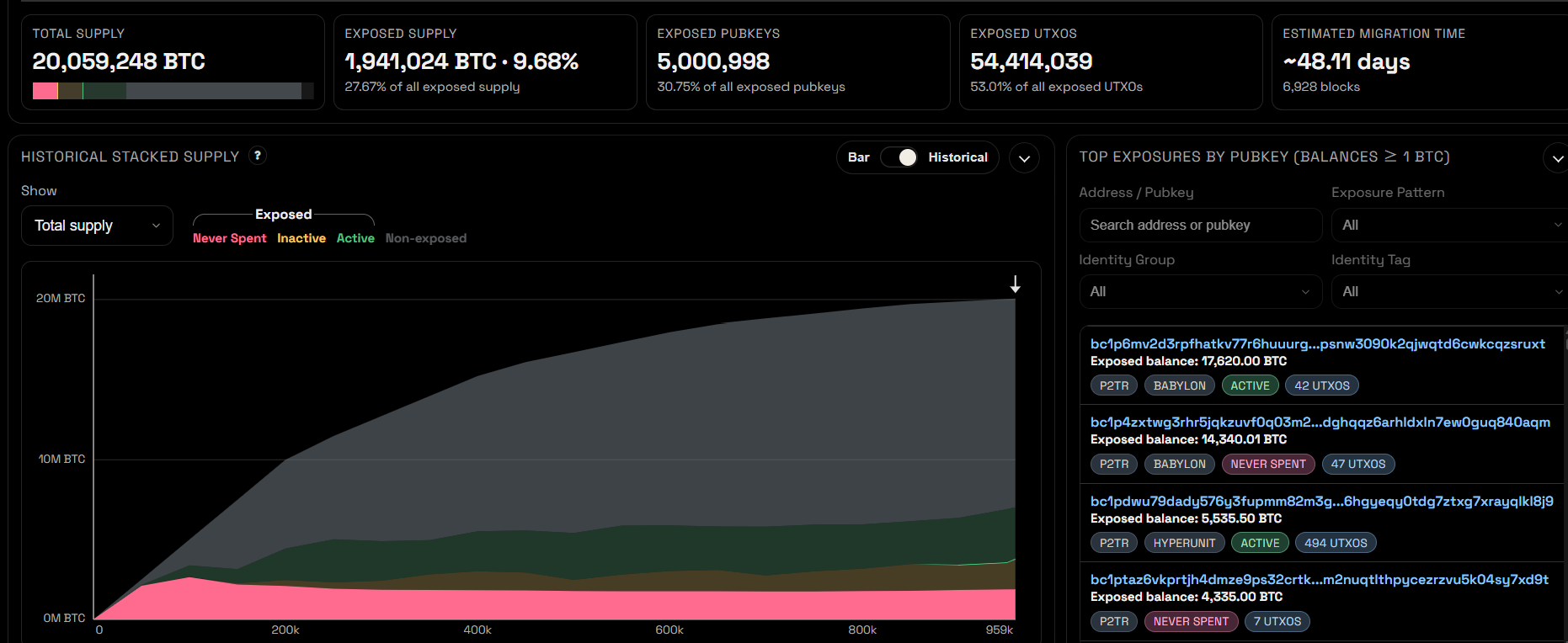
The highlighted (red) portion of the image shows the share of P2PK and P2TR addresses out of Bitcoin's total supply of 21 million BTC. Reading off the figures, about 1.94 million BTC, roughly 9.68%, is held in addresses with exposed public keys.
For more on address formats, see the earlier article below.
ビットコインアドレスの種類まとめ|レガシー・SegWit・Taprootの違いと選び方
ビットコインアドレスの種類を総まとめ。レガシー(1/3)・SegWit(bc1q)・Taproot(bc1p)の違いを、プレフィックスや文字数、手数料、互換性の観点から比較表つきでわかりやすく解説します。
 三倉 大司

In addition, Bitcoin requires you to reveal your public key when you send a transaction. So no matter how much you rely on hash-based addresses, that protection (the hash) becomes meaningless once you've sent from the address. That's why it's important not to receive funds again at an address you've already sent from. You could say this is one defense against quantum computers that individuals can take on their own.
In recent years, people have tended not to worry much about address reuse, so I think this is a good opportunity to recognize the risk once again.
In short, Bitcoin's quantum computing risk lies in places where public keys are exposed, and is limited to certain address formats and addresses that have already been used to send funds. There's no need to take claims that everything will collapse at face value.
Bottom Line: Do I Think Quantum Computers Will Threaten Cryptocurrency Within Five Years?
Even researchers are divided on when a cryptographically relevant quantum computer (CRQC), one capable of breaking encryption, will arrive. Opinions were split in our session too.
I can't say anything definitive in answer to "Will they become a threat within five years?", but my position is that they probably won't. (The other speakers leaned toward thinking they would.)
Here are my two reasons.
Today's quantum computers reportedly struggle even to factor 21
I explained that Shor's algorithm can solve prime factorization efficiently and can therefore break RSA encryption, but there is a large gap between theory and reality.
So far, the only cases that can be said to have seriously performed prime factorization with Shor's algorithm are factoring 15 in 2001, factoring 21 in 2012, and factoring 35 in 2019 (which failed), among a few others. On the other hand, it has been pointed out that these involve a trick: they use "compiled" circuits built with prior knowledge of the answer.
💡
In 2025, a paper was even published satirizing these answer-assisted tricks by describing how to get a dog to do prime factorization.
For details on why 21 can't be factored, please watch this YouTube video.
For those who haven't watched it, here's a quick summary: the video gives three reasons why 21 can't be factored.
- It requires implementing complex circuits that the compiled versions don't use
- The circuits are deep (requiring a lot of computation), and noise and decoherence (the loss of superposition) prevent correct results
- The physical layout of qubits on real hardware imposes constraints that force even more complex circuits
So even if Shor's algorithm can produce results in theory, in practice noise and hardware constraints make it hard to use for general purposes. That's why I think it's somewhat premature to say quantum computers will become a threat within five years.
That said, I'm not arguing that no countermeasures are needed.
Five years is still too early, based on IBM's quantum computing roadmap and the theoretical requirements for breaking encryption
Quantum computers have two kinds of qubits: ordinary "physical qubits" and "logical qubits," which can correct errors. Logical qubits are built by bundling together multiple physical qubits.
According to this paper, breaking RSA-2048 requires about 1,400 logical qubits. The trade-off is that the computation needs about 6.5 billion Toffoli gates (the counterpart of NAND gates in classical computers) and is estimated to take about five days.
Now let's look at the quantum computing roadmap IBM has published.
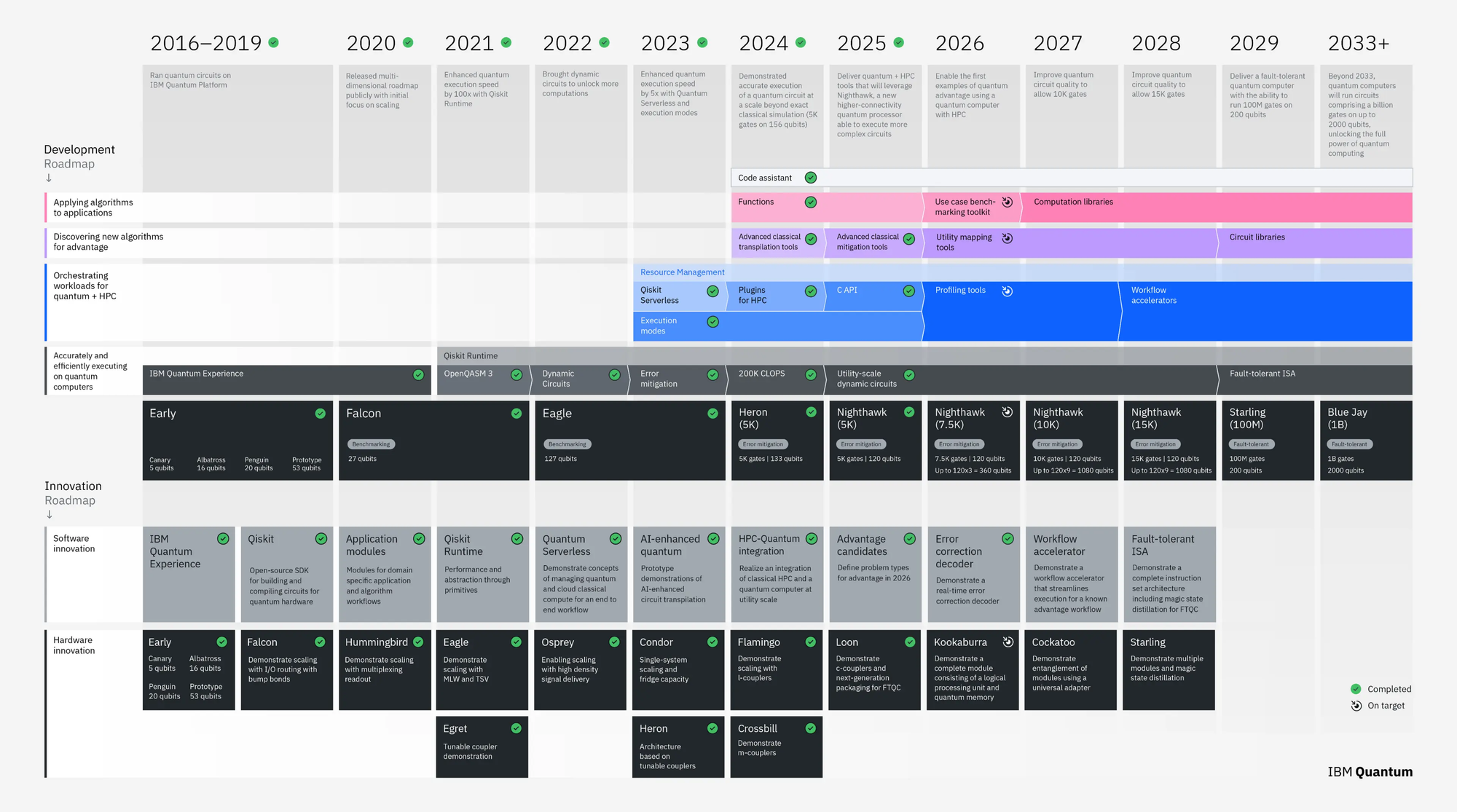
The figure is hard to read, so please see the linked PDF for details.
In brief, it lays out the roadmap for two error-corrected quantum computers, "Starling" and "Blue Jay." The specific figures are as follows.
| Machine | Target date | Logical qubits | Approximate gate count |
|---|---|---|---|
| IBM Quantum Starling | 2029 | 200 qubits | 100 million gates (circuits capable of running 100 million operations) |
| IBM Quantum Blue Jay | 2033 | 2,000 qubits | 1 billion gates (circuits capable of running 1 billion operations) |
Breaking RSA-2048 requires about 1,400 logical qubits and about 6.5 billion Toffoli gates, so the gate counts here clearly fall far short. (Executing a Toffoli gate is more costly than executing an ordinary gate, so the two can't be compared directly.)
💡
Breaking ECC (specifically secp256k1, which Bitcoin uses) reportedly requires about 1,200 logical qubits and about 90 million Toffoli gates, with a run time of 9–23 minutes. (This assumes the computation runs in an ideal environment, which is rather "hype"-like, isn't it?)
We can also see that Starling in 2029 falls short on logical qubits, while Blue Jay in 2033 only finally approaches the theoretically required number.
Quantum computing research doesn't leap forward overnight through some "breakthrough," so if you ask whether the quantum threat will be upon us five years from now, in 2031, my view is that it probably won't be a threat yet.
Please note that other types of quantum computers and different research approaches mean this can't be stated as a blanket rule.
The Worst-Case Scenario for Bitcoin
What is the worst-case scenario for Bitcoin? Some may be surprised, but I don't consider bitcoin being stolen by quantum computers to be the worst-case scenario.
In Bitcoin, which is rooted in libertarian principles, self-custody of your coins is fundamental. Just as losing your coins is said to be your own responsibility, I think that if coins haven't been moved to quantum-resistant addresses and they get stolen, their owners arguably have no grounds to complain.
There's a very real possibility that Satoshi's coins will be stolen. I don't see that as a problem. The price may fall at first out of anxiety. But as long as Bitcoin's data doesn't disappear from every computer around the world, Bitcoin will keep producing blocks without issue, and I think the anxiety will eventually fade.
On the other hand, the worst-case scenario we should worry about, I think, is "trust in Bitcoin staying permanently low and the network going unused for the rest of my life." In a sense, the worst case would be Bitcoin reverting to a hobbyist's plaything, as it was around 2010, and staying that way for something like 50 years.
What Countermeasures Are Being Considered for Bitcoin to Become Quantum-Resistant?
What does becoming quantum-resistant actually mean? My impression is that many people assume it involves developing some special device or cryptography that uses quantum computers, but put simply, it means the following:
Taking inventory of systems that use cryptography considered vulnerable to quantum computers (such as RSA and ECC) and replacing it with cryptography whose underlying math problems remain hard to solve even with quantum computers.
In terms of broader trends, there is a move to ban existing cryptography by 2035 and migrate to quantum-resistant schemes recommended by NIST (the National Institute of Standards and Technology), a US government agency.
For Bitcoin, however, adopting NIST's recommended cryptography as is would cause problems: signature sizes would grow by roughly 100 times or more, and existing wallets and multisig could not be implemented.
💡
What's interesting here is that Bitcoin doesn't necessarily intend to adopt NIST-standard cryptography. In fact, the elliptic curve Bitcoin uses for ECC is secp256k1, which is not one of the curves NIST recommends.
For now, the community is carefully debating which of the available cryptographic schemes is the best fit for Bitcoin. I've covered several of the specific proposals in earlier articles, so please refer to those.
SHRINCS:Blockstream社が提案する耐量子署名
ビットコインのPQC導入における署名サイズ問題を解決するSHRINCSを解説。Unbalanced XMSSとSPHINCS+を組み合わせ、最小324バイトの量子耐性署名を実現したBlockstreamの提案を詳しく紹介。
 三倉 大司

SHRIMPS:マルチデバイス間でステートフルな署名を実現する耐量子暗号
BlockstreamがSHRINCSのマルチデバイス問題を解決するために提案した耐量子署名SHRIMPSを解説。コンパクト・パスとフォールバック・パスの使い分けで、復元したデバイスでも約2.5KBの署名を実現する仕組みを紹介。
 三倉 大司

Bitcoin Is Said to Be the Most Affected by Quantum Computers. Is That True?
In the context of cryptocurrency, Bitcoin is said to be the most vulnerable to quantum computers, but is that really true? Below, I'll consider this from three angles, including what I discussed in the WebX session.
The chain's long history and old coins
Bitcoin is the first blockchain, and it has run without a single halt since January 3, 2009. Because of the chain's long history, there are many coins that were recorded on the blockchain long ago and have never moved, as well as lost, effectively dormant coins.
Specifically, roughly 1,715,000 BTC is said to remain unmoved in addresses from the early days (P2PK). If these addresses can't be migrated to quantum-resistant addresses, that amount translates directly into what could be stolen.
There's no denying that the potential losses are larger than for altcoins, but these coins simply haven't been moved, and there's a good chance they'll be migrated if the quantum threat becomes imminent.
Also, 1,715,000 BTC out of a total supply of 21 million BTC is about 8%, and you could see this as those coins being redistributed by quantum attackers, so it doesn't seem to be purely a downside.
Decentralization and governance
Bitcoin and Ethereum take very different approaches to migrating to quantum resistance.
Because Bitcoin is designed to eliminate centralization, protocol changes are said to take time to reach consensus.
Ethereum, by contrast, has published a roadmap for migrating to quantum resistance by 2029, and its strength is that it can roll out updates toward quantum resistance in a planned way. Flip that around, though, and you could say it reflects the strong influence of the Ethereum Foundation.
Because this centralization exists, forced updates like the one carried out after The DAO are possible. Perhaps this governance issue is why Ethereum is said to be less affected by quantum computers than Bitcoin.
The DAO事件の衝撃とEthereumの未来:スマートコントラクトと分散ガバナンスの行方
お待たせしました。事件からちょうど1週間ほどが経っていますが、The DAO事件の概要と露呈されたEthereumの課題や今後の展望について自分の考えをまとめました。 実は事件前の時点では、The DAOの投票の仕組みのインセンティブ設計の問題点、攻撃ベクターなどについて解説し、長期的に考えてなぜ自分がThe DAOが上手く機能しない可能性が高いか、という記事を書こうと思っていたのですが、自分でも予期せない形で思ったよりずっと早くThe DAOは崩壊してしまいました。同時に自分も含め業界関係者に大きな衝撃を与え、多くの問題提起をしてくれました。その点では、The DAOの実験はすでに失敗したといえますが、意義は大きかったと思います。 今回の記事に関しては事前に注意書きをしておこうと思いますが、自分はThe DAOトークンもEtherも保有しておらず、今回の事件に関して金銭的被害や関心はありません。また、この記事の解釈や展望の予想はかなり個人的な意見、バイアスがかかっていることをあらかじめお伝えしておきます。自分はビットコイン推進派的な立場から、今回の事件やその後のEthereumの
 東 晃慈

There are trade-offs on both sides: Bitcoin is slow to reach consensus, while Ethereum's centralized elements are cited as a single point of failure and can be seen as vulnerable to censorship and pressure. The difference probably comes down to fundamentally different philosophies, so arguing over which is better is pointless, but I thought it made for a clear illustration of their different approaches in the context of quantum computing, so I brought it up.
Since Bitcoin Research Lab is a Bitcoin-focused publication, I'll also offer a counterargument to the concerns about consensus in Bitcoin.
Cutting-edge cryptographic research and discussion takes place in the Bitcoin community every day. It's true that, as with the introduction of SegWit and Taproot, reaching consensus has taken time in the past. But that was because interests and priorities were divided within the community, and I think changes on which everyone's interests align tend to reach consensus relatively smoothly.
The quantum threat bears on the security of Bitcoin itself, which makes it a topic on which the whole community's interests are likely to align. So once the threat becomes realistic, consensus may well come faster than for ordinary protocol changes.
Given all this, it seems reasonable to say that Bitcoin doesn't need to rush the migration to quantum-resistant algorithms, and that the sensible stance is to keep researching more conservative cryptographic schemes without vulnerabilities.
Differences in the scope of quantum-resistance work
From here on, I'm mainly raising questions about Ethereum. If you disagree or if I've gotten anything wrong, please let me know.
For Bitcoin, I think the scope of quantum-resistance work broadly covers the Bitcoin protocol itself and the corresponding changes to Lightning Network implementations. Infrastructure such as exchanges and wallets will also need to adapt, but that applies to everything, so I'll leave it aside.
By contrast, my understanding is that the roadmap presented by the Ethereum Foundation targets Ethereum's L1. That means tokens issued on Ethereum's L2s each need their own quantum-readiness work for every implementation. There are currently more than 100 Ethereum L2s, so the scope of that work is enormous.
In short, my view is that you can't simply say Bitcoin is the most vulnerable to quantum computers.
Bonus: What Are the Risks for the My Number Card?
If you got your My Number Card, Japan's national ID card, in 2016, this year marks exactly ten years since it was issued, and it's coming up for renewal. Did you know that, to coincide with this milestone, the government is considering introducing a "next-generation My Number Card" with expanded features?
The government aims to introduce the next-generation card around fiscal 2028, and what deserves attention is its cryptography. The current card uses RSA-2048, while a move to ECDSA 384 (elliptic curve cryptography) is being considered for the next-generation card.
However, this migration appears to be aimed only at strengthening encryption against today's computers. It will be worth watching how the question of quantum computing risk is handled going forward.
Summary
In this post, I've summarized my views based on the session I took part in at WebX. I hope it has given you a chance to learn what the quantum threat really is and what kinds of discussions are taking place right now.
Bitcoin Research Lab will keep publishing articles on quantum resistance, so please keep reading.