Genesis Block: Why Satoshi's 50 BTC Can Never Be Spent
This article was translated from Japanese with AI. Read the original (日本語) · Report a translation issue
January 3, 2009 is the day Bitcoin first came to life. On that day, the very first block, "Block 0," was added to the blockchain. This block is known as the Genesis Block, and Bitcoiners hold it in special regard.
The Genesis Block's block reward of 50 BTC is said to be unspendable forever. Not even Satoshi could move it, even with the private key.
In this article, I'll explain why the Genesis Block's 50 BTC can never be spent, along with some analysis of my own.
Then, going a bit further, I'll dig into why the Genesis Address, the address of the Genesis Block, is said to exist in two forms and to hold more than 100 BTC.
I also cover this in a video, so check it out if you're interested.
Why the Genesis Block's 50 BTC is said to be unmovable
Was the Genesis Block the only block that wasn't mined?
To get straight to the point: the leading theory is that because the Genesis Block alone was not mined in the normal way, Satoshi Nakamoto considered it inappropriate to collect a reward for it.
Let's take a closer look at what it means for a block not to be mined.
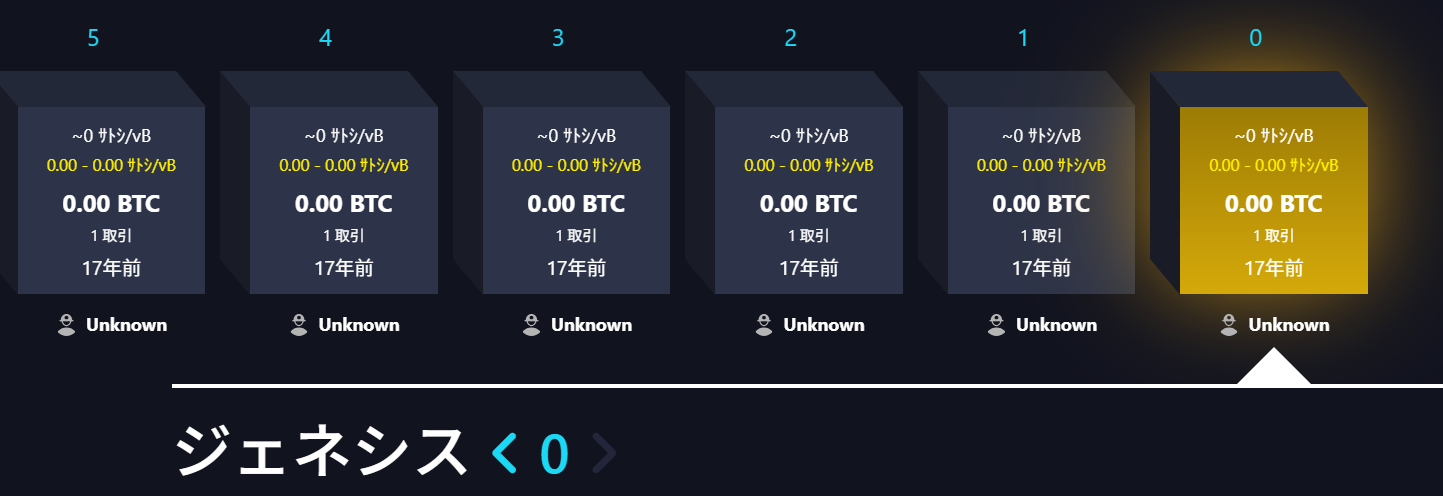
Normally, mining makes use of the previous block's "block hash." But when Bitcoin was first created, there was no concept of a Genesis Block, and the previous block hash was null (all zeros).
Satoshi had to create the first block out of nothing, so for the first block alone he hardcoded a rule saying "the block with hash 000000000019d668...a8ce26f is the first block."
💡
Hardcoding: embedding variables or strings directly in the code
A valid proof of work (PoW) does exist for it, but since the block itself was created by hardcoding, he presumably felt it would be inappropriate to take a block reward.
How the block reward went unclaimed
We've seen that the Genesis Block's reward went unclaimed because the block was generated without normal mining. But some of you may be wondering: the block does contain a coinbase transaction, so wasn't a block reward created after all?
For those unfamiliar with coinbase transactions: when a miner successfully mines a block, they can add a special transaction called the coinbase transaction to it. This is the mechanism that lets the miner send bitcoin to their own address as a reward for successful mining.
Incidentally, the coinbase transaction is the only kind of transaction that has no inputs.
The Genesis Block is no exception: it does contain a coinbase transaction.
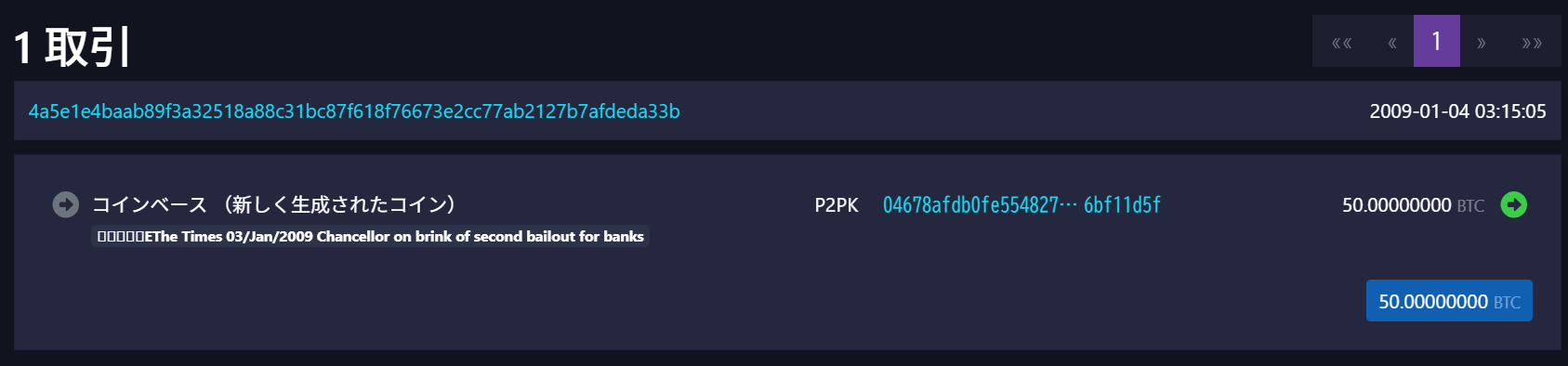
The key point here is that transaction 4a5e1e4baab8…eda33b is treated as a special case. In Bitcoin Core's implementation, the coinbase transaction of block 0 (the Genesis Block), and only that one, is specifically handled so that it is not added to the UTXO set. In other words, even if someone tried to spend the 50 BTC, nodes could not reference it as a UTXO, so it is unspendable.
If you'd like to learn more about the concept of UTXOs, see the earlier article below.
UTXOとは?ビットコイントランザクションにおける仕組みを解説
ビットコイン特有の概念UTXOを、初心者にも理解できるよう解説。ウォレット残高との関係、インプット/アウトプット、口座残高方式を採用しない理由、手数料やコインベーストランザクション、ジェネシスブロックまで丁寧に説明し、中央管理者なしで二重支払いを防ぐビットコインの核心設計を学べます。
 三倉 大司
This is my personal view, but it seems reasonable to assume that because Satoshi did not create the Genesis Block through normal mining, he felt it wasn't appropriate to receive the block reward, and so did not register the 50 BTC UTXO in the database.
Some argue that leaving it out of the database may have been a mistake rather than a deliberate choice.
Why can’t the genesis block coinbase be spent?
According to the bitcoin wiki: The first 50BTC block reward went to address 1A1zP1eP5QGefi2DMPTfTL5SLmv7DivfNa, though this reward can’t be spent due to a quirk in the way that the genesis block is
 EralpB

Why there are two Genesis Block addresses
The coinbase transaction of the Genesis Block (block #0) lists the following address as the recipient:
04678afdb0fe5548271967f1a67130b7105cd6a828e
03909a67962e0ea1f61deb649f6bc3f4cef38c4f355
04e51ec112de5c384df7ba0b8d578a4c702b6bf11d5f
This address is commonly called the "Genesis Address."
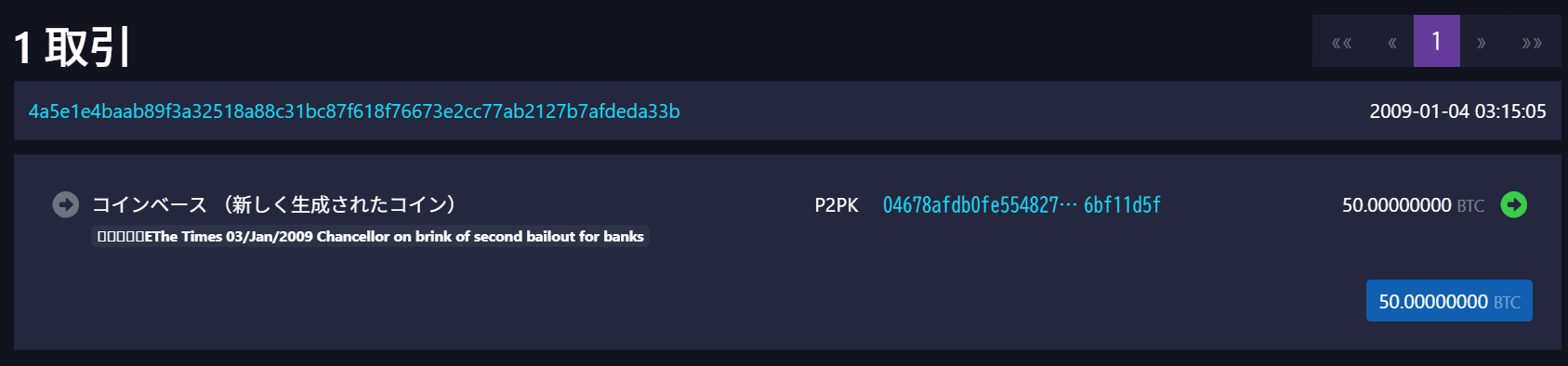
The image above shows the Genesis Block's coinbase transaction as displayed on mempool.space. You can see that 50 BTC was sent to the address 04678a…6bf11d5f.
Now take a look at the following site.
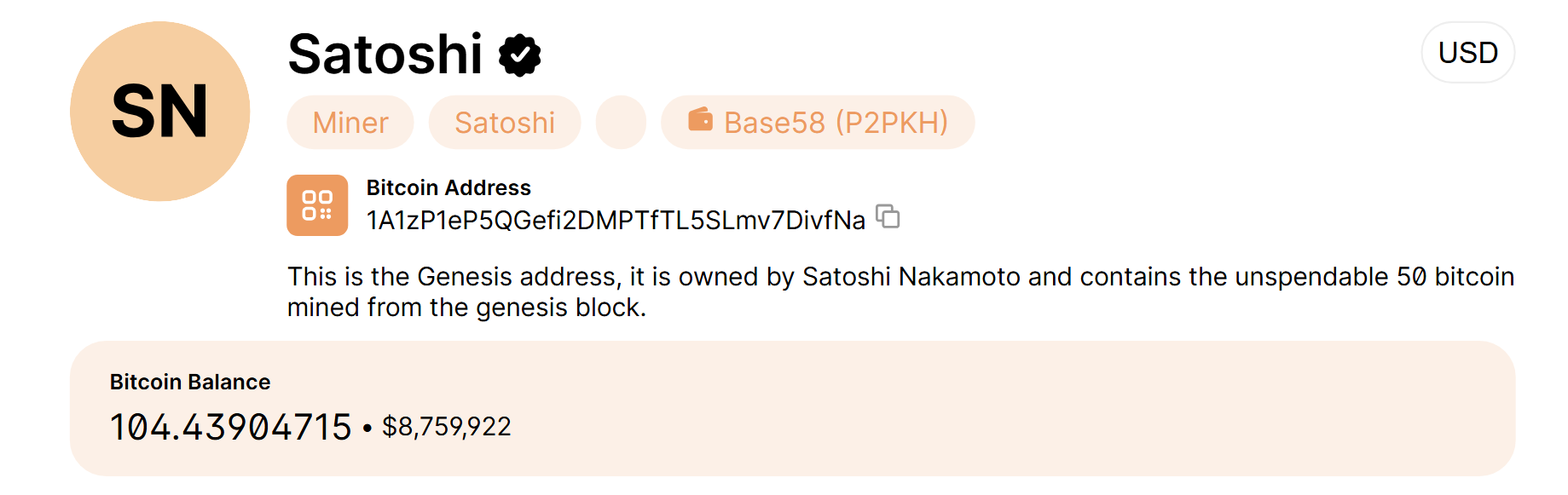
It states that the Genesis Address 1A1zP1eP5QGefi2DMPTfTL5SLmv7DivfNa holds more than 100 BTC, including the 50 BTC block reward.
So the Genesis Address appears in two formats,
- 04678a…6bf11d5f
- 1A1zP1eP5QGefi2DMPTfTL5SLmv7DivfNa
which creates confusion over whether it holds 50 BTC or more than 100 BTC. The cause is a misunderstanding that comes from mixing up two address formats, P2PK and P2PKH. Let's go through it step by step.
Confusion caused by different address types (P2PK, P2PKH)
The Genesis Address is actually a public key (P2PK)
If you search online for "Genesis Address," you'll notice that two different addresses come up. The key to solving this puzzle is the difference in address formats.
So first, let's look at address formats.
When the Genesis Block was created, the format for receiving bitcoin was called "P2PK." Because P2PK sends funds directly to a public key, it can't strictly be called an address in the technical sense.
💡
P2PK: short for "Pay to Public Key." A method of sending funds directly to a public key
Satoshi also used this P2PK public key, 04678a…6bf11d5f, to create the coinbase transaction.
In other words, it makes sense to regard the P2PK public key from the time the Genesis Block was created as the "Genesis Address," and any addresses that came later are addresses in a different format.
The mempool site displays information such as an address's balance and transactions, so let's take a closer look.
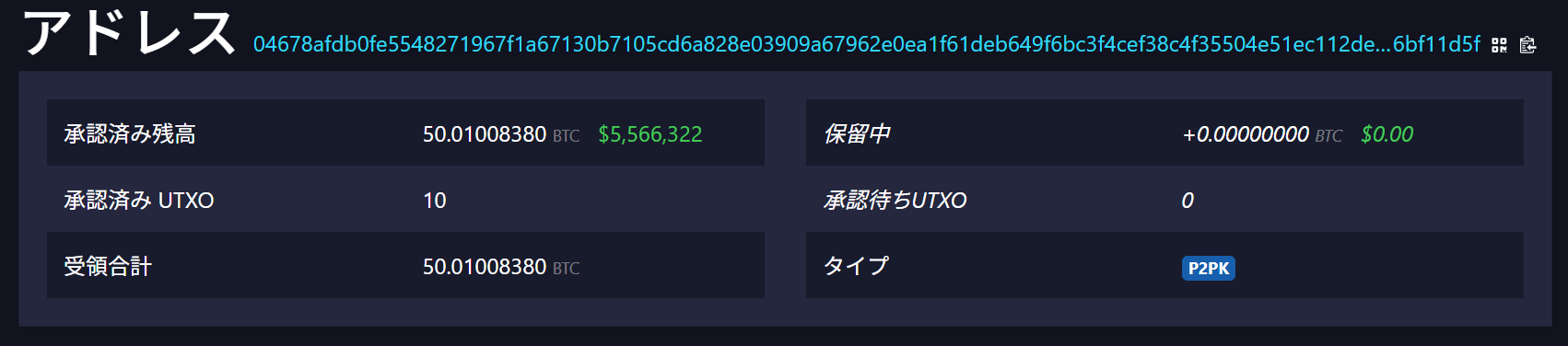
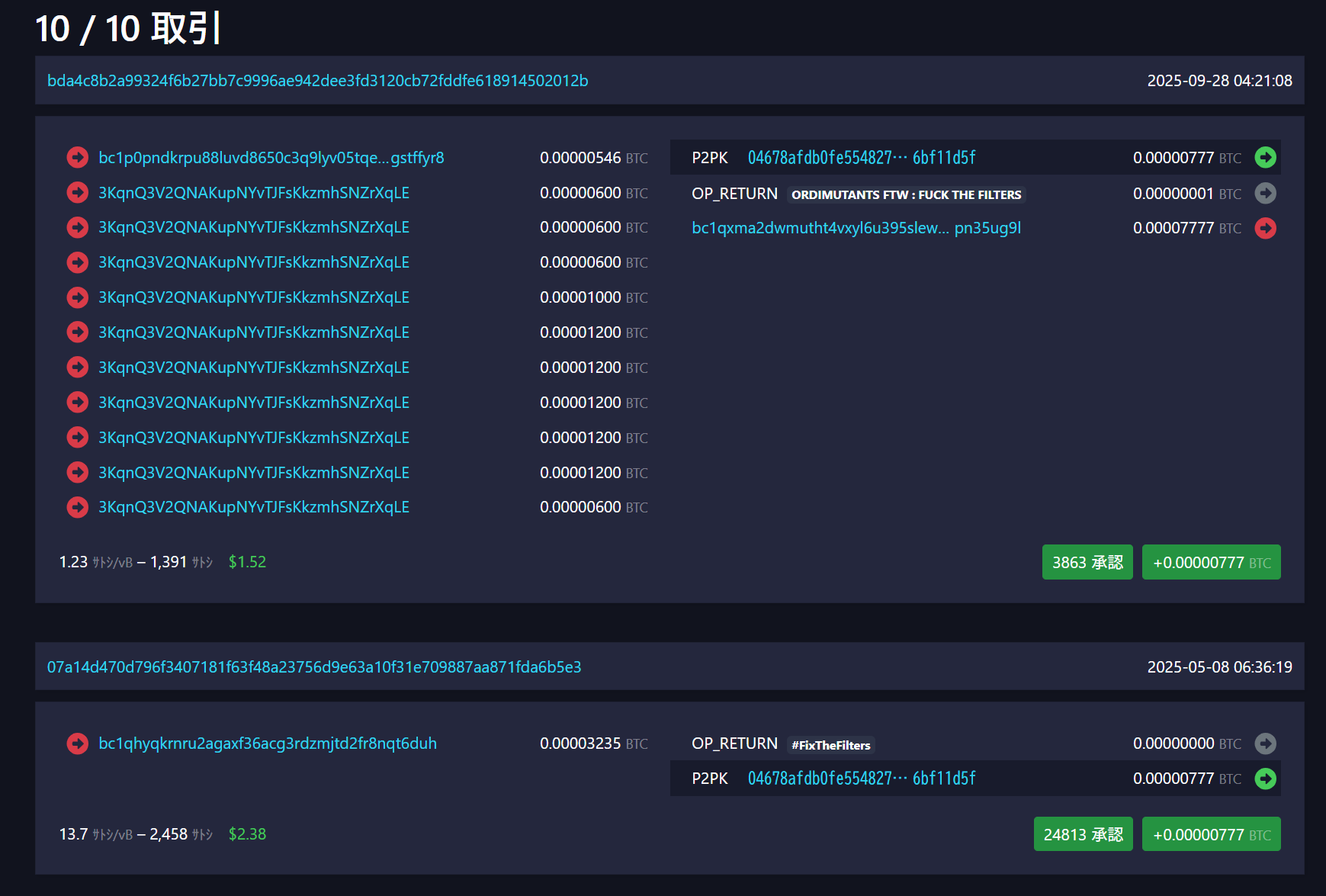
This P2PK public key shows a history of 10 transfers, including the coinbase transaction. As of the end of October 2025, the most recent transaction was on September 28, 2025. It's interesting that people are still sending to it.
These are commemorative transfers, or donations to the Genesis Address made by companies for promotional purposes.
Unlike the block reward, the 0.01008380 BTC sent here can be spent, provided Satoshi holds the private key. The reason is simply that these BTC exist in the UTXO database.
💡
Genesis Address 04678a…6bf11d5f (P2PK)
Block reward 50 BTC: unspendable (the UTXO cannot be referenced)
Commemorative transfers 0.01008380 BTC: spendable
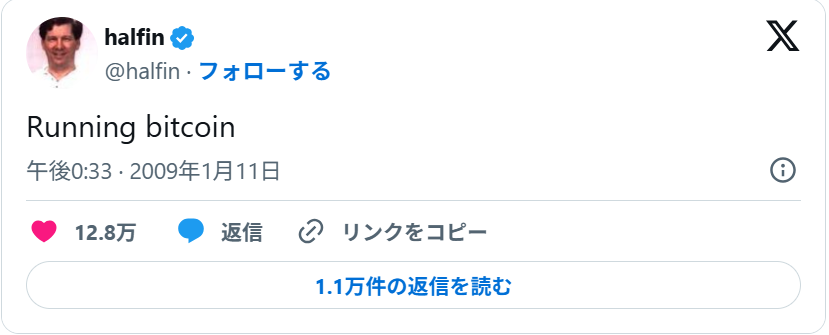
Bitcoin's first transaction between individuals was the 10 BTC Satoshi Nakamoto sent to Hal Finney, and it too was sent using the P2PK public key format.
The "Running bitcoin" post on Twitter is pretty famous.
However, because the P2PK format exposes the public key in full, it offers less privacy, costs more in fees, and is weaker on security than the address formats used today.
That's why, about two weeks after the Genesis Block (January 3, 2009), a new address format called P2PKH appeared.
What the address "1A1zP1eP5QGefi2DMPTfTL5SLmv7DivfNa" really is
The address "1A1zP1eP5QGefi2DMPTfTL5SLmv7DivfNa" is a P2PKH address, created by passing a public key through two hash functions.
💡
P2PKH: short for "Pay to Public Key Hash." An address made by passing a public key through two hash functions
This address format brings several improvements over P2PK.
Chief among them is a built-in checksum (a mechanism for detecting input errors), which helps catch typos in addresses and prevents bitcoin from being lost.
P2PKH addresses are usually 33 or 34 characters long (in theory they can be as short as 26), are encoded in Base58, and always start with "1."
They are created by passing the public key through two hash functions, SHA256 and RIPEMD-160.
There are other address formats too, so check out the earlier articles below.
ビットコインアドレスの種類まとめ|レガシー・SegWit・Taprootの違いと選び方
ビットコインアドレスの種類を総まとめ。レガシー(1/3)・SegWit(bc1q)・Taproot(bc1p)の違いを、プレフィックスや文字数、手数料、互換性の観点から比較表つきでわかりやすく解説します。
三倉 大司
The address "1A1zP1eP5QGefi2DMPTfTL5SLmv7DivfNa" was generated by applying hash functions to the original public key 04678a…6bf11d5f (the Genesis Address). Strictly speaking, then, the two are different things.
The address "1A1zP1eP5QGefi2DMPTfTL5SLmv7DivfNa" uses an address format that appeared after the Genesis Address, and in my view it isn't technically accurate to call it the "Genesis Address."
That said, sending directly to a P2PK public key today is technically difficult and requires advanced knowledge. So in practice, people use the address "1A1zP1eP5QGefi2DMPTfTL5SLmv7DivfNa" when they want to "send to the Genesis Address."
The number of transfers makes the difference clear. The original public key (the Genesis Address) has received only 10, while the address "1A1zP1eP5QGefi2DMPTfTL5SLmv7DivfNa" has recorded a whopping 53,343.
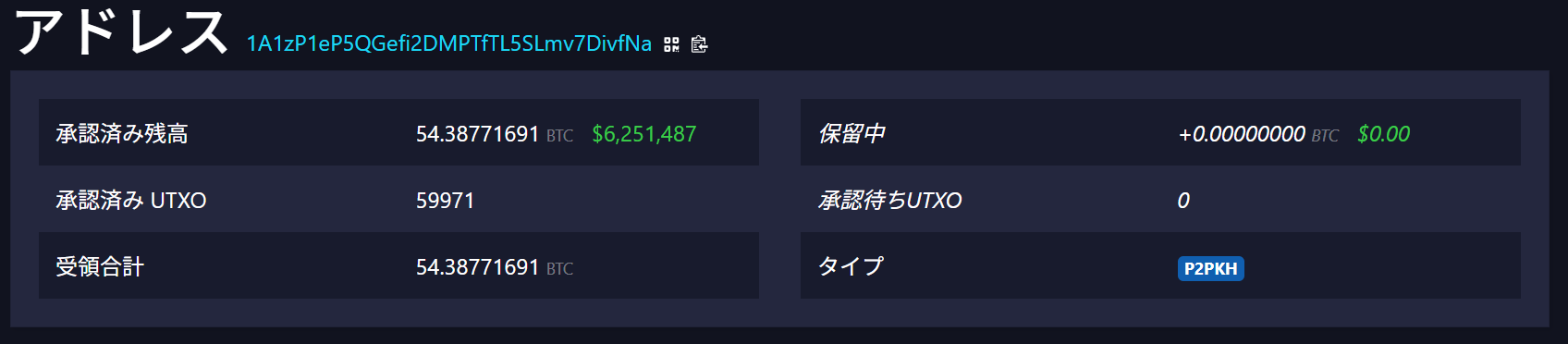
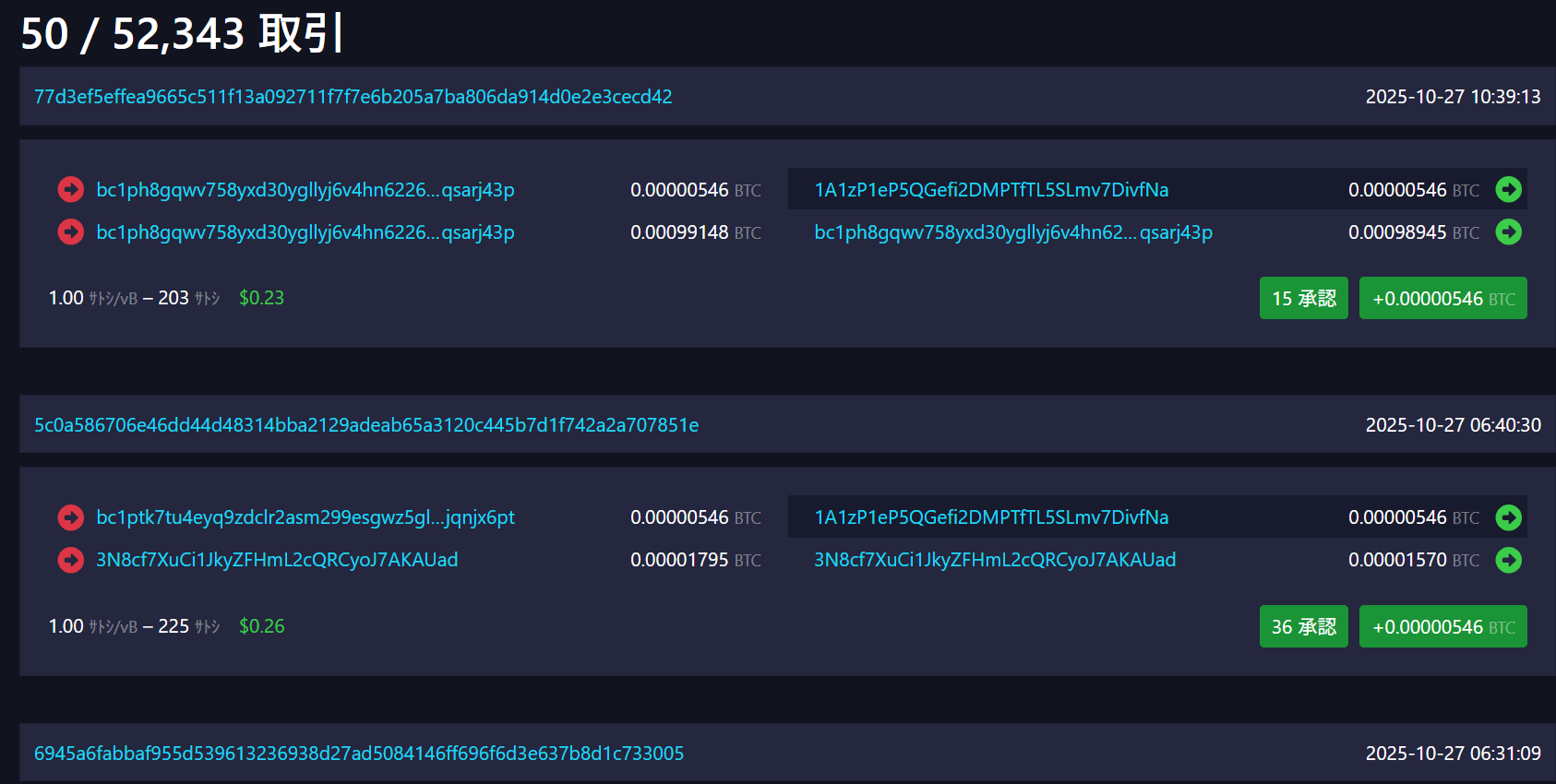
The address holds 54.38771691 BTC, with 52,343 transactions on record.
Unlike the mining reward in the P2PK address, the roughly 54 BTC in the P2PKH address should be spendable, provided Satoshi holds the private key.
Here's a summary by address format:
💡
P2PK (0467…): Genesis Address
• 50 BTC: mining reward (not in the UTXO database), unspendable
• About 0.01 BTC: spendable
P2PKH (1A1Z…Na)
• About 54 BTC: spendable
This is why the Genesis Address is mistakenly believed to hold about 100 BTC. It likely comes from confusing the P2PK and P2PKH formats and adding together the BTC held in both.
In my view, the true Genesis Address is only Satoshi Nakamoto's P2PK public key, 04678a…6bf11d5f.
Summary: The Genesis Block was hardcoded, and its address was the public key itself
The Genesis Block's 50 BTC can't be spent not because of some wallet issue, but because Satoshi Nakamoto created this block by hardcoding it rather than through normal mining.
As a result, although the coinbase transaction is recorded, it was never added to the UTXO database, so nodes can't reference it and it can't be spent.
There's also a common misconception that "the Genesis Address holds 100 BTC," but this comes from confusing the P2PK public key 04678a…6bf11d5f (about 50 BTC) with the P2PKH address 1A1z…DivfNa created by a third party (about 54 BTC). The true Genesis Address is the P2PK public key alone, and only the 50 BTC sitting there is bitcoin that can never be spent.
I hope that chasing the answer to "why can't it be moved?" has given you a taste of how fascinating Bitcoin's design is.
The 50 BTC lying dormant in the Genesis Block will no doubt continue to stand as a symbol of Bitcoin.