OP_RETURN Limit Removal: Bitcoin Core vs. Knots Scenarios

This article was translated from Japanese with AI. Read the original (日本語) · Report a translation issue
Bitcoin is digital gold.
That is also the definition of Bitcoin's value that is now starting to take hold.
In October 2025, however, the removal of the OP_RETURN limit may start to shake that definition.
The change greatly expands how much arbitrary data can be written to the blockchain, and it has set off a debate that reopens the question of what Bitcoin's value is, right down at the code level.
The ongoing clash between Bitcoin Core and Bitcoin Knots is more than a technical dispute.
It has turned into a fight over Bitcoin's fundamental identity.
For investors, this could become the next major fundamental, one that matters more than short-term price moves.
The numbers show trust in Bitcoin Core is wavering
To understand what is happening, there is one thing you need to know first.
Bitcoin runs on computers scattered around the world called "nodes." Put simply, a node is like a referee that holds Bitcoin's rulebook and checks whether transactions are valid.
For example, when someone announces "I sent 0.02 BTC," nodes around the world check whether that person actually owns that BTC and isn't trying to spend it twice.
At a bank, a central server keeps track of all this, but Bitcoin has no center. That's why anyone can become one of these referees.
According to Bitnodes data as of September 2025, about 23,246 Bitcoin nodes are running worldwide, spread across 181 countries, which covers almost the entire globe.
There are also several kinds of software for running a node.
The two main ones today are Bitcoin Core and Bitcoin Knots. They interpret the rulebook slightly differently, but fundamentally both support the same Bitcoin network.
In other words, which software most nodes run is a mirror of the Bitcoin community's values: what kind of Bitcoin it wants Bitcoin to be.
Here is where the data gets interesting.
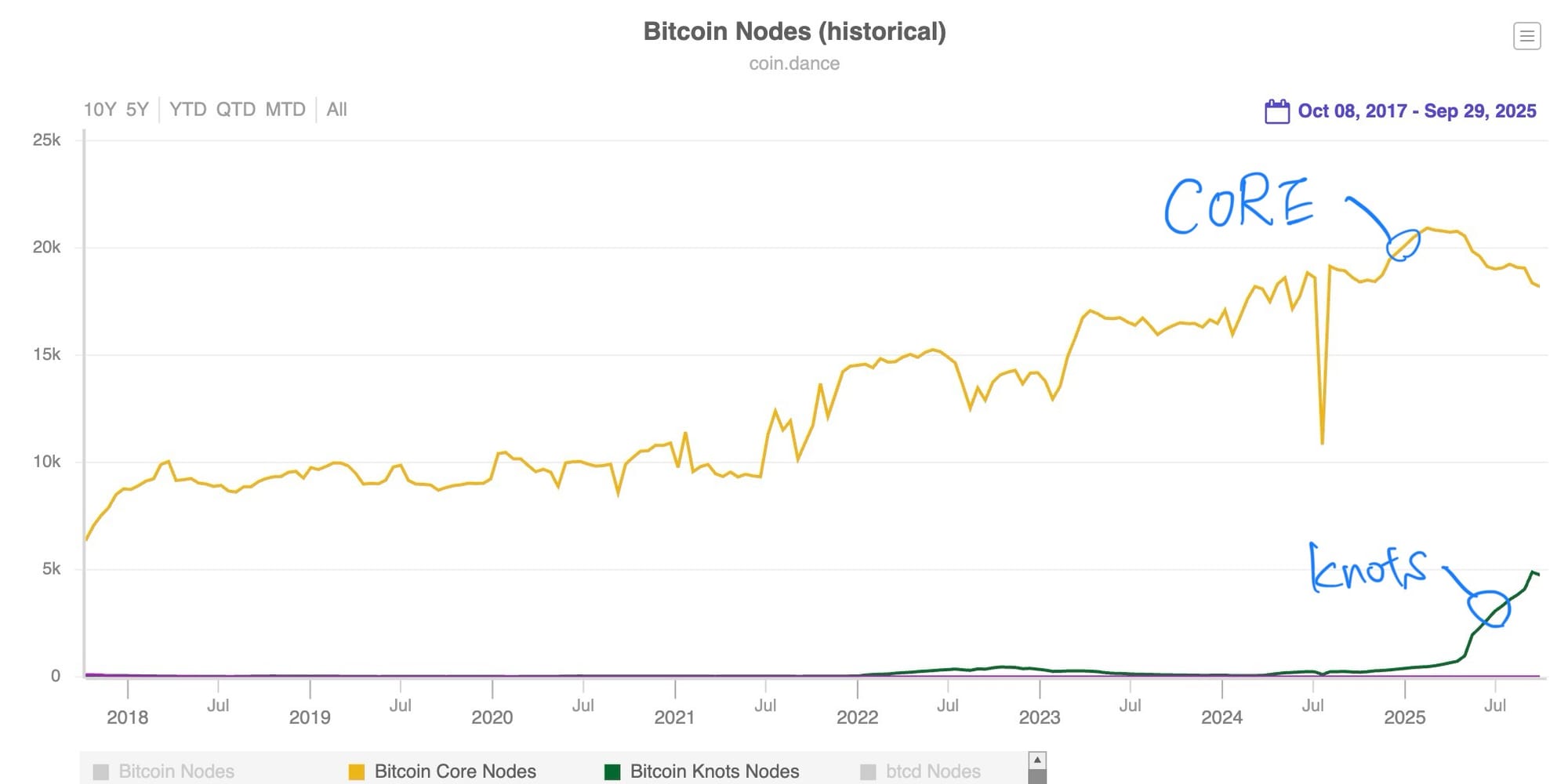
The chart below shows the number of Bitcoin Core and Bitcoin Knots nodes over time.
Since the start of 2025, Knots has grown steadily to about 24% of all nodes (5,920), while Core has stayed flat at 18,690.
That means one in four nodes is not running Core.
Behind this shift is a fundamental conflict over the direction of development.
Put simply, it's a battle between those who want to protect Bitcoin as pure money and those who want to extend it by adding new features.
Right now, the market is expressing its distrust of the latter, the Core development team, by switching to Knots nodes.
The market's distrust stems from a contradiction with the past: what happened to the lessons of the block size war?
The Core development team is currently trying to significantly relax the limits on a feature called OP_RETURN.
You can think of it as a feature that lets you put a small amount of data other than payments on the Bitcoin blockchain.
Every so often you hear of people at weddings and similar events "engraving their eternal love on the tamper-proof blockchain," and some of those use this very feature.
Bitcoin Core developers including Peter Todd have been pushing the discussion toward relaxing or removing this limit.
It is scheduled to ship in Bitcoin Core 30 in October 2025, so it's just around the corner.
Meanwhile, Luke Dashjr, who leads Bitcoin Knots, takes the position that the current limit should be kept or even tightened to prevent the blockchain from bloating.
A major contradiction with the past
So what exactly is wrong with this change?
Back in 2017, the Bitcoin community went through a huge dispute known as the "block size war." At the time, Core developers fiercely opposed the idea, arguing that "even raising the block size from 1MB to 2MB would make running a node harder and lead to centralization."
In the end, a different group created a fork coin called Bitcoin Cash (BCH), and the two chains ended up competing for mining hash power.
And yet now, the very Core developers who opposed increasing the size are trying to steer toward "allowing unlimited data storage."
The node count trend shown in Figure 1 above reflects the market's will: "Hey, we can't get behind what Core is doing."
Samson Mow's take on "the Bitcoin Core vs. Knots debate" is easy to follow
For the background to all this, and what might happen if the OP_RETURN limit is removed, Samson Mow's discussion with Danny Knowles on the What Bitcoin Did podcast is a useful reference.
Reference: The Fight For Bitcoin's Future | Samson Mow https://podcasts.apple.com/au/podcast/the-fight-for-bitcoins-future-samson-mow/id1482455669?i=1000728696951
Here is a summary of the main points discussed on the show.
Background to the OP_RETURN limit removal debate
Core developers have proposed removing the 80-byte limit to keep the UTXO set from bloating. Some point out, however, that embedding data in UTXOs is actually cheaper, so removing the limit may not increase OP_RETURN usage at all.
Distrust of Core developers
Actions by Core developers, such as pushing out Luke Dashjr and banning people who voiced opposing views, have eroded the community's trust.
Corporate influence and a lack of transparency
It has come to light that removing the OP_RETURN limit was proposed at the request of Chaincode Labs and that Citrea stands to benefit, drawing criticism over corporate influence and a lack of transparency.
The Bitcoin Core vs. Knots debate now spans the OP_RETURN limit removal, distrust of Core developers, and corporate influence. Beyond the technical arguments, a conflict over what Bitcoin fundamentally is has come to the surface.
Two possible scenarios ahead
Nobody can predict whether the capacity limit removal that Core is pushing will ultimately be adopted by Bitcoin.
Even so, I think investors need to think through in advance what would happen in each case.
Let's dig into each case a little.
Scenario A: The Core proposal goes through
Benefits:
- The Bitcoin economy expands as Layer 2 projects become more active
- Miners become more profitable thanks to higher transaction fees
- Potential for new financial products aimed at institutional investors
What would happen if the OP_RETURN limit were removed?
On the positive side, Bitcoin's range of uses would widen and new forms of value creation could emerge. Running smart contracts on sidechains would become easier, opening the door to a wider variety of uses.
And when transactions from those sidechains are anchored to the main chain, they will probably generate larger fees than today. As halvings continue and block rewards shrink, some argue that securing transaction fee revenue is necessary to keep the hashrate healthy.
Risks:
- Network congestion from spam transactions
- Weaker decentralization as the blockchain grows larger
- More scam projects exploiting the "Bitcoin" brand
But the downsides can't be ignored either.
Samson Mow issued a warning on the podcast: "Bitcoin has overwhelming name recognition. People will inevitably use that name to pitch dubious tokens to investors who don't understand it well."
It's easy to imagine a future where new tokens are sold with misleading marketing like "This token is safe because it's issued on Bitcoin," the issuers take their profits and abandon development, and all that's left is wreckage.
Scenario B: Knots becomes dominant
Benefits:
- Bitcoin keeps its purity as "sound money"
- Greater decentralization thanks to a leaner blockchain
- Long-term sustainability is secured
If the current 80-byte limit is kept, Bitcoin will maintain its position, as it does today, as a pure store of value and means of payment. This is a choice that prioritizes long-term security and decentralization.
Even in this case, though, the demand for technical innovation won't go away, so Layer 2 solutions such as sidechains and the Lightning Network will likely become even more important.
Risks:
- Stagnating innovation
- Developers leaving for other blockchains
- Falling behind competitors on features
Why Layer 2 solutions matter
For the Bitcoin network to keep being secured by proof of work, it needs a reliable source of fee revenue.
That's because Bitcoin's mining reward (the block reward) will reach zero around 2140.
Layer 2 improves scalability while reducing the processing load on the main chain, which in turn leads to higher fee revenue for miners.
Since Layer 2 plays a key role in sustaining the Bitcoin network after block rewards reach zero, the need to develop it will only grow.
Conclusion
Looking back at past examples (the introduction of SegWit and the Taproot upgrade), technical changes like these tend to take around a year from implementation before their impact on the market becomes clear.
The current conflict between Bitcoin Core and Bitcoin Knots goes beyond a simple difference in technical specifications and is becoming a turning point that forces the question of what Bitcoin fundamentally is.
There's little doubt that the OP_RETURN limit removal scheduled for the Bitcoin Core 30 release in October 2025 will only intensify this debate.
What matters for investors may be to not treat this technical debate merely as a driver of short-term price swings, but to understand it as a shift in Bitcoin's long-term value.
Bitcoin is still a technology with an experimental side. The debates and conflicts along the way could even be seen as signs of healthy growth.
If you have your own version of the scenarios examined in this article, you'll stand a better chance of staying calm when the market starts to panic.
Nobody knows yet what lies on the other side of this change. Still, the outcome should be very different for investors who have prepared and those who know nothing.
Let's always meet change with flexibility.
As always, Happy Bitcoin!