Why BIP-110 Failed: The Bitcoin Soft Fork That Never Won Broad Support

This article was translated from Japanese with AI. Read the original (日本語) · Report a translation issue
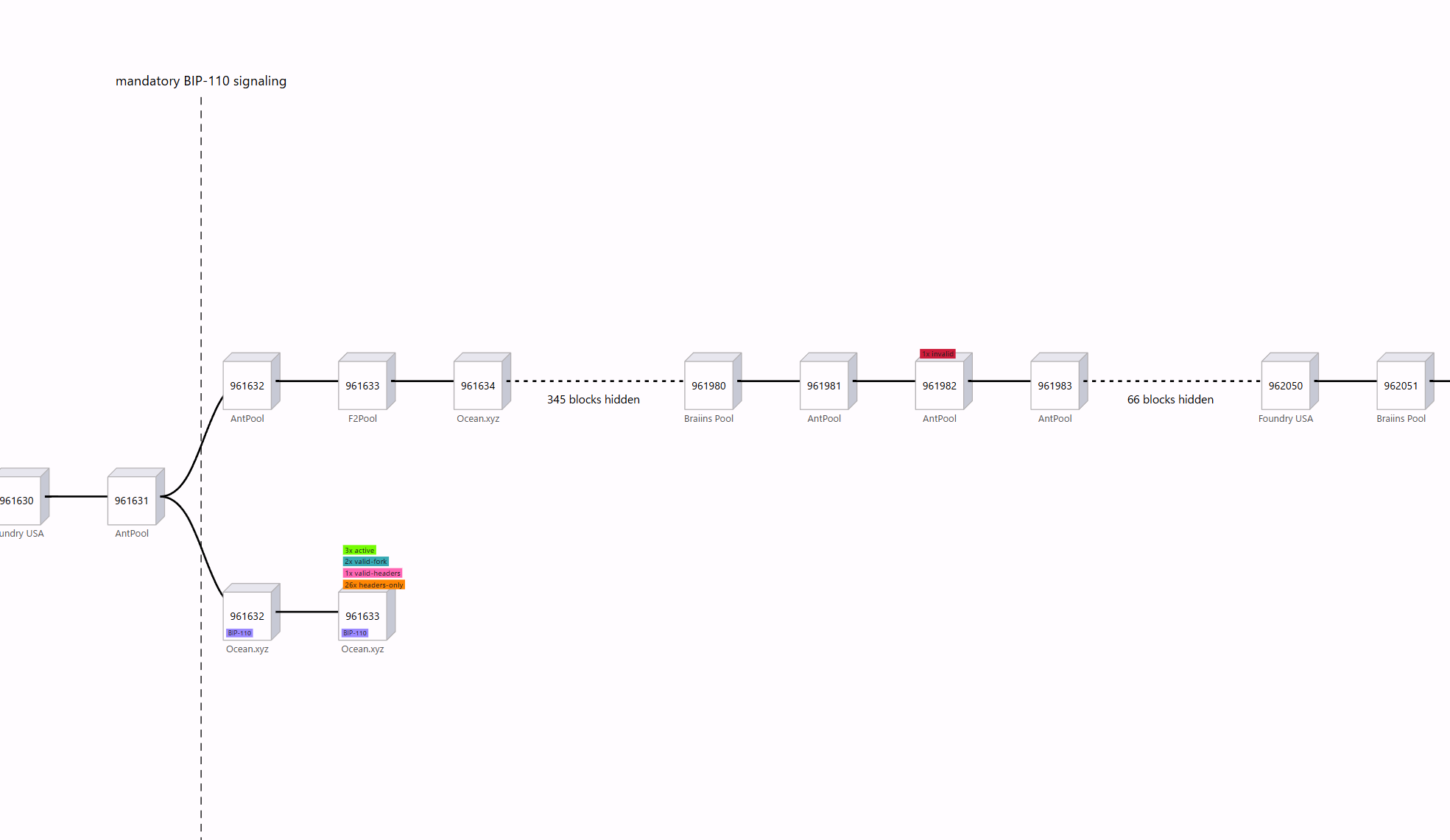
On August 8, 2026, the minority that activated BIP-110 finally split off from the Bitcoin blockchain and set out on a history of its own. Only two blocks were mined in the first three days, however, and the chain is widely seen as an economic failure.
Here at Bitcoin Research Lab, we have spent the past few years covering the arrival of Ordinals Inscriptions, their effect on Bitcoin's fee market, and the opposition movement of sorts that formed around a mining pool called Ocean. That movement reached its peak under the banners of "Kick spam out of Bitcoin" and "Make Bitcoin for payments only." Although it never won broad support, the BIP-110 soft fork finally activated in August 2026, and the blockchain split.
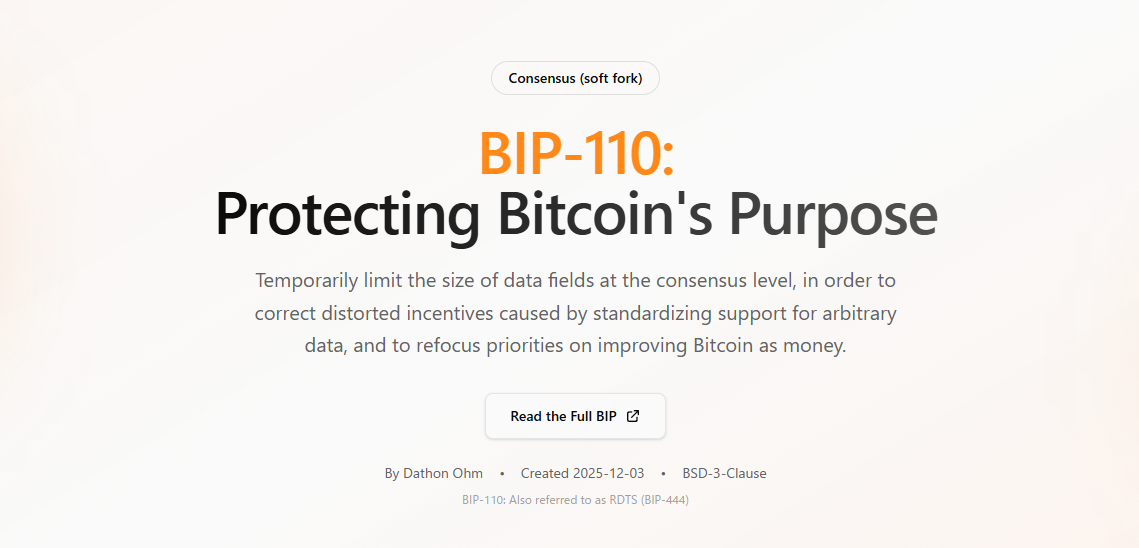
BIP-110 supporters' message can be heard as "Let's optimize Bitcoin for its use as money!", which at first glance seems like it should go down well with Bitcoiners. Spam drives up fees and crowds out block space that should be going to someone's payment. So why did BIP-110 fail to win broad support and, for all practical purposes, fail?
Today I'll explain why BIP-110 failed, in three reasons.
BIP-110はなぜ失敗するのか | ビットコイン開発でソフトフォークに慎重になるべき理由
ビットコイン上に送金以外のデータを記録するようなトランザクションを排除しようとするBIP-110というソフトフォーク提案について、その経緯と内容を説明します。また、実際にソフトフォークが成功する可能性が低いと考えられる理由を解説します。
 加藤 規新
Be sure to also read our earlier article explaining why BIP-110 would fail
Reason 1: It did not address so-called spam at the root, so its premise never held up
No change to Bitcoin happens unless it wins broad support among Bitcoin's users. Every user is sovereign and free to propose changes or to fork, so users won't follow a change they judge to be unjustified, and Bitcoin users as a whole will never adopt it together.
OP_CTVとソフトフォーク導入方法
先週は寄稿をお休みさせていただいたので前回から間隔が空いてしまいましたが、その間にビットコインの世界は一大論争が巻き起こっています。本稿でも何度か登場している独創的なビットコイン開発者、Jeremy Rubin氏が自身の提案するOP_CTVという機能のソフトフォークによる導入をSpeedy Trial方式で目指すと発表したのです。 ところが同じくSpeedy Trial方式で導入されたTaprootと異なり、まだユーザーやビットコイン開発者の中でOP_CTVに対して広く支持が得られていないこと、Speedy Trial自体がソフトフォークの導入方法として好ましくないことが意見の対立につながっています。 今日はOP_CTVの概要と論争となっているポイントを整理し、個人的な意見も交えながら現在の論争がビットコインの将来にどのような影響を与えうるかを考察します。 TAPROOT導入時のおさらい Taprootの導入にあたって、2017年にユーザーの大半が支持したSegwitの導入にマイナーが抵抗したことを踏まえ、導入に際してマイナーに依存しないソフトフォークのアクティベーション方法
 加藤 規新

Nor is there any clearly defined process for deploying a soft fork.
The general understanding is that a change can be deployed smoothly only once a wide range of parties are on board: not just users who strongly share Bitcoin's ideals, but also ordinary holders, developers, businesses, miners and others. The 2017 SegWit deployment is an example where conflicting interests were hard to reconcile and a fight broke out; Taproot in 2021 is an example where interests aligned and deployment ended up going smoothly.
BIP-110, today's topic, was promoted in a way that clearly resonated with some Bitcoiners (those who intensely loathe shitcoins), but the large majority of level-headed participants received it coolly. The root cause was that the "anti-spam measure" BIP-110 claimed to be was no fundamental fix at all.
For example, most developers understood that the changes BIP-110 proposed would not truly stop spam. Even if you can explicitly block one particular method, you cannot stop people from working around it by embedding unrelated data in what look like ordinary Bitcoin payments. In fact, it is quite possible that driving it "underground" like that would place an even greater burden on Bitcoin itself.
Even so, whenever developers debated the issue on X and elsewhere, BIP-110 supporters resorted to all kinds of sophistry, and the two sides never got anywhere. The many other Bitcoiners who watched these debates and saw how weak BIP-110's case was presumably made up their minds to oppose it, even while wanting nothing to do with the fight.
Had BIP-110 been a proposal that genuinely solved a problem Bitcoin users actually face, the outcome might have been different.
Reason 2: It took a hostile stance and pushed for a quick, decisive fight
Next, even if it wasn't a technically effective solution, things might still have played out in a way where it won broad support from the overwhelming majority of Bitcoin users. I think one reason that didn't happen was its supporters' extremely aggressive PR strategy on social media.
As I touched on at the end of Reason 1, the BIP-110 camp branded everyone who disagreed with them an "enemy of Bitcoin," slapped on all sorts of labels such as "scammer," "pedophile" and "incompetent," and tried to bully moderate Bitcoiners into submission. As part of this, they drove Gloria Zhao, one of Bitcoin Core's key contributors, to step down, and I found the camp's methods deeply repugnant.
Package Relayの導入がライトニングの弱点を改善
ビットコインのソフトウェアは常にアップデートされています。目立つのはコンセンサスに関わる変更-ハードフォークやソフトフォークと呼ばれるもの-ですが、その頻度は非常に低いためあまり積極的に開発されているイメージは強くないかもしれません。しかしながら、それ以外の部分でも重要な改善が加えられています。 たとえばBitcoin Coreのフルノードの同期はサイズの割に高速ですが、これもノードの挙動をアップデートし最適化し続けている成果です。また、ポリシールールという、コンセンサスには影響しないがノードの挙動を決めるルールがあり、ネットワーク関連の機能に使われることが多いです。 今日はポリシールールとして近い将来に導入されるであろう“Package Relay”というトランザクションの伝播に関わる新しい仕様と、それがライトニングやDLCにとってどのような問題を解決するのかについて説明します。 メモリプールとトランザクションのリレー ビットコインの手数料を意識したことのある方にとってメモリプールというものは馴染み深いものかもしれません。一応説明すると、フルノードが他のノードからまだブロッ
 加藤 規新

Gloria Zhao made major contributions to mempool-related development, including the introduction of Package Relay
Even when there are opposing views, I am against resorting to tactics like personal attacks, defamation and cancel culture.
On top of that, Luke Dashjr, who led the charge for BIP-110, was a maintainer of the BIP repository (for a time, the only maintainer!). He refused to assign numbers to proposals he disliked, yet assigned one to BIP-110 outside the normal procedure. This amounted to what could be called a hijacking of the BIP process, and it fed the developer community's distrust. With this fork, Luke Dashjr was finally stripped of his BIP maintainer privileges.
BIPを通したビットコイン改善プロセスはもう終わり?BINANAとは
読者の皆さんのほとんどはBIPという用語をご存知かと思います。Bitcoin Improvement Proposal (BIP)とはビットコインに対してなにか変更(新しい機能や仕様など)を加えるためのプロセスで、誰でも参加できる状況で、慎重にゆっくりとその是非を検討するための仕組みとなっています。 ところが、近年このBIP採択パイプラインが非常に遅いことに不満を持つ開発者が増えています。また、昨年注目を集めていたコベナンツに関連してソフトフォークをSignetで実際に動かしてみて評価するためのクライアント:Bitcoin Inquisitionというものも生まれています。このBitcoin InquisitionにおいてBINANAというBIPを置き換える仕様追加プロセスが導入されました。 今日はBINANAがBIPプロセスとどう異なるのか、そしてBitcoin InquisitionとBINANAが描くビットコイン開発の今後のあり方を解説していきます。 ・BIPプロセスの問題点 ・BINANAとBitcoin Inquisition ・これからのビットコイン開発はどうなる
 加藤 規新

When the problems with the BIP process became a topic of discussion in the past, you could say that half of the problem was a shortage of people, and the other half was obstruction driven by Luke Dashjr's subjective judgments.
Reason 3: There was no demand for the fork coin
BIP-110 supporters set up several so-called miner signaling periods, but ultimately gained almost no support, and the chain forked the moment the final signaling period ended (as had been decided in advance). Block production then effectively came to a near halt.
What finished BIP-110 off was the overwhelming lack of demand for the fork coin. As far as I know, no exchange anywhere in the world lists coins on the BIP-110 chain, and I haven't heard of them actually having a price.
💡
Moving coins on the BIP-110 chain is not something I recommend given their meager economic value right now: the same transaction is also valid on the BTC chain, so you could accidentally send the recipient your BTC as well. I'll write an article on claiming fork coins if and when there seems to be demand for it.
Had there been demand, prediction markets might have launched, exchanges might have listed the coin, and miners might have signaled. But the overwhelming lack of demand for BIP-110 coins is what caused it to fail, and by market logic you could say failure was only natural.
In sum, BIP-110 could not expand its support because of hype with no technical substance behind it and relentless personal attacks, and nobody wanted to put their own money into buying it. It is fair to say it failed because it was bound to fail.
What happens to BIP-110 from here
As this article goes out, about half a month has passed since the BIP-110 fork. Over that half month, the BIP-110 chain has advanced a total of seven blocks. Luke Dashjr, having effectively fallen from grace on the Bitcoin side, continues his activities on the BIP-110 side, but many BIP-110 supporters have concluded that the matter is settled and have withdrawn.

As next steps for the remnants of BIP-110, proposals reportedly include a soft fork to force a difficulty adjustment and a change to the mining algorithm. Taking these measures would likely get the blockchain moving again. But what remains would be "something that can adopt whatever changes it wants, but is no longer Bitcoin." Seeing that reality, I suspect many former BIP-110 supporters have given up.
Between this month and the fall, a hard fork of Bitcoin called eCash (ECX) is scheduled, led by Paul Sztorc, another rather contentious developer. (Its name overlaps with Ecash, a technology Bitcoin Research Lab has covered several times, but they are different things.) His motivation appears to be getting a technology he has championed for more than 10 years, Drivechain, deployed, and the story overlaps with BIP-110 in places, including the fact that it has never gained much support within Bitcoin. That fork, too, will simply end in failure if there is no demand for the fork coin itself, and for now I don't think there is any.
The time wasted on the BIP-110 debate, and the discord and retirements caused by personal attacks, cannot be undone, but it is good news that the matter is finally settled. Bitcoin Research Lab kept its BIP-110 coverage to a minimum, and I believe that not wasting resources on fruitless debates is extremely important for Bitcoin's future.