Six Reasons to Oppose BIP-361's Bitcoin Freeze Proposal

This article was translated from Japanese with AI. Read the original (日本語) · Report a translation issue
In February 2026, Jameson Lopp and others proposed BIP-361, "Post Quantum Migration and Legacy Signature Sunset," as a draft. To prepare for the threat of quantum computers, it would phase out the existing ECDSA and Schnorr signatures and effectively freeze any UTXOs that have not migrated.
About 34% of all bitcoin sits in outputs with exposed public keys. These include coins attributed to Satoshi and coins that were simply lost in the earliest days and have been sitting dormant ever since. I understand the concern: if those dormant coins, along with bitcoin whose owners were slow to move to quantum-resistant addresses, flooded back into the market all at once, the result could be a price crash, weaker incentives for mining, and a lasting negative impression of Bitcoin's security.
Even so, I oppose not only BIP-361 but freezing bitcoin in general. My impression is that opponents also outnumber supporters within the community. In this article I explain what BIP-361 proposes and lay out six reasons why I oppose it and freezing coins.
Whenever a migration becomes necessary, whether or not it involves BIP-361 or quantum computers, freezing is likely to come up as one of the options. I hope this article serves as a mental rehearsal for the next time that happens.
What is BIP-361? A three-phase freeze proposal

BIP-361 is a proposal to protect Bitcoin from quantum attacks by phasing out the existing signature schemes (ECDSA and Schnorr signatures) and forcing a migration to quantum-resistant addresses. It is currently in draft status. It would be implemented as a soft fork.
The schedule is split into the following three phases.
Phase A (3 years): restrictions on where coins can be sent
For three years after BIP-361 activates, coins may only be sent to quantum-resistant addresses.
Transactions signed with today's ECDSA or Schnorr signatures will still be processed, but they can only send to quantum-resistant addresses.
Because it would be implemented as a soft fork, nodes that have not upgraded would not enforce the restriction, but if the vast majority of miners upgrade, it would likely have real force in practice.
Phase B (2 years): grace period, then an effective freeze
This is a two-year grace period following Phase A. Once Phase B ends, the network will reject any spend signed with ECDSA or Schnorr signatures.
In other words, five years after BIP-361 activates, every signature scheme in use today becomes invalid. Any bitcoin that has not been moved to a quantum-resistant address can no longer be spent in practice, which amounts to a freeze.
Phase C (timing undecided): recovery of frozen bitcoin
Phase C is meant as a way to recover coins frozen at the end of Phase B.
Holders of a BIP-39 seed phrase (12–24 words) would supposedly be able to prove ownership with a zero-knowledge proof and move their funds to a quantum-resistant address. However, as of the draft, the mechanism is still at the research stage and how it would actually be implemented has not been decided.
The concern behind BIP-361
Using Shor's algorithm to exploit the periodic structure in the elliptic curve cryptography that ECDSA relies on, a quantum computer may be able to derive a private key from a public key.
UTXOs whose public keys are exposed are vulnerable to long-exposure attacks (attacks that can take several days or more), and as of April 2026 these account for about 34% of the total. BIP-361 describes the quantum threat as "real and urgent," estimates that a cryptographically relevant quantum computer (CRQC) could arrive between 2027 and 2030, and argues on that basis that migration must be mandatory.
Six reasons to oppose BIP-361

So far I have covered what BIP-361 proposes and the concern behind it. However, I believe its risks outweigh its benefits, and here are my six reasons.
- With Q-Day uncertain, no deadline can be justified
- Phase A alone is destructive enough to cause chaos before Q-Day
- It targets everyone, which is far too broad
- Fears of a price crash are overblown
- The Phase C recovery would not work in practice
- A habit of freezing coins threatens Bitcoin's future
Let's go through them one at a time.
Reason 1: With Q-Day uncertain, no deadline can be justified
First, the basis for the five-year deadline is unclear. A quantum computer (CRQC) is estimated to arrive between 2027 and 2030, yet even if BIP-361 were activated now, in 2026, five years later would be 2031, leaving a window in which coins could be targeted. On top of that, reaching consensus takes time, so the freeze would actually happen sometime after 2031.
That said, I don't think the answer is simply to shorten the deadline from five years to something like one year.
Set the freeze date earlier than Q-Day and people lose their property rights for longer; set it later and the freeze becomes pointless. In other words, any freeze must take effect before Q-Day.
But quantum computing does not progress in a straight line, and there is a great deal of uncertainty on both the scientific and engineering sides, so it is hard to predict accurately when Q-Day will come. Whatever date is chosen for the freeze, doubts will remain.
Reason 2: Phase A alone is destructive enough to cause chaos before Q-Day
Once BIP-361 activates, Phase A means coins can only be sent to quantum-resistant addresses. In other words, every active Bitcoin user today would be heavily affected.
Individuals might manage to keep up, but exchanges, Bitcoin payment systems and the Lightning ecosystem would be hit hard. Phase A comes with no grace period, so their systems would have to switch to sending to quantum-resistant addresses immediately. Rushed migrations produce bugs, and bugs are a breeding ground for hacks. We don't even know yet what quantum-resistant addresses will look like, so verifying their security will also take time.
On top of that, scam services posing as "quantum-resistant address migration services" could spring up and claim victim after victim.
People running exchanges, payment systems and the Lightning ecosystem follow Bitcoin developments closely, and once migrating to quantum-resistant addresses becomes possible, they should do it on their own. I don't think forcing them to migrate is necessary.
The point of BIP-361 was to prevent quantum-induced chaos by encouraging migration and making apparently ownerless bitcoin unspendable. Ironically, BIP-361 itself could cause large-scale chaos before Q-Day ever arrives.
Reason 3: It targets everyone, which is far too broad
BIP-361's forced migration and freeze apply to all bitcoin. Every Bitcoin user alive today would therefore have to know the BIP-361 timeline and move to a quantum-resistant address before the freeze date.
It's true that, as things stand, every coin is exposed to the quantum threat. But quantum attacks come in two kinds that operate on different timescales: long-exposure attacks and short-exposure attacks.
- Long-exposure attack: an attack on public keys exposed on the blockchain (the attacker can take their time)
- Short-exposure attack: an attack on a public key exposed when a transaction enters the mempool, carried out in the short window before it is confirmed (the time limit makes it hard to pull off)
The roughly 34.6% of coins with exposed public keys are targets for long-exposure attacks, which are a higher priority for attackers than short-exposure attacks because they are more cost-effective and easier to carry out. Conversely, the remaining 65.4% or so face no need to hurry on the same timeline as long-exposure targets, yet once BIP-361 activates they must comply anyway, and after five years they get frozen even if their public keys were never exposed on-chain.
And if we consider which coins actually ought to be frozen according to BIP-361's own rationale, the number appears to be even smaller. The red, yellow and green below show the share of coins with exposed public keys.
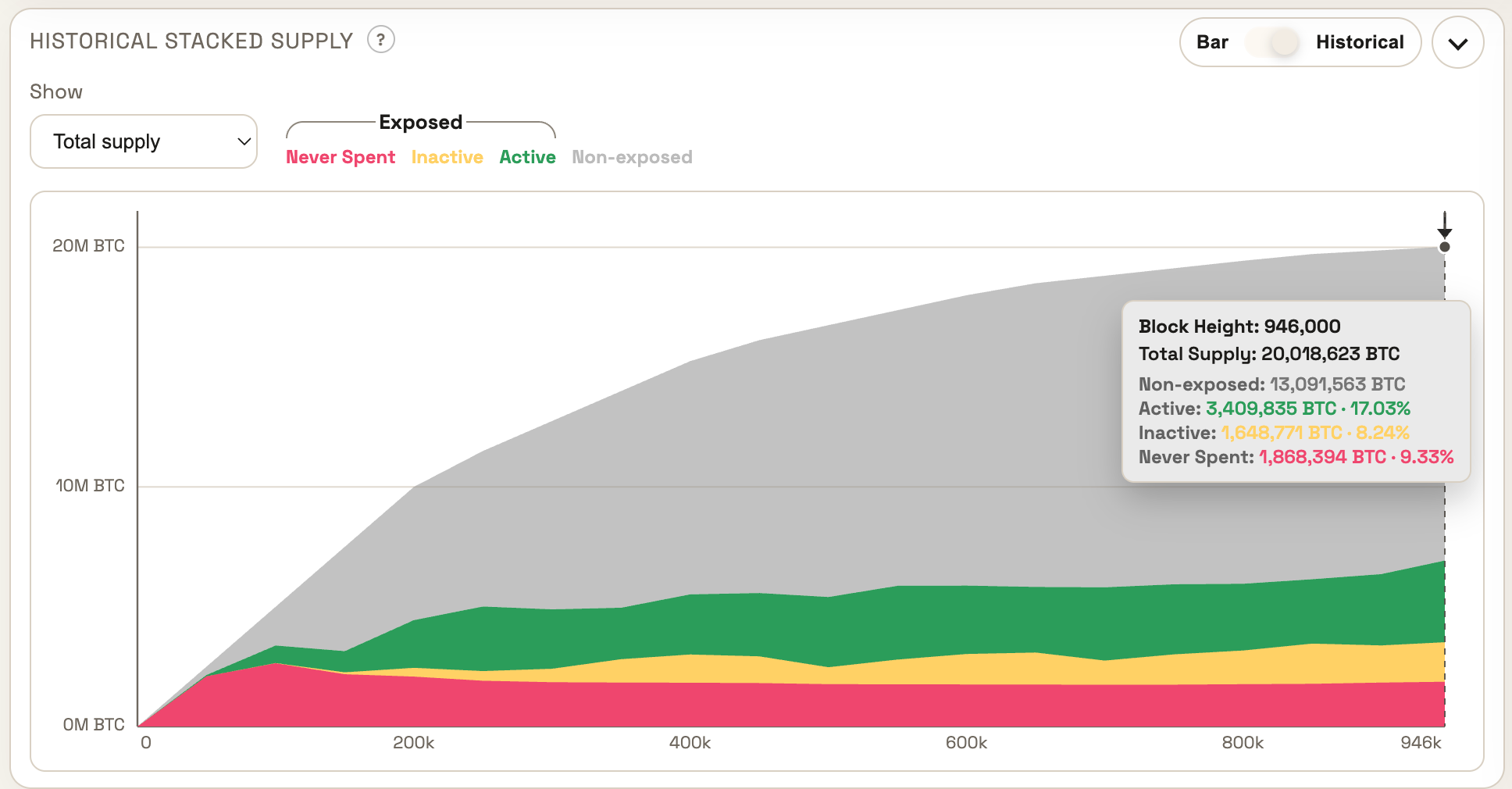
Red (Never Spent): coins that have never moved (mainly address formats that expose the public key, such as P2PK and P2TR)
- Yellow (Inactive): coins whose public keys were exposed mainly through address reuse
- Green (Active): coins moved within the past year
The green (Active) coins have moved within the past year, so their owners are very likely still around. That means roughly 17.57%, the 34.6% minus the green 17.03%, is what ultimately appears to be at risk of long-exposure attacks. There are also probably a fair number of yellow (Inactive) coins that haven't moved in over a year but whose owners are still around.
In other words, BIP-361 is a coercive measure that drags in everyone (100%) in order to flush out about 17.57% of coins to freeze, and I think its scope is far too broad. It could also end up freezing coins among the remaining 82% or so simply because their owners didn't notice or forgot.
If you're interested in how quantum computers relate to address formats such as P2PK and P2TR, the following article also covers it.
 三倉 大司
Reason 4: Fears of a price crash are overblown
Bitcoin uses proof of work, so holding a large amount of it does not confer any special power. Even if someone obtained a huge amount of bitcoin with a quantum computer, all they could do is sell it, hold it or spend it.
Running a quantum computer costs money in facilities and energy, so if an attacker wants to recoup those costs, the rational move is to sell slowly while the price holds up. Even an attacker with a terrorist-style motive to crash the price would be deterred by the enormous cost.
And even if the price did crash, Bitcoin mining is self-correcting. When miners who can no longer turn a profit drop out, profitability improves for those who remain. The price is self-correcting too, and if you believe Bitcoin will carry on, a crash is a chance to pick up a lot of bitcoin cheaply.
Freezing coins through BIP-361 would take away the chance to see these market forces play out, and the fear of a price crash would never go away.
Reason 5: The Phase C recovery would not work in practice
BIP-361's way of recovering frozen coins depends on whether the owner has a seed phrase (BIP-39). But addresses that predate BIP-39 (2013) have no seed phrase, so they cannot be recovered.
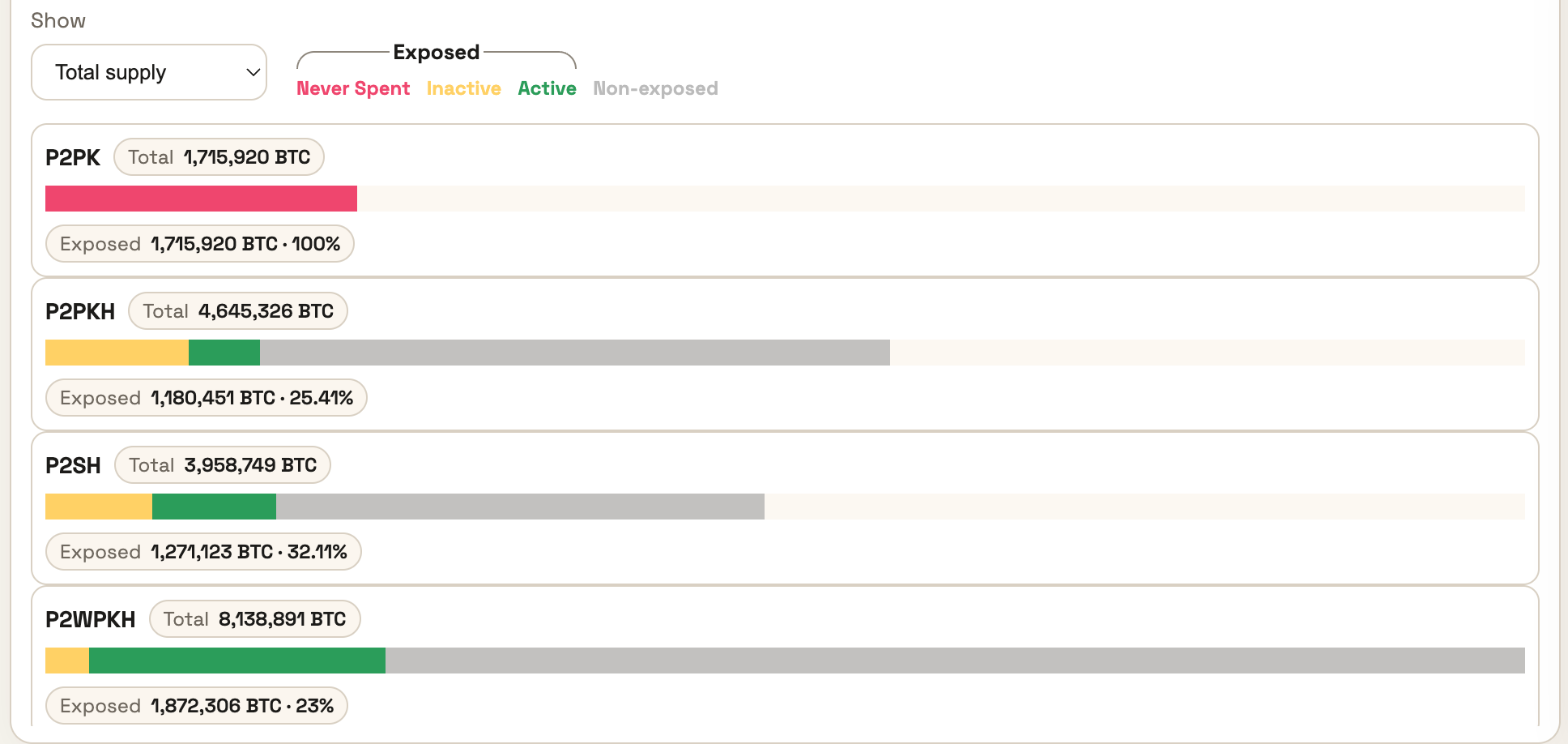
The address format drawing the most attention as quantum-vulnerable is P2PK (about 8.57% of the total), and most of it is said to date from Satoshi Nakamoto's era, so there is very likely no seed phrase for those coins.
That means about 8.57% of coins could never be recovered through Phase C in the first place and would stay frozen more or less permanently. Moreover, the Phase C recovery mechanism is still at the research stage, and it isn't even certain that it will ever be implemented.
Reason 6: A habit of freezing coins threatens Bitcoin's future
Setting a precedent for freezing bitcoin, whether through BIP-361 or anything else, means that the next time Bitcoin faces a migration, freezing could come up again, and the precedent could make it all too easy to steer toward a freeze.
If freezes keep adding to the pile of permanently unspendable coins, the circulating supply of bitcoin will keep shrinking over the long term. That risks hurting usability and increasing dependence on custodians.
Rather than leaving frozen coins locked in P2PK forever, I think it is healthier and simpler in the long run for them to flow back into the market, even if that happens because a quantum computer stole them. Besides, as long as the freeze lasts, anxiety and FUD that the frozen coins might someday be moved in some way will linger.
Fundamentally, creating a real case of "I left my bitcoin alone and the community froze it" damages trust in Bitcoin. Even once a quantum computer (CRQC) exists, the computation takes time, so not all bitcoin would be stolen at once, and small UTXOs with little payoff would probably be ignored. Having coins frozen not by an attacker but by the Bitcoin community itself reinforces an image of improvisation and gives people lasting reason to fear that their property rights could be taken away in the future.
Kishin's article lays out how to think about achieving quantum resistance. It also touches on "not freezing coins," and I agree that what matters is to deliberate carefully rather than rush.
加藤 規新
Conclusion: freezing takes away property rights and undermines trust in Bitcoin
I've covered what BIP-361 proposes and why I oppose both it and freezing coins.
Not just with BIP-361 but in any future debate, I believe freezing should be avoided as a rule. A permanent freeze would affect trust in Bitcoin over the long term and, I believe, threaten Bitcoin's very survival.
It would also be more constructive to focus on designing quantum-resistant addresses before debating any freeze.
If Bitcoin can get through Q-Day on the strength of its own self-correcting nature, without resorting to a freeze, that will be proof that it can keep going for the long haul.