SHRINCS: Blockstream's Quantum-Resistant Signatures for Bitcoin

This article was translated from Japanese with AI. Read the original (日本語) · Report a translation issue
Many people probably wonder how far Bitcoin's discussion of, and countermeasures against, quantum computers have actually progressed. The attack generally considered a risk is deriving a private key from a public key (breaking the elliptic curve discrete logarithm problem with Shor's algorithm), and to prepare for the coming quantum threat, the community is researching quantum-resistant cryptography and putting forward a variety of proposals.
This article looks at one of those proposals: "SHRINCS," a quantum-resistant signature scheme announced in December 2025 by Blockstream, the company led by CEO Adam Back. SHRINCS is a signature scheme built on hash-based algorithms, and it has drawn attention because it takes advantage of the way Bitcoin addresses are typically used to achieve efficient signature sizes.
On March 3, 2026, the company announced that it had successfully built and broadcast transactions signed with SHRINCS on the Liquid Network, a Bitcoin sidechain (example transactions: 1, 2), a sign that research toward quantum resistance is steadily moving forward.
That said, this research is not about speed; careful decision-making is given just as much weight. See the article below for details.
ビットコインの量子耐性獲得は慎重さが鍵となる|早すぎる決断がもたらしうるリスクを解説
話題が沸騰するビットコインの量子耐性獲得について、議論が活発化してきた背景に触れ、なぜ慎重派の意見が拡散されにくいか指摘します。その上で、慎重派がどういう理由で量子耐性獲得を進めているのかをビットコイン特有のリスクを元に解説し、最後に個人で取れる対策も紹介します。
 加藤 規新

The problem of oversized post-quantum signatures
Before getting to the main topic, we need to address the problem that signatures in post-quantum cryptography (hereafter PQC) are simply too large.
The Schnorr signatures currently used in Bitcoin are 64 bytes. With them, Bitcoin can handle about 6.5 transactions per second (TPS) on average.
By contrast, SLH-DSA, one of the PQC schemes standardized by NIST (the US National Institute of Standards and Technology) as FIPS 205, has a signature size of roughly 7,872 bytes, about 123 times larger. That translates to an average of just 0.36 transactions per second, raising concerns about the strain on block size. In other words, a key question for the Bitcoin community is how to introduce PQC while keeping signatures as small as possible.
This is where SHRINCS, the subject of this article, comes in. SHRINCS achieves signatures as small as 324 bytes, enough to handle about 4.1 transactions per second.
The chart below compares these signature schemes.
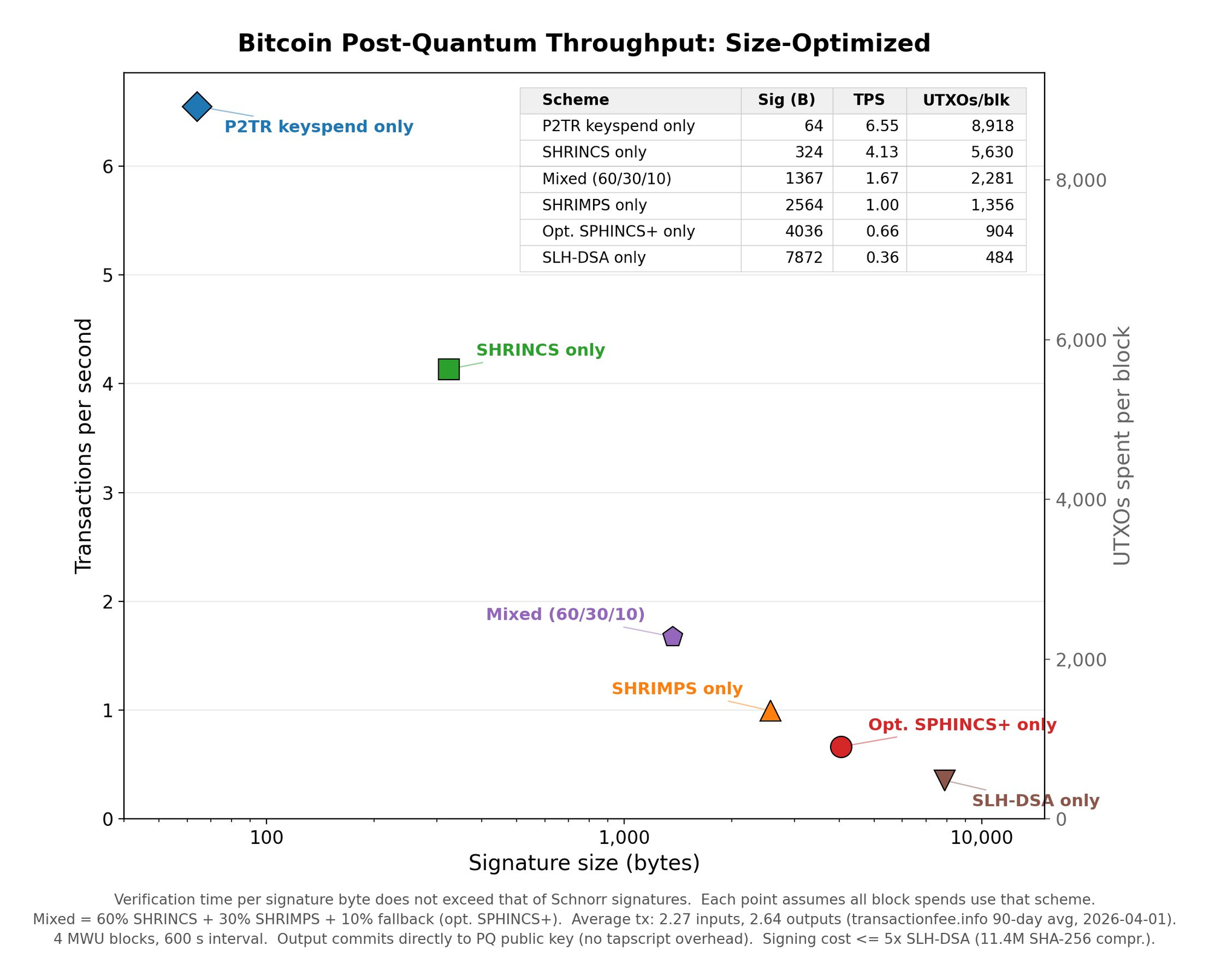
The horizontal axis shows signature size, which grows larger toward the right. The left vertical axis shows the number of transactions that can be processed per second, and the right vertical axis shows the number of UTXOs that can be spent per block.
The closer a scheme sits to the upper left, the smaller its signatures and the more transactions and UTXOs it can handle. P2TR keyspend (Schnorr signatures) sits in that position, followed by SHRINCS and then SLH-DSA.
"SHRIMPS" is another post-quantum signature scheme proposed by Blockstream, like SHRINCS, and will be covered in a separate article. "SPHINCS+" is discussed later in this article.
SHRINCS: a proposal for quantum-resistant signatures
Even with a quantum computer, finding a preimage of a hash function is believed to require an enormous amount of computation, and lengthening the output is said to be an effective defense against quantum attacks.
As mentioned above, SLH-DSA, a hash-based signature scheme, has been criticized for its large signature size. To improve on that, Jonas Nick and Mikhail Kudinov of Blockstream proposed "SHRINCS."
SLH-DSA signatures are large, about 8 KB, mainly because their limit on the number of signatures, called the "signature budget," is set to an enormous 2^64. In Bitcoin, address reuse is discouraged (because it exposes the public key), and a single key signs only once or a handful of times, so the signature budget can be made much smaller.
On the other hand, signing beyond the signature budget creates a security vulnerability. The idea behind SHRINCS is therefore to keep track of which keys have signed, including the order, and to provide two paths: a compact path with a small signature budget, and a fallback path that allows signing with a key that produces larger signatures if the signature count has been lost.
Let's clarify some terms.
- Stateful: keeping track of how many signatures have been made (the state)
- Stateless: not keeping any state
In a typical SHRINCS use case, a dedicated device produces stateful signatures in normal operation to keep signatures small. If the device breaks or is lost and the wallet is restored from a seed phrase backup, the state has been lost, so stateless signatures are used as a fallback.
Concretely, SHRINCS is structured as shown in the diagram below.
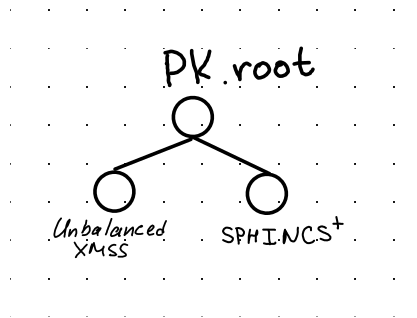
"Unbalanced XMSS" is used for stateful signatures, and "SPHINCS+" for stateless signatures. The SHRINCS public key is created by hashing the two together.
The stateful scheme: Unbalanced XMSS
XMSS stands for eXtended Merkle Signature Scheme, a stateful hash-based PQC signature recommended in NIST SP 800-208 (listed alongside LMS; unlike SLH-DSA, which is a FIPS standard, it has the status of a "recommendation" because stateful schemes come with their own operational requirements).
Structurally, it achieves 292-byte signatures using one-time signatures (OTS) and keeps track of state using a Merkle tree.
"Unbalanced" means the Merkle tree has a lopsided shape, as shown in the diagram below.

SHRINCS uses "WOTS+C" (Winternitz One-Time Signature with Checksum), a one-time signature (OTS) optimized for XMSS, and the unbalanced Merkle tree makes it easy to express whether a signature is the first, second, and so on from the top.
💡
Interestingly, each additional level of depth in the Merkle tree adds 16 bytes to the signature (a depth of 1 gives 324 bytes). This means the more an address is reused, the larger the signatures and the higher the transaction fees, creating an incentive to avoid address reuse.
The stateless scheme: SPHINCS+
The fallback for when state can no longer be maintained is a signature called SPHINCS+, which ranges from 3–8 KB. (Strictly speaking, it is a modified version of SPHINCS+.)
💡
Side note: SLH-DSA is the NIST-standardized version of SPHINCS+, so the two have nearly identical structures.
SPHINCS+ is built by stacking the useful components of PQC signatures in multiple layers, so its signatures are larger, but it has the advantage of not needing to track state. This is because the structure is so large that the chance of selecting the same key twice is statistically negligible.
In Bitcoin, keys do not need to sign an enormous number of times, so signature size can be reduced by using a smaller SPHINCS+ structure, which allows the size to be tuned within a range of 3 KB to 8 KB.
Other signature schemes have also been proposed
One drawback of SHRINCS as proposed is that after restoring from a backup, only the fallback path can be used, so only large signatures are available. "SHRIMPS" was proposed to provide relatively small signatures even when restoring from a backup.
SHRIMPS:マルチデバイス間でステートフルな署名を実現する耐量子暗号
BlockstreamがSHRINCSのマルチデバイス問題を解決するために提案した耐量子署名SHRIMPSを解説。コンパクト・パスとフォールバック・パスの使い分けで、復元したデバイスでも約2.5KBの署名を実現する仕組みを紹介。
 三倉 大司

In addition, off-chain signing happens extremely frequently, which would quickly exhaust the signature limit inherent to hash-based signatures, making hash-based schemes, including SHRINCS, difficult to use there. For that reason, roasbeef has proposed a lattice-based signature scheme for off-chain signature authentication.
Post Quantum Lightning: Layer by Layer
Hi y’all, Over the past few weeks I’ve received some direct and indirect questions asking how the rise of quantum computers may affect the Lightning Network. I searched and didn’t see anything concrete written on the topic, so I figured that I’d write something up! To answer the question of how quantum computers may affect the design of Lightning, a useful starting point is recognizing that any layer that uses cryptography that rests on classical security assumptions requires modifications. S…
 roasbeef

A challenge for hash-based PQC in general, including SHRINCS, is the loss of non-hardened derivation in HD wallets (hierarchical deterministic wallets) as defined in BIP32, that is, the ability to hierarchically generate multiple child public keys from a public key alone. Discussion on this is likely to continue.
Summary
The biggest challenge in bringing PQC to Bitcoin is signature bloat. Compared with today's Schnorr signatures (64 bytes), SLH-DSA, the scheme adopted by NIST, is about 7,872 bytes, a full 123 times larger.
SHRINCS is Blockstream's proposal to solve this problem. It uses a two-tier design: in normal operation, stateful Unbalanced XMSS achieves signatures as small as 324 bytes, and if the state is lost, for example because a device is lost, it switches to stateless fallback signatures using SPHINCS+ (3–8 KB).
Open issues include the fact that only large signatures are available after restoring from a backup and the loss of non-hardened derivation in HD wallets, and discussion is ongoing.