Quantum Computers Aren't Parallel Computers: 5 Reasons Why

This article was translated from Japanese with AI. Read the original (日本語) · Report a translation issue
What comes to mind when you think of a quantum computer? Some people picture it as a strictly better version of the computers we use every day. But a quantum computer is not a magic machine that can solve anything.
Quantum computers are often described as parallel computers, and I think the preconceptions that come with the phrase "parallel computing" are the source of a lot of misunderstanding.
In this article, I'll explain how quantum computers work by comparing them with today's computers, and then give five reasons why a quantum computer is not an all-purpose machine.
The goal of this article is to clear up misconceptions about quantum computers and give you a sharper picture of what they are, so it doesn't touch on Bitcoin. That said, you may find it interesting to read it alongside our earlier articles on Bitcoin's quantum resistance, linked below.
『量子耐性ハードウェアウォレット』の本当の意味|Trezor発表を正しく理解する
今週、Trezor社が業界初の「量子耐性のあるハードウェアウォレット」を発表しました。私もその場で発表を聞いていたのですが、最初の感想は「どういうこと??」でした。一般的に言われがちなビットコイン(やアルトコイン)の量子耐性リスクはハードウェアウォレット側で対応できるものではないためです。 しかし、発表をよく聞いてみるとそれとは別にハードウェアウォレットの仕組みにも量子コンピューターによるリスクがあること、そして今回Trezorはそこを手当したことに納得しました。 今日は「量子耐性のあるハードウェアウォレット」が具体的に何を指すのか解説します。 ・ビットコインの「量子耐性リスク」はハードウェアウォレット側で手当てできるものではない ・ハードウェアウォレットの仕組みのどこに「量子耐性」を実現したのか? ・超長期的には必要だが、いま購入すべきという判断材料にはならない ビットコインの「量子耐性リスク」はハードウェアウォレット側で手当てできるものではない ビットコインが量子コンピューターの時代にどう対応していくのかという問題は定期的に話題に上がります。典型的な内容は、ビットコ
 加藤 規新

ビットコインは量子コンピューター耐性をどうやって手に入れるのか
ここ数年、定期的に話題に上がる量子コンピュータのビットコインに対する脅威が今週もツイッターで話題になっていました。確かに量子コンピュータは進歩していますが、現時点で状況が大きく変わったとは言い難いのが実情です。 また、4年近く前に有識者によってSpotlightに投稿された以下の記事もとても参考になるので、お時間のある方は読んでみてください。 ビットコイン vs 量子コンピュータ本記事では結局量子コンピュータはブロックチェーンに対してどのような影響があるのかをなるべく詳細に説明Spotlight😆 この話題が盛り上がるとき、多くの場合話題の中心は「量子コンピュータがどのようにビットコインに対して脅威なのか」「時期的にはいつくらいからリスクがあるのか」「自分が取れる対策は」というテーマになります。しかし重要なのはビットコインがどのようにして量子コンピュータ耐性を獲得するのか、そのプロセスなのではないでしょうか。 今日はビットコインが量子コンピュータ耐性を獲得するプロセスを想像してみましょう。 ・量子耐性のある署名アルゴリズムのBIPドラフトが提案されている ・提案の内容、導
加藤 規新
For context, I worked on research into gate-based quantum computers during my time at university, and I draw on that experience throughout this article.
💡
Quantum computers can be divided into two types:
• Gate-based: general-purpose quantum computers
• Annealing-based: specialized for combinatorial optimization problems
As of February 2026, most of the quantum computers in practical use are the annealing type, but whenever this article says "quantum computer" from here on, it means a gate-based quantum computer.
I also explain this in a video, so please check it out.
What Is a Quantum Computer? How It Differs from a Classical Computer
In the quantum world, conventional computers like the PCs and smartphones we use every day are called classical computers, to distinguish them. A quantum computer, by contrast, is a computer that applies the properties of quantum mechanics, the physics that describes the microscopic world, to computation.
The point of a quantum computer is not to make every computation faster. It's that, for certain kinds of problems, there are more efficient ways of solving them (algorithms) than a classical computer has. For problems that lack the structure quantum computation is good at, classical computers remain strong, so a quantum computer is not an all-purpose upgrade.
To understand the difference between classical and quantum computers, the key is to look at the bit, the smallest unit of information. The difference between the two comes down to how their bits behave.
Classical Computers (Conventional): Computing with 0s and 1s
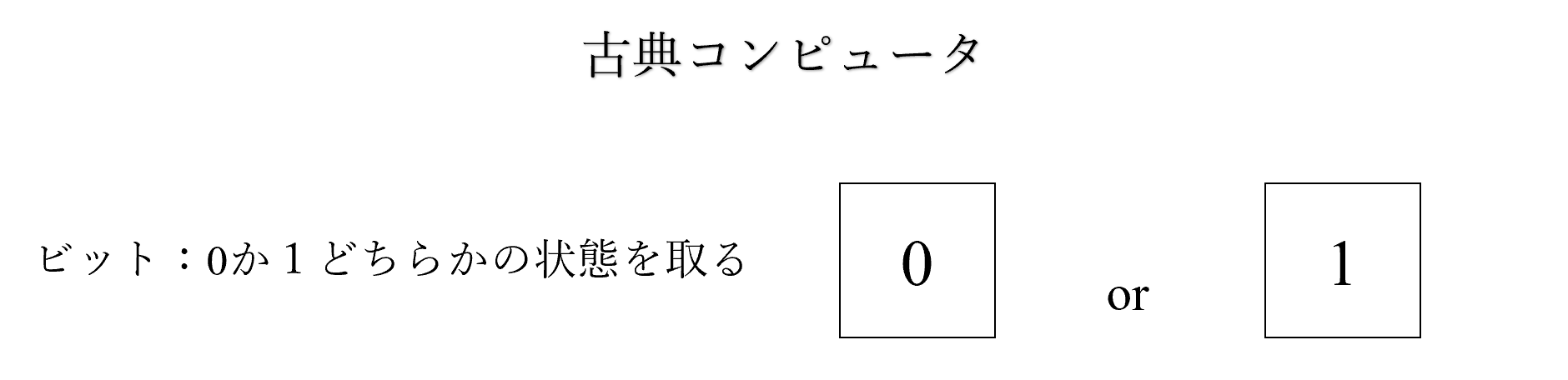
A bit in a classical computer always holds a definite value: either 0 or 1. It is represented by a physical state, such as whether a transistor's voltage is high or low, or whether a magnetic orientation points up or down.
The important thing is that a bit's state can always be observed and is always definite. One byte (8 bits) of data stored in memory exists as a sequence of eight clear 0s and 1s, for example "01001101."
Suppose we process information using 10 classical bits. Covering every combination of 10 bits takes 1,024 computations. With n bits, that becomes 2ⁿ computations, so as you can see, the amount of computation grows explosively and it can become impractical to get an answer in a realistic amount of time.
So what about a quantum computer?
Quantum Computers: Computing with Qubits
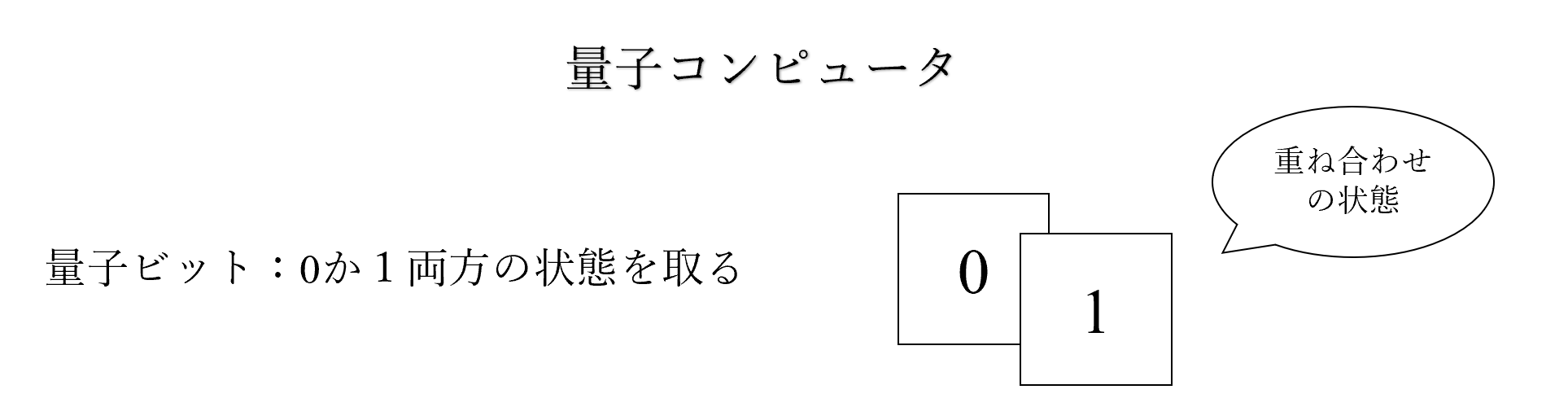
The quantum bits, or qubits, in a quantum computer have fundamentally different properties. Until it is observed, a qubit is in a superposition of 0 and 1. Being both 0 and 1 at once is a phenomenon unique to quantum mechanics that classical physics cannot explain.
It isn't a strictly accurate explanation, but picturing a die may make this easier to grasp. Take an ordinary six-sided die and imagine rolling it once.
Before you roll, every face is equally likely to come up (1 in 6), so you could think of the die as being in a superposition: it is "1, 2, 3, 4, 5 and 6 all at once."
Then, rolling the die (that is, observing it) makes it settle into a single state.
💡
Unlike a die, when a qubit is observed, its superposition collapses and its state becomes fixed. In other words, the moment you look to find out what state it's in, that state is lost. This means debugging is extremely difficult. On a classical computer you can check values in memory partway through a program, but on a quantum computer the very act of looking destroys the computation.
With 10 qubits, a quantum computer can hold a superposition of all 1,024 states at once. With n qubits, it can hold 2ⁿ states.
This explanation, that the principle of superposition lets a quantum computer hold every state at once, is probably what has led to the image of quantum computers performing parallel computation.
Five Reasons Quantum Computing Is Not Parallel Computing
When people hear "parallel computing," they probably imagine something like 10 computers each doing a separate calculation and combining their answers at the end, making the job 10 times faster than one computer doing 10 calculations.
Presumably that's why the misconception has spread that, since a quantum computer can hold 2ⁿ states, it computes them in parallel and is therefore faster than a classical computer.
The key point is that a quantum computer is not running 2ⁿ computations in parallel. Here are five reasons that explain the difference.
Reason 1: A Measurement Gives You Only One Answer
If a quantum computer really were computing in parallel, you should be able to retrieve all the results at once. But that's not how it works. Let's think it through with an example.
A parallel computing setup could try 1,000 paths through a maze simultaneously on 1,000 computers and report the results for all 1,000. A quantum computer handles the 1,000 paths internally as a superposition, but when you observe it at the end, it tells you only one answer: "this was the path." The information about the other 999 paths disappears.
That goes against the definition of parallel computing. In parallel computing, you should be able to collect the results of every parallel process.
Reason 2: It's Only Faster When Interference Can Amplify the Right Answer
A quantum computer only shows its power when specific conditions are met. The key to this is a phenomenon called quantum interference.
Each component of a quantum state is assigned a complex number called an amplitude. Quantum algorithms work by skillfully manipulating these amplitudes so that the amplitudes for correct answers reinforce each other and the amplitudes for wrong answers cancel each other out. Why is this different from parallel computing?
In parallel computing, each process runs independently and keeps its own result. Good results and bad results alike are all retained.
In a quantum computer, the amplitudes of the various possibilities interfere with one another during the computation. The computation is designed so that when you finally measure, the amplified right answer is observed with high probability.
Reason 3: Noise Breaks Down the Ideal Parallelism
If a quantum computer were a perfect parallel computing machine, 2ⁿ parallel processes would run independently. Real quantum computers, however, are extremely fragile.
Superpositions are easily destroyed by the slightest temperature change, vibration or electromagnetic wave. The coherence time of today's qubits (how long they can maintain a quantum state) varies widely by technology, but is generally somewhere between a few microseconds and a few milliseconds.
Reason 4: Quantum States Can't Be Copied (the No-Cloning Theorem)
In parallel computing, copying results is a basic operation. Multiple processes reading the same data or duplicating results is completely routine.
Quantum mechanics, however, has a fundamental constraint called the no-cloning theorem: an unknown quantum state cannot be copied perfectly. In a quantum computer, trying to copy a qubit in superposition would violate the basic laws of quantum mechanics. Any attempt to copy it either destroys the original state or produces only an imperfect copy.
This constraint is one of the decisive reasons a quantum computer cannot function as a parallel computing machine. It can't duplicate and distribute data, something any parallel computer should naturally be able to do.
Reason 5: There Are Problems Even a Quantum Computer Can't Solve
Finally, let me offer a more fundamental perspective. Even if a quantum computer were a perfect parallel computing machine, that alone wouldn't mean it could solve every problem quickly.
Computer science has a famous unsolved problem known as the P≠NP conjecture. Put simply, it conjectures that "there are problems where checking whether an answer is correct is fast, but finding that answer takes an enormous amount of time." It is one of the Millennium Prize Problems, each of which carries a prize of $1 million for its solution.
The Millennium Prize Problems - Clay Mathematics Institute
In order to celebrate mathematics in the new millennium, The Clay Mathematics Institute of Cambridge, Massachusetts (CMI) established seven Prize Problems. The Prizes were conceived to record some of the most difficult problems with which mathematicians were grappling at the turn of the second millennium; to elevate in the consciousness of the general public the fact […]


The important point is that quantum computers are not believed to be able to solve NP-complete problems efficiently either. What quantum computers are good at is the class of problems called BQP (Bounded-error Quantum Polynomial time). This is a different kind of problem from both classical parallel computing and NP-complete problems.
For example, prime factorization, which Shor's algorithm can solve, is in BQP but is believed not to be NP-complete. Conversely, many NP-complete problems are expected to be impossible to solve efficiently even on a quantum computer.
In other words, a quantum computer isn't a magic machine that can solve anything. It's something that is more efficient than a classical computer for particular kinds of problems.
How Quantum Computers Actually Compute

We've seen that a quantum computer is not a parallel computing machine. So how does it actually work? In a nutshell, it's a computer that shapes a probability distribution to steer it toward a state where the correct answer is likely to come out.
It first creates a state in which every possible answer for the qubits exists with equal probability, then uses operations called quantum gates to gradually reshape this probability distribution.
What it's doing is:
- Gradually raising the probability of the correct answer
- Gradually lowering the probability of the wrong answers
It achieves this using the wave property known as quantum interference. Just as sound waves resonate so that only certain tones get louder, only the quantum states that correspond to the correct answer are reinforced.
Finally, the quantum state is measured. One answer is then selected at random according to the probabilities. This is the basic way a real quantum computer computes.
To go back to the die example: at first every face has the same probability, but it's as if you've modified the die so that a particular number is more likely to come up.
The strength of a quantum computer lies in the fact that, for certain problems, this uniquely quantum way of computing lets it solve them quickly.
Summary: A Quantum Computer Designs Probabilities Rather Than Running Things in Parallel
A quantum computer is not a parallel machine that computes every possibility at once. At its core, it is a computer that manipulates probability distributions to create a state where the correct answer is likely to come out.
Parallel computing can work through 1,000 possibilities on 1,000 machines and get all 1,000 results. Quantum computing holds a superposition of 1,000 possibilities, but a measurement yields only one answer. In exchange, by using quantum interference to amplify the probability of the correct answer and suppress the probability of wrong ones, it can land on the correct answer with far higher probability than picking at random.
The reasons a quantum computer is not a parallel computer are clear: a measurement extracts only one result; it operates on its own principle of manipulating probabilities through interference; it is so fragile that noise can bring the whole thing down; it cannot copy quantum states; and there is a theoretical limit in that some problems can't be solved even with parallel computing.
A quantum computer is neither a strictly better version of a classical computer nor a massively parallel one. It's an entirely new computing paradigm that cleverly designs probability distributions through quantum interference. Only for certain problems does this unique mechanism deliver dramatic speedups.