SHRIMPS: Multi-Device Quantum-Resistant Signatures for Bitcoin

This article was translated from Japanese with AI. Read the original (日本語) · Report a translation issue
The Bitcoin community is actively debating how to make Bitcoin quantum-resistant, and a wide range of cryptographic schemes are being researched and proposed.
Among these, one scheme drawing particular attention right now is the "hash-based signature." Its security rests on the one-way (black-box-like) nature of hash functions, and Shor's algorithm, which a quantum computer would use to break cryptography, cannot be applied to it.
Hash-based signatures also have a long research history, dating back to around 1979 with Lamport signatures. In my view, this cryptographic maturity, combined with how well they fit the hash-function security model Bitcoin has relied on from the start, is why they are attracting attention in the quantum-resistance discussion.
Now to the subject of this article: SHRIMPS is a hash-based, quantum-resistant signature scheme being researched by Blockstream. Published on March 27, 2026, the proposal aims to address the shortcomings of SHRINCS, which Bitcoin Research Lab covered previously.
Each scheme has its own strengths and weaknesses, and the key point is that SHRIMPS is not meant to replace SHRINCS but is designed to complement it. For details on SHRINCS, see the article below.
SHRINCS:Blockstream社が提案する耐量子署名
ビットコインのPQC導入における署名サイズ問題を解決するSHRINCSを解説。Unbalanced XMSSとSPHINCS+を組み合わせ、最小324バイトの量子耐性署名を実現したBlockstreamの提案を詳しく紹介。
 三倉 大司

This article gives an overview of SHRIMPS and looks at the role it is expected to play in making Bitcoin quantum-resistant.
💡
How to remember the names
Both schemes use a hash-based signature algorithm called SPHINCS+. The origins of the names have not been officially explained, so my guess is that they are plays on the word SPHINCS+.
• SHRINCS: a pun on "shrinks," meant to convey that its signatures are smaller than those of SPHINCS+
• SHRIMPS: a pun on "shrimps," conveying that it is smaller than SPHINCS+, with a swarm of shrimp tied to the idea of "multi-device support" (explained later)
Background: SHRINCS's multi-device problem
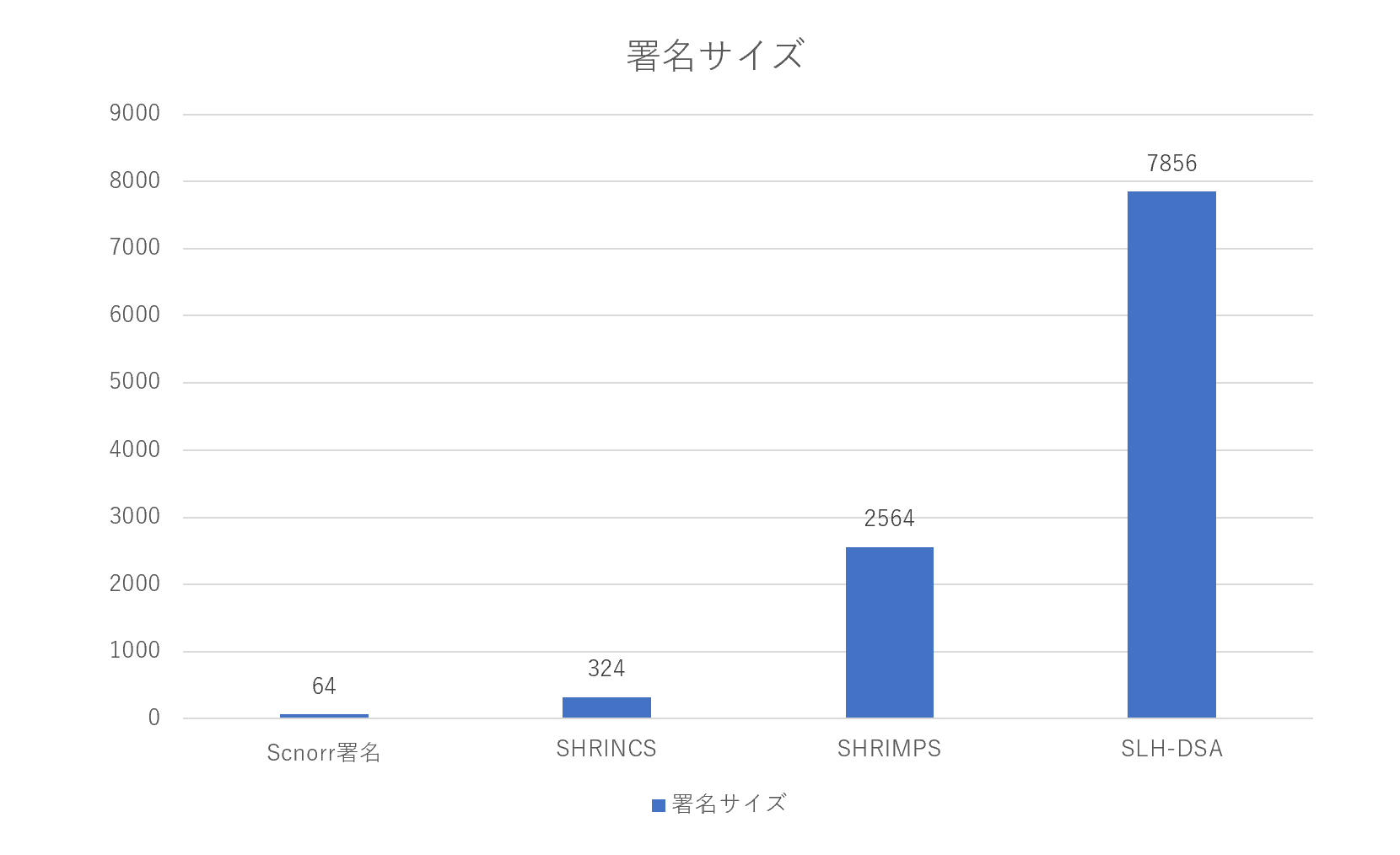
The pain point in bringing quantum-resistant signatures to Bitcoin is their large size.
The Schnorr signatures Bitcoin uses today are very compact at about 64 bytes, but with SLH-DSA, the quantum-resistant signature standardized by NIST, signatures balloon to about 7,856 bytes.
Larger signatures take up more block space and push transaction fees higher, which is why this is recognized as a major problem.
To address this, Blockstream's Jonas Nick proposed SHRINCS in December 2025, a hash-based signature that keeps signatures down to about 324 bytes.
SHRINCS managed to shrink signature data by keeping a record of the signing state, but it was designed on the assumption that only a single device would be used. In other words, sharing and synchronizing that state across multiple devices is extremely difficult.
As a result, a new device restored from the seed phrase cannot inherit the state and has no choice but to fall back to a signature scheme with much larger signatures.
SHRIMPS was proposed to solve this multi-device problem.
What is SHRIMPS?
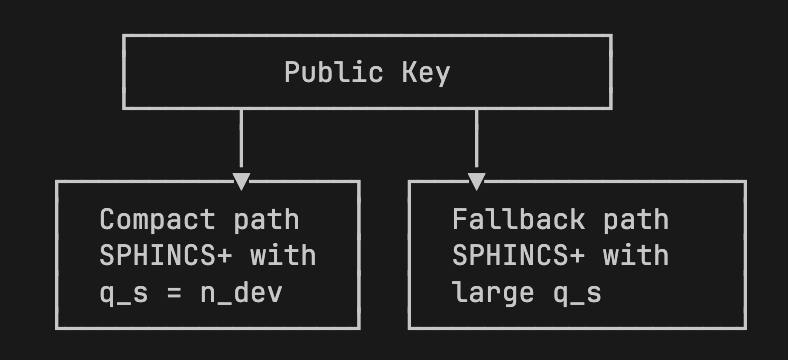
With SHRIMPS, a single public key supports two ways of signing: a "compact path" and a "fallback path."
Both paths use SPHINCS+, a stateless signature scheme, but they differ in one parameter: the maximum number of signatures, \(q_s\).
SPHINCS+ works by preparing an enormous number of signing keys in advance and pseudo-randomly picking one each time it signs. To push the probability of the same key being picked multiple times by chance down to a negligible level, it caps the number of signatures that can safely be produced with one key (\(q_s\)). The smaller \(q_s\) is set, the smaller the cryptographic structure itself can be, and therefore the smaller the signatures.
A SHRIMPS public key is created by hashing together the public keys of two SPHINCS+ instances with different properties: the "compact path," which has a low signature cap, and the "fallback path," which has a high one.
When signing, the wallet checks how many times the key has signed before. If the cap has not been exceeded, it uses the compact path; if it has, it uses the fallback path.
1. Compact path
In Bitcoin, reusing an address that has already signed is discouraged because it exposes the public key, so any one address is likely to sign only a few times at most.
With that in mind, consider setting the compact path's signature budget (the maximum number of signatures it can produce) as follows.
\[ q_s = n_{dev} \times n_{dsig} \]- \( q_s\): signature budget
- \(n_{dev}\): number of times the wallet can be restored from the seed
- \(n_{dsig}\): number of signatures per device
From the equation above, if each device is limited to a single signature (\(n_{dsig}=1\)) to avoid exposing the public key, the signature budget (\( q_s\)) equals the number of times the wallet can be restored from the seed (\(q_s=n_{dev}\)).
Entering a seed phrase is a manual process, so restores do not happen often. Even with a conservative value of \(n_{dev}\) (the number of restores from the seed) set to \(2^{10}=1024\), the signature comes out at 2,564 bytes, roughly a third of SLH-DSA's 7,856 bytes.
Even if each device is allowed up to \(n_{dsig}=2^4\) (16) signatures, signing takes longer but signatures stay under 3,000 bytes.
💡
The decisive difference from SHRINCS is that, without transferring any state, the seed alone lets you independently initialize up to the configured number of devices, so backup devices can naturally use the compact path too.
2. Fallback path
Once the compact path's signature budget is used up (for example, when \(n_{dsig}=1\) and a second signature is needed), signing must be done with the fallback path. Because it uses parameters with a large \(q_s\), its signatures are larger, but it serves as a backup that can sign an effectively unlimited number of times.
For example, setting \(q_s=2^{64}\) yields 7,856-byte signatures, while \(q_s=2^{40}\) keeps them under about 4,500 bytes.
How SHRIMPS signing works
Signing with SHRIMPS is very simple: the sender just provides "the signature from the chosen path" and "the public key of the unused path (16 bytes, the sibling public key)."
The verifier recovers "the public key of the path actually used (16 bytes)" from the SPHINCS+ signature, then hashes it together with the other 16-byte public key to reconstruct the original public key.
Finally, the verifier checks whether this reconstructed public key matches the public key recorded in advance.
💡
The only data added to the signature (the overhead) is the 16-byte sibling public key.
A hybrid implementation of SHRINCS and SHRIMPS is anticipated
By setting \(n_{dev}=2^{10}=1024, n_{dsig}=1\), the SHRIMPS compact path can shrink signatures to 2,564 bytes, but compared with today's roughly 64-byte Schnorr signatures, that is still too large to be practical for Bitcoin. To solve this, a hybrid implementation combining it with SHRINCS, the quantum-resistant signature proposed earlier, is anticipated.
On the first device you start using, the wallet can record how many times it has signed, that is, it can update the state, so SHRINCS's stateful scheme can be used. In this case, signatures can be as small as 324 bytes.
If that device then breaks or can no longer update its state properly, you would use a second device restored from the seed phrase. At that point, it can fall back to the SHRIMPS compact path with its small signature budget.
The original SHRINCS proposal used signatures of about 7.8 KB as its fallback, so this cuts signature size to roughly a third or less. And although few people are likely to restore from the seed phrase that many times, a third device and beyond would seemingly inherit the same SHRIMPS properties, allowing each to be restored independently and sign statefully.
Appendix: About SPHINCS+
SPHINCS+ is a quantum-resistant digital signature scheme based solely on cryptographic hash functions. It was selected as part of NIST's post-quantum cryptography standardization competition and is documented in FIPS 205 as SLH-DSA (Stateless Hash-based Digital Signature Algorithm).
SPHINCS+ is distinguished by a multi-layered structure that combines the following three signature schemes. For WOTS+ and FORS, I have linked explainer videos by Shigeyuki Azuchi, CTO of Chaintope Inc., for reference.
An overview of Merkle trees is given in a previous article.
Taprootとは?Schnorr署名・MAST・P2TRで実現するプライバシーと効率性の向上
2021年6月12日にロックインされ11月にアクティベートされたビットコインのTaprootを徹底解説。Schnorr署名・MAST・Tapscriptの3つの改善点と、2種類のアンロック方法を持つP2TRアドレスの仕組みをわかりやすく紹介します。
 三倉 大司

Through its multi-layered structure (a hypertree), SPHINCS+ can prepare an enormous number of few-time signature keys. It is designed so that the chance of picking the same key twice is statistically negligible, which allows it to operate statelessly without any state management.
Conclusion
SHRIMPS is a hash-based, quantum-resistant signature scheme proposed to solve SHRINCS's problem of being unable to share state across multiple devices. By switching between two SPHINCS+ instances with different signature caps (the compact path and the fallback path) depending on the state, even a device restored from the seed phrase can independently produce compact signatures of about 2.5 KB. That is roughly a third the size of SLH-DSA.
Moreover, a hybrid implementation that uses 324-byte SHRINCS on a single device and the SHRIMPS compact path on restored devices could make a quantum-resistant wallet practical for real-world use. Making Bitcoin quantum-resistant is still very much under discussion, but this can fairly be called a solid step toward putting hash-based signatures into practice.