What Is P2MR (BIP360)? Why It Isn't True Quantum Resistance

This article was translated from Japanese with AI. Read the original (日本語) · Report a translation issue
The relationship between Bitcoin and quantum computers has been drawing more and more attention in recent years.
Most recently, a company called BTQ Technologies made the news for implementing BIP360, an improvement proposal related to quantum resistance, on its own testnet.
In response to this news, Shigeyuki Azuchi, CTO of Chaintope Inc., who has previously contributed an article to Bitcoin Research Lab, shared the following view on X.
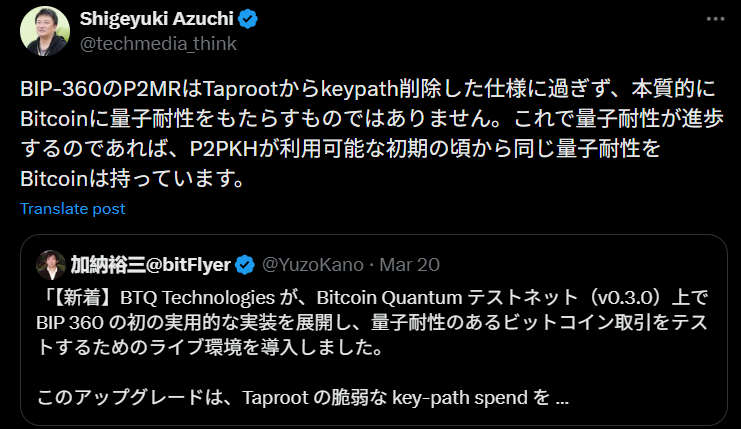
He wrote that "BIP-360's P2MR is nothing more than Taproot with the keypath removed, and it doesn't fundamentally make Bitcoin quantum-resistant."
In this article, I'll explain what kind of proposal BIP360 is, why it can't be called true quantum resistance, and what its real significance is, including my own view.
Overview of P2MR (BIP360)
| Name | P2MR |
| Introduced in | BIP360 |
| Prefix | bc1z |
| Encoding | Bech32m |
| Length | 62 characters |
BIP360 was merged into the BIPs repository in February 2026. It proposes P2MR (Pay-to-Merkle-Root), a new output type that can be introduced via a soft fork.
P2MR addresses start with the prefix bc1z and are 62 characters long in total. An example address looks like this:
P2MRの例
bc1zzmv50jjgxxhww6ve4g5zpewrkjqhr06fyujpm20tuezdlxmfphcqfc80ve
The encoding is Bech32m, the same scheme used by P2TR (Pay-to-Taproot).
The easiest way to understand P2MR is to compare it with P2TR, which has a similar structure. First, for readers who aren't familiar with how P2TR spending works, here's a quick overview.
The two ways to spend P2TR
P2TR offers the following two ways to spend:
- Key Path Spend (spending with a key)
- Script Path Spend (spending by meeting conditions)
The first, Key Path Spend, is a method where you spend by providing a signature corresponding to the internal public key. You can think of it as equivalent to an ordinary payment (providing a signature that matches a public key).
The second, Script Path Spend, is a method where you spend by satisfying specific script conditions (such as multisig or a timelock). You reveal a script called a Tapscript, and meeting its conditions allows the funds to be spent.
The public key is created by combining these two spending methods, but P2TR has a structural drawback: this public key is exposed on the blockchain.
💡
Bitcoin addresses (except for certain formats) are created by running the public key through hash functions twice. In other words, you can't learn the public key just by looking at the address. However, continuing to hold bitcoin while the public key itself sits recorded on the blockchain poses a potential risk: in a future where quantum computers become practical, the private key could be derived from it.
Trade-offs between P2TR and P2MR
P2MR is a new output type that removes Key Path Spend and keeps only Script Path Spend, in order to eliminate P2TR's drawback of exposing the public key on-chain.
Compared with P2TR, P2MR comes with a number of trade-offs.
| Comparison | Aspect | Verdict | Reason |
|---|---|---|---|
| P2TR (key path) vs P2MR | Fees | P2MR is higher | P2MR requires not only a signature but also data (a path) proving the script structure, so the data size is larger. |
| P2TR (key path) vs P2MR | Privacy | P2MR is lower | With P2MR, you can't hide the fact that you're using complex conditions (scripts). |
| P2TR (script path) vs P2MR | Fees | P2MR is cheaper | P2MR disables Key Path Spend by removing steps such as the internal key and the tap tweak, so the data for that structure is eliminated. |
| P2TR (script path) vs P2MR | Privacy | Equivalent | Because the spending method is the same |
Let's start with fees. Compared with P2TR's Key Path Spend, P2MR always spends via the script path, so it involves more data and higher fees.
On the other hand, compared with P2TR's Script Path Spend, P2MR is actually cheaper. Because Key Path Spend has been removed, P2MR lacks structures such as the internal key and the tap tweak that P2TR has, so it requires less data than P2TR.
What about privacy? With P2TR, using Key Path Spend lets you hide whether a script (conditions) exists at all. With P2MR, however, you can't hide the fact that you're using a script, so P2MR offers less privacy. When both use Script Path Spend, their privacy levels are the same.
In the following sections, let's look at how BIP360's P2MR relates to quantum computers.
How quantum computers relate to Bitcoin
If a cryptographically relevant quantum computer (CRQC) is built in the future, the biggest threat is that it could break Bitcoin's cryptographic assumptions.
It is known that Shor's algorithm lets a quantum computer solve the discrete logarithm problem exponentially faster than classical methods. ECDSA, the cryptography used for Bitcoin signatures, is built on this discrete logarithm problem (DLP).
For now, however, quantum computer development is taking a long time to produce error-corrected qubits, and breaking this cryptography is said to be a long way off.
In light of this situation, and to prepare for future advances in quantum computing, the US government (NIST and CNSA) has announced that current cryptography will no longer be used in the 2030s.
In this way, there is a growing trend worldwide, led by the United States, to start migrating to cryptography that holds up against quantum computers.
There is also a lingering psychological concern: the possibility that private keys could someday be derived from public keys (quantum key recovery).
That is the background to BIP360: developers proposed it to prepare for future advances in quantum computing rather than simply fear them.
💡
As part of this preparation for quantum computers, BIP360 was originally drafted in 2024 as P2QRH (Pay-to-Quantum-Resistant-Hash), renamed P2TSH (Pay-to-Tapscript-Hash) in late 2025, and then, following community feedback, settled on P2MR (Pay-to-Merkle-Root).
That said, quantum computers are not all-powerful. The idea that they can solve every computation simultaneously is a myth, and they are constrained by noise and errors. For details, see the following article.
量子コンピュータとは?万能な並列計算機ではない5つの理由
量子コンピュータは「並列計算マシン」ではありません。測定で1つの答えしか得られない、ノークローン定理、量子干渉の仕組みなど、5つの理由から量子コンピュータの本質を解説。万能な計算機という誤解を解きます。
 三倉 大司
Two scenarios for quantum attacks on Bitcoin
How should we prepare for quantum computers? Here, let's break things down into two broad attack scenarios, considering the risk of key theft and the technical aspects.
We'll look at the following two quantum attack scenarios:
- Short Exposure Attacks: an attack in which, during the short time a transaction waits in the mempool for confirmation, the attacker recovers the private key from the public key and steals the funds by creating a "fake transaction" that sends them to themselves, using RBF or similar
- Long Exposure Attacks: an attack in which, after a transaction has been included in a block and confirmed, the attacker uses a quantum computer to recover the private key from a public key exposed on the blockchain and steals the funds
When it comes to Short Exposure Attacks, Bitcoin is at a disadvantage due to how its transactions are structured, because sending funds always requires revealing the public key for the relevant address. Fully protecting against Short Exposure Attacks would require introducing quantum-resistant signatures into Bitcoin.
Long Exposure Attacks target public keys on the blockchain and give the attacker plenty of time, so they are likely to be the first quantum threat Bitcoin faces. BIP360 therefore proposes, as a first step, creating an output type that is resistant to Long Exposure Attacks.
Outputs vulnerable to Long Exposure Attacks
Outputs vulnerable to Long Exposure Attacks are those whose public keys are always exposed on the blockchain. Specifically, there are three types:
- P2PK outputs
- Reused outputs
- P2TR (Taproot) outputs
P2PK is an early Bitcoin address format that pays directly to a public key, so the public key is always exposed on the blockchain. Many coins, such as Satoshi Nakamoto's, sit in P2PK outputs, so they would likely be the first targets of an attack.
As for reused outputs: as briefly mentioned earlier, Bitcoin transactions require revealing the public key when sending. So if you receive bitcoin again at an address you've already spent from even once, the public key for that bitcoin is already known on the blockchain from the earlier transaction. This means the newly received bitcoin is also vulnerable to attack.
In particular, one commonly cited step individuals can take against quantum computers is to avoid using the same address repeatedly. This is why using a new address for every receipt is recommended.
P2TR (Taproot) outputs contain the public key data almost as-is in the address itself, rather than hiding it behind a hash function. As a result, the moment it's recorded on the blockchain, the public key becomes known and is a target for quantum attacks.
💡
The reason P2TR outputs don't hash the public key is to improve efficiency by cutting the data and effort needed to reveal the public key when signing. Hashing also isn't a fundamental fix, since the public key is exposed anyway between when a transaction is sent and when it's confirmed. On top of that, the designers took the view that achieving quantum resistance should be addressed with dedicated quantum-resistant algorithms.
In short, P2MR is a proposal that counters Long Exposure Attacks by fixing P2TR's vulnerability (public key exposure) while reusing P2TR's code to make implementation easier.
If you'd like to learn more about the existing Bitcoin address types, see the following earlier article.
ビットコインアドレスの種類まとめ|レガシー・SegWit・Taprootの違いと選び方
ビットコインアドレスの種類を総まとめ。レガシー(1/3)・SegWit(bc1q)・Taproot(bc1p)の違いを、プレフィックスや文字数、手数料、互換性の観点から比較表つきでわかりやすく解説します。
三倉 大司
P2MR is not true quantum resistance but extensibility
One question remains here: if the goal is resistance to Long Exposure Attacks, wouldn't the P2WPKH address format, which is protected by a hash function, be enough? It's true that P2WPKH can withstand Long Exposure Attacks.
The problem with P2WPKH, however, is that it lacks extensibility: its structure makes adding new opcodes difficult.
The key point is that P2MR incorporates OP_SUCCESS, a reserved slot that allows any kind of instruction to be added in the future.
Quantum-resistant signature algorithms selected by the US National Institute of Standards and Technology (NIST) include the following two:
- ML-DSA
- SLH-DSA
P2MR is designed to serve as a practical foundation when quantum-resistant signatures like these are adopted into Bitcoin in the future, and in my view, this extensibility for quantum-resistant signatures is what P2MR is really about.
💡
To avoid any misunderstanding, one caveat: OP_SUCCESS is not a newly introduced opcode. OP_SUCCESS already exists in P2TR as well.
To sum up, P2MR is an improvement on P2TR against Long Exposure Attacks, and what it really offers is extensibility for Bitcoin's future.
It gives users an option for reducing their own risk from quantum computers, and my conclusion is that P2MR in its current form cannot be called true quantum resistance.
Summary
P2MR, proposed in BIP360, is a new output type that removes Key Path Spend from P2TR and keeps only Script Path Spend, preventing public keys from being exposed on-chain and making it resistant to Long Exposure Attacks.
However, it comes with trade-offs such as higher fees and reduced privacy, and it remains vulnerable to Short Exposure Attacks, in which the public key is revealed when sending. For these reasons, it cannot be called true quantum resistance.
P2MR's real significance lies in the extensibility it gains from OP_SUCCESS, which can serve as a practical foundation when quantum-resistant signature algorithms selected by NIST, such as ML-DSA and SLH-DSA, are introduced into Bitcoin in the future.
My impression is that news about Bitcoin and quantum computers tends to get exaggerated, for better or worse, and that people are easily swayed by it. That's exactly why I think we need to identify accurate information and keep up with developments calmly.