Lightning capacity ≠ liquidity

1. Capacity: a misleading metric
Open any Lightning Network explorer — Amboss, mempool.space, 1ML — and it presents the same headline figure: "Network Capacity," in bitcoin. Analysts cite it in quarterly reports. Journalists use it to lead adoption stories. Business decision-makers treat it as the metric that tells them whether Lightning is growing. The explorers do not even agree on the number: on the same day in July 2026, mempool.space put network capacity at 4,494 BTC while 1ML reported 2,785 BTC, each seeing only what its own crawler finds.
It is not a liquidity figure. It is the sum of committed capital across all announced channels: the bitcoin that node operators have locked into publicly registered channels. What it does not tell you is how much of that capital is available to route a payment in any given direction, or whether or when it last moved.
The distinction is not a technicality. Think of beads on an abacus' wire: capacity is how many beads the wire holds in total. Liquidity is how many sit on your side, ready to slide across when a payment needs to move. Slide them all to the other receiver channel's end and the wire is still full, but you have no beads left to spend and can only receive payments (beads) from the other side. This article maps exactly what Lightning publishes to the public and what it withholds: the field-by-field inventory is in §6 for readers who want that level of detail. The conclusion: channel balances, the quantity that determines whether a payment can route, are never published. They are hidden by design. The entire category of "Lightning liquidity analysis from public data" is measuring the wrong thing.
2. Hidden balances — feature not bug
Gossiping balances would require every payment to trigger a network-wide broadcast. A Lightning channel can process thousands of payments per day, each shifting the balance split. If nodes gossiped their balance after each payment, the gossip layer would generate more traffic than the payment layer, a protocol that collapses under its own announcements.
Privacy is the other reason, not just an engineering constraint. Bitcoin's base layer is fully public: every on-chain transaction, address, and amount is permanently visible and linkable by anyone. Lightning, as a Layer 2 protocol, was designed in part to improve on that: most of a user's payment activity never touches the chain at all, and onion routing keeps each hop blind to the full path. Withholding balances from gossip extends the same design goal to the routing layer itself; the one number that would expose who is paying whom and how much is kept private by design, not merely by omission. (Lightning Network whitepaper)
Instead, nodes broadcast policy infrequently and discover liquidity dynamically by attempting payments and learning from failures. When an intermediate node returns a failure because it lacked balance to forward, the sender learns something about that hop and tries a different path. The network operates on imperfect information and converges on working paths through trial and error. This is not a bug; it is how Lightning routing works.
One corollary for the business reader: the network is larger than the public graph shows. A substantial fraction of channels are private, opened without any channel_announcement. Mobile wallets, Lightning Service Provider clients, and many merchant integrations run entirely on private channels. They do not appear in the capacity figure; one 2026 industry estimate puts private capacity at twice the publicly visible figure or more (Spark, State of the Lightning Network in 2026). "Total network capacity" measures the announced network only, which is itself a subset of the actual network.
3. Four misconceptions capacity creates
High-capacity node = important or active router. A node with large channels has committed a lot of capital. It has not necessarily routed a single payment. A channel can sit fully balanced at 50/50 for months without forwarding anything. The only signal that correlates with routing activity, forwarding volume, is private data no node is required to share.
Total capacity = adoption, economic activity, or Total Value Locked (TVL). Capacity measures bitcoin committed to public channels, an upper bound on value theoretically in-flight across the entire network simultaneously. It is not volume, not payment count, not economic value transacted. An operator who opens a 1 BTC channel and routes nothing adds 1 BTC to the figure. One who closes a heavily-used 0.1 BTC channel subtracts 0.1 BTC. The figure moves with capital commitment decisions, not with economic activity.
Capacity tells you routing capability. A channel with 1,000,000 satoshis could theoretically route 1,000,000 satoshis in either direction. After enough payments flow one way, 900,000 may sit on one end with only 100,000 available for return traffic. The public record still reads 1,000,000. The htlc_maximum_msat field in channel_update sets a policy ceiling, not a liquidity report. This is the cost for anyone building on Lightning: wallets, exchanges, payment processors. A sending node cannot know in advance whether a candidate route has sufficient balance in the required direction, which is why Lightning routing algorithms are probabilistic, why failed payments update local balance estimates, and why multi-path payments exist, to spread the routing problem across channels and improve the odds that at least one path works.
Capacity-weighted centrality identifies the most important routers. Betweenness, closeness, and eigenvector centrality calculated with capacity as the edge weight measure influence weighted by committed capital, not routing throughput. High-capital, low-activity nodes rank well; high-throughput, low-capital nodes rank below their actual importance. A capacity-weighted centrality ranking is ranking capital commitment and topology, not routing significance.
Of the four, the second is the easiest to test against data. A 2026 empirical study of Lightning Network topology snapshots from January 2019 to July 2023 (35,481 nodes, 336 snapshots) confirms this mechanically: a node's capacity correlates far more strongly with its connectivity (network degree, correlation 0.79-0.86) than with how long it has operated (correlation 0.03-0.12), and capacity varies systematically with a country's gross domestic product (GDP) per capita. Capacity accumulates through topology and economic geography, not through usage or time in operation (Valko and Marx Gómez, "Shared Channel Capacity and Node Lifetime," arXiv:2606.20566).
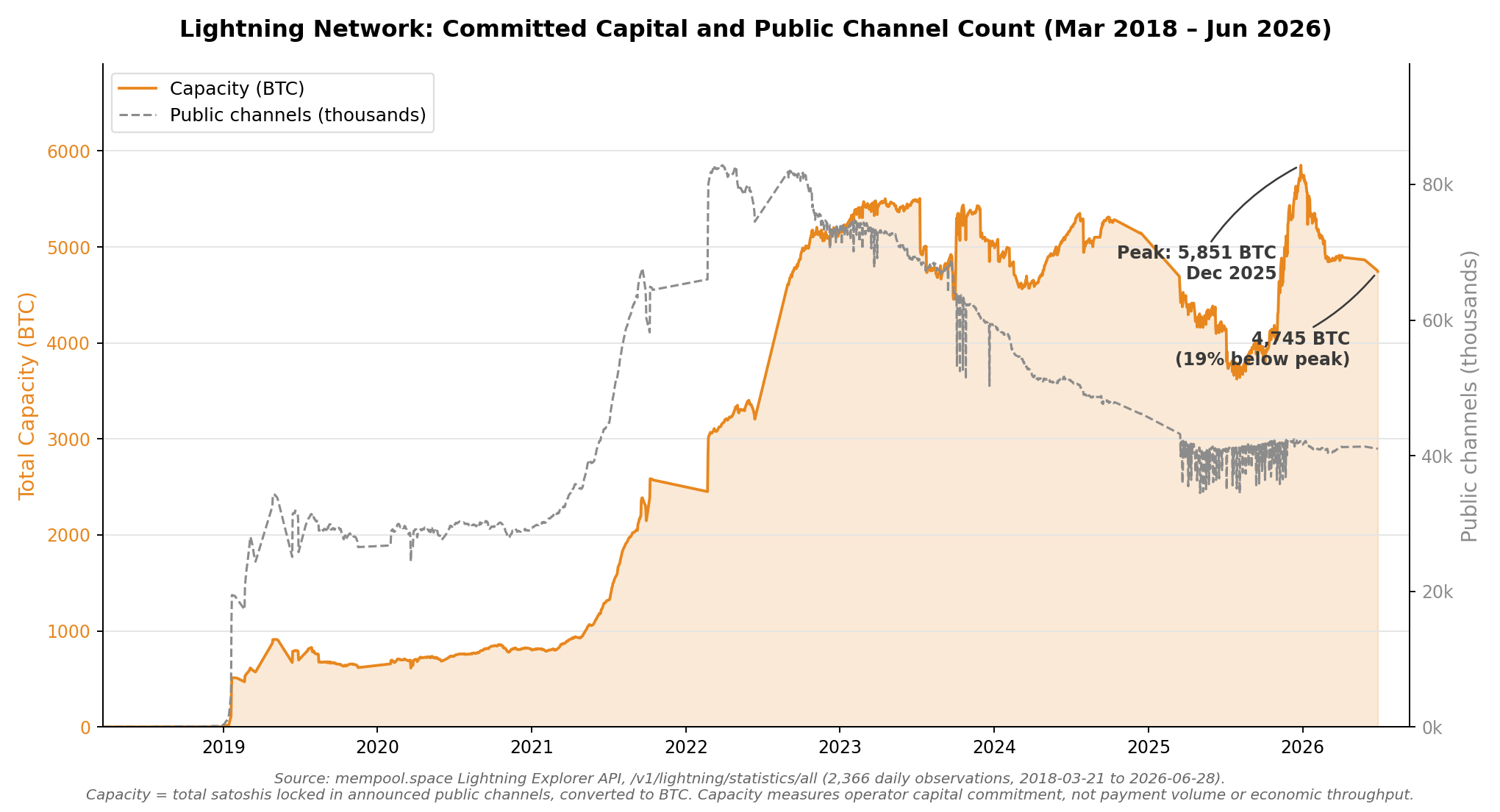
Figure 1 makes the cost concrete: it plots both metrics from Lightning's first public data in March 2018 through June 2026 (mempool.space, 2,366 daily observations), and the two series tell opposite stories. Public channel count peaked in March 2022 at 82,825 and has since fallen 51% to 40,971, which looks like collapse. Committed capital in BTC rose through that same period, hit a new all-time high of 5,851 BTC in December 2025, and has since declined 19% to 4,745 BTC, which looks like a recent surge followed by pullback. Both readings are coherent with the underlying data; neither tells you anything about payment volume. An accurate description: "Fewer but larger channels are now operational; committed capital hit a new high in late 2025 before declining." Using either series as a throughput or adoption metric generates claims that cannot be validated or falsified from any available data.
All four trace back to the same root cause: capacity is the only quantity Lightning's gossip layer publishes, so every downstream metric built on it, an adoption story, a routing estimate, a centrality ranking, inherits the same blind spot. And the error runs in both directions: as a measure of economic activity the number is too large, while as a measure of the network's true size it is too small, since private channels never enter it (§2). The first step toward defensible Lightning analysis is distinguishing what public data can support from what it cannot.
4. Potential workarounds
A technically informed reader will raise the obvious objection that channel balances can be recovered by active probing: sending payments along a target channel and bisecting on success or failure to recover the balance split to arbitrary precision. The academic literature confirms this works. Failed payment attempts are returned and not settled on-chain, so the capital cost is near zero.
Three reasons this does not rescue public data analysis (Tikhomirov et al., "Probing Channel Balances in the Lightning Network," arXiv:2004.00333).
First, probing is active and adversarial. It generates artificial payment traffic, consumes routing capacity, and imposes real latency costs on probed nodes. It is not passive observation of public data; it is deliberate intrusion.
Second, the snapshot decays instantly. A probed balance is valid at the moment of measurement and stale after the next payment through that channel (on a high-traffic node, potentially seconds later). The decay is discontinuous: one payment shifts the balance by the full HTLC amount.
Third, network-wide coverage is intractable. With tens of thousands of public channels, probing all of them within a consistent time window requires millions of attempts executed faster than individual balances change. This is a combinatorial constraint, not a current technology limitation.
Active probing is useful for a node operator characterizing its immediate neighborhood. It does not make "Lightning liquidity analysis from public data" a coherent category. The data is still not public.
A more durable alternative is being researched, though it does not exist yet. A 2025 proposal (arXiv:2512.12095) would let a node prove its balance is accurate using Trusted Execution Environments and zero-knowledge Transport Layer Security (TLS) attestations, without ever gossiping the number itself, an approach that could make balances verifiable without probing at all. It is not a trust-free fix: it swaps "node operators self-report honestly" for trusting hardware manufacturers (Intel Software Guard Extensions, SGX, or AMD Secure Encrypted Virtualization, SEV) and the underlying cryptographic assumptions holding. The balance visibility problem is structurally hard, not neglected, and for now probing remains the only way to recover it at all, at the cost described above.
5. Summary and what's next
Treat capacity for what the public record actually contains: a measure of capital committed, not capital in motion. Three citation rules follow. Call it announced capacity or committed capital, never liquidity, volume, or TVL. Date the snapshot and name the explorer; as §1 showed, two explorers can report figures 1,700 BTC apart on the same day. And do not build throughput, adoption, or growth claims on it; the public record can neither support nor falsify them. The “fix” described in §4 is years from being real and trusted, and probing only recovers a single channel at a single instant. Until one of those changes, this is what the data can support, no more: capacity is the full wire, not the beads on your side.
That same confusion runs one layer up, into §3's fourth misconception. Capacity-weighted centrality is the version of this error that appears on Amboss's Performance tab and similar leaderboards as a stand-in for "which nodes matter": a node can rank near the top on every measure and still have forwarded nothing in months. The next piece in this series takes those rankings apart directly: what betweenness, closeness, eigenvector, and degree centrality each actually capture mathematically; which of them, if any, correlates with real routing volume or fee revenue; and which measure fits which use case, a routing node optimizing for fees, a wallet optimizing for reliable sends, or an operator optimizing for privacy. Capacity-weighted rankings answer a question about capital. They have never answered the question readers actually ask when they look at one: which nodes are useful?
6. What channels actually publish
For readers who want the technical inventory. Everyone else can stop here.
Lightning runs a gossip protocol, a peer-to-peer broadcast system that lets nodes share network topology. Three message types carry the public record:
channel_announcement: Broadcast when a channel opens. Contains the short channel ID (SCID), both node pubkeys, and signatures.channel_update: Broadcast when a node updates its routing policy. Contains fee rates, payment size limits, and a timestamp.node_announcement: Broadcast by connectable nodes. Contains pubkey, alias, Internet Protocol (IP) or Tor address, and protocol features.
When a channel_announcement is verified, nodes look up the funding transaction on-chain and read the output value. That value is the capacity, the number every dashboard shows.
Everything the public record exposes (BOLT 7: P2P Node and Channel Discovery):
| Field | Source |
|---|---|
| Channel ID | channel_announcement |
| Node pubkeys (both sides) | channel_announcement |
| Capacity (satoshis) | On-chain funding output |
| Fee base and rate per direction | channel_update |
| Min/max payment size | channel_update |
| Enable/disable flag | channel_update |
| Last policy update timestamp | channel_update |
| Node alias, address, features | node_announcement |
What the public record does not expose:
| Field | Reason |
|---|---|
| Balance split | Never gossiped. Changes with every payment. |
| Routing volume or direction | Onion routing hides the payment path. |
| Private channels | Unannounced; no gossip message exists. |
| Historical forwarding data | Each node's local logs are never shared. |
The public record is rich in policy data and contains nothing about performance: no traffic, no volume, no directional flow. The balance split, the single most economically meaningful quantity, is absent from every message type. It was absent from the first Lightning specification and has remained absent since.
This is not an oversight.
Sources: mempool.space Lightning Explorer (June-July 2026 figures); Tikhomirov et al., arXiv:2004.00333 (balance probing); arXiv:2512.12095 (TEE + zkTLS balance attestation); Valko and Marx Gómez, arXiv:2606.20566 (capacity driven by connectivity, not node age or usage); Spark (private-channel capacity estimate); BOLT 7 (gossip protocol specification).