Pseudo-Covenant Wallets: Bitcoin Multisig With Spending Rules

This article was translated from Japanese with AI. Read the original (日本語) · Report a translation issue
How to store your bitcoin yourself has always been a tricky question, and recent incidents such as the Coldcard seed-generation vulnerability and supply chain attacks on hardware wallets in distribution channels have muddied the debate even further. At the extreme end, some people are even seriously reconsidering Glacier Protocol, an old-school (and extremely laborious) storage method that uses two PCs.
長期保存向けマルチシグアドレスのセットアップ方法:Glacier Protocol
私がマルチシグ推しであることは恐らく皆さんもご存知のことでしょう。マルチシグウォレットを使い、送金の手順に移動やコミュニケーションを必要とすることは、特に5ドルレンチ攻撃(家に来た強盗にハードウェアウォレットのPINを吐くまで鈍器で殴られる)などの強盗対策に有効です。(鍵を集める際に時間もかかるし通報の機会が生まれ、失敗リスクが高い) 今日はマルチシグを活用したもっとも堅牢なコールドストレージのプロトコルの1つであるGlacier Protocolについて紹介します。 実際に実行される際は、この抄訳ではなく、より詳細で正確な原文を使用してください: GlacierThe step-by-step protocol for storing bitcoins in a highly secure way GLACIER PROTOCOLとは 多額のビットコインを自身で管理したい方向けのプロトコルで、技術的な知識はそれほど必要ありませんが、Glacier(氷河)という名のとおり、Glacier Protocolに則って資金の安全を確保するには時間と労力が必要です。 セキュリティの観
 加藤 規新

More on Glacier Protocol here. In short, it's an air-gapped setup using PCs.
If you just want something similar, SeedSigner comes very close, and you can run an air-gapped setup with many hardware wallets and smartphones. Even so, distrust has spread to the point that some people deliberately want to narrow their attack surface to Bitcoin Core alone as far as possible (even though, frankly, it's not a very user-friendly wallet).
From what I've seen, however, this runs counter to recent trends in wallets. What has been steadily growing over the past few years is wallets that introduce "pseudo-covenants" by combining pre-signed transactions and co-signing servers, improving security and functionality without significantly compromising the user experience.
ビットコインの新機能「コベナンツ」とは? Shnorr署名・Taprootで再燃する議論
ビットコインの送金先を制限できる「コベナンツ」機能が再び議論されています。Shnorr署名とTaprootを組み合わせた新たな実装案は過去の提案より洗練されており、取引所などのコイン管理の高度化や、コインジョイン・チャネルファクトリーへの応用も期待されています。
 大石 哲之
For more on covenants, see Oishi's article. As of 2026, Bitcoin Script still has no functionality for covenants, so they can only be emulated, as in the examples below.
In this article, I'll sort these "pseudo-covenant"-based wallets into a few types, look at the characteristics of each, and consider how they might spread going forward.
Type 1: Programmability through a co-signing server
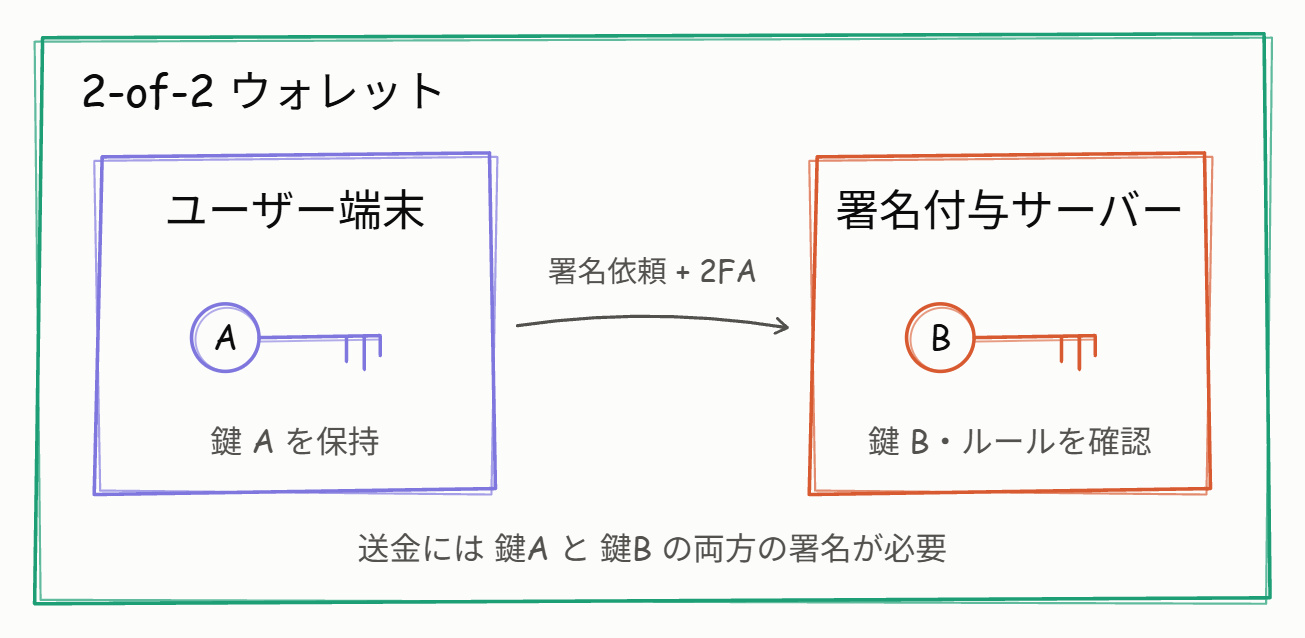
In the first type, the user sets up a 2-of-2 multisig with what could be called a "co-signing server," and the server won't sign unless certain specified conditions are met.
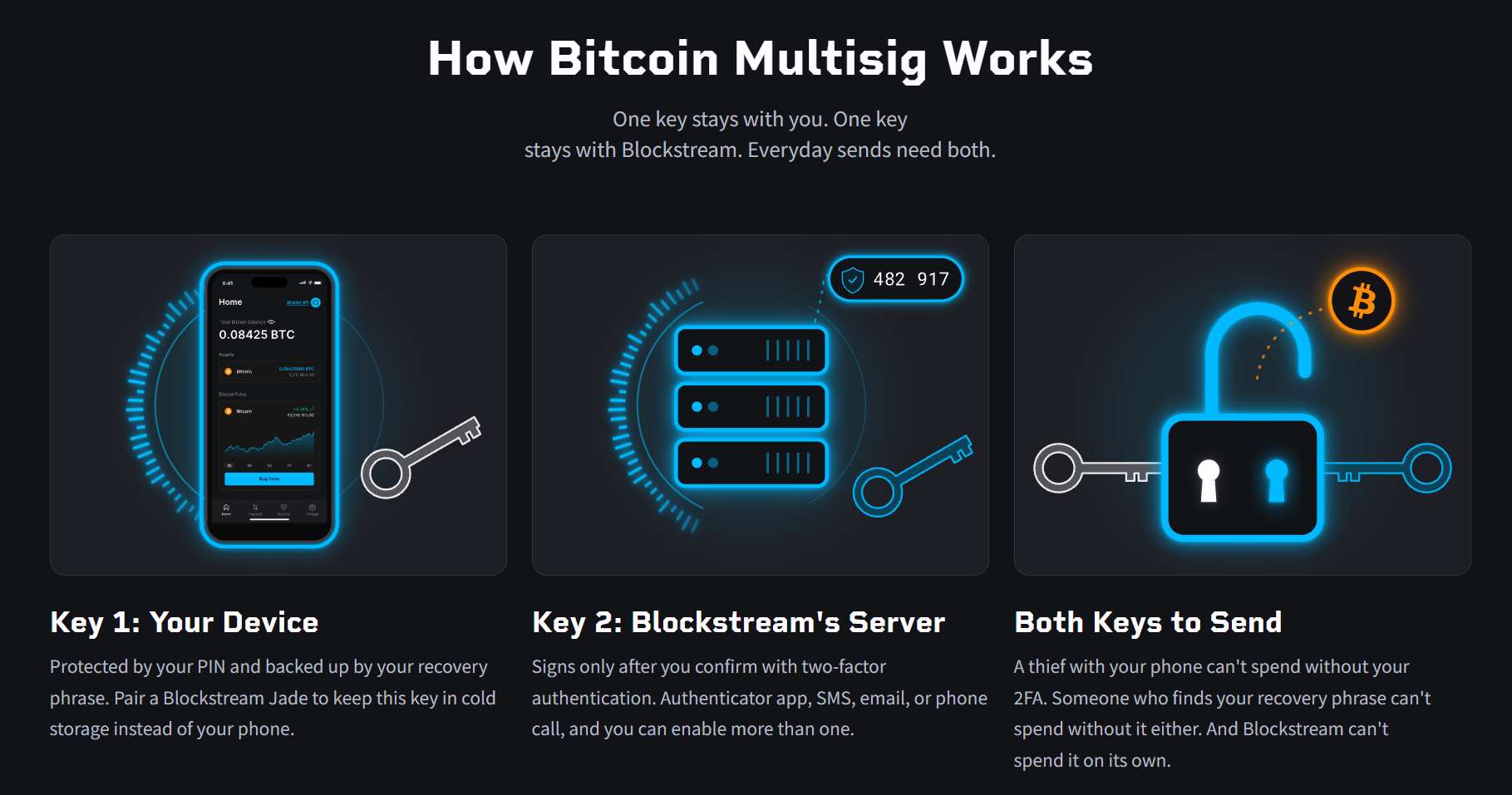
Some readers may have long used Blockstream Green (now Blockstream App) as a mobile wallet. It too implements a 2-of-2 multisig between the user's device and Blockstream's server, which enables things like two-factor authentication for sends (Blockstream won't sign unless you pass authentication).
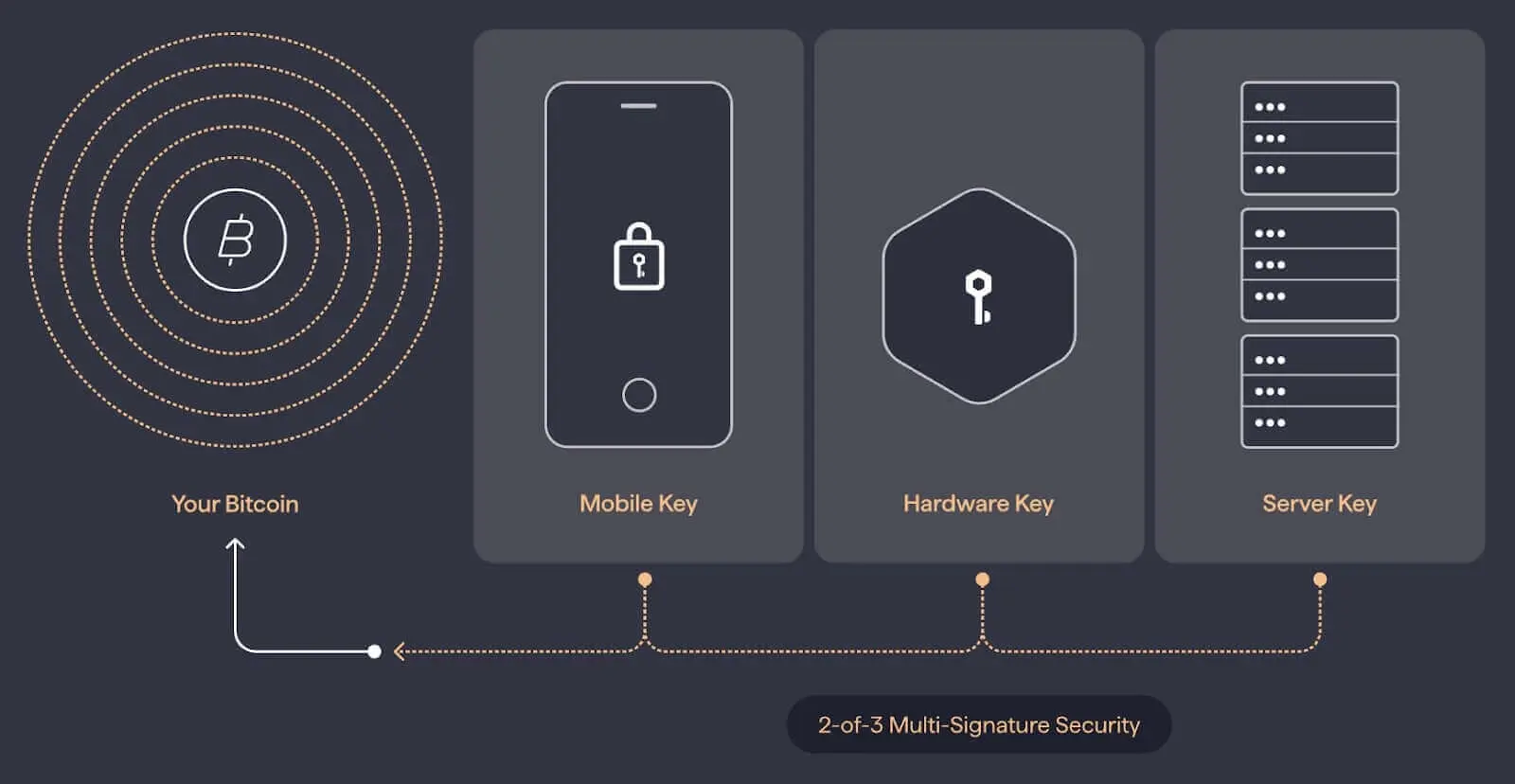
The biggest advantage of this type is that the conditions under which the co-signing server signs can be defined freely, allowing fine-grained wallet controls that Bitcoin alone can't provide. For example, Bitkey lets you set a daily sending limit: within that limit, you can send with two signatures, one from the key in the mobile app and one from the co-signing server, while sends above the limit can be set to require a signature from the key in the hardware wallet. This brings a real convenience benefit: in everyday situations, such as topping up a spending wallet, you can transact without pulling out the hardware you keep safely stored away.
Nunchuk, a multisig service, also offers features such as setting a waiting period on Nunchuk's co-signature, capping how much can be sent within a set period, and scheduling transactions in advance.
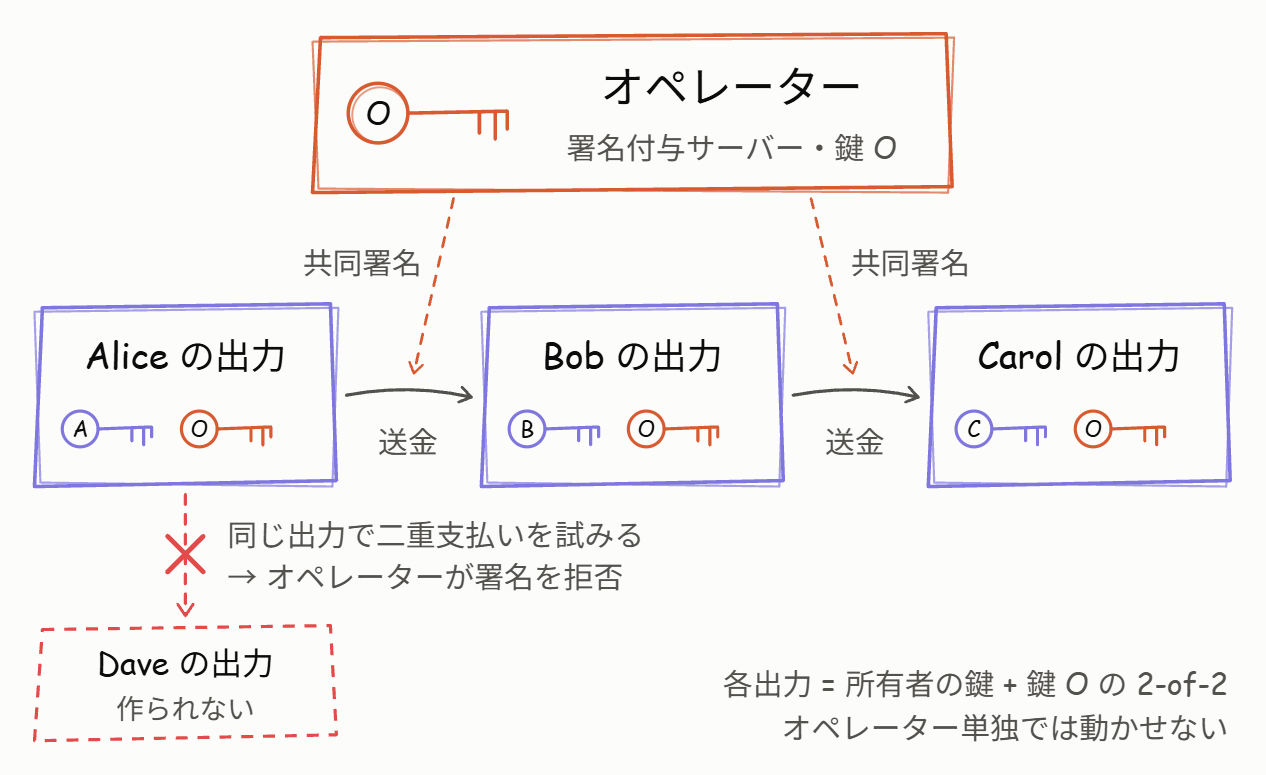
Alternatively, in Ark implementations such as Arkade, the operator runs a co-signing server that signs every transfer within Arkade together with the user, as a way to provide instant settlement while preventing double spends. In Arkade's case, measures such as the design of the server's execution environment are said to prevent even double spends carried out in collusion with a user. (Though in practice, I think users still need to monitor things too.)
It's not a server, but some hardware wallets (Coldcard and Foundation Passport, for example) have similar features that let you impose signing conditions on the wallet that can't be expressed in Bitcoin Script. However, hardware wallets aren't connected to the internet and don't have a trusted clock, so they fall short of co-signing servers in functionality. Restoring the seed phrase also lets you bypass these restrictions, so their use cases may be limited.
Features like these tie directly into the value each wallet offers as a product, and are arguably key to delivering a highly convenient experience for users. And because the features a co-signing server can provide also help lock users in, they're likely to be very effective for anyone running a wallet as a business.
Type 2: Vaults via pre-signed transactions
The next approach is relatively rare because setup and storage take considerable effort, but a few experimental concepts have appeared. It uses pre-signed transactions to emulate covenants.
Examples include Revault, a rather esoteric design I've covered before, and in a broader sense, DLCs (which you hardly hear about anymore) might also fit.
Revaultでコベナンツなしでビットコインに特殊な送金条件を適用する
ビットコインの次の機能追加として期待されているコベナンツですが、実装方法自体については議論が続く一方で昔から言われてきたユースケースの1つとしてよりきめ細やかな保管を可能にする「Vault(金庫)」と呼ばれるものがあります。 何回か本稿でも取り上げていますが、提案されている実装方法のいくつかについて2023年に軽い要約をしています。 2023年はビットコイン開発への関心が高まった1年だった今年も1年を振り返る時期になってまいりました。私は久しぶりの海外旅行やカンファレンス登壇などで充実させた一年でした。皆さんの2023年はどうでしたか? 先週、読者様から以下のようなリクエストが寄せられていました。 Bitcoin Optech Newsletterの2023年まとめ(https://bitcoinops.org/ja/newsletters/2023/12/20 )を読みましたが、ソフトフォーク提案が様々あり、どのOPコードがメインで議論されているかなど、開発の方向性がよく理解出てきていません。 今年の開発の総括や、来年以降の展望などこちらでもおまとめいただけると大変ありがたいです
 加藤 規新

I have doubts about its practicality, but Revault is a concept for adding covenants with various spending conditions to a multisig wallet while using pre-signed transactions to prevent cheating.
More recently, Luke Childs, the creator of Umbrel, announced a concept for a pre-signed-transaction-based wallet called "Anzen." The idea is to estimate a year's bitcoin budget in advance, turn it into twelve transactions that each release one month's worth, and sign and store them ahead of time. Instead of handling your cold wallet frequently, you load a predetermined amount into your phone's hot wallet each month and return whatever you don't spend to the cold wallet, keeping security risk contained.
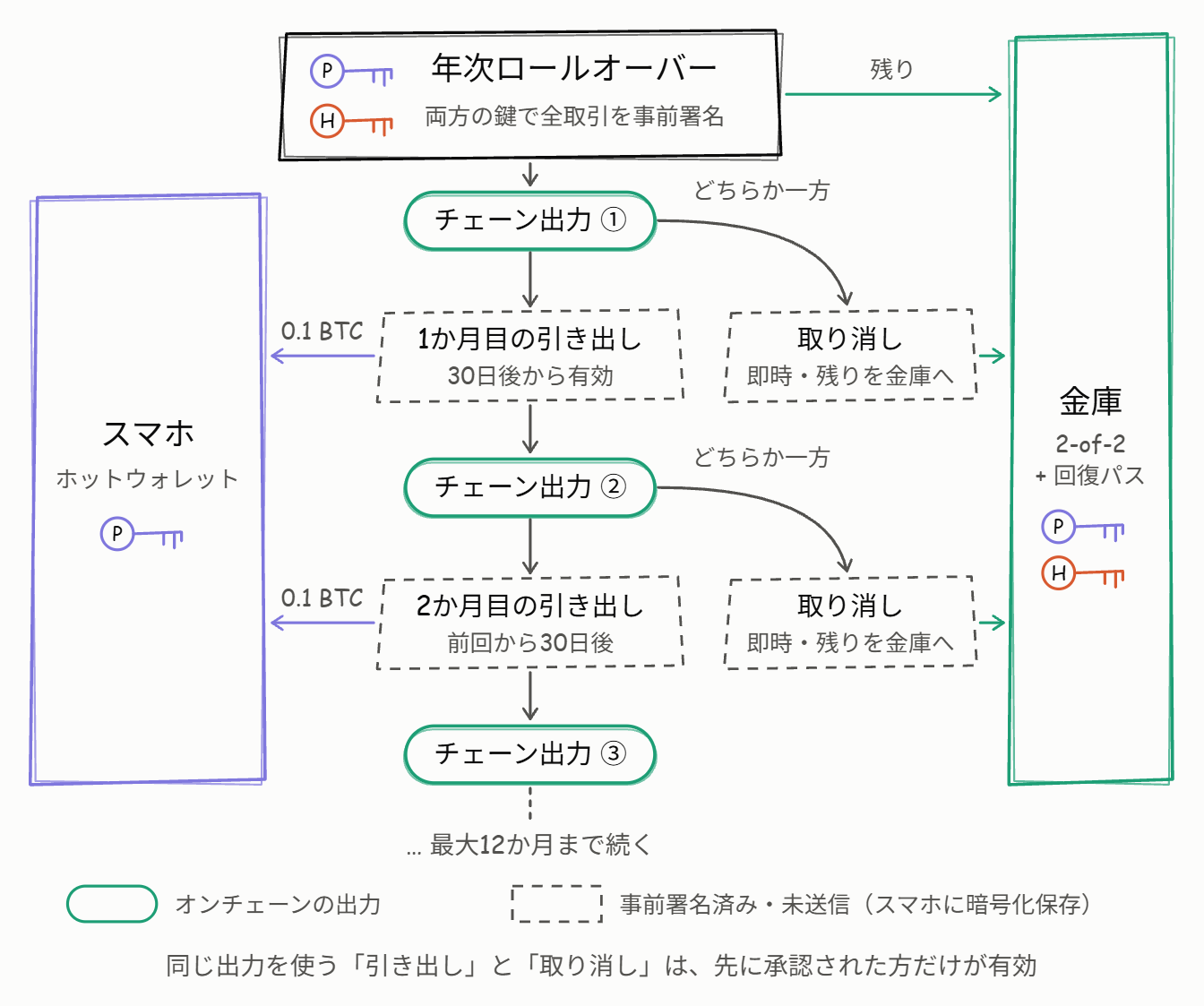
Of course, if you want to stop using Anzen partway through, you can sign with both keys, the hardware wallet and the phone, and if either one is unavailable, there's also a mechanism that lets you move the funds with a single key after waiting a set period.
💡
As an aside, I realized Anzen closely resembles the way checks work. Checks can be post-dated, meaning they only become valid from a certain date and can't be cashed until then. Anzen is exactly like keeping the next twelve months of allowance on hand as post-dated checks.
The strength of this type is that it barely depends on outside services, since all it involves is storing Bitcoin transactions and broadcasting them at the right time. On the other hand, it's limited to the controls that Bitcoin Script can express, so my impression is that unless covenants come to Bitcoin, the available features have more or less all been explored already (there's little room for further development).
開発者メーリスより:Covenants抜きでBitcoin Vaultsを実現する
送金完了までに一定の待ち時間を設け、その間に不正送金を無効化できるBitcoin Vaultsの仕組みを解説。2016年の原案から、Covenantsなしで実現する2019年の新提案まで、ビットコインのセキュリティ強化アイデアを紹介します。
 加藤 規新

Vaults built on pre-signed transactions have been around as a concept for more than ten years
Variant: Using Bitcoin's standard features with Miniscript (not pseudo-covenants, but with similar goals)
Finally, this again comes down to wallets built on Bitcoin Script, but Miniscript in particular has made Bitcoin Script much easier to write and verify, and several wallets such as Liana and Nunchuk have appeared that can't really be called pseudo-covenants but whose goals are close to those of Type 2.
For example, Liana is a wallet designed with inheritance in mind. It uses Miniscript to define a wallet in which private keys handed to heirs or lawyers gradually become valid if the owner doesn't make a refresh transaction every so often. It isn't a pseudo-covenant, since it can't impose conditions on how the newly valid keys are used (such as limits on how much can be sent within a set period), but I think this kind of degrading multisig is a feature a fair number of users want, including for backup purposes.
ビットコインの相続を支援するプロダクトを俯瞰する
ビットコインの相続は今後需要が大きくなっていく重要な課題です。基本的には、被相続人が生前にはビットコインを自由に使える状態を維持し、セキュリティを保ちつつ死後に相続人にスムーズにカストディを移行できるプロダクトが望まれます。 もちろん、被相続人がビットコインについてどれくらい詳しいかによっても選べる選択肢は変わってきます。個人的には相続させる気があるならそれくらい教えてあげればよいと思いますが、それでもマルチシグなどが絡むレベルになると教えるのも一苦労です。(簡単なマニュアルなどあれば良いのですが…) 今日はCasa、Nunchuk、Unchained、Riverが提供する相続支援プロダクトと、そのオープンソース版ともいえるLianaについて解説します。ちなみに、Lianaについては6月にArkの記事の末尾で軽く紹介しました。 ビットコインで話題の新レイヤー2「Ark」はどのような技術なのか読者の皆さんはちょうど昨年のこの時期にBurak Keceli氏がBitcoin 2023カンファレンスで「Ark」として正式に発表したレイヤー2の話題を覚えていらっしゃるでしょうか? 今年の
 加藤 規新

This is a common feature in wallets designed with inheritance in mind, Liana among them
Conclusion
Bitcoin wallets come in many varieties and there's no single right answer, but a recent trend is the growing number of wallets that use multisig with a co-signing server, pre-signed transactions, or Miniscript to offer "restrictions on spending conditions that Bitcoin Script alone can't achieve, which could be called pseudo-covenants" as a feature. This could be a major step forward for UX and should also help strengthen security. Five years from now, wallets that let you define your own spending conditions in some form may well be the norm.