Bitcoin White Paper Trivia: The Lost Draft and Hidden macOS PDF

This article was translated from Japanese with AI. Read the original (日本語) · Report a translation issue
Happy White Paper!!!
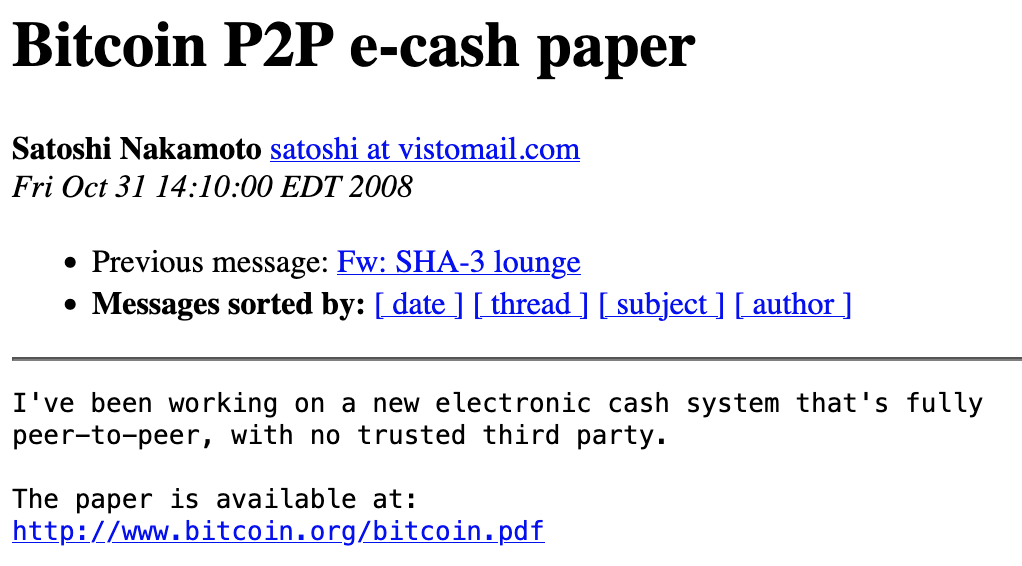
Today, October 31, is known as "White Paper Day," the day Satoshi Nakamoto released Bitcoin to the world. The thumbnail image is an archive of the actual post, so take a look at the date.
For most people, October 31 means Halloween. The holiday reportedly traces back to the Celtic calendar: at the end of the year, the spirits of the dead and evil spirits were believed to cross into the world of the living, so people wore masks to protect themselves. There is something fitting about a person of unknown identity unveiling Bitcoin on this "day of masks."
In this article, I'm taking a break from my usual technical pieces to share some trivia and history about the white paper.
A post to a cryptography mailing list
The Bitcoin white paper was posted to "metzdowd.com," a mailing list that was popular among cypherpunks and cryptographers in 2008. Bitcoin's arrival is so closely tied to the history of the cypherpunks that it could almost be called part of that history. For details, see the article below.
サイファーパンクとデジタルキャッシュの歴史①
ビットコイン誕生に寄与したサイファーパンクの歴史を紹介。公開鍵暗号の考案から、暗号技術の輸出規制をめぐる政府との攻防、PGP開発者への捜査までを振り返る前編です。
 練木 照子

サイファーパンクとデジタルキャッシュの歴史②
本コラムは【2021/10/22】サイファーパンクとデジタルキャッシュの歴史①の続きです。 サイファーパンクとデジタルキャッシュの歴史①ビットコインは彗星の如く現れた革新的技術、サトシ・ナカモトという天才がゼロから生み出したシステムと思っている人は多いのではないでしょうか? ビットコインにつながる技術を1970年代から列挙したAnsel Lindner 氏による “Bitcoin Prehistory”(ビットコイン前史)というタイムラインを見れば、そうでないことがよくわかります。以下、Lindner 氏がタイムラインに添えたメッセージです。 ビットコインは突然現れたわけでも、偶然の産物でもない。デジタルキャッシュの必要性を痛感した先人たちによる40年間の研究開発の賜物なのだ。 本コラムでは、ビットコイン誕生に寄与したサイファーパンクと彼らの偉業を Bitcoin Magazine が先週公開したAlex Gladstein 氏の寄稿記事 “The Quest for Digital Cash”(デジタルキャッシュを追い求めて)を基に振り返ります。 https://bitcoinma
 練木 照子
For those who haven't read it, here is the short version: Bitcoin grew out of a history of cryptography and digital cash that goes back to the 1970s. It was not built out of nowhere by a lone genius; it stands on the research of many people who came before.
Against this backdrop, Bitcoin was announced on a cryptography mailing list. At the time, the list had been carrying a run of posts about hash functions, and the Bitcoin post seems to have slipped in among them.
Here is the actual post.
Bitcoin P2P e-cash paper

The first reactions and Hal Finney
The response to the Bitcoin post seems to have been quite cold.
The first reply came on November 2, 2008, from James A. Donald:
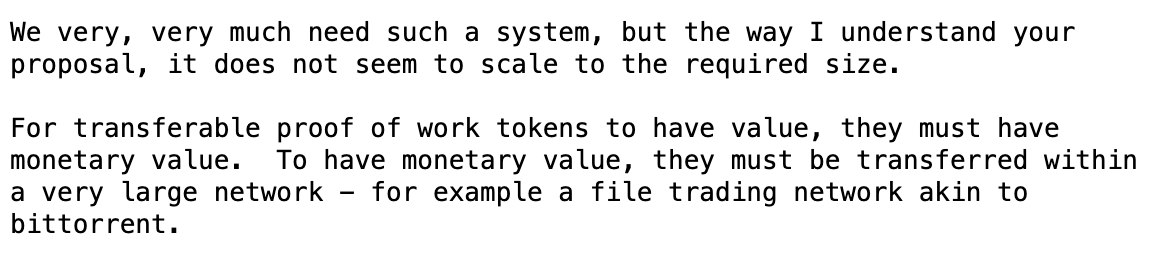
We very, very much need such a system, but the way I understand your proposal, it does not seem to scale to the required size.
For transferable proof of work tokens to have value, they must have monetary value. To have monetary value, they must be transferred within a very large network (for example, a file trading network akin to BitTorrent).
It's fascinating that the criticism that Bitcoin doesn't scale, which still pops up now and then, was there from the very first reply. At the time, though, every earlier attempt at digital cash had failed, and there seems to have been a feeling that this one would fail too.
Others, such as John Levine and Ray Dillinger, likewise responded to Satoshi with skepticism and technical questions. The most positive response came from Hal Finney. His post is below.
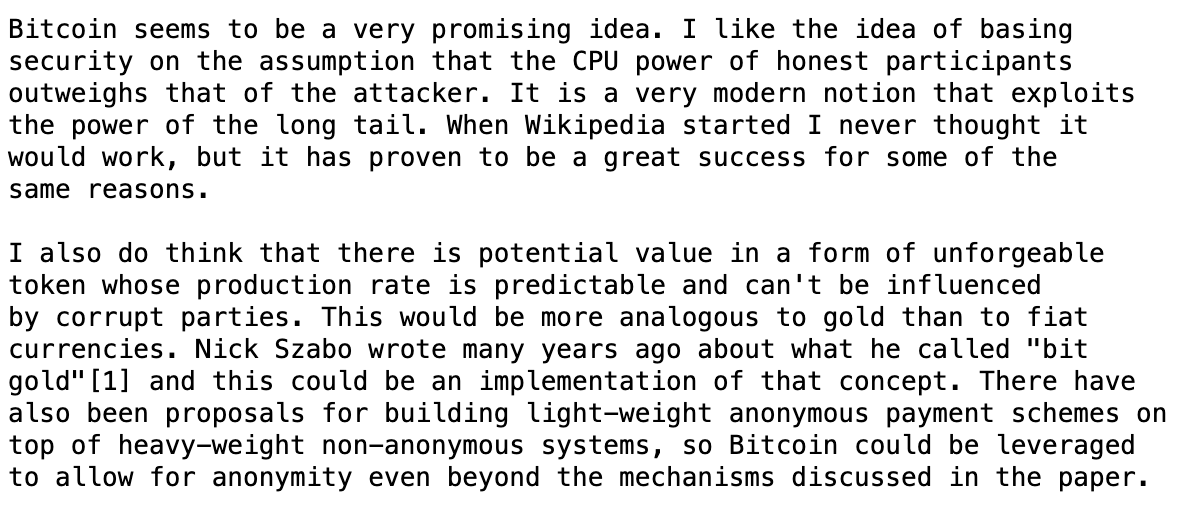
Bitcoin seems to be a very promising idea. I like the idea of basing security on the assumption that the CPU power of honest participants outweighs that of the attacker. It is a very modern notion that exploits the power of the "long tail." When Wikipedia started I never thought it would work, but it has proven to be a great success for some of the same reasons.
I also do think that there is potential value in a form of "unforgeable token" whose production rate is predictable and can't be influenced by corrupt parties. This would be more analogous to gold than to fiat currencies. Nick Szabo wrote many years ago about what he called "bit gold" [1] and this could be an implementation of that concept. There have also been proposals for building light-weight anonymous payment schemes on top of heavy-weight non-anonymous systems, so Bitcoin could be leveraged to allow for anonymity even beyond the mechanisms discussed in the paper.
Hal Finney sent this post on November 7, 2008, a week after Satoshi's first post, and it's clear he had a favorable impression. Reading the full text, though, you can see he still had some technical doubts, and he sent Satoshi a range of questions.
Hal Finney later ran a Bitcoin node himself, and on January 12, 2009, he received the first transfer in history from Satoshi (10 BTC).
You can see the actual transaction here.
Next, while reading through the mailing list from that time, I came across a post that says something distinctive about Satoshi, so I'd like to share it.
First, take a look at this post.

Also, can you please learn to use linefeeds?? Your lines run ridiculously far to the right, so I have to scroll to read what you're saying, and then I have to edit in linefeeds myself before I can reply.
Ray Dillinger's post of November 15, 2008, shows that Satoshi's posts up to then had almost no line breaks and were hard to read, and Dillinger's irritation comes through loud and clear.
Satoshi didn't reply to the complaint at all, but from his very next post he simply went along with it and started adding line breaks. Some might think he left out line breaks to protect his anonymity (to avoid being profiled), but my view is that it came down to how his software worked and to habit.
According to one report, the habit of putting two spaces after a period shows up in about 81% of Satoshi's writing, a habit said to date back to the days of typewriters. If he had been writing with his anonymity in mind, you would expect him not to display traits that could be used to profile him, so it seems likely he didn't think much about line breaks either.
The email service Satoshi used
From here on there's some speculation involved, but I'd like to dig deeper into why he didn't use line breaks by looking at Satoshi's emails. Have you heard of Pastebin? It's a website where you can paste text and share it via a URL, and an archive of an exchange with Satoshi is preserved there.
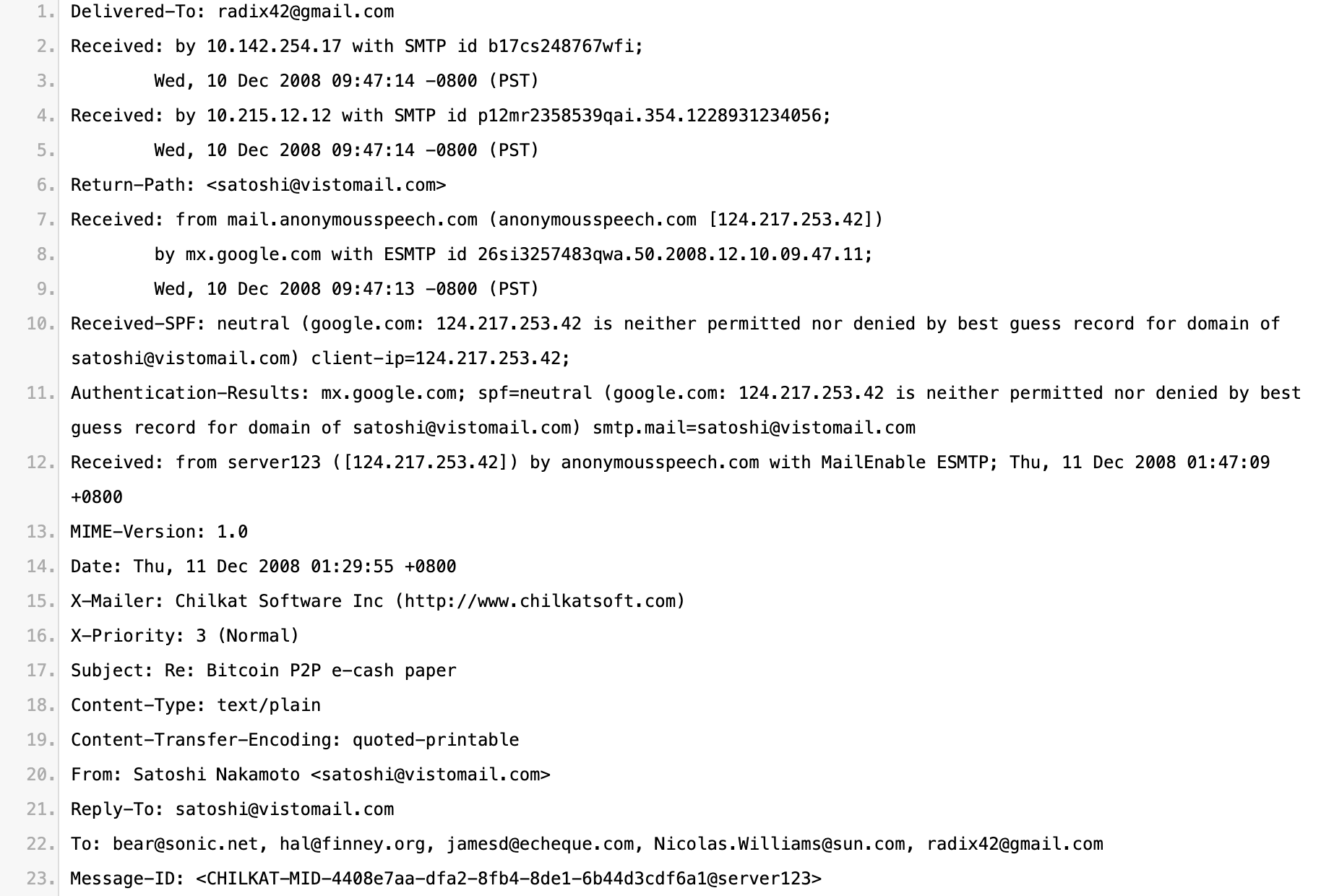
It was posted by someone called RADIX42, which matches the name of the email's recipient, radix42@gmail.com. One caveat: since anyone can post anything to Pastebin, its authenticity can't be guaranteed.
What sets this email apart is that, unlike the metzdowd archive page, it preserves the email headers. I'd like you to focus on the parts outlined in red below.
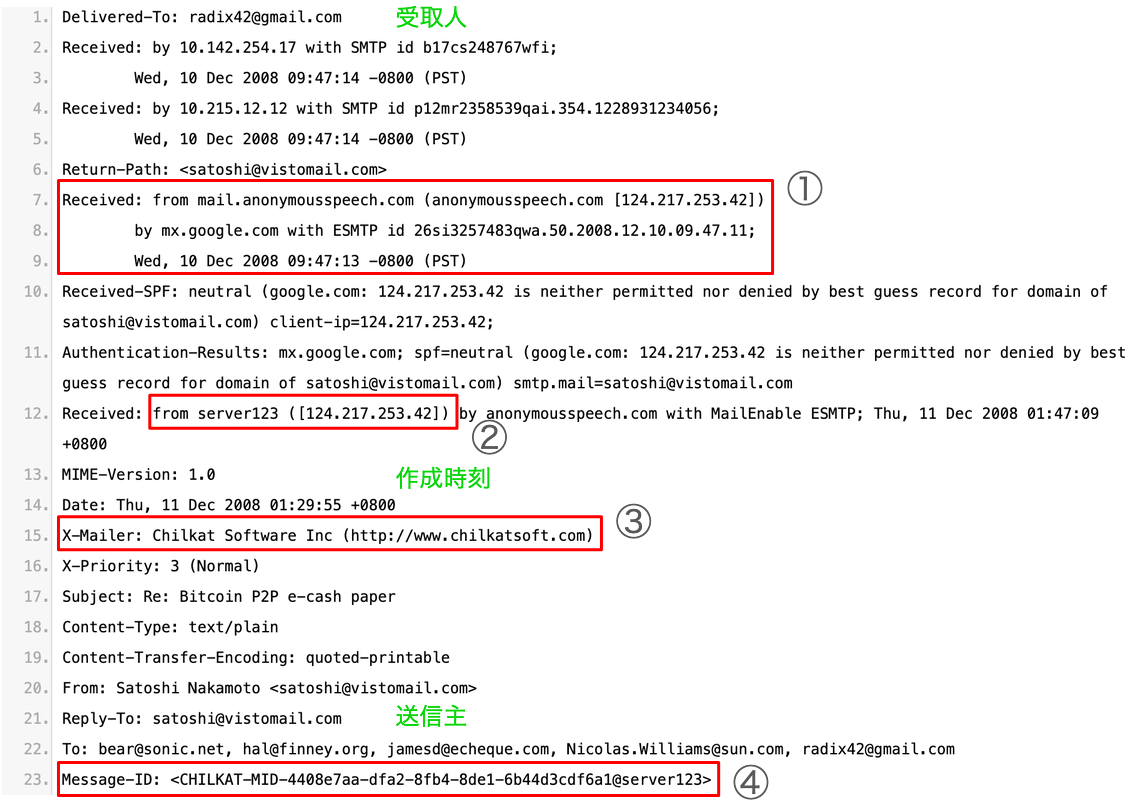
① A record of Google's server receiving the email from an AnonymousSpeech server (IP: 124.217.253.42)
② "server123" has the same IP as AnonymousSpeech
③ The name of the software that created the email (Chilkat)
④ Chilkat ran on server123
Chilkat is a company that provides libraries for developers, and its products are still being updated today. AnonymousSpeech, meanwhile, is an anonymous webmail service that doesn't reveal your personal IP address to recipients and encrypts all communication with SSL. From ①–④, we can see that the email was created with Chilkat and that the machine that created it sent it from the same IP address as AnonymousSpeech's mail server.
💡
I couldn't find any primary source showing that AnonymousSpeech uses Chilkat, so this remains speculation.
Putting this together, we can form a hypothesis. Satoshi's email domain, "vistomail.com," was one provided by AnonymousSpeech, and he was probably writing his emails in the service's web interface. Either the interface automatically wrapped lines when they reached the edge, or he just kept typing across until he finished a paragraph; either way, I believe that's why he didn't bother adding line breaks.
The +0800 is also likely to reflect the time on AnonymousSpeech's server rather than the time where Satoshi was.
💡
Besides Pastebin, on another archive page here, "CHILKAT" and "server123" appear in the address of an email James A. Donald sent to Satoshi.
The lost white paper draft
The common understanding is that the white paper posted to metzdowd was the first edition and that the one now on bitcoin.org is a revised edition. But did you know there was also an unpublished draft?
The draft has never been found, but a few things are known about it.
- Its title was "Electronic Cash Without a Trusted Third Party"
- The current white paper is titled "Bitcoin: A Peer-to-Peer Electronic Cash System"
- The link was upload.ae/file/6157/ecash-pdf.html. Judging from the link, the file name is thought to have been "ecash.pdf"
- The full abstract survives
We know all this because, before posting the white paper, Satoshi emailed Adam Back and Wei Dai to check his citations of their work.
Below is the original email he sent to Wei Dai.
From: "Satoshi Nakamoto" <satoshi@anonymousspeech.com>
Sent: Friday, August 22, 2008 4:38 PM
To: "Wei Dai" <weidai@ibiblio.org>
Cc: "Satoshi Nakamoto" <satoshi@anonymousspeech.com>
Subject: Citation of your b-money page

I was very interested to read your b-money page.  I'm getting ready to
release a paper that expands on your ideas into a complete working system.
Adam Back (hashcash.org) noticed the similarities and pointed me to your
site.

I need to find out the year of publication of your b-money page for the
citation in my paper.  It'll look like:
[1] W. Dai, "b-money," <http://www.weidai.com/bmoney.txt>, (2006?).

You can download a pre-release draft at
<http://www.upload.ae/file/6157/ecash-pdf.html>  Feel free to forward it to
anyone else you think would be interested.

Title: Electronic Cash Without a Trusted Third Party

Abstract: A purely peer-to-peer version of electronic cash would allow
online payments to be sent directly from one party to another without the
burdens of going through a financial institution.  Digital signatures
offer part of the solution, but the main benefits are lost if a trusted
party is still required to prevent double-spending.  We propose a solution
to the double-spending problem using a peer-to-peer network.  The network
timestamps transactions by hashing them into an ongoing chain of
hash-based proof-of-work, forming a record that cannot be changed without
redoing the proof-of-work.  The longest chain not only serves as proof of
the sequence of events witnessed, but proof that it came from the largest
pool of CPU power.  As long as honest nodes control the most CPU power on
the network, they can generate the longest chain and outpace any
attackers.  The network itself requires minimal structure.  Messages are
broadcasted on a best effort basis, and nodes can leave and rejoin the
network at will, accepting the longest proof-of-work chain as proof of
what happened while they were gone.

Satoshi
Quoted from https://gwern.net/doc/bitcoin/2008-nakamoto
The link in the body of the email, http://www.upload.ae/file/6157/ecash-pdf.html, pointed to the draft, but the site itself has since disappeared, and the draft with it. Not even Wei Dai, who received the email, has a copy, which is why it's called the lost white paper.
The abstract, however, is written out in full in the second half of the email, so it's the one part of the draft we can know. I've put the changes between the draft, the first edition and the revised edition into a table, with the changed parts in bold.
| Part | Draft (August 2008) | First edition (October 2008) | Revised edition (March 2009) |
|---|---|---|---|
| Title | Electronic Cash Without a Trusted Third Party | Bitcoin: A Peer-to-Peer Electronic Cash System | Same as first edition |
| Sentence 1 | …sent directly from one party to another without the burdens of going through a financial institution. | Same as draft | …without going through a financial institution. |
| Sentence 2 | Digital signatures offer part of the solution, but the main benefits are lost if a trusted party is still required to prevent double-spending. | Digital signatures provide part of the solution, …a trusted party… | Digital signatures provide part of the solution, …a trusted third party… |
| Sentences 3–5 | We propose a solution… / The network timestamps transactions… / The longest chain not only serves as proof… | Same as draft | Same as first edition |
| Sentence 6 | As long as honest nodes control the most CPU power on the network, they can generate the longest chain and outpace any attackers. | Same as draft | As long as a majority of CPU power is controlled by nodes that are not cooperating to attack the network, they’ll generate the longest chain and outpace attackers. |
| Sentence 7 | The network itself requires minimal structure. | Same as draft | Same as first edition |
| Sentence 8 | Messages are broadcasted on a best effort basis, and nodes can leave and rejoin the network at will, … | Same as draft | Messages are broadcast on a best effort basis, … |
What I personally find most interesting is the title. Since the draft doesn't use the name Bitcoin at all, I can't help imagining that it may originally have had a different name (ecash, for example, as in the draft's title).
One could also speculate that it might have ended up as "netcoin." The domain bitcoin.org was registered on August 18, 2008, about four days before the email to Wei Dai was sent, so it's possible the name Bitcoin hadn't yet been settled while the draft was being written. And according to a tweet by Or Weinberger, DomainTools records show that the domain netcoin.org was registered through AnonymousSpeech, the email service Satoshi used, on August 17, 2008. (Whether Satoshi was the one who registered it is unknown.)
netcoin.org was later dropped and picked up by another company, but it's possible to hypothesize that Satoshi went back and forth on the name until the very last minute.
The white paper hidden in macOS
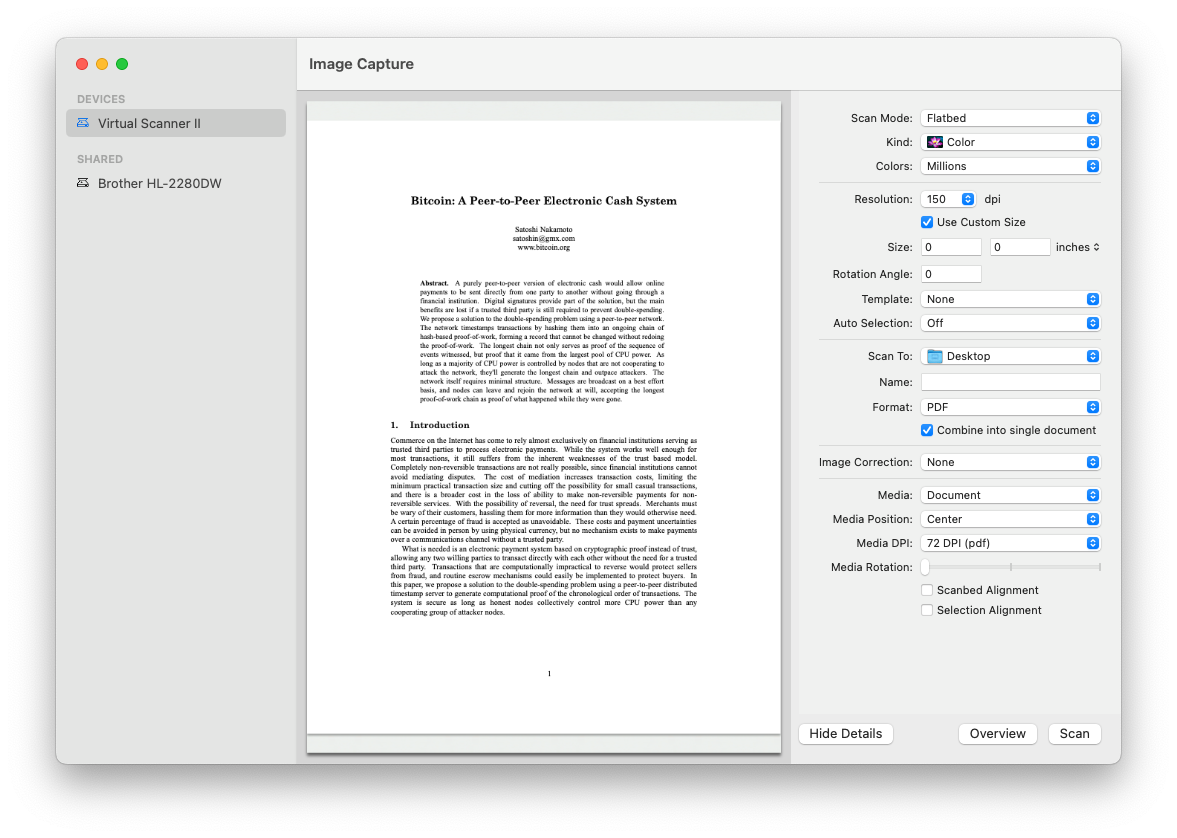
From around 2018 to 2023, macOS contained a secret file: the Bitcoin white paper. If you're on a version between Mojave (10.14.0) and Ventura (13.3), try entering the following command in Terminal.
open /System/Library/Image\ Capture/Devices/VirtualScanner.app/Contents/Resources/simpledoc.pdf
To open it in Finder instead, try the following steps.
- In Finder, open "Macintosh HD" → "System" → "Library" → "Image Capture" → "Devices"
- Control-click "VirtualScanner.app" and choose "Show Package Contents"
- Open "simpledoc.pdf" in "Contents" → "Resources"
Apple has never explained why the Bitcoin white paper was there, and it's known to have been removed in macOS Ventura 13.4 beta 3 in 2023.
The file was named "simpledoc.pdf" and was only 184 KB, so the leading theory is that it was used internally as test material. Either way, Apple presumably never expected ordinary users to open it.
Conclusion
Digging into the white paper, you can follow a trail from a habit with line breaks all the way to the name of an email service, and a picture of Satoshi emerges more clearly than you might expect. The traces of Chilkat and AnonymousSpeech left in the headers offer clues to why his text had no line breaks, and the draft's title, the changes to the abstract and the timing of the domain registrations even suggest that Satoshi may have hesitated before settling on the name Bitcoin.
At the same time, part of the appeal is that some mysteries remain unsolved, such as the contents of the draft itself and why the PDF was included in macOS. Perhaps next year's White Paper Day will bring new discoveries.