Bitcoin DNS Seeds: How Much Trust Do They Require?

This article was translated from Japanese with AI. Read the original (日本語) · Report a translation issue
This article explains Bitcoin's DNS seeds, a set of special servers hardcoded into Bitcoin Core.
I previously wrote an article about Bitcoin and trust.
Bitcoinとトラストを考える:トラストレスという理想の行方
Bitcoinにおける「トラスト」とは何かについて、その概念を整理しながら考察します。 初期のBitcoinが掲げていた、フルノード運用やセルフカストディを重視する姿勢がどのような背景から生まれ、どのように変化してきたのかについても振り返ります。
 押川 拓夢
Bitcoin is designed to eliminate trust wherever possible, but one thing that could not be eliminated is the DNS seed.
Below, I explain what DNS seeds are, what concerns they raise, and the measures taken to minimize the trust placed in them.
What is a DNS seed?
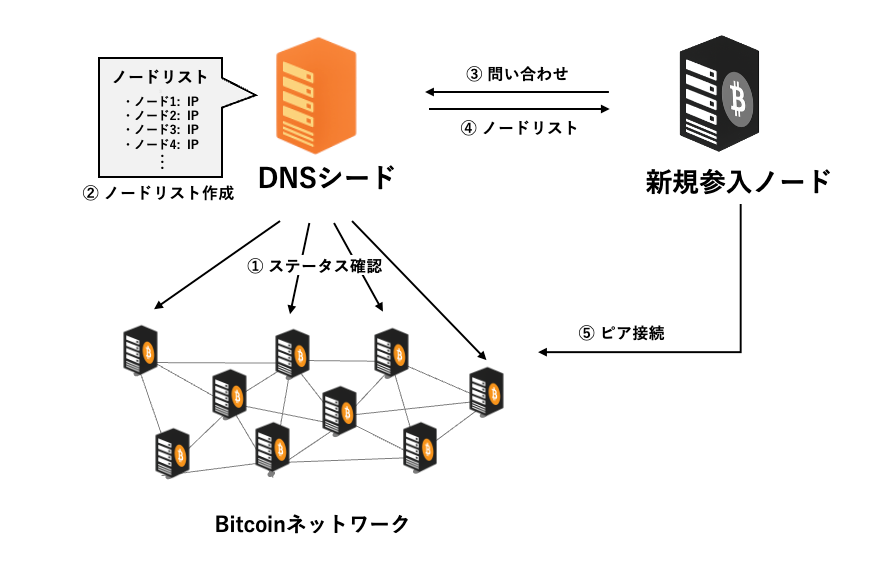
Put simply, a Bitcoin DNS seed is a system that returns a list of candidate nodes for a Bitcoin full node to connect to as its first peers, so it can fetch block data when it starts syncing.
The domain names of the DNS seeds are hardcoded into implementations such as Bitcoin Core. By resolving those domains and querying the DNS seeds, a node receives a list of nodes it can use as candidate peers.
💡
They are sometimes called "Seed Nodes," but that is a little misleading. A DNS seed is a different implementation from a node and does not have the block-serving functionality of an ordinary Bitcoin node.
When a Bitcoin node starts for the first time, it needs to bootstrap, meaning it syncs the blockchain data. A node starts bootstrapping by connecting to other nodes as peers. But if it doesn't know any peers on first launch, it can't connect to anyone and can't join the Bitcoin network. To solve this, it queries a handful of DNS seeds hardcoded into the Bitcoin implementation, which the Bitcoin community has judged to be reliably operated, and obtains information about nodes to use as its first peers.
Many other blockchains, including Ethereum, Monero and Solana, use a mechanism similar to Bitcoin's DNS seeds.
DNS seed domain names hardcoded in Bitcoin Core (v30):
vSeeds.emplace_back("seed.bitcoin.sipa.be."); // Pieter Wuille
vSeeds.emplace_back("dnsseed.bluematt.me."); // Matt Corallo
vSeeds.emplace_back("seed.bitcoin.jonasschnelli.ch."); // Jonas Schnelli
vSeeds.emplace_back("seed.btc.petertodd.net."); // Peter Todd,
vSeeds.emplace_back("seed.bitcoin.sprovoost.nl."); // Sjors Provoost
vSeeds.emplace_back("dnsseed.emzy.de."); // Stephan Oeste
vSeeds.emplace_back("seed.bitcoin.wiz.biz."); // Jason Maurice
vSeeds.emplace_back("seed.mainnet.achownodes.xyz."); // Ava Chow
How DNS seeds came about
In Bitcoin's early days (2008–2011), peers were discovered using IRC (Internet Relay Chat), a chat protocol from the early internet. Bitcoin Core had the IP addresses of IRC servers hardcoded, and querying them returned candidate peer nodes. Because it relied on querying servers, this approach was even more centralized and trust-dependent than DNS seeds. It was also unreliable, and DNS seeds were considered as a more robust alternative.
DNS seeds were introduced in Bitcoin Core v0.3.2, but even then they were criticized for requiring trust, and more decentralized approaches were being explored.
(For example, Christian Decker's proposal to use BitTorrent trackers):
Re: [Bitcoin-development] Bootstrapping via BitTorrent trackers - Christian Decker

IRC server IP addresses hardcoded in Bitcoin Core v0.4:
bitcoin/src/irc.cpp at c7eb151ad0ed441d6fd598551059a9bbfb09e99e · bitcoin/bitcoin
Bitcoin Core integration/staging tree. Contribute to bitcoin/bitcoin development by creating an account on GitHub.
 bitcoin
The DNS seed policy
Bitcoin Core contributors have set a strict policy for DNS seeds and written it down.
bitcoin/doc/dnsseed-policy.md at master · bitcoin/bitcoin
Bitcoin Core integration/staging tree. Contribute to bitcoin/bitcoin development by creating an account on GitHub.
bitcoinHere is a summary of the eight points in the policy.
- DNS seed operators must manage their infrastructure and security properly, and must not transfer or sell the right to operate the seed to anyone else.
- The peers a DNS seed returns must be selected fairly.
- Results must be randomized and must not significantly favor particular nodes.
- The DNS TTL must not be set below one minute.
- Logging of DNS queries must be kept to a minimum, retained only briefly, and not disclosed to others.
- Anyone who observes bias in a DNS seed's results is free to publish their findings.
- Operators are encouraged to publicly document how they run their seed.
- Operators must publish an email address for inquiries.
A seed that violates this policy is removed after discussion. The policy document also mentions a reference implementation for DNS seeds called "Bitcoin Seeder."
Bitcoin Seeder
Bitcoin Seeder works as a crawler of the Bitcoin network, regularly checking the availability of nodes on the network. It keeps a list of stable nodes judged to have sufficient availability. It also acts as a DNS server mapping domain names to IP addresses: when a Bitcoin node sends a query, it picks a few stable nodes at random and returns them.
GitHub - sipa/bitcoin-seeder
Contribute to sipa/bitcoin-seeder development by creating an account on GitHub.
sipa
Anyone can run a DNS seed, and if yours is judged stable and reliable, it may even be added to the Bitcoin Core implementation (though that's not easy).
DNS seeds and the problem of trust
DNS seeds are sometimes viewed as a point of trust in Bitcoin and criticized for it. Let's look at why.
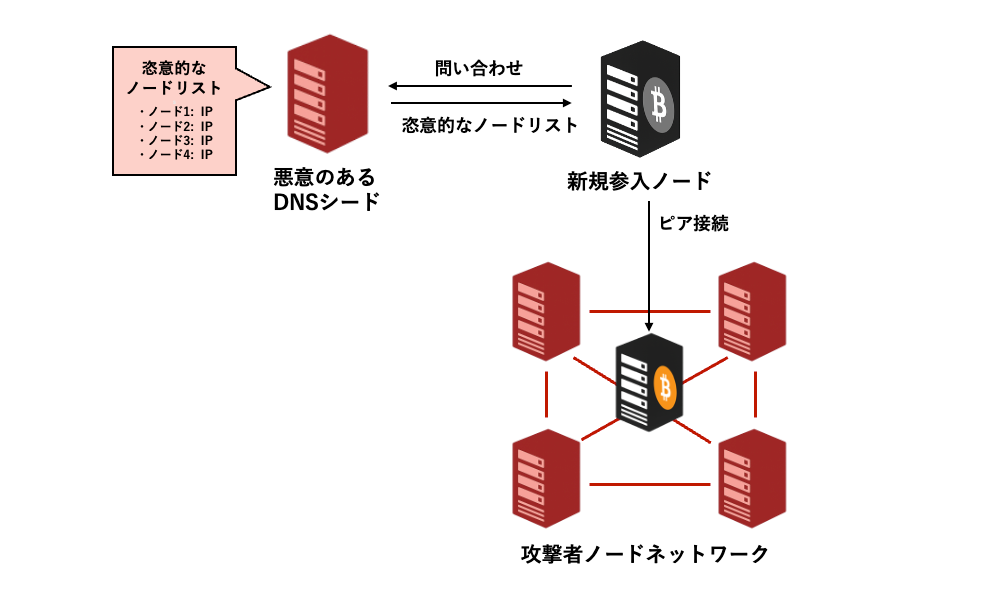
DNS seeds don't hold privileges significant enough to be called a central authority, but each one is managed by a specific operator. If most of the DNS seeds were attacked or censored, it would affect the security of Bitcoin as a whole.
Suppose, for example, a malicious attacker takes over a DNS seed. The hijacked seed could disrupt syncing by giving newly joining nodes only unstable, biased peer information, or connect them to dishonest nodes that monitor and collect information about other nodes. It could also set up an eclipse attack, surrounding a new node with the attacker's nodes and isolating it from the network.
In Bitcoin, too, a newcomer to the Bitcoin network who knows nothing about any other nodes has no choice but to trust the DNS seeds. And it is arguably nonsensical in the first place to use DNS, an authoritative, hierarchical system, as the starting point for syncing Bitcoin.
Also, if a DNS seed operator neglects to renew the domain name, the seed can no longer be resolved, and in the worst case a third party could re-register the domain and use it to launch an attack.
Four ways trust in DNS seeds is minimized
As described above, some trust in DNS seeds is unavoidable, but measures are in place to minimize it. Here they are.
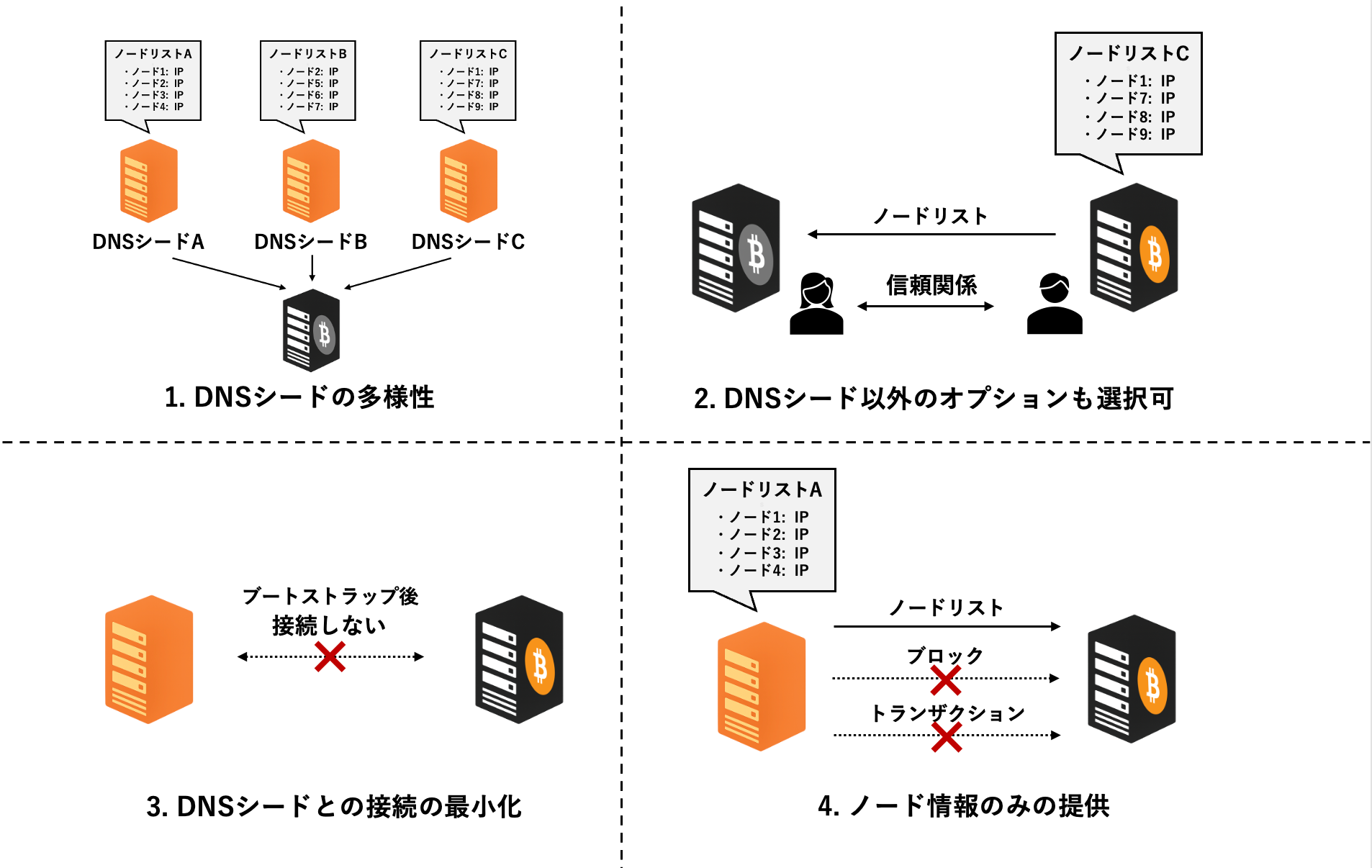
1. Diversity of DNS seeds
There are multiple hardcoded DNS seeds, run by different operators under different operating rules. Bitcoin Core also queries several DNS seeds, so a successful eclipse attack would require taking over most of the seeds.
2. Options other than DNS seeds are available
Whether to bootstrap using DNS seeds is up to you, and there are ways to bootstrap without them. If you don't use DNS seeds, you set the IP addresses of your first peer nodes yourself and start bootstrapping. Using DNS seeds is left to each individual's judgment. As I'll explain in the conclusion, I consider this the most important of the measures.
3. Minimal contact with DNS seeds
DNS seeds are not designed to be used continuously. A node contacts them during its initial bootstrap, and once it has obtained its first candidate peers, it no longer uses the DNS seeds. From then on, it gets further peer information from the nodes it is connected to.
4. They only provide node information
The only information a DNS seed provides is a list of candidate peers. A node does not receive blocks or any other data from DNS seeds. Unless something like the eclipse attack described above is attempted, you won't suffer harm such as having your funds stolen.
News: one DNS seed removed
On December 8, 2025, around the time this article was published, a change removing one of the DNS seeds was merged into Bitcoin Core.
chainparams: remove dnsseed.bitcoin.dashjr-list-of-p2p-nodes.us by SatsAndSports · Pull Request #33723 · bitcoin/bitcoin
The DNS seed dnsseed.bitcoin.dashjr-list-of-p2p-nodes.us. is not returning a representative sample of bitcoin nodes. It currently returns nothing later than 28.1.0, breaching the policy.
This PR re…
bitcoin
I'll cover this in more detail in a separate article.
To give just an overview here: one DNS seed was not returning nodes running version 28.1.0 or later as peers. The resulting bias was judged to violate the policy point described above, "1. Select nodes fairly and randomly," and the DNS seed was removed from Bitcoin Core's hardcoded list.
The policy violation was reported by an ordinary member of the Bitcoin community, and the removal was decided after discussion following that report. This process shows that node operation and the implementation are independent of each other, and it can be seen as democratic decision-making.
Conclusion: thinking about trust in DNS seeds
This article explained what DNS seeds, the special domain names hardcoded into Bitcoin Core, actually are, how they came about, and the policy governing their operation.
In my earlier article on Bitcoin and trust, I wrote that trust is minimized in Bitcoin's Layer 1. It's true, however, that some trust is involved in bootstrapping. That said, if you still can't trust it even after understanding the trust-minimizing mechanisms above, I think it's fine not to choose Bitcoin.
Of the trust-minimizing measures, I consider "2. Options other than DNS seeds are available" to be an extremely important feature.
In my view, the ideal way to bootstrap is to skip DNS seeds and instead use real human relationships as the starting point of trust, choosing the node of someone you trust as your first peer, based on your own judgment of "I can trust this person." With this approach, no entity such as Bitcoin Core forces you to trust any particular party. For this to work, it's best if more people are running Bitcoin nodes. So run a node to protect your neighbors!
In future articles, I plan to cover the characteristics and operational status of each DNS seed.