Silent Payments vs. BIP47/PayNym: Fixing Bitcoin Address Reuse

This article was translated from Japanese with AI. Read the original (日本語) · Report a translation issue
Silent payments are getting renewed attention now that Sparrow Wallet, a desktop Bitcoin wallet that has grown in popularity in recent years, supports them. This privacy feature actually fixes most of the shortcomings of BIP47, a protocol that has been around for some time.
Both protocols give you a static string that can receive payments while avoiding Bitcoin address reuse. Their mechanisms are very similar, yet their underlying design philosophies differ significantly.
Some readers may also have heard of PayNym, a privacy feature related to BIP47.
In this article, I look at the relationship between silent payments and BIP47/PayNym to explain why silent payments are attracting so much attention.
For more on silent payments, see our earlier article.
第三者からプライバシーを守る新しい支払い方法、Silent Payments
ビットコインで寄付を受け付けたいとき、ウェブサイトなどにビットコインアドレスを公開することが一般的です。この方法のメリットはどのウォレットでも必ず使えること、送金する際に相手との通信等が不要なこと(新しいアドレスを発行してもらう必要がない)、アドレスを生成して貼り付けるだけというシンプルさです。また、場合によっては集まった金額を見てもらいたいという場合もあるでしょう。 一方で、集まった金額の透明性はそのアドレスに対する送金がすべて見れてしまうことの裏返しです。このため、特定の団体に寄付したユーザーのトランザクションを辿って本人を特定したり、逆にその団体の資金の流れを追って取引所等の口座を凍結することができてしまいます。 この問題の解決方法はBIP47、寄付の両側でのミキシング等いくつかありますが、今日はそれらと比較してシンプルさが際立つ“Silent Payments”という新しいものを解説します。 仕組み 送金を受け付けたい者は32バイトの公開鍵X = x*Gを「サイレントアドレス」として公開します。 送金したい者はサイレントアドレスを見て、自身の持つUTXOから送金に使
 加藤 規新
There is also a video, so check that out as well.
BIP47's design involves a lot of waste
We briefly covered BIP47/PayNym in an earlier article too. Here it is:
ビットコインの送金UXに一石を投じるeasypaysyとPayNymの比較
安土さんの技術ブログに先を越されてしまいましたが、今月初めにビットコインのUXを向上するeasypaysyというプロトコルのホワイトペーパーが発表されました。 easypaysyが改善しようとしているのはビットコインアドレスという仕組みのUXなのですが、似た機能としてSamourai Walletが実装したPayNymsというものがあります。今回のコラムでは双方の特徴を紹介し比較します。 EASYPAYSY ビットコインアドレスは使い回しが推奨されない上に、人間にとって読みづらいです。実際、送金のたびにドキドキする人も多いでしょう。また、頻繁に送金する相手から毎回新しいアドレスを教えてもらうのも面倒です。easypaysyはこれらの問題を改善するために可読性の高い「アカウント」を使って扱いやすさとセキュリティを両立しようと提案されたプロトコルです。 技術的な詳細は冒頭で紹介した安土さんのブログに任せて、ここでは概要を説明します。 easypaysyを使うと、ユーザーは自身が保有する鍵2つを使った2-of-2マルチシグアドレスから送金することで次のようなアカウント名を取得できま
加藤 規新
This time, I'll try to explain it with diagrams.
How BIP47 works
In BIP47, the recipient first publishes a public key called a BIP47 payment code, on a website or elsewhere. It looks something like a Bitcoin address starting with "PM8T…".

A user who wants to send funds must first notify the recipient of their own payment code. To do this, the sender encrypts their payment code with the recipient's payment code, puts that data in an OP_RETURN output, and sends this "notification transaction" to the first address derived from the recipient's payment code.
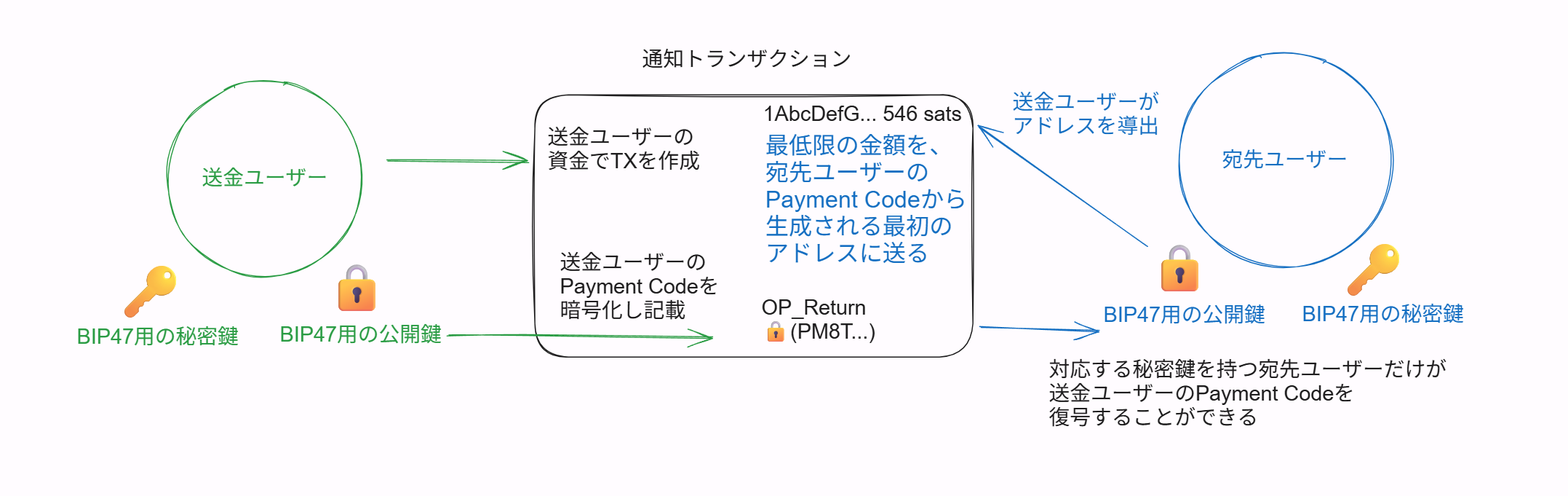
When this notification transaction arrives, the recipient knows that "from now on, payments may come from the user with this BIP47 payment code."
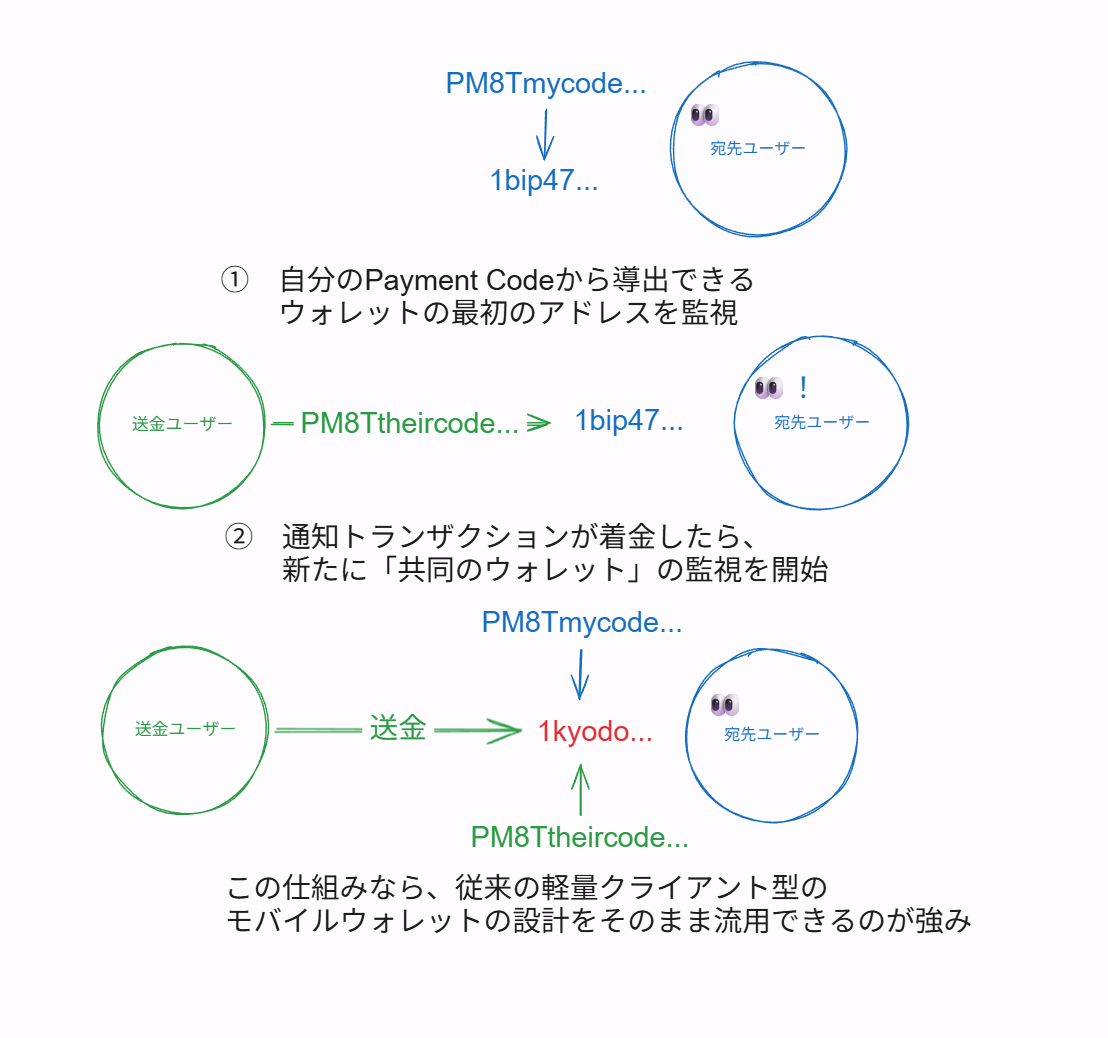
After the notification transaction, the sender can combine their own payment code with the recipient's to create a wallet that only the two of them know about. By generating a new address in this "shared wallet" each time, the sender can make payments without reusing addresses. The recipient simply needs to check this wallet for incoming payments, just like any ordinary wallet.
💡
I called it a shared wallet, but while the sender can also generate new addresses, only the recipient can move the funds held there.
Because a different sender or recipient produces a different "shared wallet," no matter how many times funds are sent to addresses generated this way, the actual payment transactions look like ordinary Bitcoin transactions to anyone other than the two parties, and their connection to the recipient's public payment code cannot be seen.
Where it's wasteful and where privacy falls short
However, BIP47 has some parts that feel wasteful, as well as some privacy pitfalls.
First, every time you send to someone new, you need a notification transaction. This is the tricky part.
- On top of the actual payment, you pay an extra fee for the notification transaction, so sending is expensive
- The address derived from the payment code, which notification transactions are sent to, gets reused (from the recipient's side, this reveals how many notification transactions they have received)
- If the coins used for the notification transaction and the coins used for the later actual transactions share a linked history, the privacy you were supposed to gain may be undermined
These are the problems notification transactions bring.
So why is a notification transaction needed in the first place? It's so the recipient doesn't have to scan every Bitcoin transaction. The recipient watches the wallet derived from their own payment code, and when a notification transaction arrives, registers the new "wallet" derived by combining it with that sender's payment code, then only has to watch that wallet's addresses. This can be done with the infrastructure of ordinary mobile wallets, which watch for balance updates on each address in a wallet.
On the other hand, if you scan every transaction, you don't need a notification transaction, but you do need a Bitcoin full node (more on this below).
BIP47 has a few other problems as well:
- The sender has to keep track of how many recipient addresses in the "shared wallet" have been used, so addresses may end up being reused, for example when using multiple devices
- The recipient learns the sender's payment code (to maximize privacy, the sender would need to use a disposable payment code each time and send a new notification transaction)
In short, BIP47 seems to have been designed with mobile wallets and light clients in mind. But since that approach has privacy problems of its own, I imagine it was a difficult choice. Using Bitcoin with privacy as a priority is a genuinely hard problem.
How PayNym relates to BIP47
So far I've deliberately stuck to the term "BIP47 payment code," but let me briefly explain how it relates to PayNym, the more widely known name.
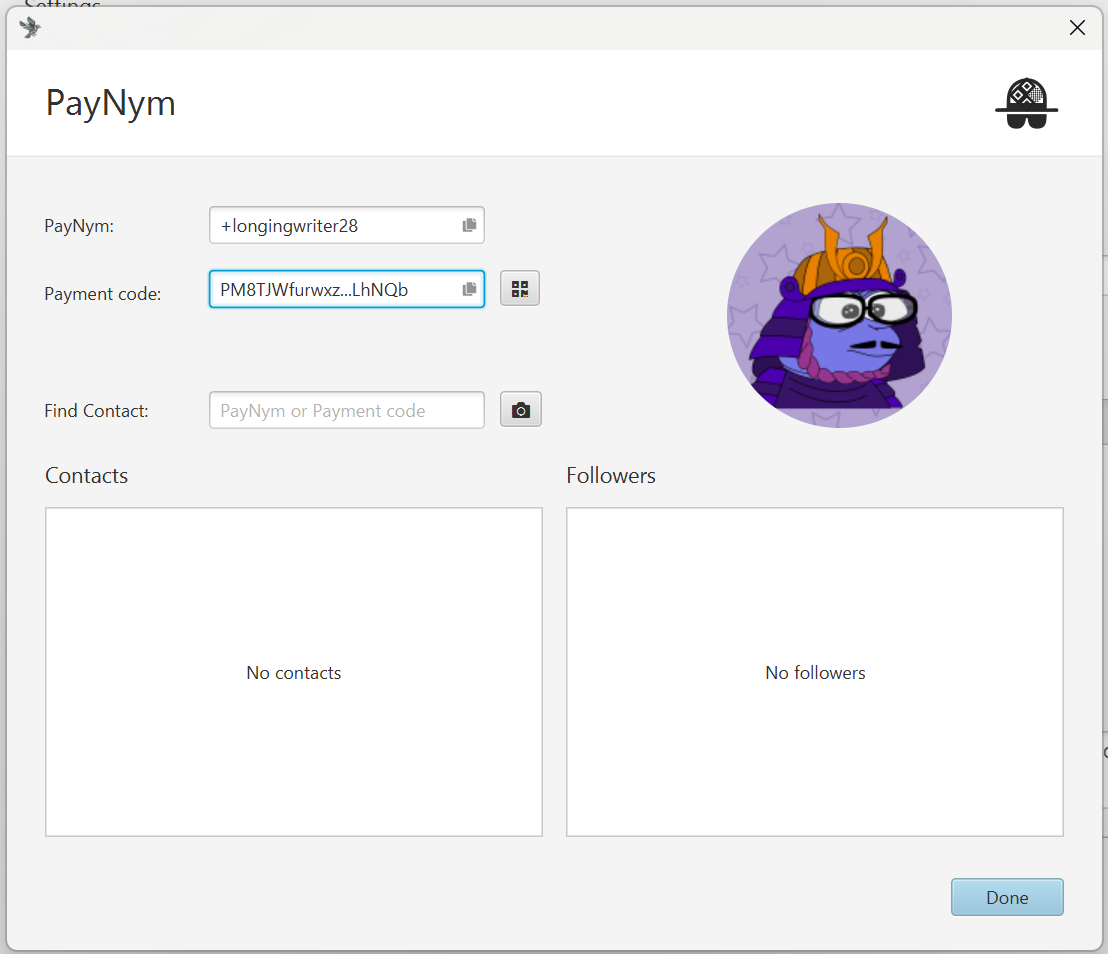
PayNym turns a BIP47 payment code, which is hard for humans to read, into a human-friendly ID-like string and a profile image. The string and profile image make BIP47 payment codes easier to handle on the web and in wallets.
Sparrow Wallet, a desktop wallet popular with advanced Bitcoin users, also supports BIP47/PayNym, so if you're having trouble picturing how it works, give it a try.
Here is our article on Sparrow Wallet.
Sparrow Walletのススメ | ビットコインの技術に詳しくなりたい上級者向けPC用ウォレット
ビットコインの上級者ユーザーや技術者に評判のよいSparrow Walletを紹介する記事です。ウォレットの作成方法、マルチシグやハードウェア対応についての説明のほか、新しいプライバシー機能であるSilent Paymentsやトランザクションのプライバシー面の最適化について解説します。
加藤 規新
Silent payments are simpler, but receiving takes more work
As explained above, BIP47 avoids scanning every transaction at the cost of requiring a notification transaction. To eliminate the notification transaction, the sender's payment code, or some other public key, has to reach the recipient somehow.
One solution is to "do the key exchange off the blockchain (have the sender share their payment code via a message or similar)." If the parties can communicate off-chain, the notification transaction, a bundle of privacy risks, can be dropped entirely. But you lose the convenience of simply publishing a payment code on your website.
The other solution is to "perform the key exchange and the payment in a single transaction, and have the recipient find it somehow (by checking every transaction)." This is the approach silent payments took.
With silent payments, the sender does almost the same thing as in BIP47, but uses the public key of the sending address instead of a payment code. The recipient treats every Bitcoin transaction as "possibly a payment to me" and checks each one to see whether it pays to a Bitcoin address generated by that procedure.
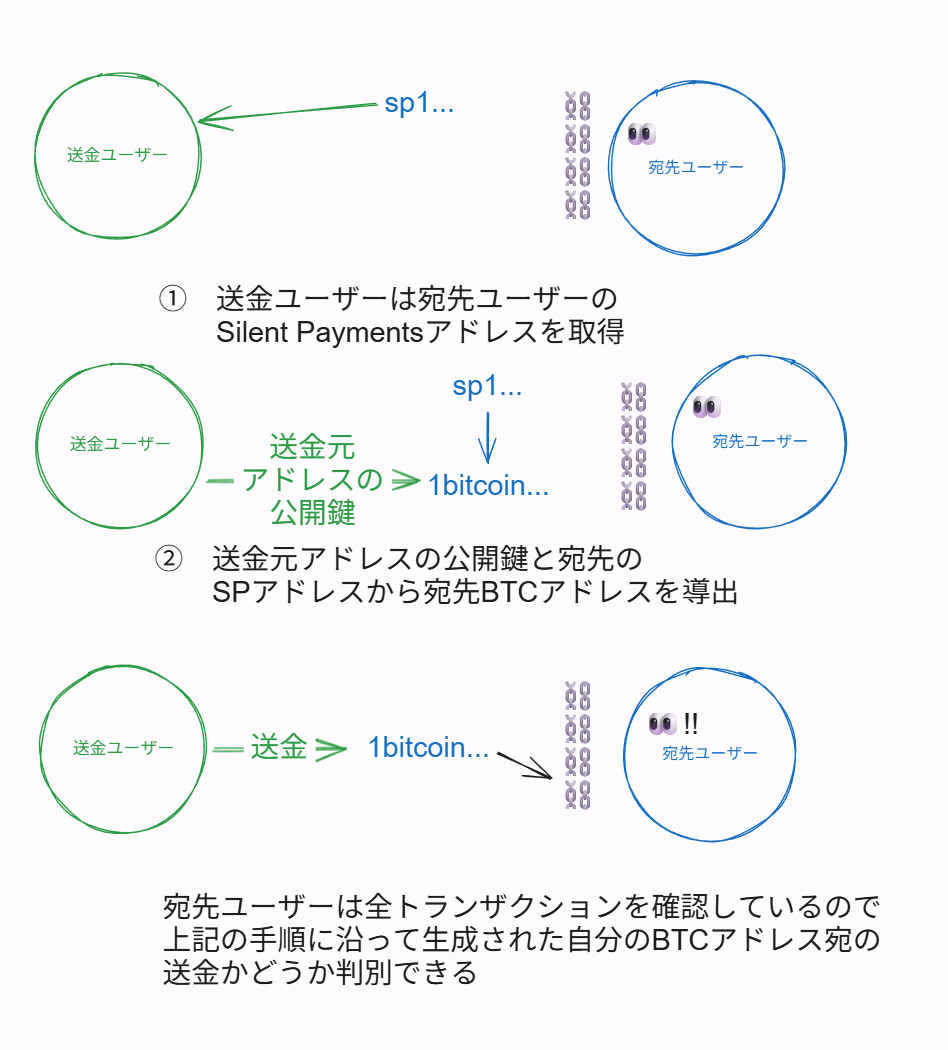
Since a payment is completed in a single transaction with no OP_RETURN and no extra outputs, a silent payment looks like nothing more than an ordinary Bitcoin transfer to outside observers. The trade-off is that, from the recipient's perspective, any Bitcoin transaction could be a payment to them, so every transaction has to be checked. That's why a Bitcoin node is required.
So the downside of silent payments is:
- The recipient needs a Bitcoin node
This is a somewhat difficult requirement to meet on a mobile device alone.
Privacy is not easy
Keep in mind that the privacy problem both BIP47 and silent payments try to solve is "the address reuse problem." When it comes to privacy in using Bitcoin, there are many other challenges as well, such as:
- Analysis of transaction contents using heuristics
- Transactions linked to KYC information
- The difficulty of using coin control to hide the full picture of your funds
- Leaking balance data and metadata by not running your own node
- Spillover from other users' bad practices
While the Lightning Network has greatly improved privacy for senders, there is still room for improvement in privacy when receiving.
Privacy when using Bitcoin is an important issue, and the reality is that a great deal of work still lies ahead.
An example use case for silent payments
One familiar place where adopting silent payments could bring big benefits might be exchange deposit addresses. If the same deposit address is used repeatedly, deposits can be detected in advance through chain analysis, and the exchange user can get front-run before they trade, putting them at a disadvantage.
Simply using silent payments so that a deposit to an exchange can only be identified after the fact would, I think, be attractive, especially to large users.
💡
Sadly, privacy has picked up a negative image in the financial industry, so exchanges may find it hard to adopt a protocol called "silent payments."
But silent payments only reduce what third parties can learn; what the exchange knows about the source of a deposit is exactly the same as before.