What Is Taproot? Schnorr, MAST and P2TR Addresses Explained

This article was translated from Japanese with AI. Read the original (日本語) · Report a translation issue
First, take a look at this short video.
0:00
/1:51
The video was posted on a site run by Lightning wallet developer Hampus, and was made to celebrate Taproot's lock-in, the point at which its activation became certain.
As the video suggests, Taproot locked in on June 12, 2021, exactly five years before this article was published. It didn't actually activate until about five months later, on November 14, at block height 709632.
Taproot is often called the biggest upgrade since SegWit, and it went in without any major dispute over its technical requirements. So what did it actually improve?
In this article, I'll walk through how Taproot came to be activated, then explain in detail what Taproot actually is and what benefits it brings.
Speedy Trial: How Taproot Was Activated
At the time, most people supported the Taproot upgrade, but there was still no clear path to activation. The proposed answer was Speedy Trial: give it a short window of about three months and see whether it activates or fails.
💡
Even if activation failed, the discussion could resume after a short time. Since there was no technical opposition, the mood seems to have been: why not give it a try?
Under Speedy Trial, miners signal that they are ready for the upgrade, and if signaling miners produce at least 90% (1,815) of the blocks in a 2,016-block period (about two weeks), the upgrade locks in.
If a 2,016-block period falls short of 90%, the count starts over in the next 2,016 blocks, and this cycle repeats for about three months, until August 11.
The exact Speedy Trial window was as follows:
- Start: April 24, 2021, 00:00 (UTC)
- End: August 11, 2021, 00:00 (UTC)
Bitcoin Research Lab actually published an article just before Speedy Trial began, so feel free to read it for background.
Taprootのアクティベーション方法がSpeedy Trialに決定か
本日、Taprootのアクティベーション方法の1つとして提案されている「Speedy Trial (BIP341)」のコードを含むプルリクエストがBitcoin Coreにマージされました。 (=将来リリースされるコードに組み込まれた)3月4日にこちらでTaprootのアクティベーション方法としてBIP8を利用することで概ね合意が取れていると紹介した時点では話題になっていなかったSpeedy Trialは、かなりのスピードで多くの開発者の支持を取り付けたということになります。ただし、今なお反対している開発者も少数います。 今回の記事ではSpeedy Trialとはなにか、どのようなスケジュールでアクティベーションを目指すものか、見ていきたいと思います。 SPEEDY TRIALとは Taprootのアクティベーション方法に関して、マイナーの準備が整うことを条件にすることでマイナーに事実上の拒否権を与えてしまうBIP9を使うか、期限切れ時にアクティベーションを強制すること(LOT=true)もできるBIP8を使うかで揉めてきました。 Speedy Trialは、約3ヶ月間の期間
 加藤 規新

Here is how the signaling actually played out:
| Start time (UTC) | Period (blocks) | Signaling blocks | Share | Notes |
|---|---|---|---|---|
| 2021/4/15 19:41:43 | 679,392–681,407 | 0 / 2016 | 0.00% | |
| 2021/5/1 20:27:02 | 681,408–683,423 | 823 / 2016 | 40.82% | |
| 2021/5/13 08:58:58 | 683,424–685,439 | 1690 / 2016 | 83.83% | |
| 2021/5/30 01:18:41 | 685,440–687,455 | 1983 / 2016 | 98.36% | Period that reached 90% (crossed 90% at block height 687,284) |
| 2021/6/13 20:07:16 | 687,456–689,471 | 2011 / 2016 | 99.75% | Formally transitioned to LOCKED_IN at the period's first block, 687,456 |
| 2021/7/3 06:34:06 | 689,472–691,487 | 2010 / 2016 | 99.70% | |
| 2021/7/17 23:32:17 | 691,488–693,503 | 2013 / 2016 | 99.85% | |
| 2021/7/31 04:35:26 | 693,504–695,519 | 1990 / 2016 | 98.71% | |
| 2021/8/13 05:53:47 | 695,520–697,535 | 1957 / 2016 | 97.07% |
Signaling crossed the 90% threshold with the block mined at height 687,284 on June 12, 2021, the moment lock-in became certain. Note, however, that the lock-in counting logic follows BIP9, which tallies the result when the first block of the next two-week period is mined. So, at the protocol level, the formal lock-in happened at block height 687,456 on June 13, 2021.
Taproot Overview
A Brief History of Taproot
It began in January 2018 with a mailing list post by Gregory Maxwell titled "Taproot: Privacy preserving switchable scripting."
The thread proposed a way to make transactions with complex conditions (multisig or timelocks, for example) look on the blockchain like "an ordinary payment to a single person," with the main focus on transaction privacy.
Before Taproot, when you spent bitcoin that had been locked with script conditions, you had to reveal every condition. On top of that, the more conditions there were, the more data was needed and the higher the fees. These were problems of both privacy and cost, and Taproot was proposed to address them.
After discussion of the mailing list post and further work, Pieter Wuille and others compiled the technical specifications into BIPs and published them in 2020.
💡
A mailing list is a group email that many people subscribe to, and many important technical proposals were discussed there.
Three Improvements in Taproot
Here are the three main improvements Taproot introduced.
1: Schnorr Signatures
Bitcoin originally used ECDSA, a signature algorithm based on elliptic curves. With Taproot, Schnorr signatures were adopted to make signing more efficient.
I'll skip the detailed mechanics, but Schnorr makes it possible to aggregate multiple public keys into one and multiple signatures into one, which reduces the amount of signature data.
2: MAST (Merkelized Alternative Script Trees)
MAST (Merkelized Alternative Script Trees) organizes the scripts of a Bitcoin transaction into a data structure called a Merkle tree.
That's a lot of jargon, so let's go through it with some simple diagrams.
First, suppose there are conditions A–D for spending some bitcoin.
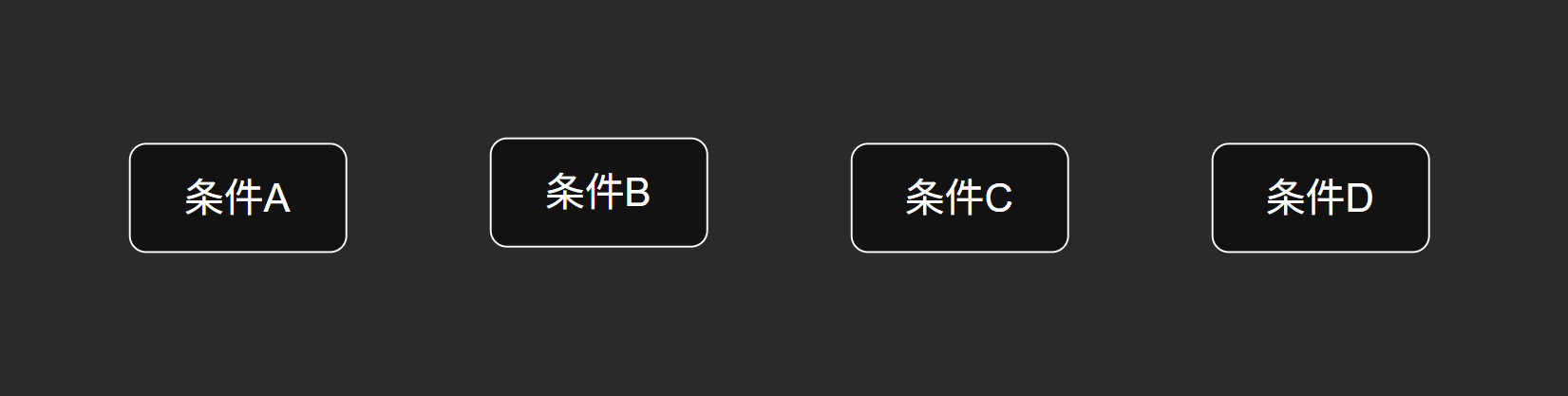
If you run each of conditions A–D through a hash function and build a tree, you get the diagram below.
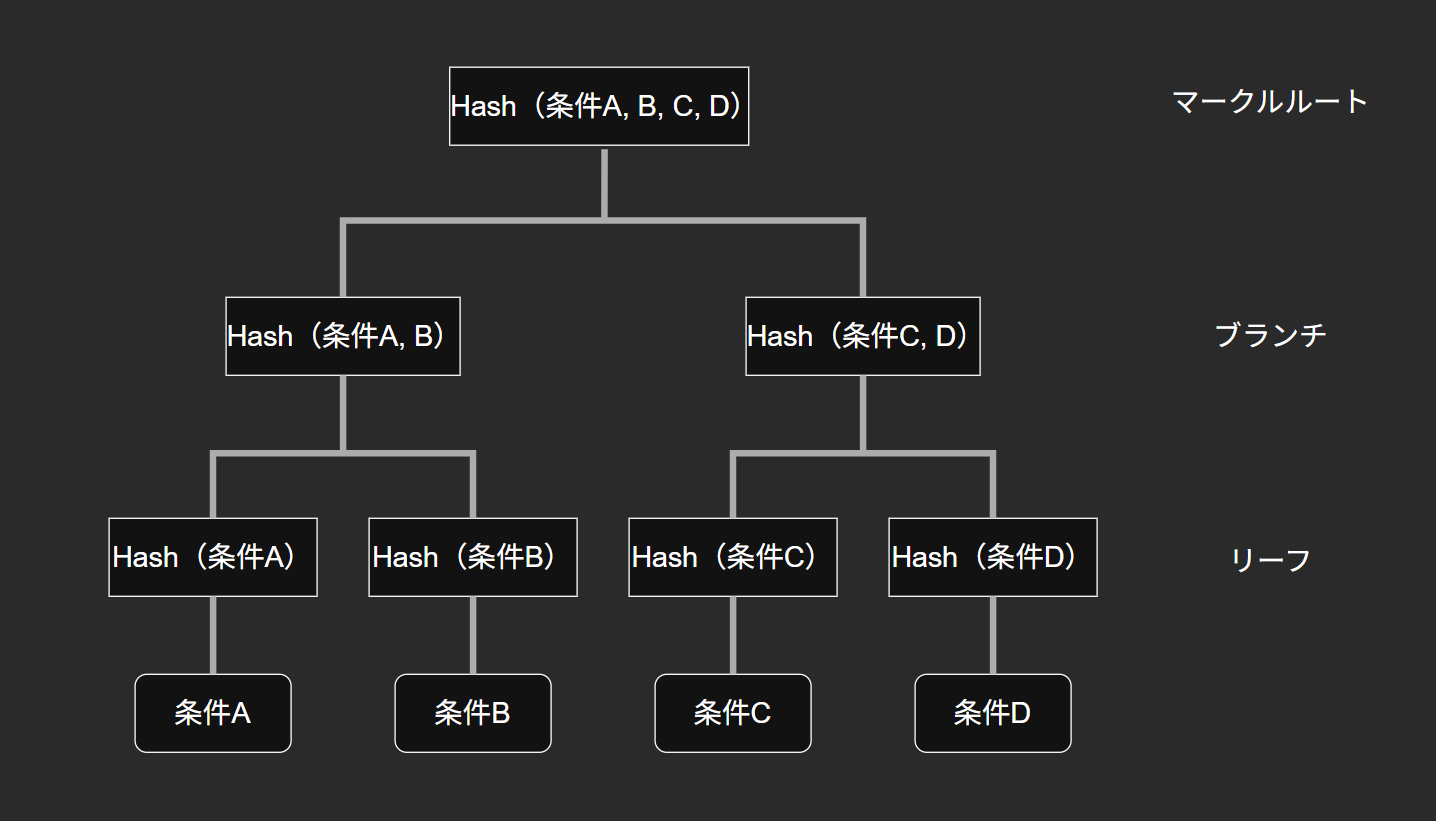
A structure like the one above is called a Merkle tree. The hash of each condition (script) is called a "leaf," and the hash of two leaves combined is called a "branch." Repeat this process across the branches and you're left with a single identifier called the "Merkle root." (No matter how many leaves are added, the Merkle root fits into 32 bytes.)
So what's good about using a Merkle tree? A third party can verify whether a given element (say, condition A) is in the tree without knowing the tree's detailed structure.
Concretely, if you spend using condition A, then because of how the tree is structured, providing Hash(condition B) and Hash(conditions C, D) along with condition A is enough to compute the Merkle root. In other words, the spend can be verified (that is, the tree's Merkle root can be computed) without revealing the details of conditions B, C and D. Compared with revealing every condition, this reduces data size and also protects privacy.
💡
Fun fact: the theoretical maximum number of scripts (leaves) a MAST can hold is 2128.
3: Tapscript
Enabling MAST couldn't be done with the existing script language, so the upgrade introduced a new version of it. This new version is called Tapscript.
Among other things, it redefines opcodes that had been disabled in the old script language and reimplements multisig to work with Schnorr signatures.
P2TR: The Taproot Address
Next, let's look at P2TR (Pay-to-Taproot), the Taproot address type.
An address is something like a vault where bitcoin is locked up. To send it, you unlock the vault with a key that fits it and move the bitcoin into another vault.
P2TR's vault has a special design: it offers two different ways to unlock it.
- Key Path Spend
- Unlock by providing a signature for the public key
- Script Path Spend
- Unlock using one of several conditions (scripts)
The first, Key Path Spend, works like an ordinary payment: you unlock the funds by providing the required Schnorr signature for the public key, then send them. Even if complex conditions exist in the MAST, you don't have to reveal them, and the transaction is indistinguishable from an ordinary Bitcoin payment. That's the nice part.
Also, as mentioned briefly above, Schnorr signatures allow multiple public keys and signatures to be aggregated into one. So the signature provided might actually be a multisig, yet from the outside it looks like a one-to-one, single-sig spend.
The second, Script Path Spend, is the method touched on in the MAST section: you unlock by providing a condition (script) along with the hashes needed to compute the Merkle root. The advantage here is that even when there are many conditions, you only need to reveal one of them.
How P2TR Works: Merging Two Ways to Unlock
Now let's look at how P2TR is built. Knowing that there are two ways to unlock is all you need to use it, but this section is for anyone curious about how a single address can support two unlocking methods.
The short answer: a P2TR address is made by blending a "key" and a "Merkle tree" into one. Because both are fused together, you can unlock it either with the key or with a condition.
Take a look at the diagram below.
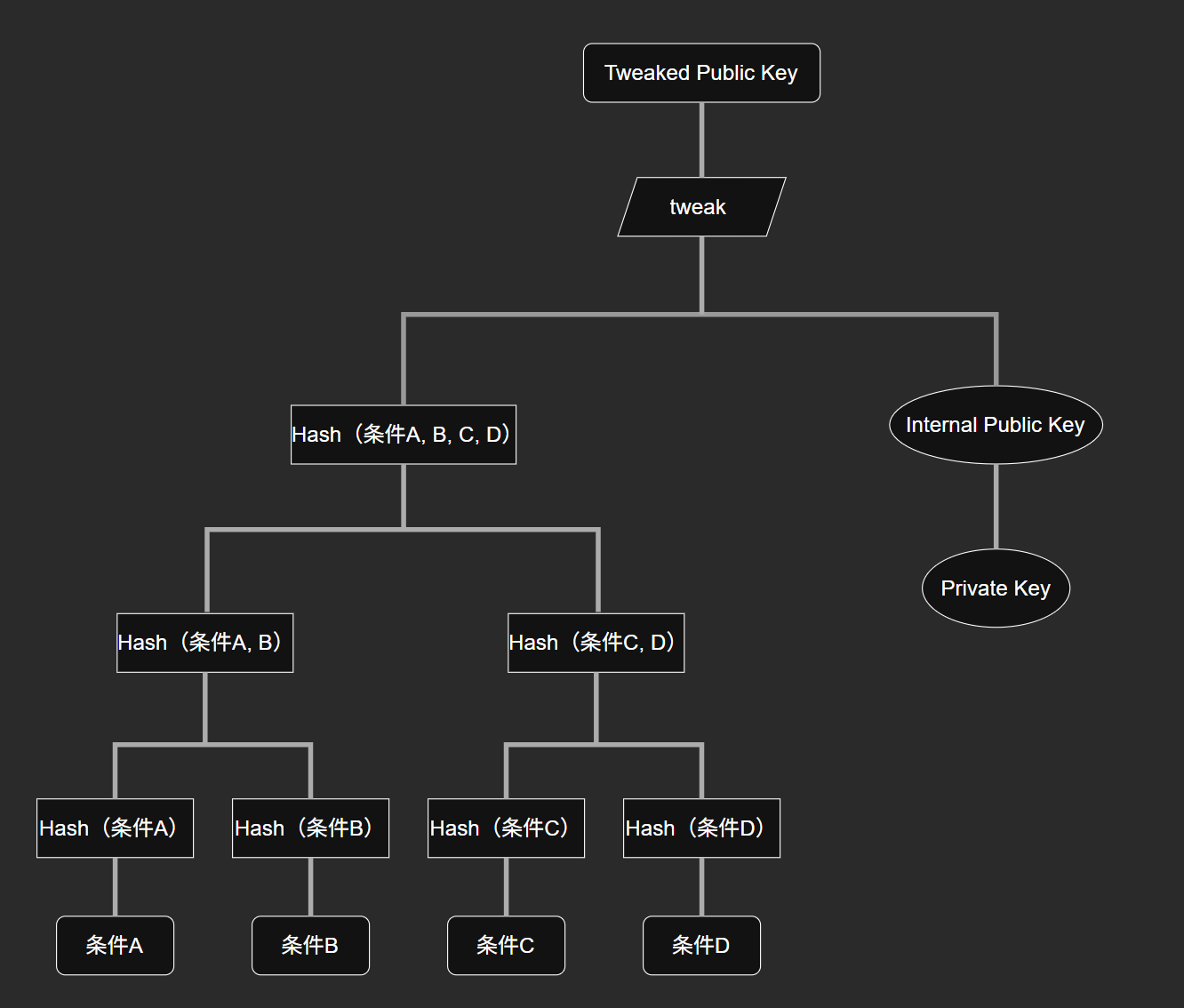
The right side of the diagram is an ordinary key pair: a public key (the Internal Public Key) derived from a private key. This is the basis of the key used for Key Path Spend (unlocking with a key).
The tree spreading from the left side down is the Merkle tree (MAST) from the previous section. Hashing and combining conditions A–D eventually yields a single Merkle root ("Hash(conditions A, B, C, D)" in the diagram). This is used for Script Path Spend (unlocking with a condition).
The internal public key on the right and the Merkle root on the left are then blended together by the tweak in the center to create a new public key, the Tweaked Public Key. A tweak is an "adjustment value": roughly speaking, the internal public key and the Merkle root are combined, and a calculation that exploits the properties of elliptic curves produces a new public key.
Through this combination, both the key information and the condition (script) information are embedded in the Tweaked Public Key. That's why a single address supports two ways of unlocking.
Finally, encoding this Tweaked Public Key with the Bech32m standard produces a P2TR address starting with "bc1p…" (this encoding step isn't shown in the diagram).
Main Benefits of P2TR
The P2TR features covered so far boil down to three benefits:
- Flexibility: a single address can carry multiple spending conditions
- Privacy: a Key Path spend is indistinguishable from an ordinary payment, and even with a Script Path spend, every script other than the one used stays hidden
- Efficiency: all conditions are condensed into a 32-byte Merkle root
In addition, Taproot includes several fields that may look redundant at first glance, so that it can easily accommodate future upgrades. This extensibility can also be counted as a benefit.
Two Drawbacks of P2TR
That said, P2TR also has some issues.
Exposed public keys
A P2TR address ("bc1p…") is created by encoding the Tweaked Public Key with the Bech32m standard. (For details on address specifications, see the earlier article below.)
ビットコインアドレスの種類まとめ|レガシー・SegWit・Taprootの違いと選び方
ビットコインアドレスの種類を総まとめ。レガシー(1/3)・SegWit(bc1q)・Taproot(bc1p)の違いを、プレフィックスや文字数、手数料、互換性の観点から比較表つきでわかりやすく解説します。
三倉 大司
Normally, an address is created by running the public key through hash functions twice and then encoding the result. Hashing adds security strength, but P2TR encodes the raw public key directly into the address. (In other words, the public key is exposed as is.)
The concern here is quantum resistance. Since quantum computers might one day be able to derive private keys from public keys, there are worries that leaving raw public keys on the blockchain could be dangerous.
However, P2TR's developers were aware of this concern and chose to use the public key directly anyway. Taproot prioritizes efficiency, leaves quantum computing to future technological advances, and focuses on improvements that don't change the security model. This is actually stated in BIP341, the Taproot BIP, so take a look.
There is also a proposal, BIP360 (P2MR), that aims to fix the exposed public key issue. If you're interested, see the article below.
BIP360で提案されているP2MRとは?本質的な量子耐性獲得ではない理由
BIP360のP2MRとは何か?P2TRとの違いやトレードオフ、量子コンピュータの攻撃シナリオを整理し、本質的な量子耐性と言えない理由と真の意義である拡張性を解説します。
三倉 大司
P2TR adoption is still low
Another drawback is that P2TR usage is low and major exchanges don't support it for deposits or withdrawals. Exchanges take strict security precautions, so it may be unavoidable that they are slow to support new address formats.
Beyond that, I believe usage is low because people simply don't know what Taproot is. I think that if individuals come to understand Taproot's characteristics, it may spread more widely as one tool for improving their privacy.
Personally, I also think Script Path Spend is likely to be used to add quantum-resistant signatures as a fallback, but I'll cover that in detail in a separate article.
Taproot Use Cases

Many of us are actually using Taproot without realizing it. A fairly familiar example: the Bitcoin addresses in Phoenix Wallet, the wallet from ACINQ, use the P2TR format.
Taproot is also used in submarine swaps, which atomically swap between Lightning and on-chain, and you can see these addresses on major services such as Boltz.
Boltzは本当にトラストレスなのか?Submarine Swapの仕組みから解説
BoltzはSubmarine Swapを用いて、オンチェーンBTCとLightning残高をアトミックに交換できるサービスです。本記事では、その仕組みとWeb appの役割から、Boltzがどこまでトラストレスと言えるのかを技術的観点で解説します。
三倉 大司
If you want to try Taproot to improve your privacy, Sparrow, an advanced desktop wallet, is also a good choice.
One more use case: there are efforts to use Taproot for opening Lightning channels. Compared with a regular channel open, this makes it harder to tell on the blockchain that a transaction is Lightning-related.
Conclusion
In this article, I covered how Taproot came to be activated, how it works and what benefits it offers.
Taproot is an upgrade that improves privacy and efficiency at the same time, built on three core components: Schnorr signatures, MAST and Tapscript. Together, they make it possible for complex conditional transactions such as multisig and timelocks to look like "an ordinary one-to-one payment." The result is the P2TR (bc1p…) address format, whose key feature is combining two unlocking methods, Key Path and Script Path, in a single address.
The fact that Taproot activated smoothly through Speedy Trial, a quick, short-window approach, with almost no technical dispute is a sign of how widely supported it was. Challenges remain, such as future quantum computing concerns from exposed raw public keys and slow support from exchanges, but five years after lock-in, Taproot is starting to be used in places close to home, like Phoenix and submarine swaps. I believe the biggest reason adoption is lagging is that people don't know what Taproot is. If this article helps you understand its characteristics, and each of us actually tries using it, that should be a solid step toward wider adoption.