Self-Sovereign Identity (SSI) Explained: Bitcoin and Web5

This article was translated from Japanese with AI. Read the original (日本語) · Report a translation issue
In this article, I explain the idea of Self-Sovereign Identity (SSI) and how it relates to Bitcoin.
If you keep up with Bitcoin, there is a good chance you have come across the terms SSI and Web5.
SSI and Web5 are ideas and movements that put individual ownership and control at the center of how personal information is managed. They emerged as a countermovement to governments and Big Tech collecting and controlling vast amounts of personal data.
In fact, Bitcoin had a major influence on the origins of SSI. Because the two grow out of similar concerns, SSI is a natural fit for Bitcoiners, and understanding it should also help you think about how you manage your own bitcoin.
Until recently, I was researching digital identity in graduate school, so this happens to be my area of expertise.
What Is Self-Sovereign Identity (SSI)?
Self-Sovereign Identity (SSI) refers to the idea, and the systems built on it, that you manage and control your identity in the digital world (your digital identity) yourself.
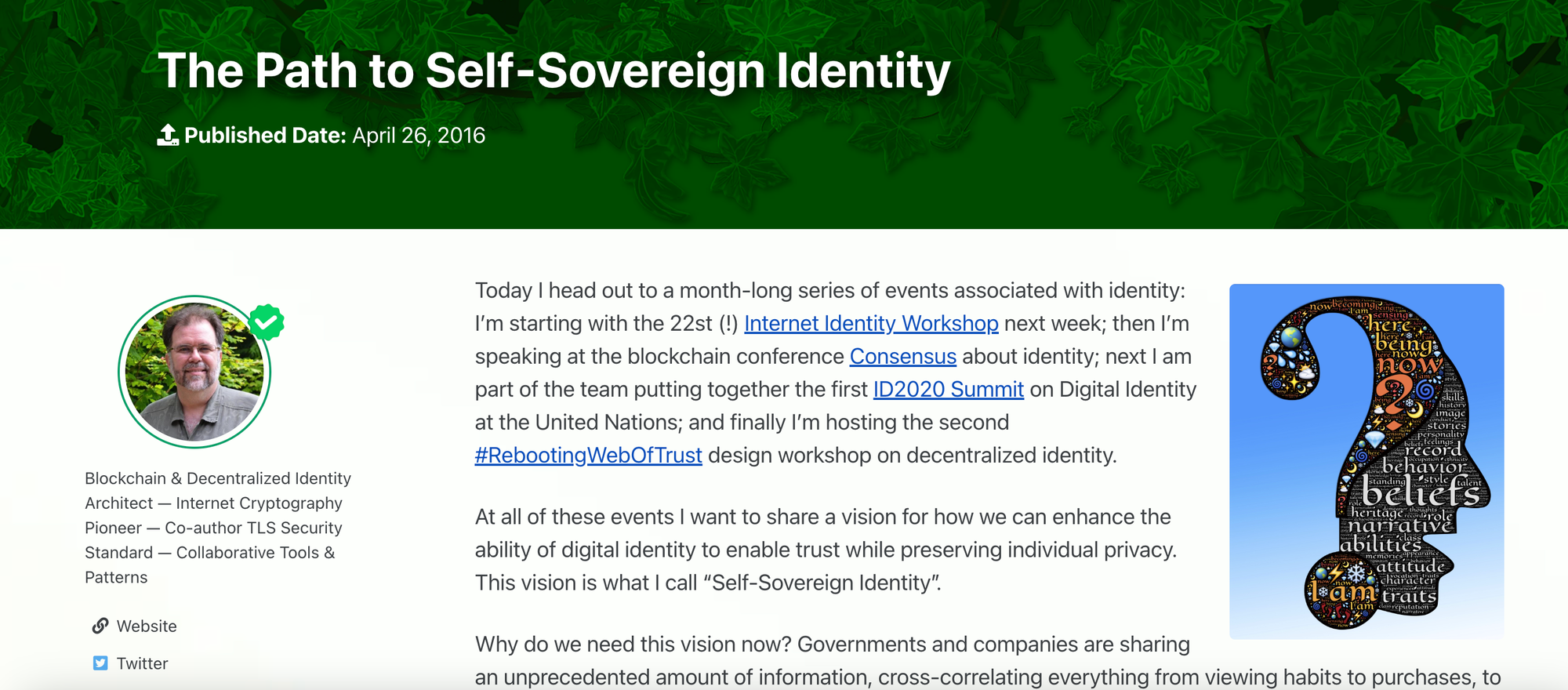
SSI began with a blog post titled "The Path to Self-Sovereign Identity," published by Christopher Allen in 2016. Allen is a well-known cryptography expert who was involved in standardizing TLS/SSL, the protocols used to encrypt communication on the web.
It is said that digital identity researchers, seeing the arrival of blockchains as data platforms anyone can write to and read, found in them one model of what self-sovereignty in identity management could look like [2].
When proposing SSI at conferences and elsewhere, Allen has made remarks showing Bitcoin's influence, and that influence is clearly felt in the principles of SSI (covered below). Today, Allen runs Blockchain Commons, which develops tools for digital assets and digital identity using cryptography and blockchains, and works on education and advocacy.
A Brief History and the Goals of SSI
The concerns and goals behind SSI become clear when you look back at how it came about. I will walk through the history in chronological order: the "centralized identity stage" → the "federated identity stage" → the "self-sovereign identity stage."
The Centralized Identity Stage
Even before the internet, identity depended on centralized institutions to vouch for it. Passports, driver's licenses and degree certificates all work because a centralized institution vouches for some attribute of yours.
In the early days of the internet, identity in the digital world likewise depended on centralized institutions. The certificate authorities (CAs) that vouch for the link between a public key and its owner, and the domain registrars that manage domain names, are also central, authoritative structures.
In most cases, web services are also central authorities that store your identity information. You get access to your locked-away personal information by reciting your name (username) and a secret password.
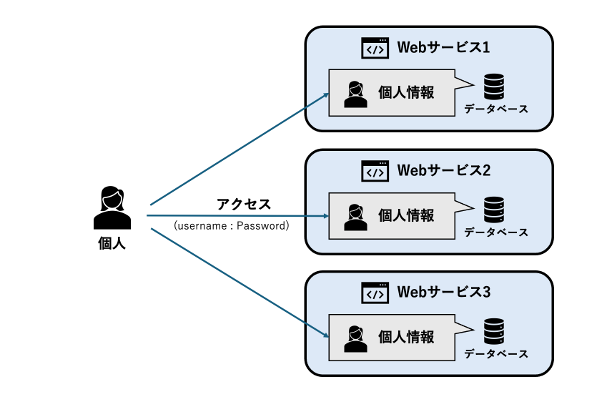
Centralized identity, however, suffers from the problem of silos: your personal information is scattered across every web service you use, making it hard to manage. The central authority is also extremely powerful. It can view your information at will, rewrite it, and if it doesn't like you, erase you or expose you publicly.
🤢
Some past incidents:
• Allegations surfaced that Facebook engineers abused their access, including to stalk women.
• Amazon faced two lawsuits, including over employees improperly viewing footage from smart cameras and illegally retaining the voice recordings and location data of thousands of children to train Alexa.
The Federated Identity Stage
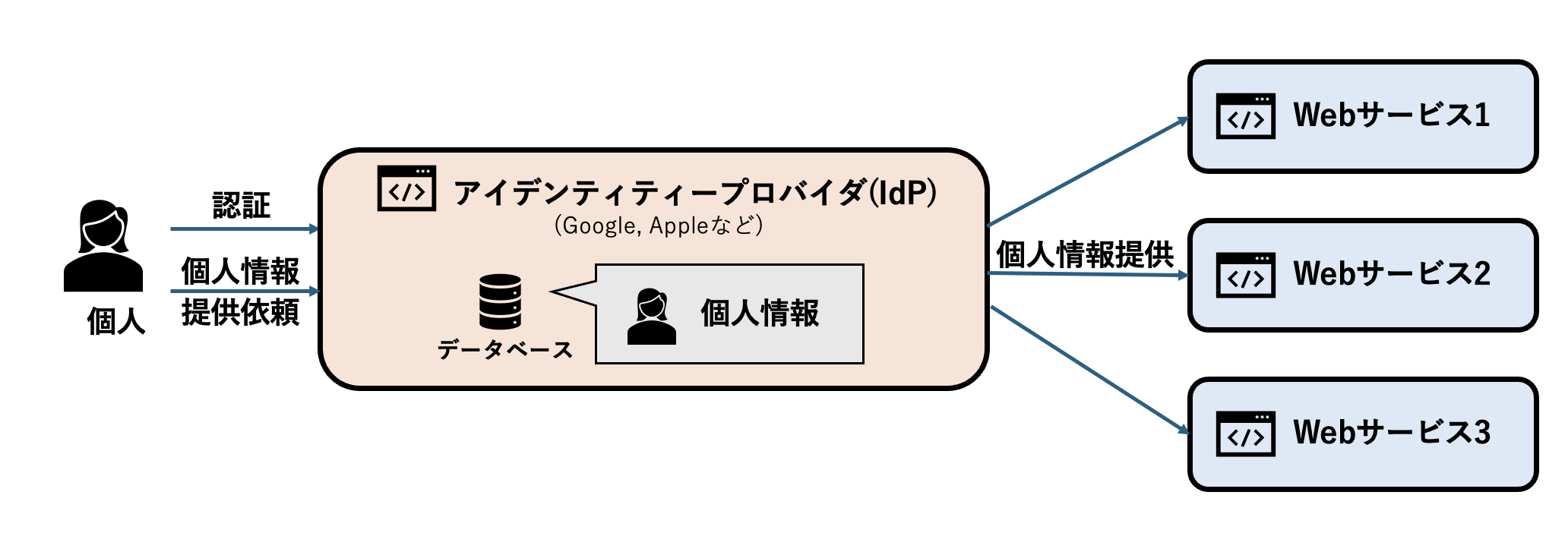
One possible solution to the problem of scattered, siloed personal information is the federated identity model, in which an organization called an identity provider (IdP) stores your identity information and presents your credentials on your behalf when you log in to each service.
The "Sign in with Google" and "Sign in with Apple" buttons you often see on websites these days are examples of authentication using federated identity.
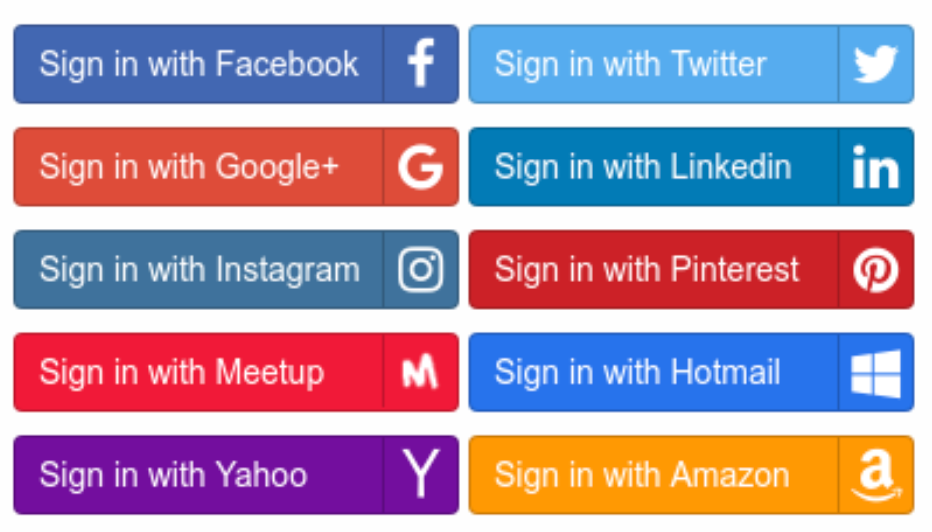
This kind of authentication uses standards called OpenID Connect or OAuth 2.0.
It is convenient because you don't have to register credentials and personal information with every service, but it gives the identity provider a great deal of power. If your Google account gets banned, you lose access to every service you were signing into with it.
There is also no guarantee that an identity provider will exist forever. In fact, during the chaos of the transition from Twitter to X, the "Log in with Twitter" option that had worked until then stopped working.
In other words, your persona in the digital world can always be wiped out or permanently frozen.
The Self-Sovereign Identity Stage
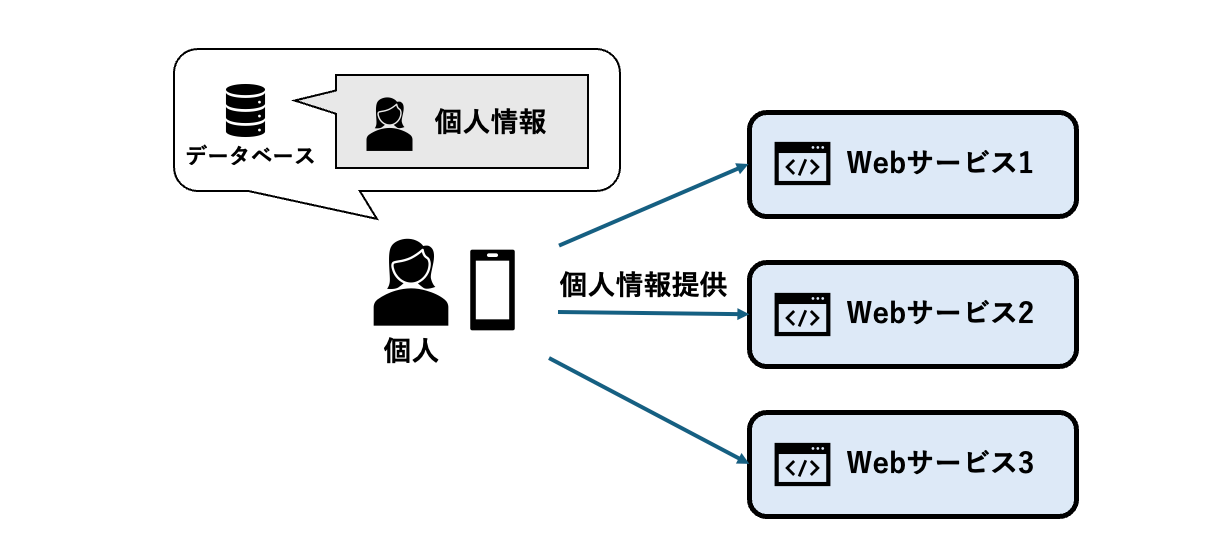
Learning from these shortcomings, the self-sovereign identity model (SSI model) aims to make users the sovereigns of their own identities.
The user sits at the center of their own identity and has the ability to control it: based on their own consent to share data, they present only the personal information they choose, to the services they choose. Building an identity system like this requires interoperability and portability of identity systems and data across services.
You manage the private key you use to authenticate yourself, along with your own personal information, and can present only the information needed, when it is needed. In the SSI model, a service cannot erase you.
The Sovrin community, which works toward realizing SSI, emphasized not only official identities backed by authorities but also peer-to-peer identity. Instead of being recognized as who you are through a government-issued birth certificate or My Number (Japan's national identification number), this is an identity model in which third parties who trust you attest to your existence and attributes.
The 10 Principles of SSI
Aiming to build identity systems that are transparent and fair and that balance protecting the commons with protecting individuals, Allen proposed the "10 Principles of SSI."
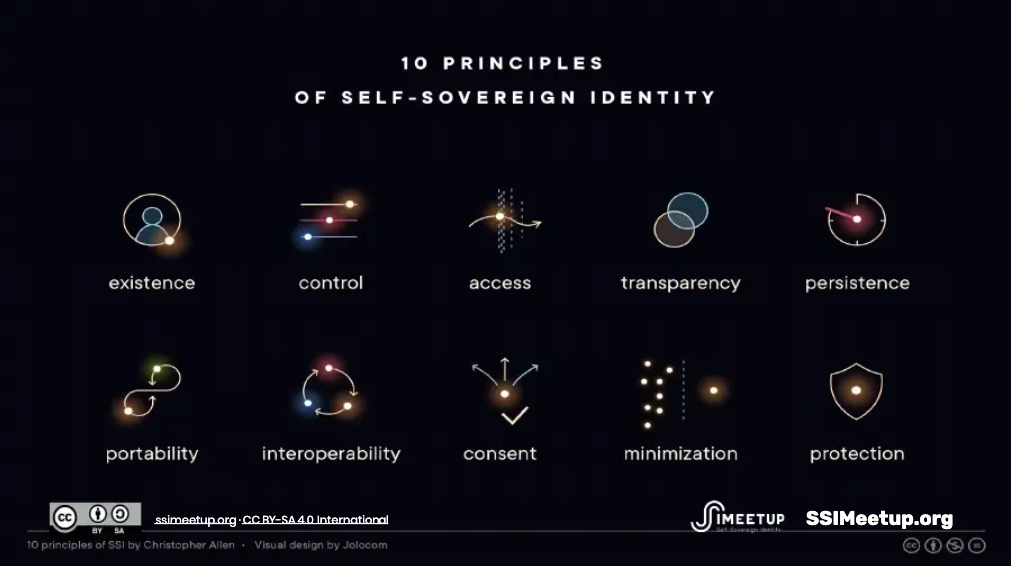
Each principle is summarized below.
- Existence: Users have an independent existence; an identity makes public and accessible only certain aspects of the "me" that exists in the real world.
- Control: Users must be able to control their identities, including viewing, updating or even hiding them at any time.
- Access: Users must be able to easily see and retrieve all data about themselves at any time.
- Transparency: The systems and algorithms that manage and operate on users' data must be transparent, and how they work must be verifiable.
- Persistence: A user's identity information should last for as long as the user wishes. At the same time, users should be able to dispose of or delete their identity if they want to.
- Portability: Information and services related to identity should not be held by any single third-party organization; their persistence should be ensured by their being portable.
- Interoperability: Identities should be usable globally, across national borders.
- Consent: Users must consent to the use of their identity, and systems may use it only with the user's consent.
- Minimization: When data is disclosed, only the minimum data needed to accomplish the task at hand should be disclosed.
- Protection: Users' rights must be protected, and individual freedoms and rights should take priority over everything else.
The Building Blocks That Make SSI Possible
Here I explain three technologies currently attracting attention as building blocks for SSI: Verifiable Credentials, Decentralized Identifiers and selective disclosure.
I will cover the details in a separate article, so this one only gives a high-level overview.
Verifiable Credentials (VC)
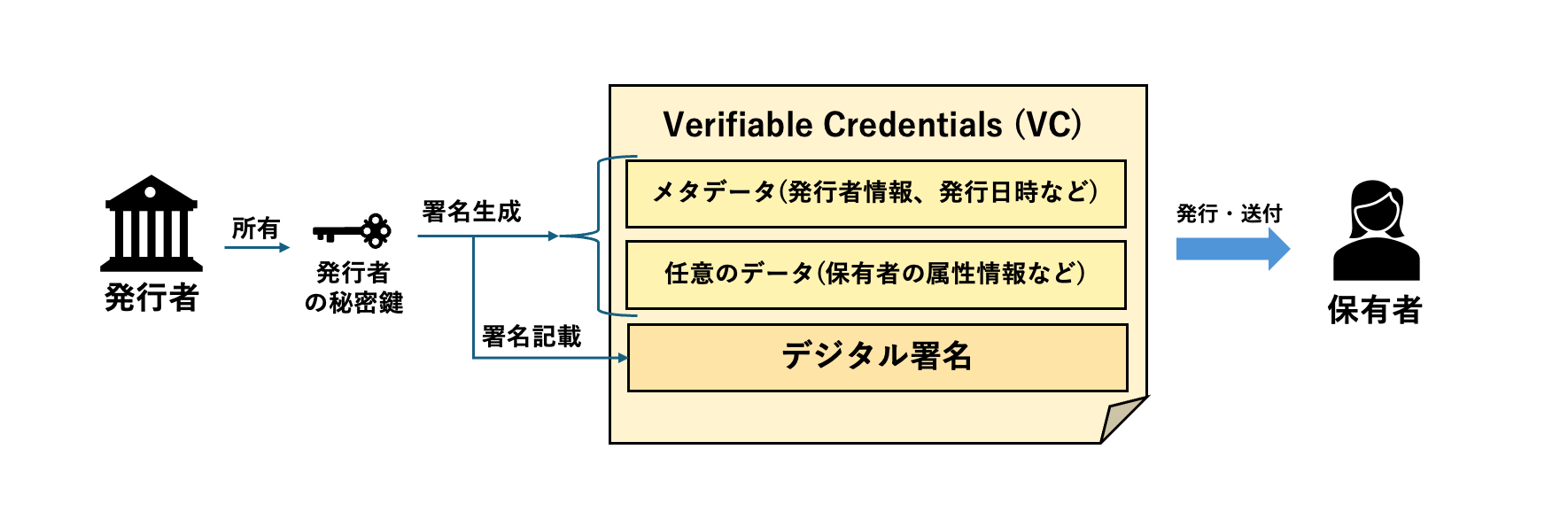
Verifiable Credentials (VC) are a standard data model that can be made tamper-resistant with digital signatures.
Put simply, they are certificates, such as a driver's license or diploma in digital form, with a digital signature attached so they cannot be altered. Because the certificates are standardized into the same format, driver's licenses and diplomas from different issuers become interoperable, making it easier to expand where they can be used.
VCs use what is called the Issuer-Holder-Verifier model, which splits the roles among three parties (issuer, holder and verifier) and separates the information and functions each one has.
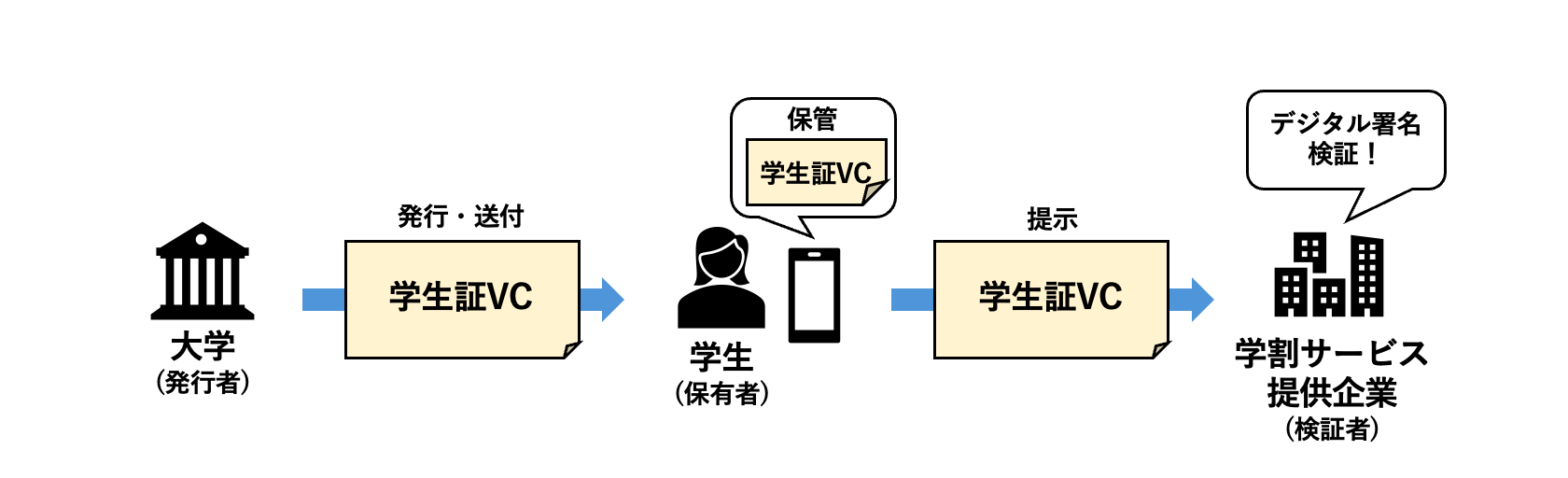
- Issuer: Issues a VC vouching for some attribute of the holder, such as a skill or affiliation. The VC includes the issuer's identifying information and is digitally signed with the issuer's key.
- Holder: Stores the VC received from the issuer. When presenting the VC, the holder adds their own identifying information and digital signature, then hands it to the verifier to provide the data.
- Verifier: Verifies the signatures on the VC received from the holder, which carries the holder's digital signature, and uses the data in the VC once verification succeeds.
✏️
People who came to this from cryptography or blockchains often get this wrong, but VCs are generally not information recorded on a blockchain.
Decentralized Identifiers (DID)
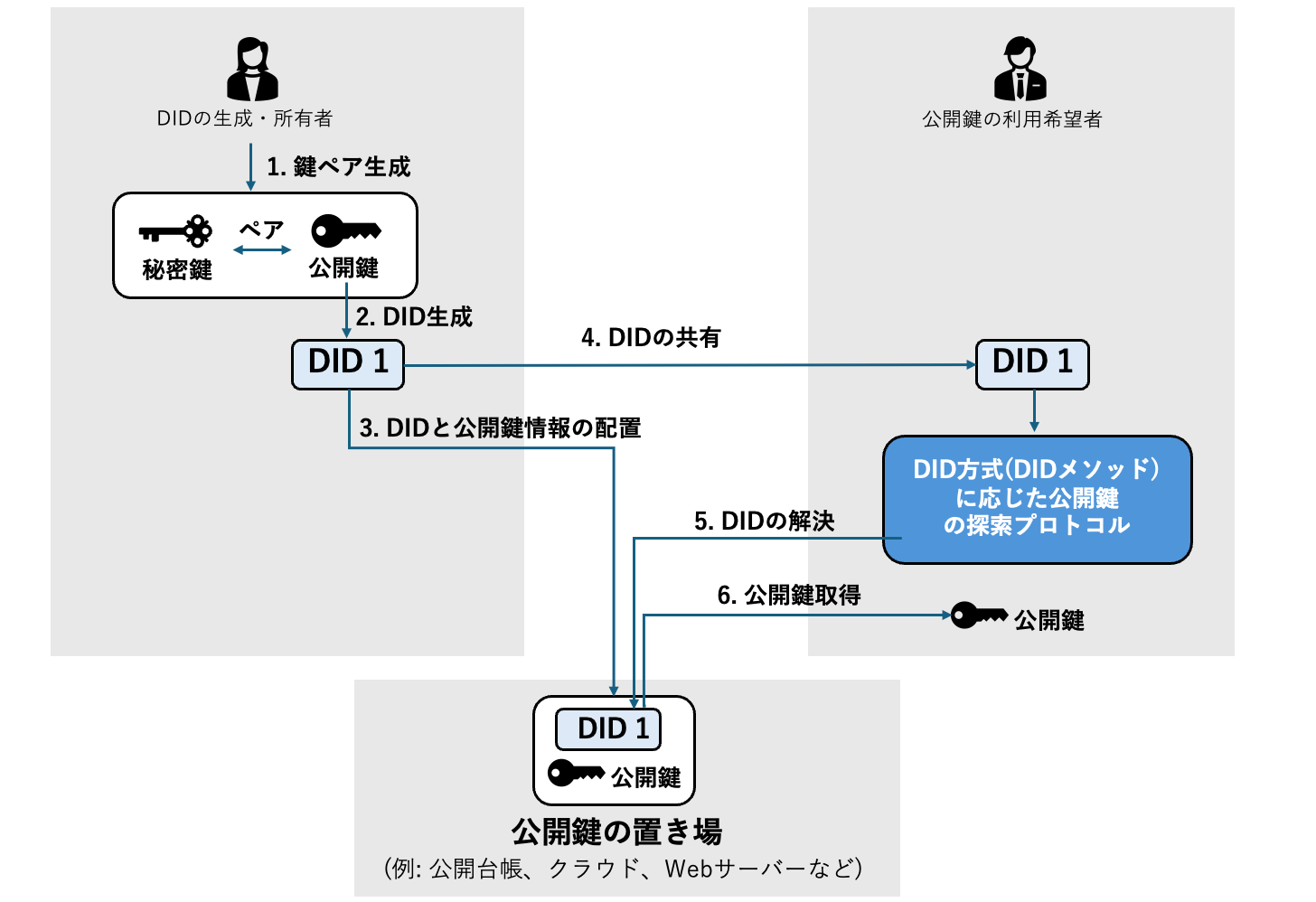
A Decentralized Identifier (DID) is a standard that makes it possible to retrieve a public key from an identifier (ID). The public key is placed anywhere, such as on a web server, a blockchain or in the cloud, and the ID is a string containing directions for reaching that location. Anyone who knows the ID can use those directions to retrieve the public key.
DIDs and VCs are separate standards, but they become more useful when combined. Writing a DID into a VC makes it possible to retrieve the public key of the key pair used to sign the VC, so the VC's signature can be verified.
(The name has drawn a lot of criticism for being misleading, and the W3C appears to be in the process of consolidating and renaming the spec as Controllable Identifiers.)
Selective Disclosure
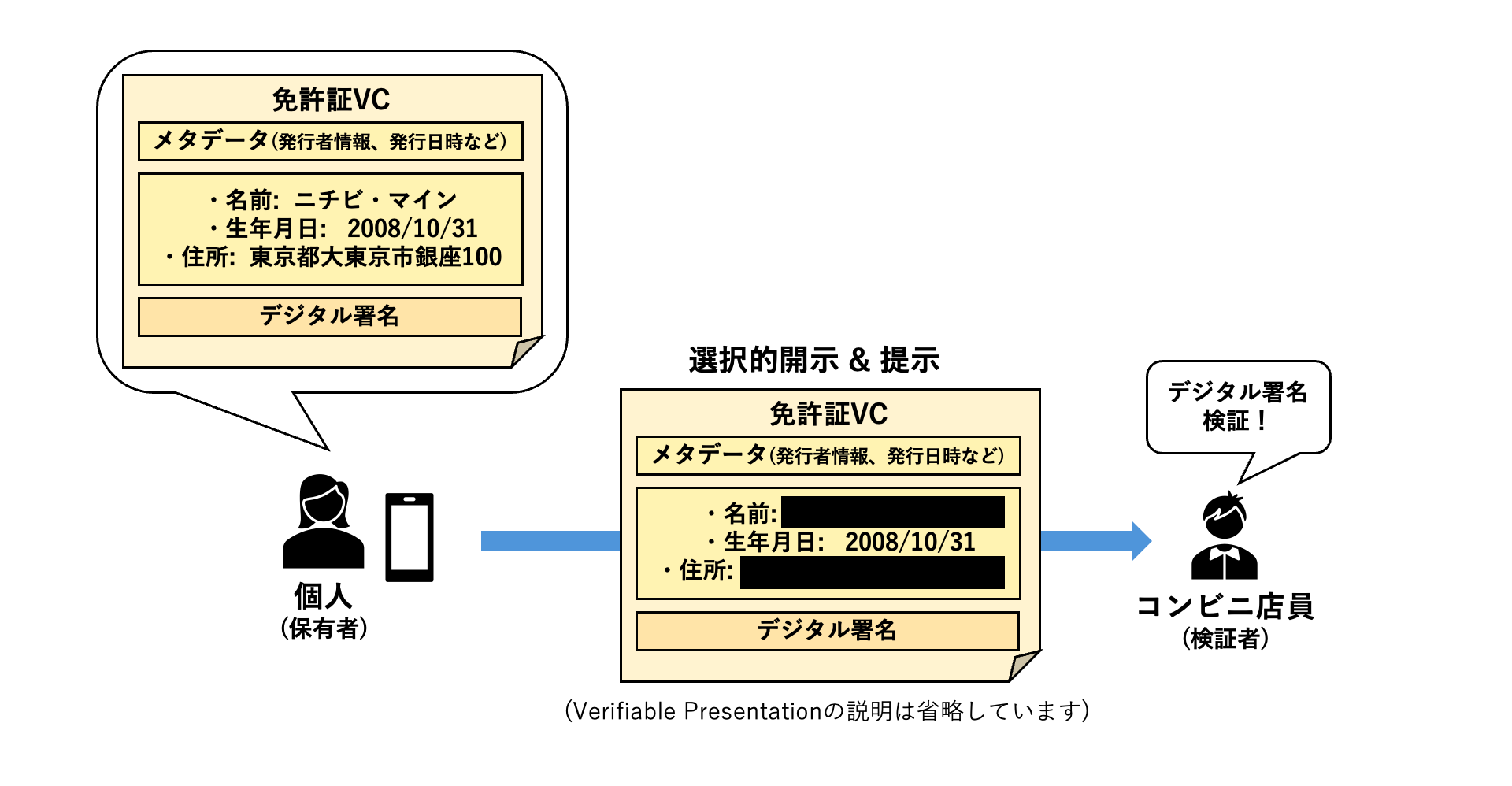
By applying cryptographic techniques to the information written into a VC, you can show others only part of the information in it, keeping the data you don't want to reveal hidden while still proving to them that the data has not been tampered with.
For example, if you show your driver's license for an age check at a convenience store, you also reveal information that isn't needed for the age check, such as your name and address, which is a privacy concern.
If the driver's license were a VC that supported selective disclosure, the age check could be done with only three pieces of information: "1. that the certificate is a driver's license," "2. the age stated on the license," and "3. that you are the holder of the license," and personal information unrelated to the purpose would stay protected.
How Bitcoin and SSI Are Related
As mentioned earlier, Bitcoin influenced the birth of SSI. Below, I briefly lay out the Bitcoin influences visible in SSI, then introduce examples of Bitcoin technology being used to implement SSI.
1. Proof of ownership through verifiability based on public-key cryptography
In Bitcoin, the private key you hold serves as proof of your ability to control UTXOs, and digital signatures are used to prove and verify the authenticity of transfers. In SSI as well, presenting a digital signature lets you assert your own attributes, and the recipient is guaranteed the ability to verify them. Both Bitcoin and SSI use public-key cryptography and digital signatures as proof of ownership.
2. Minimal disclosure of personal information
As a financial application, Bitcoin requires only the bare minimum of information. It is recommended to use a new Bitcoin address, which identifies the recipient, for every transaction, and no identifying personal attributes are needed on the transparent blockchain.
3. Eliminating dependence on a central authority
Bitcoin has no privileged central administrator, and individuals can protect their ownership of their assets through self-custody. In the same way, with self-custody of private keys in SSI, you can be the one who expresses consent and controls your own attribute information.
Using Bitcoin in SSI: Blockchain-Based DIDs
When SSI first started drawing attention, people explored using the Bitcoin blockchain to implement the DID mechanism.
DID methods that use Bitcoin include the did:ion method, whose development Microsoft once led, and the did:btc method, a DID method specification proposed by MicroStrategy. I will cover the specifications in detail in a separate article. In [Figure 9: Conceptual diagram of the DID creation flow], used in the DID explanation above, there is a part labeled as the place where the public key is stored. The Bitcoin blockchain, among others, is used as that storage location for public keys.
How Web5 and SSI Are Related
If you already know about Web5, which Jack Dorsey proposed and which was a hot topic in the Bitcoin community for a while, you may be wondering how SSI differs from it.
Kishin Kato has previously written an overview of Web5.
ジャック・ドーシーらが提唱する「Web5.0」とは
Web5構想を解説 先月、Jack Dorsey率いるTBDが”Web5”という構想をスライドにまとめ、物議を醸しました。その挑発的なネーミングやWeb3に批判的なJack Dorseyのスタンスからイーサリアム周辺の反発を招いたり、あるいは逆に「何のことかさっぱりわからん」という反応も少なくありませんでした。 出典:TBD 本稿では”Web5”がどのような目的をもった構想で、どのような仕組みなのかを具体例を交えて解説します。 現在のWEBの問題 Web3にしろWeb5にしろ、ウェブを変えるという主張は「現在のWebに問題がある」という批判でもあります。 Web3の定義があまりはっきりしない問題はありますが、Gavin WoodがWeb3.0を提唱した2014年当時はスノーデン氏によって米諜報機関NSAの世界的な大規模盗聴が暴露された直後ということもあり、データを1箇所に集めないこと、仮名的なIDを使ってプライバシーを守れること、分散的なネットワーク構造によって簡単に検閲できないことなど、中央集権的なウェブの有様が監視や検閲につながっていることに対する反発という側面が強い
 加藤 規新
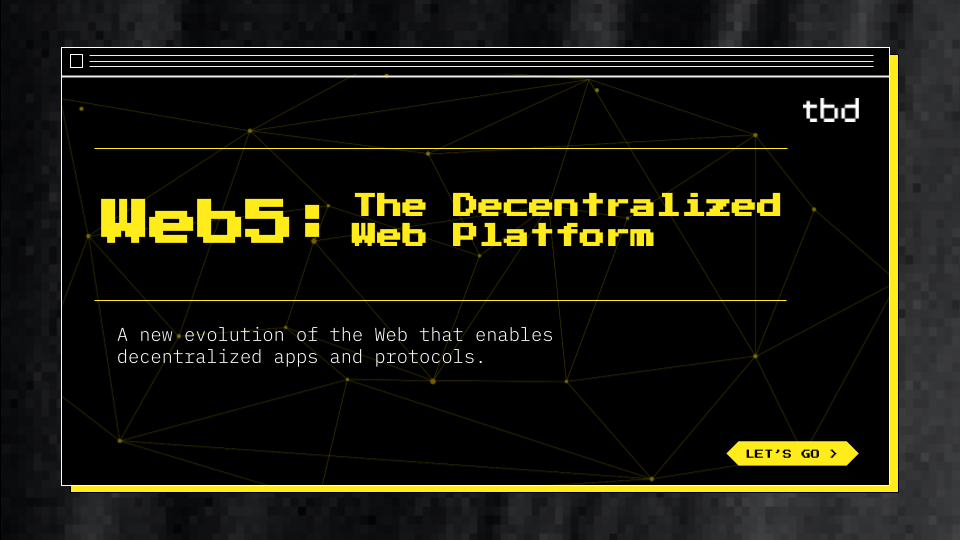
Web5 shares very similar concerns and a very similar approach with SSI: it pushes back against centralized surveillance and censorship, and uses DIDs and VCs as the technical building blocks that let individual users protect their own information. SSI was proposed before Web5.
For reasons I don't know, however, Jack Dorsey and his team did not reference SSI and pushed ahead with their own project, presenting it as a concept they had come up with independently.
Unfortunately, the Web5 project has since been shut down.
Conclusion: What Bitcoin Can Do to Make SSI a Reality
In this article, I explained the origins of SSI, including its relationship to Bitcoin and blockchains, and how SSI emerged from the evolution of identity systems. I also gave an overview of SSI's building blocks: VCs, DIDs and selective disclosure. Finally, I described how SSI relates to Web5, a similar project.
SSI has drawn attention as a prompt to rethink identity management in the digital world, and companies and governments are moving ahead with initiatives.
Unfortunately, however, SSI is being distorted by surveillance-style initiatives that borrow its name, and is increasingly being used in ways that stray from its original ideals. For example, government-led "SSI projects" in Southeast Asian countries disregard SSI's principles, for instance by forcing people to upload personal information such as their education and employment history and administrative documents to state-run blockchain databases.
The same trend can be seen in Japan, and it worries me.
The SSI building blocks described above are merely the methods that are feasible today, and they still fall far short of true SSI. Meanwhile, Bitcoin, as a rare application that has succeeded in achieving self-sovereignty, offers many lessons. I believe that Bitcoin spreading the value of self-sovereignty over money will help create freedom in the digital world.
This article only covers the basics of SSI and how it came about.
In future articles, I will cover more detailed technical elements and their applications, including the latest developments around SSI.
References
[1] Alex Preukschat and Drummond Reed (eds.), Japanese edition of Self-Sovereign Identity (published in Japanese as "Everything About Digital Identity"), O'Reilly Japan, https://www.oreilly.co.jp/books/9784814400980/
[2] Alex Preukschat and Drummond Reed (eds.), Self-Sovereign Identity, Manning Publications, https://www.manning.com/books/self-sovereign-identity
[3] Nomura Research Institute, "Digital Identity: The Core of Cyber Business That Executives Don't Know" (in Japanese), Nikkei BP, https://bookplus.nikkei.com/atcl/catalog/21/283450/
Other references are provided as links in the text.