3 Reasons to Run a Bitcoin Full Node: Verification and Privacy

This article was translated from Japanese with AI. Read the original (日本語) · Report a translation issue
If you want to use Bitcoin securely, nodes are essential.
A Bitcoin node is a computer that participates in the peer-to-peer (P2P) network. It stores, verifies and shares blockchain transaction data, preventing invalid transactions and double spends. Nodes also underpin the reliability and decentralization of the system as a whole.
The chart below shows the number of Bitcoin nodes observed by Bitnodes over the past 10 years. As of the end of February 2026, about 24,688 reachable Bitcoin nodes have been identified, and you can see that the number has been rising year after year.
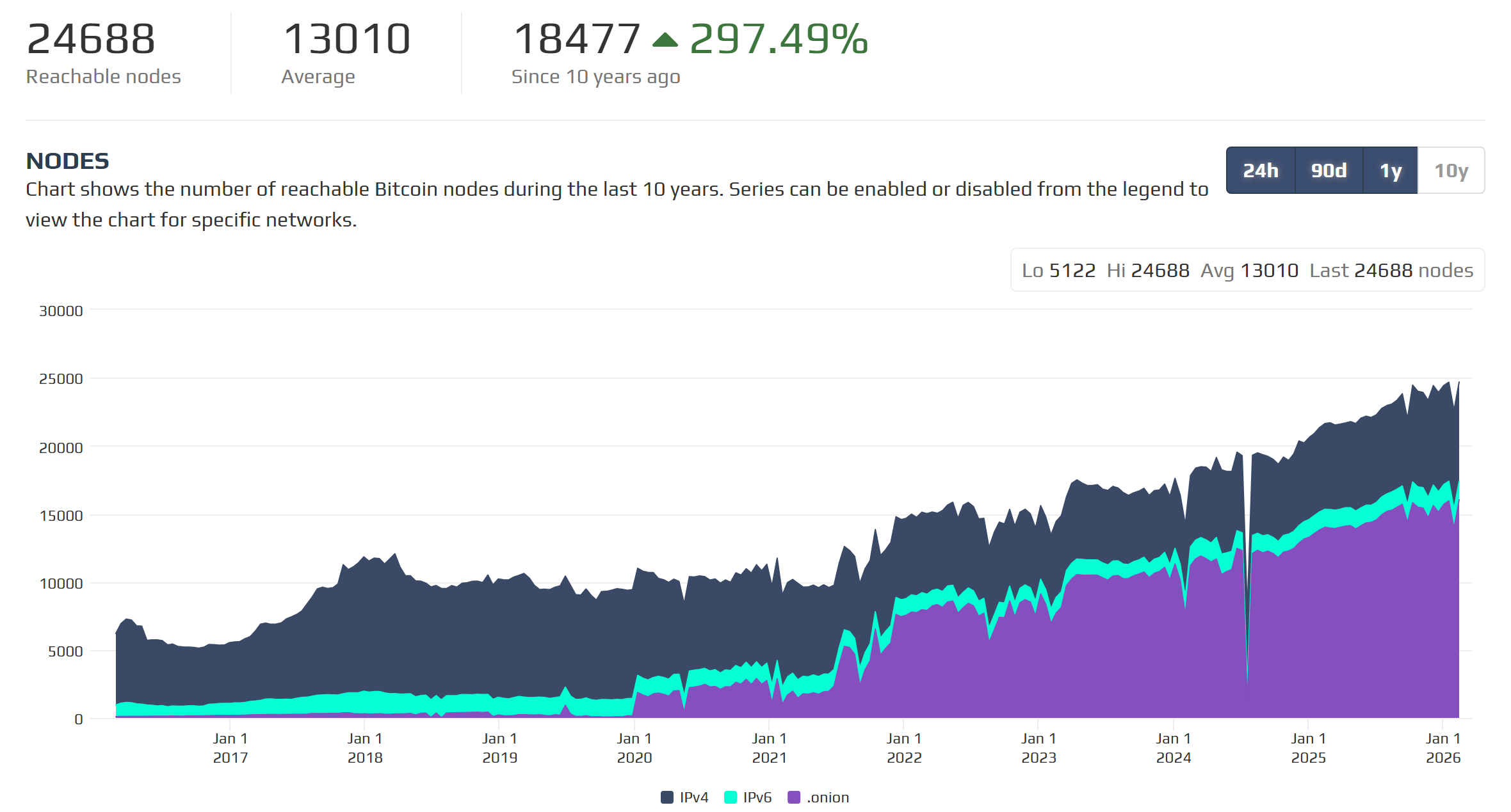
That said, this node count is not necessarily accurate, and it varies with network conditions and the counting method used.
So what's the point of running your own node?
If all you have is a wallet app, you are querying someone else's node to check your balance and transaction status. That means you can end up dependent on others without realizing it, both for control over verification and for your privacy. This is where a Bitcoin full node comes in: it lets you verify the entire blockchain and the full set of rules yourself.
In this article, I'll explain in plain terms the three main reasons you should run a full node.
- You can verify transactions yourself
- You can contribute to Bitcoin's decentralization
- You can strengthen your privacy
Running a full node is what takes you a step beyond simply using Bitcoin, making you a participant who checks the network's rules for yourself and helps uphold them.
💡
A full node also lets you run your own Lightning Network (LN) setup. I'm reminded every day that you learn a great deal by trying things yourself.
Verify transactions yourself
Are you simply taking a third-party node's or exchange's word when they tell you a transfer is valid? The greatest value of running a full node is being able to confirm for yourself that the bitcoin you received is genuinely valid.
A full node keeps the entire blockchain and rule set locally and verifies the blocks and transactions it receives from the network against the consensus rules. In other words, you can treat something as valid only because your own node approved it, not because someone else said so.
By contrast, so-called light wallets, which don't hold the full history and instead fetch the information they need from a server, are fast to use. However, because they query external servers to check balances and verify transfers, the world your wallet sees tends to depend on whichever node it connects to.
💡
If the sender and the node operator were to collude, your wallet could be made to believe false information.
That is why the benefits of a full node matter most for people who hold their assets long term, handle large amounts, or want more reliable verification.
If you'd like to learn more about how Bitcoin's value lies in its verifiability, see the earlier article below.
フォークする権利と、ビットコインの価値
本稿の読者の中にどれくらい視聴者がいらっしゃるかわかりませんが、今月からビットコイナー反省会のレギュラーになりました。先日の放送で視聴者から寄せられた質問に「国家等が51%攻撃して不正なトランザクションを含むチェーンを伸ばしたらハードフォークするのか?」というものがありました。 これは表面的には国家による攻撃ベクトルの検討、あるいはノードがトランザクションやブロックをどのように扱うかについての質問ですが、この質問への回答を考えるとビットコインの本質に突き当たるように感じたので今日はビットコインでなぜフォークが発生するのか、そしてフォークできることがなぜ本質的に重要なのかについて書きます。 💡ちなみに冒頭の質問に対する私の回答をまとめると「不正なトランザクションが含まれるのであれば正常なノードは認めないから国家のノードがハードフォークした形になる」になります。 Don’t Trust, Verify ビットコイナーがよく使うスローガンで一番有名なフレーズかもしれないDon’t Trust, Verifyというものがあります。和訳は「信用せず検証すべし」、でしょうか。 ビット
 加藤 規新

You can contribute to Bitcoin's decentralization
Bitcoin can function as money that no state or company controls not because it has a particular administrator, but because it is a decentralized network in which nodes all over the world verify the blockchain against one another using the same rules.
You can hold and send bitcoin just by using a wallet or an exchange, but if the nodes doing the verification behind the scenes become concentrated among a few businesses or regions, the network gradually becomes centralized. For example, if nodes cluster in a particular country, data center or cloud provider, the network becomes more vulnerable to regulation, outages and censorship.
Conversely, when nodes run in a wide variety of places, such as homes and offices, the network becomes harder to break and harder to stop.
Running a full node isn't just for your own benefit. By keeping the blockchain and rule set at your own physical location and participating in the P2P network, you raise the baseline of Bitcoin's decentralization in the following ways.
- Stronger censorship resistance: The more nodes there are, the harder censorship becomes.
- Redundancy (more copies): The more copies of the blockchain exist, the more easily the network as a whole can keep going even when specific outages or blockages occur.
- Better geographic distribution: With nodes scattered around the world, the network is less affected by local problems such as power outages, disasters and communication failures.
💡
Even in the event of a nuclear war, as long as a full node survives on someone's computer, it is thought that Bitcoin could be restored.
Full nodes also play important roles for the network, such as serving as connection points for light wallets and supporting the initial sync (initial download) of new nodes.
This initial download (bootstrapping) is covered in detail in the earlier article below, so be sure to check it out.
BitcoinのDNSシードはトラストレス性における懸念点なのか
BitcoinのDNSシード(DNS seed)とは、端的にいうとBitcoinフルノードの同期開始時にブロックデータを取得するために、最初にピアとして接続するノードの候補を返すシステムです。
押川 拓夢
You can strengthen your privacy
One thing often overlooked with Bitcoin is where information about your balance and incoming and outgoing payments might leak. If you rely on light wallets, exchanges or public nodes, every time you check your balance or view your history, a query goes out to an external server.
That means the other side may be able to see your IP address and what you're looking up (which addresses or transactions you're viewing). With a full node, you can bring those queries back from a third party to yourself.
RPC console: getting blockchain data from your own node
Bitcoin Core has an RPC (Remote Procedure Call) interface that lets you ask your node for information, such as "What about this transaction?" or "What's the status of this address?"
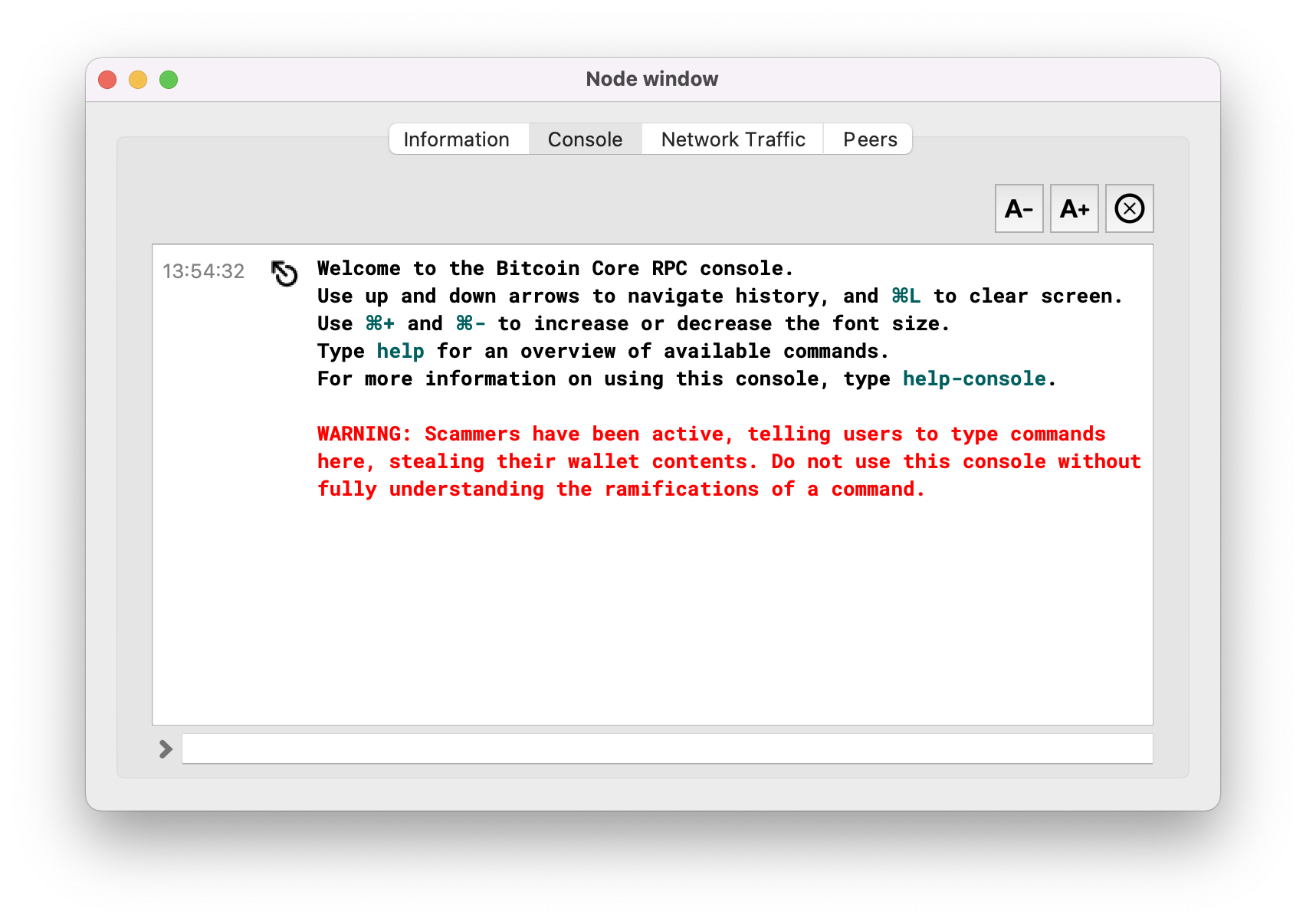
Using RPC locally means you don't have to send lookups to an external service, so the advantage is that you're less likely to reveal to third parties which transactions you're looking at.
Rather than using a public block explorer like mempool.space, I recommend running a local block explorer that pulls data from your own node. A local block explorer basically reads its data through this same RPC interface.
Connect your wallet to your own node
Even if you're running a node, the privacy gains are limited if your wallet is still querying public nodes or external servers.
So switch your wallet's connection to your own node (or a service running on your own node). This makes it easier to keep balance lookups, history checks, broadcasting and so on within your own environment, lowering the risk that third parties link your addresses and behavior patterns together.
Example: connecting your wallet to an Electrum server
For example, if you use Electrum, you can set up an Electrum Server (such as electrs or ElectrumX) on your full node and lock your Electrum client to it. Queries that would otherwise tend to go to public Electrum servers are then sent to your own node instead.
Electrs | Umbrel App Store
Discover Electrs for your umbrelOS home server. Learn more, see screenshots, and discover other self-hosted Bitcoin apps available for umbrelOS.

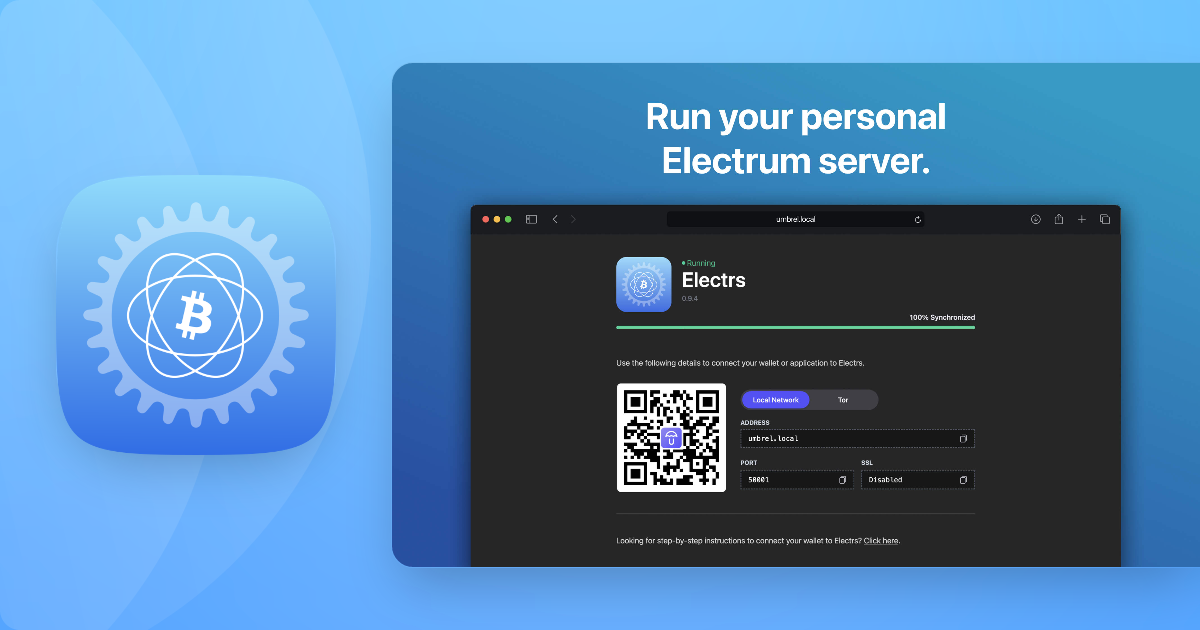
If you also route your home Electrum server's traffic through Tor, you become harder to track at the network level, giving your privacy a further boost.
An easy way to get started with a full node
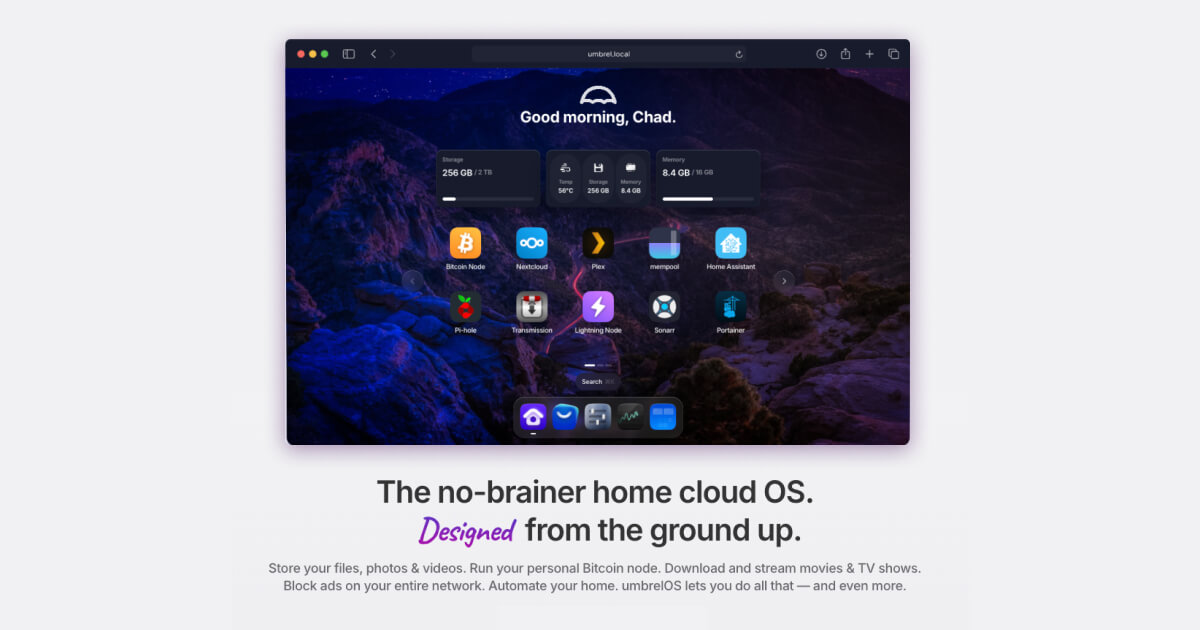
You can build a Bitcoin full node purely from the command line, but as a first step, a node OS such as Umbrel or Start9 (StartOS) is the easy option. You install the OS image, boot it up and add a Bitcoin node and related services (such as an Electrum server or block explorer) from a GUI, which greatly reduces both the learning curve and the effort of running it.
umbrelOS - An elegant OS for your home server
The ultimate OS for self-hosting and running a home cloud. Install in one click on a Raspberry Pi, NUC, or a VM to use apps like Nextcloud, Jellyfin, Bitcoin node, and more.

Sovereign Computing | Start9
Sovereign computing for a free future
 Start9
The minimum requirements are 8 GB of RAM and 1 TB of storage, but personally I recommend 2 TB to leave room for expansion and future data.
If you're going to run Umbrel, this article is also a useful reference, so be sure to take a look.
Umbrelに入れるアプリの権限管理はどうしたらよいのか【質問フォーム回答】
今日は匿名質問フォームからのご質問にお答えさせていただきます。 1問目はこちら: Alby HubとモバイルライトニングウォレットのAlby Goについて ラズパイ上で建てたUmbrelにAlby Hubをインストールし、モバイルライトニングウォレットのAlby Goに繋ぎました。
自前ノードからモバイルウォレット経由で支払いしたり、ブラウザエクステンションからコネクト経由で支払いできればと思っています。
エクステンションなどの接続アプリの権限など、運用上の注意についてアドバイスを伺いたいです。 Albyは2025年1月初旬にカストディ型ウォレットの提供を終了して以来、去年から提供しているセルフカストディ型ウォレットのAlby Hubを、モバイルアプリであるAlby Goやブラウザ拡張から接続して使うスタイルになりました。 Embrace Alby Hub - phasing out Alby’s shared wallet | Alby GuidesAlby Guides 仮にブラウザ拡張から誤って大金を送金して(されて)しまったりしないか?という心配からのご質問かと思い
加藤 規新
Summary: a full node reduces dependence on third parties and puts you back in control
For using Bitcoin securely, a full node is the foundation that makes you a verifier on the network yourself.
Running a full node lets you verify the transactions you receive with your own node rather than taking a third party's word for it, which greatly increases the reliability of how you manage your assets. At the same time, nodes running in a wide variety of places, such as homes and offices, strengthen Bitcoin's decentralization, censorship resistance and redundancy.
On top of that, because you can route balance checks and transaction lookups through your own node (via RPC, a local explorer, an Electrum server and so on) instead of relying on external services, your IP address and browsing behavior are less likely to leak to third parties, which also helps your privacy.
To get started, a node OS such as Umbrel or Start9 (StartOS) lowers the barrier to entry. Keep the three benefits in mind (verifying for yourself, taking part in decentralization and protecting your privacy) and, by running a full node, take a step from simply using Bitcoin to being a participant who supports it.