Machankura: Sending Bitcoin in Africa Without Internet

This article was translated from Japanese with AI. Read the original (日本語) · Report a translation issue
This article looks at Machankura, a wallet service operating in Africa.
Machankura focuses on the particular challenges people in Africa face. It is a service that lets people send and receive bitcoin on basic mobile phones, the old-style feature phones, even without an internet connection.
I see it as one of the most practical and ideal use cases for realizing the "free payments" and "self-sovereignty" that Bitcoin stands for.
Below, I cover Machankura's goals and background, how it works technically, and its efforts to bring self-custody to basic phones.
What is Machankura? Overview and adoption
Machankura is a service that lets people send and receive bitcoin on low-end mobile devices, so-called feature phones [1]. It was founded by Kgothatso Ngako, a South African and former Amazon engineer.
Machankura

In parts of Africa where not only smartphones but even internet infrastructure are lacking, it has drawn attention as a service that enables bitcoin payments over the protocols of the phone network itself.
As of January 2026, the service is available in about 10 African countries (Côte d'Ivoire, Ghana, Kenya, Malawi, Namibia, Nigeria, South Africa, Tanzania, Uganda and Zambia). It launched in 2022 and was in use on about 2,900 devices as of March 2023, about 15,000 as of May 2024, and about 40,000 as of March 2026.
It is currently a custodial wallet service, but a move to a non-custodial model is being considered for the future. (I explain how this could work later on.)
Showing a local how to buy and spend Bitcoin via mobile money using Bitzed, without internet access, on a feature phone with @Machankura8333 Wallet.
— BitZed (@BitZed_) February 6, 2026
USSD: *384*8333# 🇿🇲
Freedom money should be accessible to all. pic.twitter.com/PsHDjCcm1v
Machankura in use (1)
BUYING COFFEE WITH #BITCOIN USING A FEATURE PHONE WITHOUT INTERNET
— The Bitcoin Conference (@TheBitcoinConf) September 11, 2025
BTC IS UNSTOPPABLE 🚀 pic.twitter.com/AmLHzkLbZS
Machankura in use (2)
How to use Machankura
Machankura is accessed with a USSD code that starts with "*" and ends with "#". Users reach the service by dialing the number assigned to their country. (Note: it cannot be used from Japan.)
For example, the code is "*920*8333#" in Ghana and "*483*8333#" in Kenya. Dialing one of these codes brings up a menu (the USSD screen) like the one below.
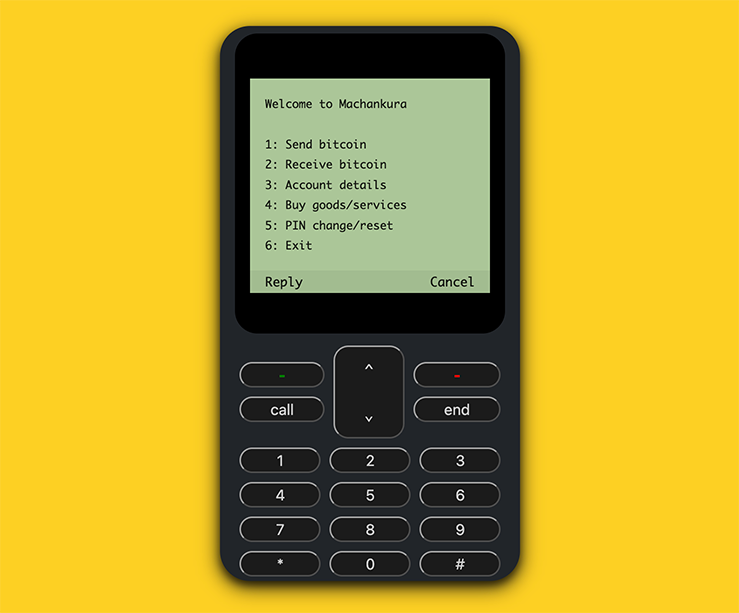
The menu shows options such as "1: Send bitcoin" and "2: Receive bitcoin."
Selecting option 1, "Send bitcoin," lets you choose how to enter the recipient: by phone number, Lightning Address, or account name. Once the recipient is entered, all that's left is to specify the amount and confirm the payment. Transfers are made over the Lightning Network.
Sending to a phone number or account name requires the recipient to have a Machankura account too, but sending to a Lightning Address also works for any other wallet that supports Lightning Addresses, not just Machankura.
I have explained Lightning Addresses in an earlier article.
LNURLとは?QRコードとLightning Addressでビットコイン支払いができる仕組みを解説
本記事ではLNURLやLightning Addressが使われるようになった理由や、送金・受金においてどのように内部処理が行われているかの詳細な仕組みについてを解説します。LN送金・受信のサービス提供や実装を検討している事業者やエンジニアの方は必読です。
 押川 拓夢
For receiving BTC, each user is assigned a Lightning Address in the format "phone number or account name@8333.mobi". Anyone who pays to this Lightning Address can send BTC to the user, even if they don't use Machankura themselves.
Machankura is also integrated with Bitrefill and Azteco, platforms for buying gift cards with bitcoin, so users can pay for prepaid airtime, electricity and groceries, or buy gift cards, through Machankura.
The video below also shows how to use it.
Africa's challenges and Machankura's approach
Internet adoption in Africa has grown far more slowly than expected. A 2025 survey found internet penetration across the continent as a whole at only about 36% [2]. Northern Africa, including the Arab region, Egypt and Morocco, has relatively high penetration of around 70%, but southern, central and eastern Africa remain low at roughly 25–40% [3]. And even in countries with internet infrastructure, access is very expensive, so the actual number of subscribers and users is presumably even lower.
SIM connections, on the other hand, are widespread, reaching the equivalent of 75% of the population even in sub-Saharan Africa [4]. By 2030, almost everyone in Africa is projected to own a mobile phone with a SIM connection.
Mobile money, which lets people send money and make payments with their phones, has also spread across Africa and is part of everyday life [5].
Ngako, who is from South Africa, saw a problem: bitcoin payments assumed a smartphone, which left many people out. So he turned to bitcoin payments over USSD, a communication protocol that people there already know well from mobile money and similar services.
How Machankura works: bitcoin transfers over USSD
To understand how Machankura works, you need to understand USSD. Put simply, it's easiest to think of it as an interactive version of SMS.
What is USSD?
USSD (Unstructured Supplementary Service Data) is a communication protocol that lets basic mobile devices like feature phones communicate with computers. It works much like SMS, but keeps a session open so that messages can go back and forth in both directions [6, 7].
In the past, there were even features that let people update social networks like Facebook and Twitter via USSD, that is, without the phone itself connecting to the internet.
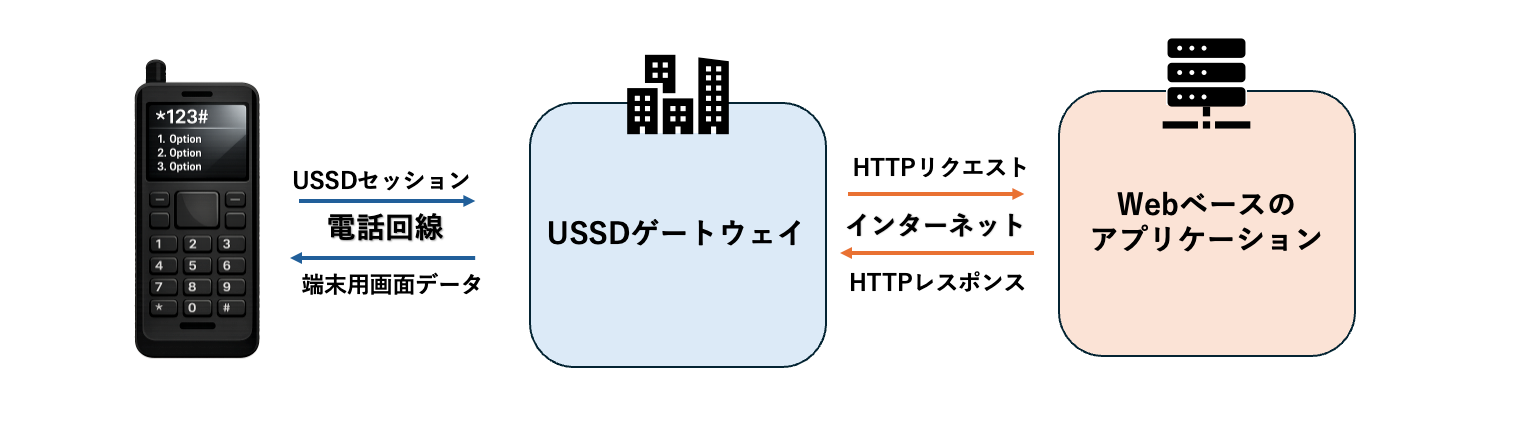
Using an internet service over USSD requires going through an operator known as a USSD gateway. Usually, the mobile carrier serves as the USSD gateway.
The USSD gateway receives what the user enters on their phone, converts the request into HTTP, and sends it to the web service provider. Responses travel the same way: the gateway receives them over HTTP, converts them into screen data for the phone and relays them, so the user sees a simple text-based UI on their handset.
In this way, the USSD protocol and USSD gateways bridge the mobile network and the internet.
In Japan, places with phone lines almost always have internet access too, so there is little demand for USSD and it is hard to become a USSD gateway. In Africa, where internet infrastructure is lacking, USSD can serve as essential everyday infrastructure, and it is relatively easy to become an operator.
How Machankura uses USSD
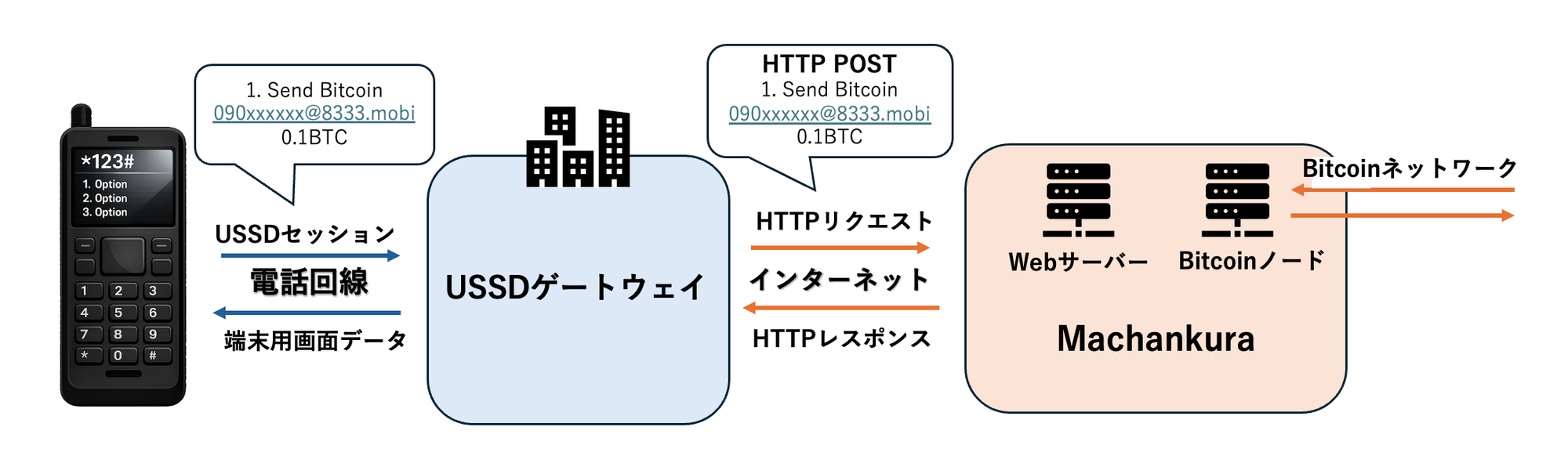
Mobile carriers in each African country act as the USSD gateways. When a user dials one of the USSD codes mentioned above, the USSD gateway uses that code to establish a session with Machankura's servers. Whatever the user does on their phone during the session is passed through the USSD gateway and sent to Machankura's servers as HTTP requests. The servers then return information or execute transfers depending on the request.
For bitcoin transfers, Machankura runs its own Bitcoin and Lightning nodes, and payments are sent over Lightning through those nodes. In other words, the service is currently fully custodial: it depends entirely on Machankura for managing each user's private keys and for the channel and liquidity management behind payments.
However, Ngako also sees problems with running a custodial service, and he has a vision for what comes next.
Machankura 2.0: toward self-custody
In African countries, unstable yet powerful governments may put pressure of one kind or another on companies that provide custody services for crypto assets.
For example, when Nigeria's currency, the naira, plunged in 2024, the government made cryptocurrency the scapegoat for it. It ordered telecom operators to block access to Binance, and detained company executives, effectively holding them hostage while demanding user data and an enormous sum of money.
In Africa, running a custodial crypto service risks exposing not only the operator but also the users who entrust their funds to it to state-led pressure.
That is why Machankura is working on the "Bitcoin Java Card project," which aims to make self-custody possible even on basic phones [8].
What is the Bitcoin Java Card project?
Java Card is a Java environment that runs on small chips such as SIM cards. SIM cards also function as secure elements, which makes them well suited to managing private keys. Taking advantage of these properties, the private key can be stored inside the SIM card, and signing and other functions can be programmed onto the chip, allowing it to work as a self-custody wallet.
Java apps running on Java Card come with many constraints, so it seems the team is still working through the technical challenges.
Conclusion: Bitcoin evolving under infrastructure constraints
Machankura is a wallet service that brings bitcoin payments to parts of Africa where the internet has not yet spread, using USSD, a mobile phone protocol. Rather than giving in to the limits of its environment, it keeps tackling the problem through technology, drawing on protocols and features like USSD and Java Card.
Personally, rather than passing buzzwords like "Bitcoin as the currency of AI," I'm hopeful about Machankura as a service that supports what Bitcoin is fundamentally for: a tool that makes people free.
I look forward to Machankura's future updates and plan to keep following its progress.
References
[1] “Machankura” 8333.mobi. Available: https://8333.mobi/
[2] “Facts and Figures 2025: Internet Use,” International Telecommunication Union (ITU). Available: https://www.itu.int/itu-d/reports/statistics/2025/10/15/ff25-internet-use
[3] “In Africa only 37 per cent of the population has access to the internet,” Afrinz. Available: https://afrinz.ru/en/2025/04/undp-in-africa-only-37-per-cent-of-the-population-has-access-to-the-internet/
[4] “Mobile Phone Penetration in Africa,” GeoPoll. Available: https://www.geopoll.com/blog/mobile-phone-penetration-africa/
[5] “Mobile Money’s Impact on Economic Growth in Five African Markets,” GSMA. Available: https://www.gsma.com/solutions-and-impact/connectivity-for-good/mobile-for-development/blog/mobile-moneys-impact-on-economic-growth-in-five-african-markets/
[6] “USSD — Architecture Analysis, Security Threats, Issues and Enhancements,” IEEE Xplore. Available: https://ieeexplore.ieee.org/document/8286115/authors
[7] “How USSD Works,” Django USSD Airflow Documentation. Available: https://django-ussd-airflow.readthedocs.io/en/latest/how_ussd_works.html#why-ussd-airflow
[8] “Machankura Overview,” Binance Square. Available: https://www.binance.com/en/square/post/5570861376186