How to Verify Dice-Generated Seed Phrases on SeedSigner

This article was translated from Japanese with AI. Read the original (日本語) · Report a translation issue
Since the Coldcard incident, more people have become interested in generating their own randomness to create a seed phrase instead of relying on the random number generator built into a hardware wallet (HWW). Randomness you generate yourself isn't affected by bugs or failures in a random number generator like the one behind the Coldcard incident, so it removes one thing you have to trust.
If you want to catch up on the Coldcard random number vulnerability incident, see the article below.
【重要】COLDCARDユーザーの方へ|シード生成に脆弱性の影響範囲と移行の判断基準
2021年3月配信のCOLDCARDファームウェア4.0.x以降、シード生成が脆弱な乱数経路を通っていたことが判明しました。2026年8月時点で現行機種を含む広範囲が対象です。該当条件の確認方法と、慌てずに移行を進めるための手順をまとめました。
 運営
There are many ways to generate your own randomness: dice, playing cards, mouse cursor movements, image data, and more. Dice are currently the standard way to generate a seed phrase. If you want to learn the practical steps, see the article below as well.
セルフカストディは最初が肝心|サイコロ・トランプで安全なシードフレーズを生成する実践ガイド
Coldcardの乱数生成における脆弱性を受けて関心が集まっている、サイコロやトランプによるBIP39シードフレーズの生成について、その安全性の根拠となる数学とともに、実際の生成手順を紹介します。その上で、機械に生成させたエントロピーと比較したトレードオフについても解説します。
 加藤 規新

Generating a seed phrase from dice rolls (hereafter "dice entropy"), the standard method, has one major drawback. Because the dice entropy is fed into a hash function (SHA256) to create the seed phrase, you can't verify after the fact whether your dice entropy was actually used.
With a malicious or defective HWW, there is a nonzero chance that the device ignores the result of passing your dice rolls through SHA256 and uses output from some other, weak random number generator instead.
In this article, I'll use SeedSigner to explain how to cross-check whether a seed phrase generated from dice entropy, the most standard method, really is based on that dice entropy. Specifically, if the same dice entropy produces the same seed phrase on SeedSigner and in a web app, you can confirm that your dice entropy was actually used.
I also walk through the verification on video, so feel free to use it as a reference.
💡
Seed phrases generated from dice entropy on a Coldcard can be verified the same way. See the Bitcoin Research Lab YouTube video. (The video uses "double-check" and "cross-check" interchangeably, but "cross-check" seems to be the more accurate term.)
Why cross-check your dice entropy?
*If you want to try it right away, skip ahead to "Cross-checking with SeedSigner in practice."
Before actually cross-checking dice entropy, let's look at why a cross-check matters in the first place.
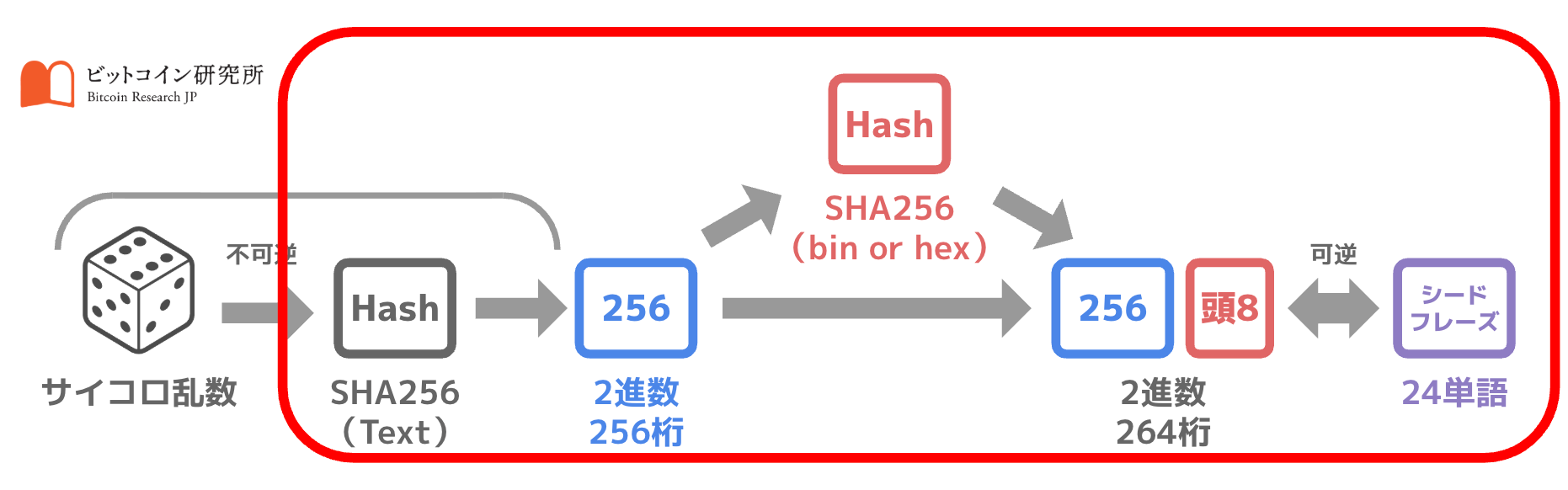
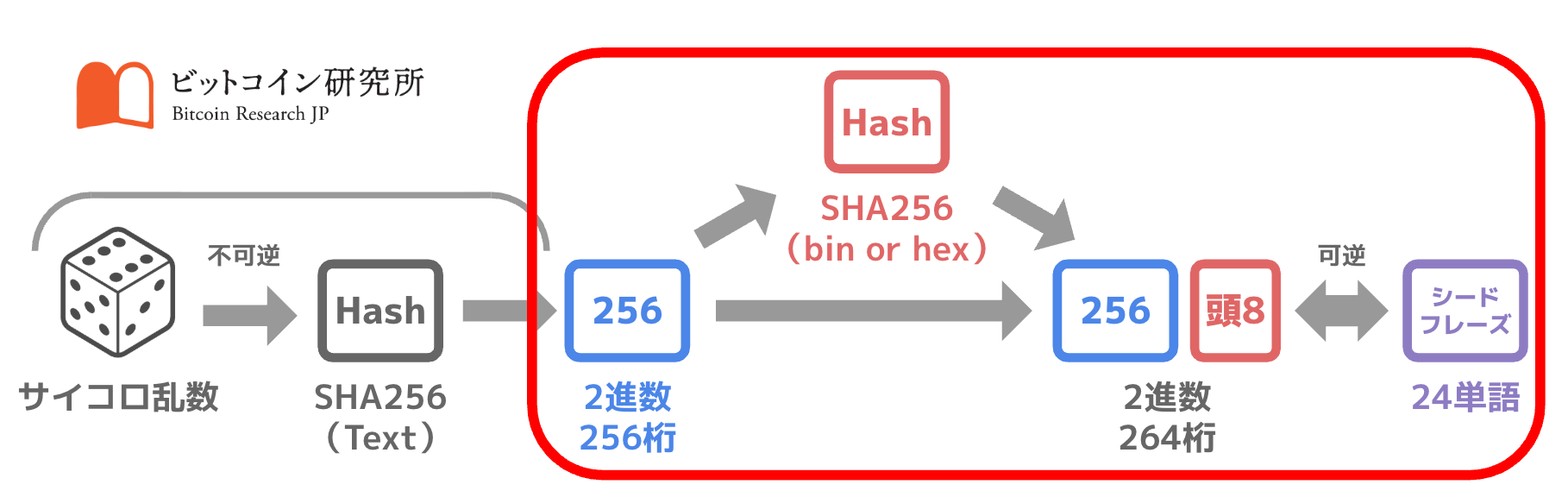
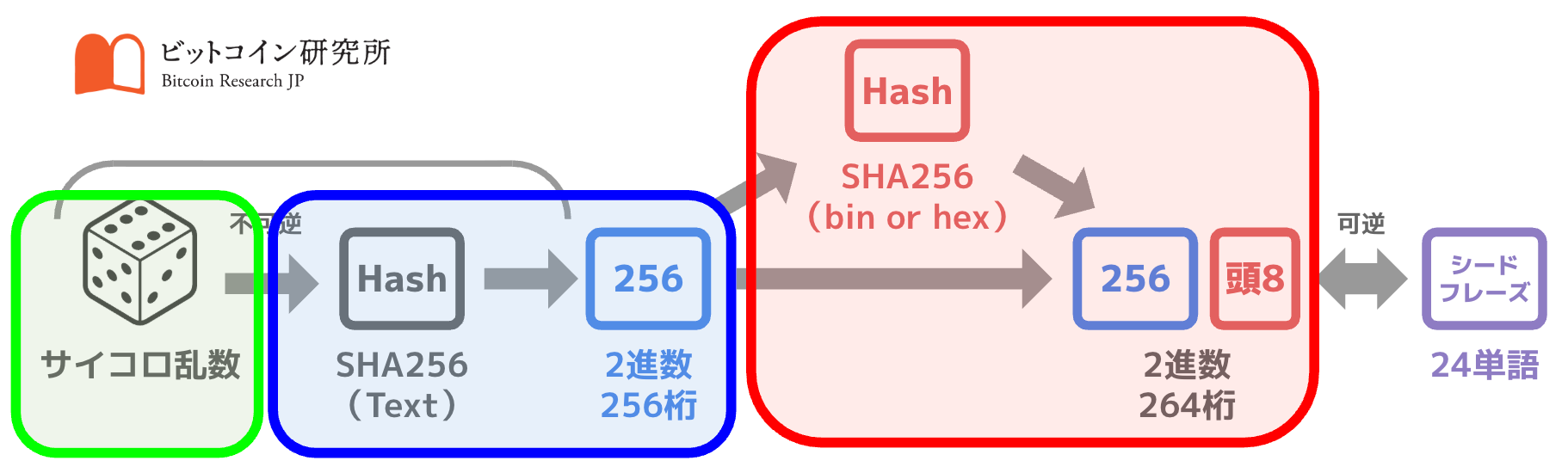
The diagram below shows how a 24-word seed phrase is created.
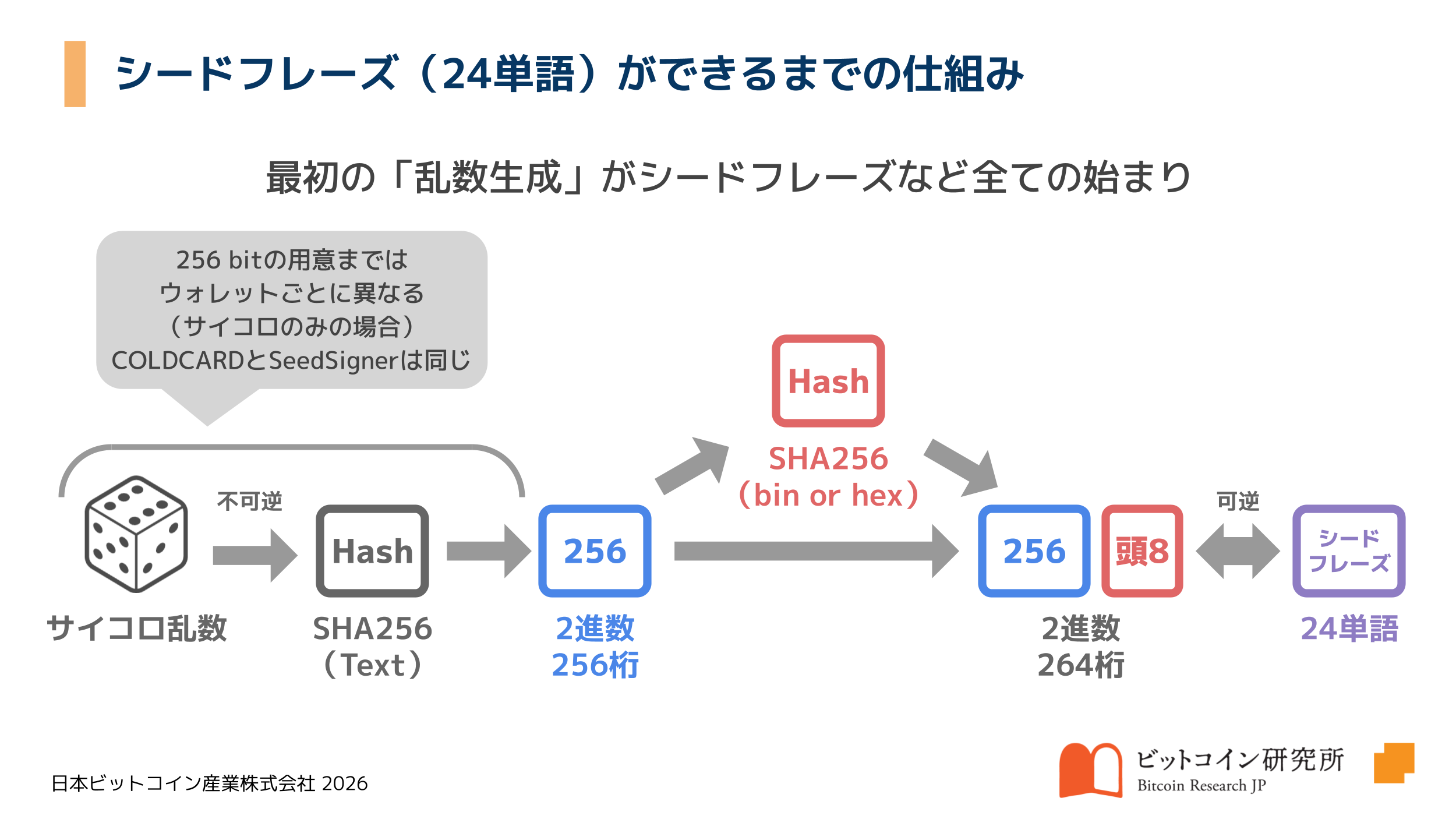
Let's go through the flow from left to right.
- Dice entropy: Roll a die at least 99 times and enter the results (99 rolls equal 256 bits of entropy)
- Hash SHA256 (Text): The dice entropy is fed into the SHA256 function as a text string
- 256 bits (256 binary digits): The SHA256 output from step 2 is 256 bits
- Hash SHA256 (bin or hex): The 256 bits from step 3 are fed into the SHA256 function as bin (binary) or hex (hexadecimal)
- (256 + first 8) bits (264 binary digits): The first 8 bits from step 4 are appended to the 256 bits from step 3 to make 264 bits
- Seed phrase (24 words): 264 bits ÷ 24 words = 11 bits, so each word represents 11 bits
The only function-like processing that requires a computer is SHA256, the hash function used in many places, including Bitcoin mining.
SeedSigner and Coldcard happen to generate "3. 256 bits (256 binary digits)" from dice entropy in the same way, but you could also create "256 bits (256 binary digits)" directly by flipping a coin (0 or 1) 256 times. How "3. 256 bits (256 binary digits)" is produced differs from wallet to wallet.
When you actually create a seed phrase from dice entropy on SeedSigner or Coldcard, you enter your dice rolls (the "dice entropy" on the far left), the device processes them internally, and the "seed phrase" on the right suddenly appears on the screen. However, it's difficult to verify after the fact whether the displayed seed phrase was really generated from your dice entropy.
Specifically, there are risks like the following.
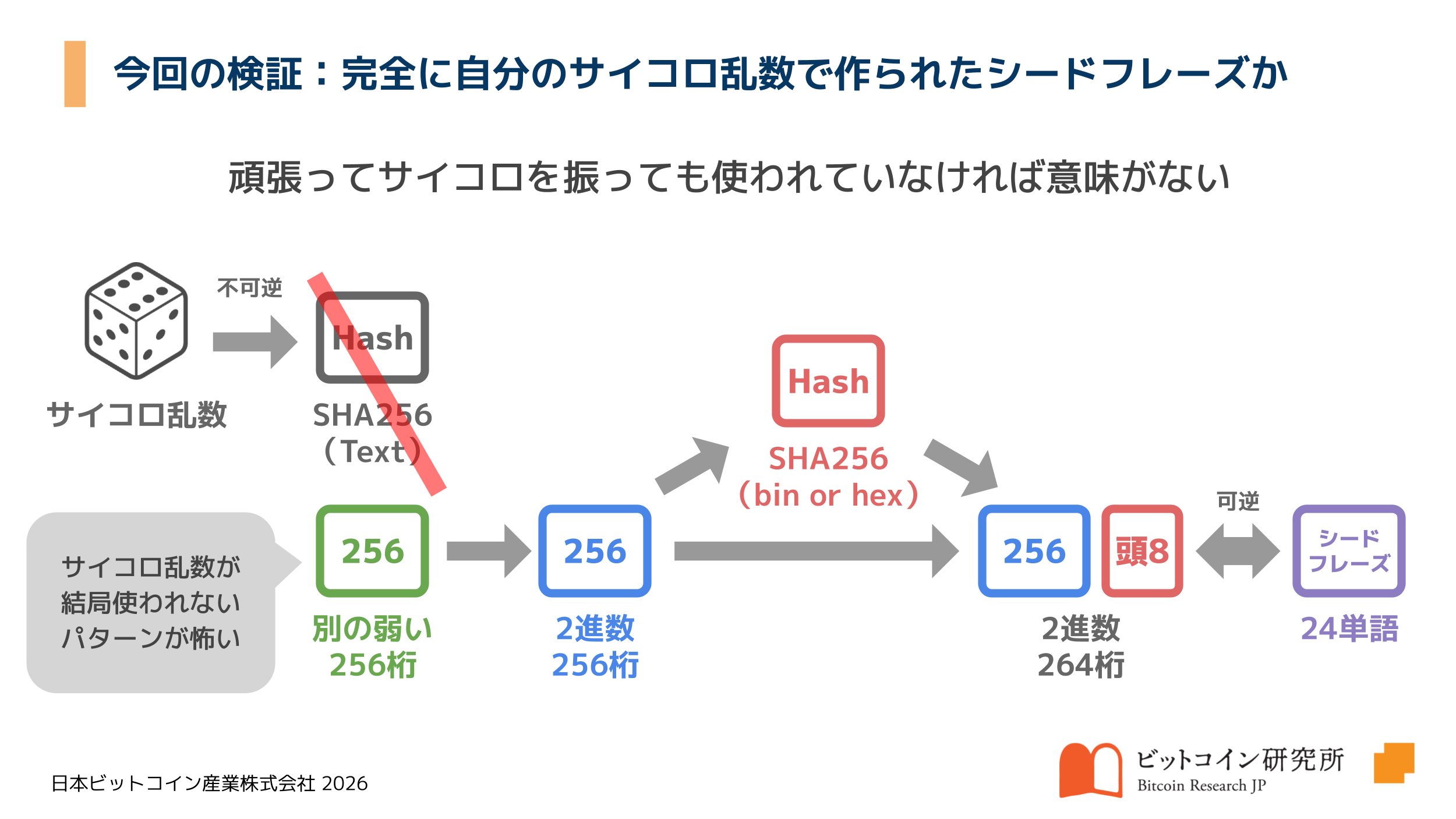
The SHA256 output from your dice entropy is irreversible and looks like a random string of digits, so even if it were swapped for the weak 256 bits shown in green, you would have no way of noticing.
So far, no incident like the one in the diagram above, where the dice entropy ends up not being used, has been confirmed. But a seed phrase created on a wallet you've cross-checked is insulated from random number vulnerabilities that could emerge in the future.
A cross-check also lets you catch, in advance, fake firmware with a backdoor in seed phrase generation, or bugs introduced by an update.
Where the Coldcard random number vulnerability went wrong
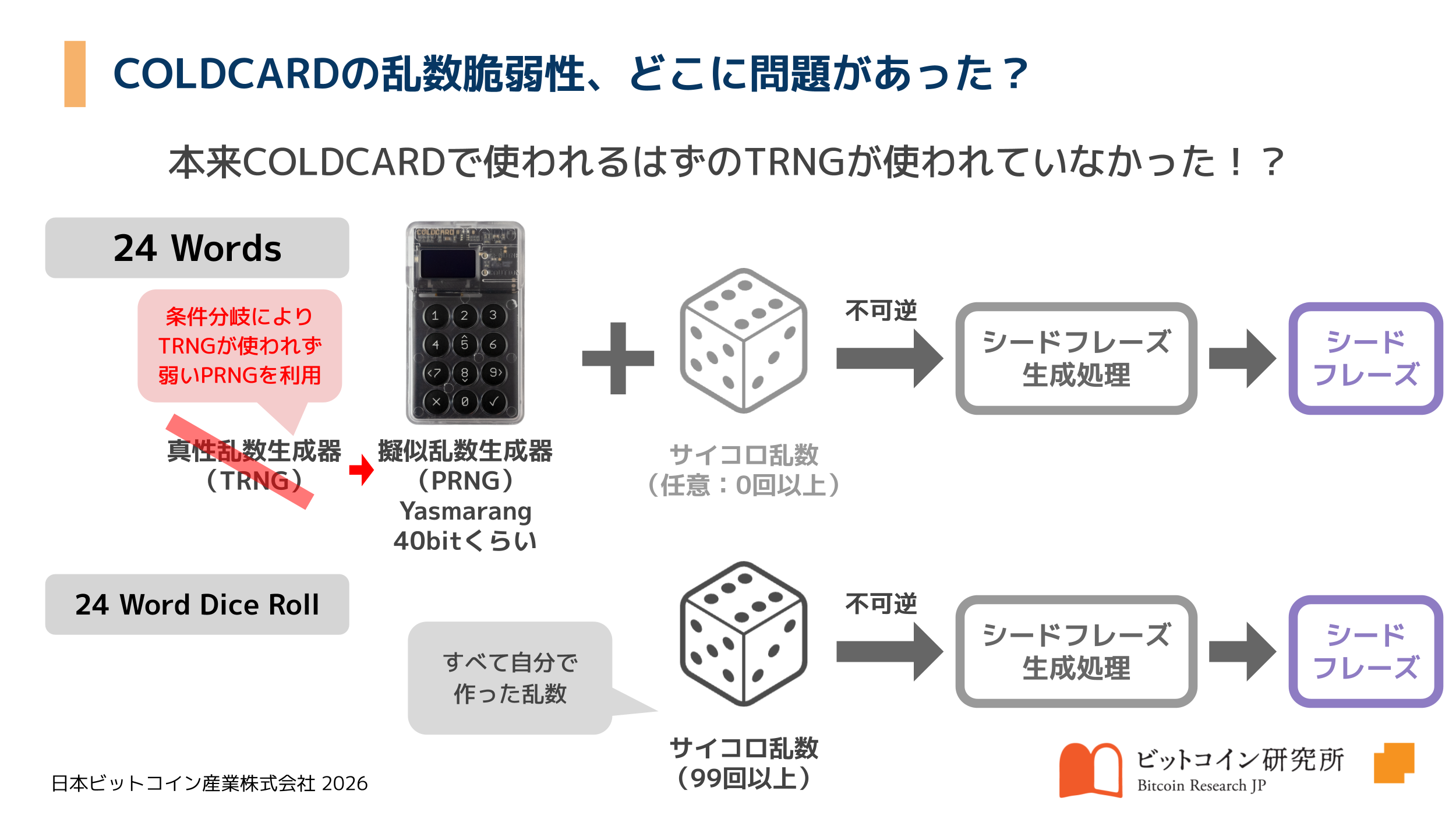
Coldcard offered the following seed phrase generation methods.
- 12 words
- 12 Words
- 12 Word Dice Roll
- 24 words
- 24 Words
- 24 Word Dice Roll
If X is the number of words, there are two options: "X Words" and "X Word Dice Roll." The latter, "X Word Dice Roll," requires rolling dice and was considered an option for advanced users, so presumably a larger share of people used the former, "X Words."
With "X Words," the hardware's built-in true random number generator (TRNG) was supposed to generate random numbers, with the option to add dice entropy. However, because of a conditional branch in the code, the TRNG wasn't used. Instead, a pseudorandom number generator (PRNG), whose search space can be narrowed down to some degree, was used.
As a result, the randomness (entropy) was only about 40 bits on the Mk3 and about 72 bits on the Mk4 and later. When 128 bits is enough for seed phrase generation, 40 bits is a very low level.
On the other hand, seed phrases generated with "X Word Dice Roll" were fine, because the built-in hardware randomness wasn't used at all and a minimum number of dice rolls was required.
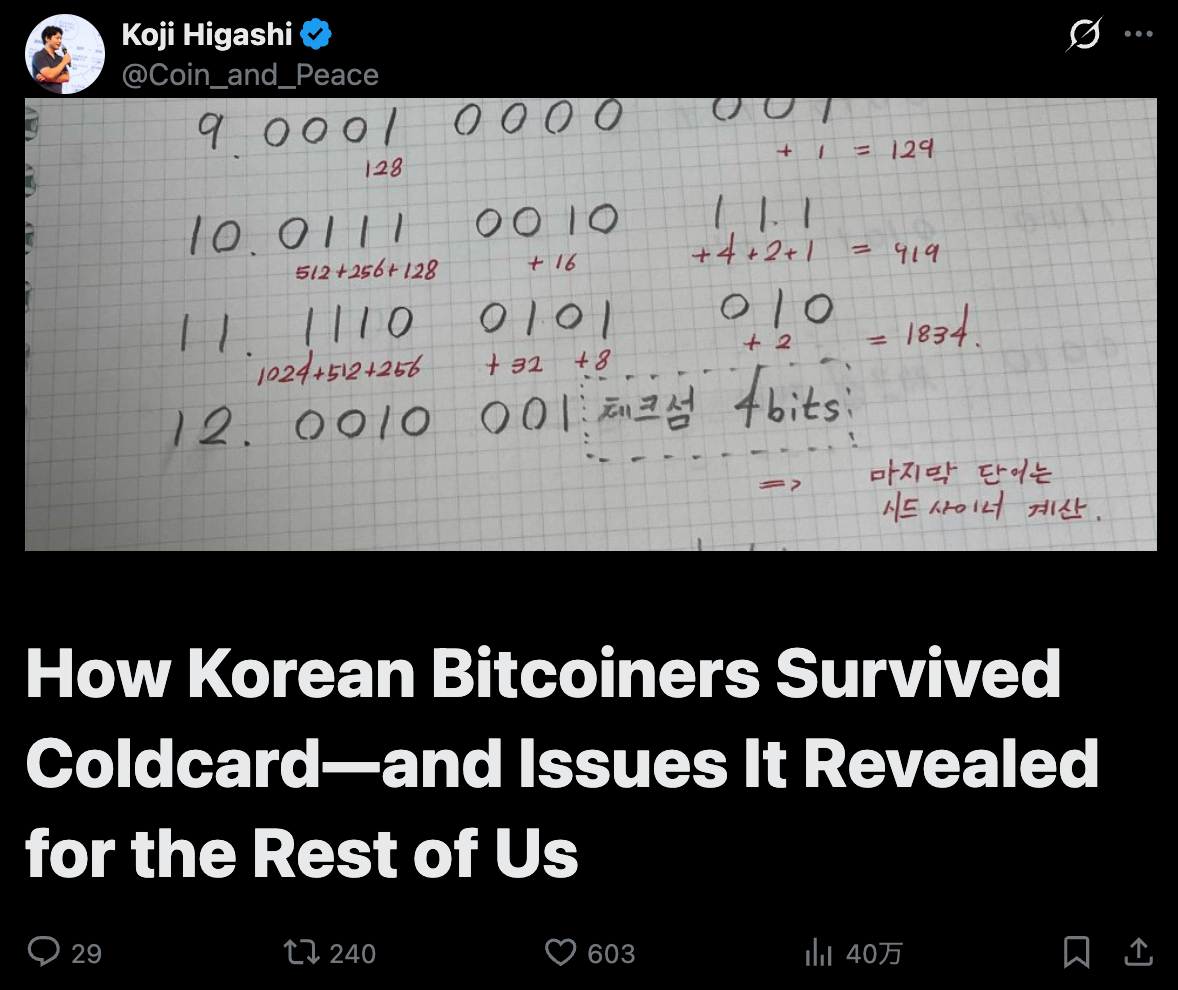
Partly because generating seed phrases from dice had been recommended in South Korea, there were reportedly few victims of the Coldcard incident there.
Cross-checking with SeedSigner in practice
We've covered why cross-checking dice entropy matters.
Next, let's actually do a cross-check with SeedSigner. Cross-checking means creating a seed phrase on SeedSigner from dice entropy, then using the same dice entropy in a third-party app, on the web or elsewhere, to confirm that it outputs the same seed phrase.
If you get the same seed phrase, you've confirmed that the seed phrase generation on your SeedSigner is working correctly.
Incidentally, Coldcard works the same way, so you can cross-check it too. If you have an HWW, give it a try.
💡
Caution: The dice entropy and seed phrase used for the cross-check may leave traces in digital form, so never use them for real.
The cross-check verifies the part of the HWW that generates seed phrases from dice entropy. If it behaves the same way, you can treat seed phrases you create after the cross-check as equally safe.
1. Generate dice entropy
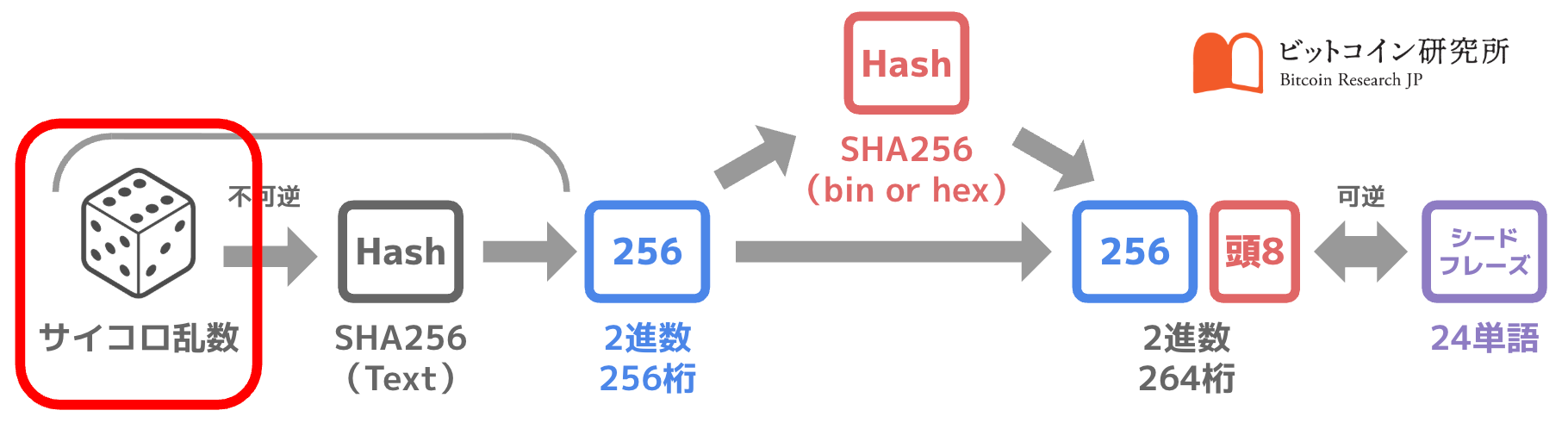
First, record 99 dice rolls on paper, on a PC, or elsewhere. Use a six-sided die. (We record 99 rolls because we're making 24 words.)
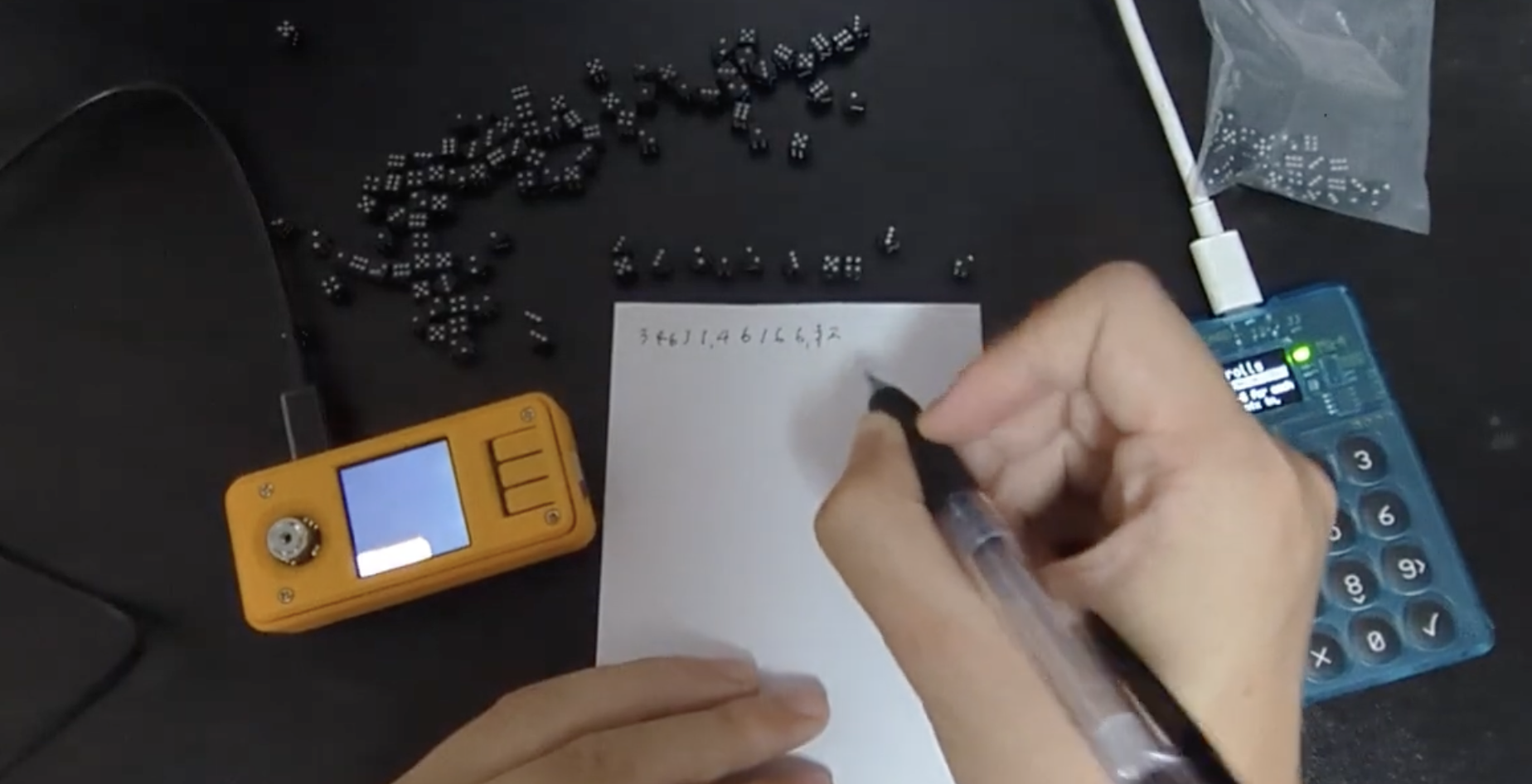
Here are the 99 dice rolls I generated.
346314616632343521235326436331312443521254515431641554542166543251122545154245653432165642544226231
2. Generate a seed phrase on SeedSigner
Next, generate a seed phrase on SeedSigner.
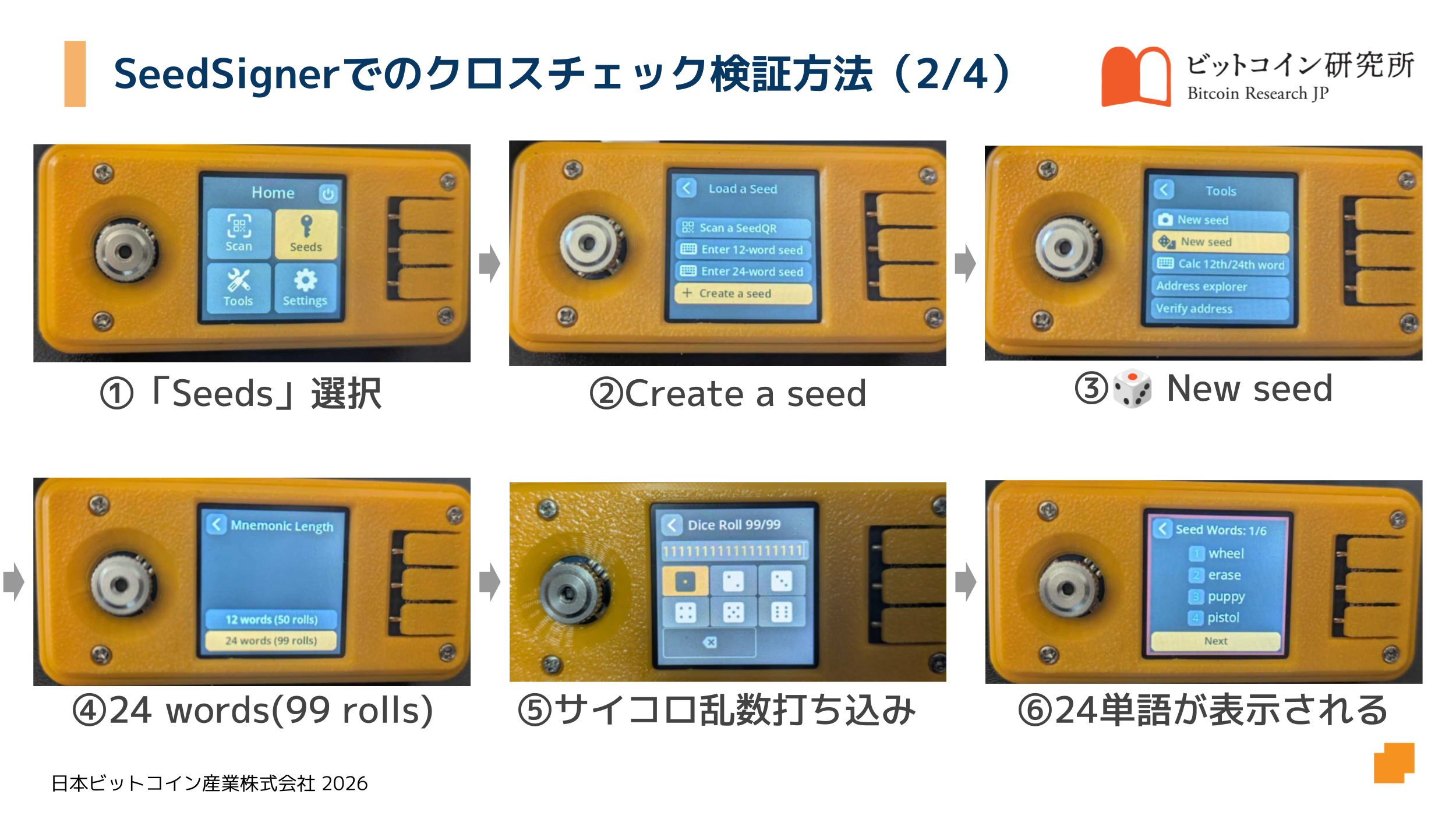
Navigate as shown in the figure above and enter the dice rolls you recorded earlier.
SeedSigner lets you go back and correct entries, so check for mistakes as you go.
Here's the seed phrase my device produced.
cable exclude they twice sugar delay exist female improve beauty bring betray awful vivid beyond cool rib napkin melody traffic taxi glue market tiny
3. Cross-check whether the seed phrase matches in a web app
For the cross-check, use a third-party app on the web to confirm that it outputs the same seed phrase.
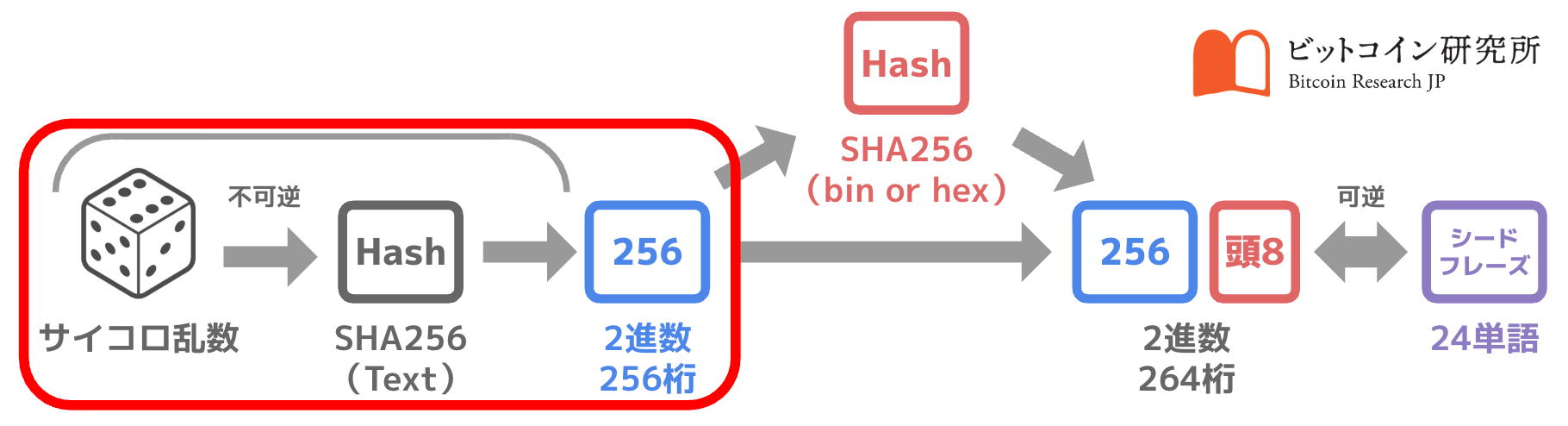
Since we already have the dice entropy, we'll proceed through the SHA256 (Text) step. You can compute SHA256 on any site or in Terminal. In this article, I'll use the site below.
Sha256 Algorithm Explained
Sha256 algorithm explained online step by step visually

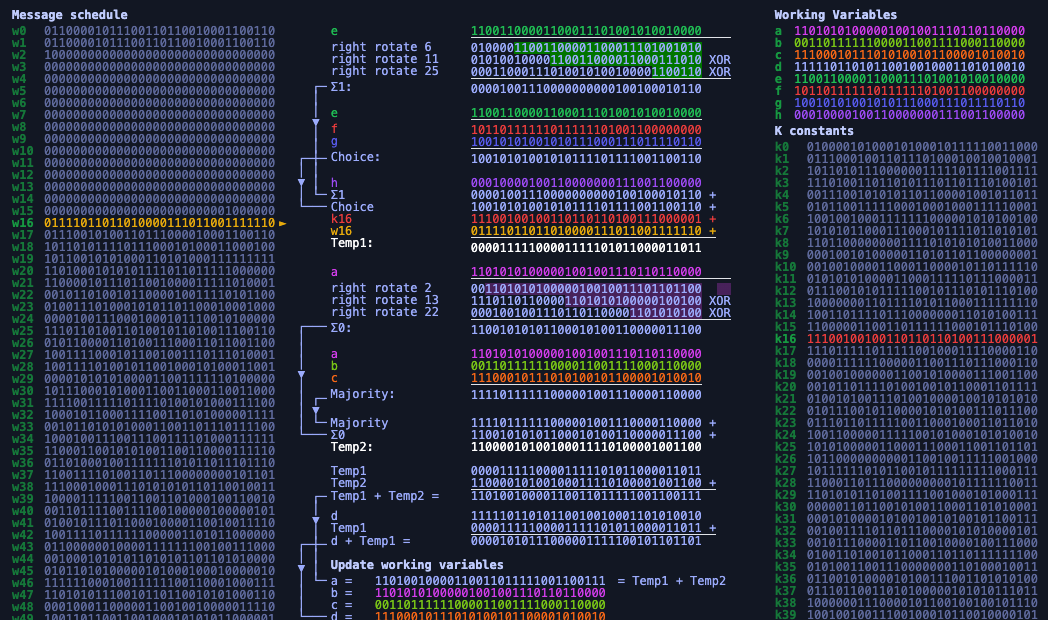
Any other SHA256 tool works too
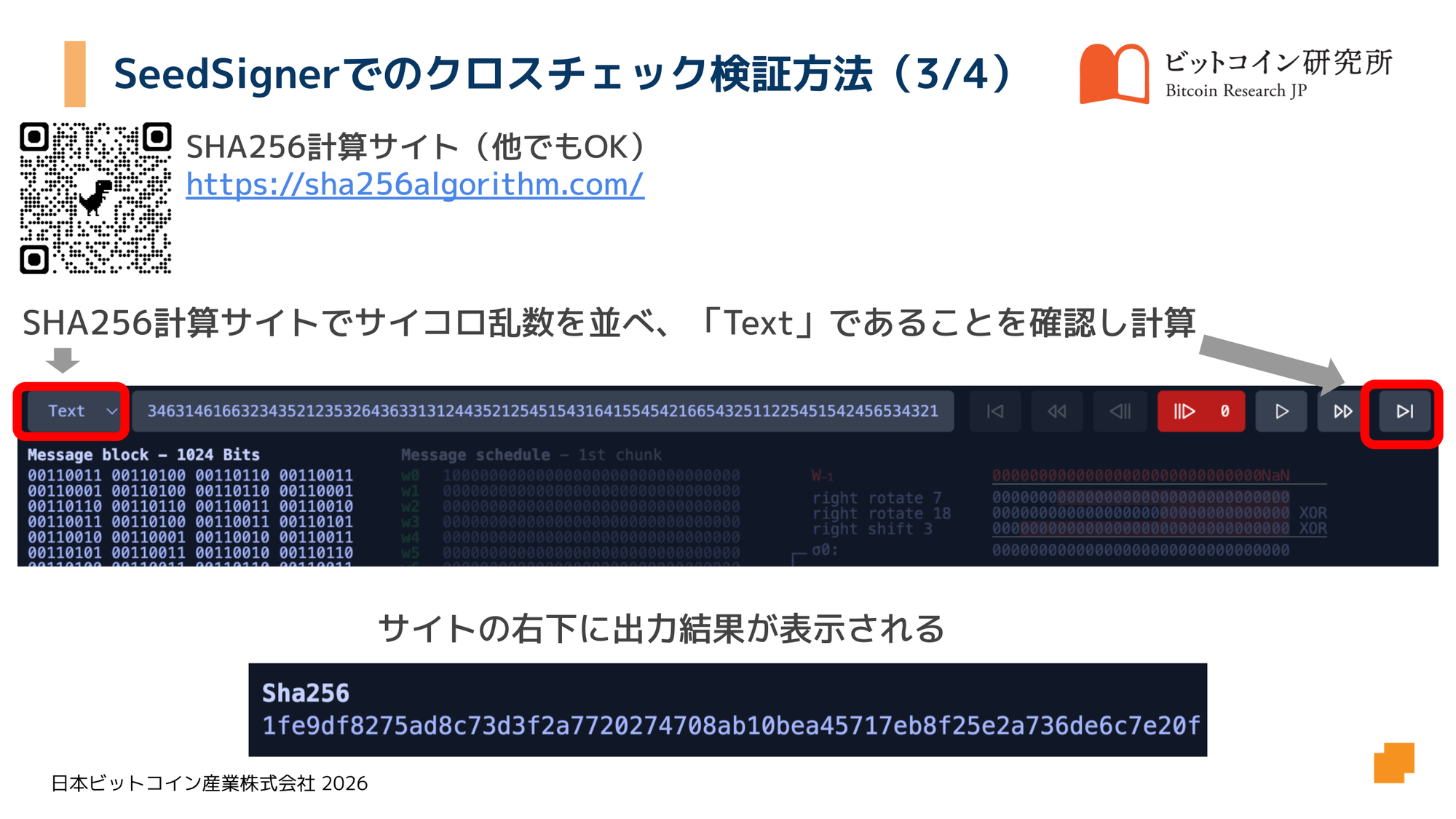
The SHA256 result changes depending on the input type, so make sure it's set to "Text." Note down the hexadecimal output (256 digits in binary).
1fe9df8275ad8c73d3f2a7720274708ab10bea45717eb8f25e2a736de6c7e20f
Finally, enter it on a site called "Mnemonic Code Converter" to output the seed phrase.
💡
Ian Coleman is the developer of the BIP39 mnemonic code converter. He is a software developer known for his expertise in security. The tool is open source and works offline, so it's widely used to verify seed phrases.
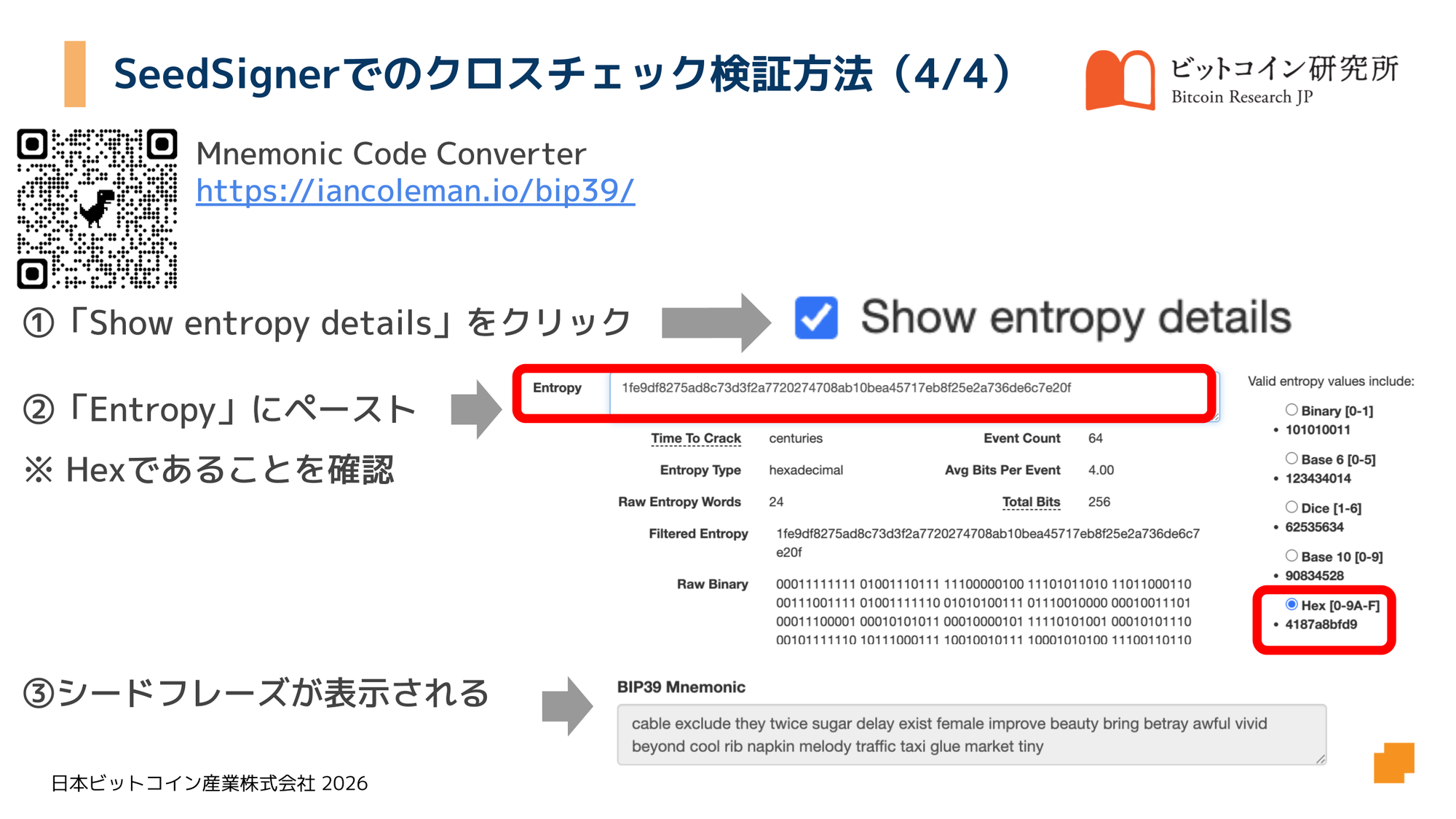
As shown in the figure above, the following steps output the seed phrase.
- Click "Show entropy details"
- Paste into "Entropy"
If it matches the SeedSigner output, the cross-check is complete. You've now confirmed that the dice-based seed phrase generation on your SeedSigner works correctly.
cable exclude they twice sugar delay exist female improve beauty bring betray awful vivid beyond cool rib napkin melody traffic taxi glue market tiny
Quick cross-check (for SeedSigner)
The dice entropy cross-check above has a few drawbacks.
- You can make typos when entering the dice rolls
- It takes time and is tedious (for example, checking after every firmware update is a chore)
With SeedSigner, there's an even easier way to cross-check: enter values without rolling any dice.
💡
Coldcard won't output a seed phrase from low-randomness input, so you can't do the same thing there. You can check the SHA256 output shown in small text before the seed phrase is displayed, but you can't confirm that the seed phrase is actually generated from it.
For example, enter all "1"s as the dice entropy on SeedSigner.
111111111111111111111111111111111111111111111111111111111111111111111111111111111111111111111111111
Cross-check it in the web app the same way, and you can confirm that the seed phrases match.
[SHA256 output]
fa098eb852b2660348b21bb00ad03a49cc177ea07ebe34f46b40baa85313525e
[24 words]
wheel erase puppy pistol chapter accuse carpet drop quote final attend near scrap satisfy limit style crunch person south inspire lunch meadow enact tattoo
Using the same number throughout makes typos unlikely and saves time.
If you're still uneasy, you can vary the check, for example by using all "6"s, or 50 "1"s followed by 49 "2"s. Personally, I think the quick cross-check is enough.
Advanced verification: without Mnemonic Code Converter
Unlike the quick cross-check introduced above, advanced verification takes more time. On the other hand, it lets you cross-check without using the Mnemonic Code Converter site.
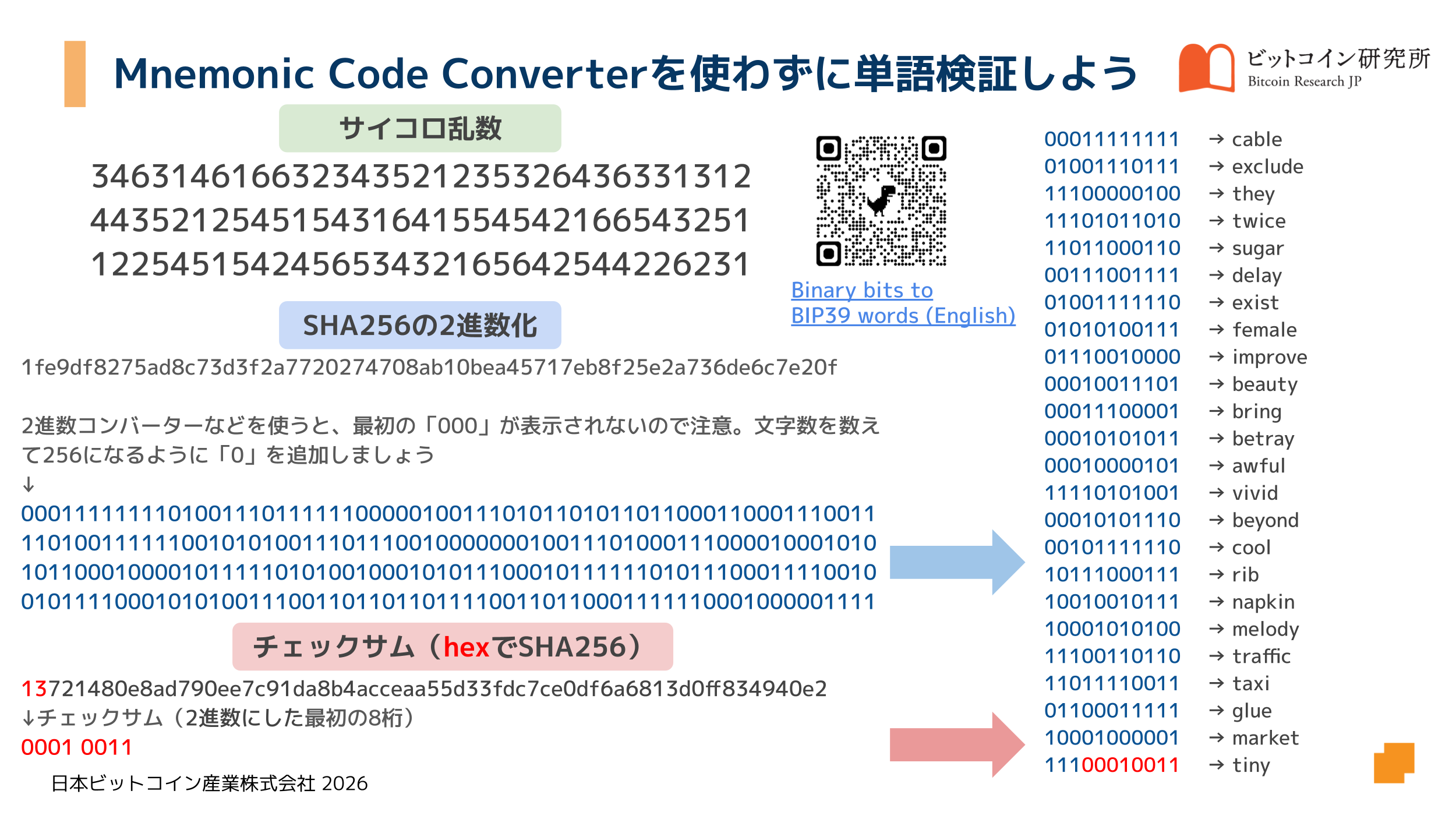
Specifically, the steps are the same as in "3. Cross-check whether the seed phrase matches in a web app" up through SHA256 (Text), and then you map the chunks of 0s and 1s to seed words by hand.
First, prepare the SHA256 (Text) output from the dice entropy.
[Dice entropy]
346314616632343521235326436331312443521254515431641554542166543251122545154245653432165642544226231
[SHA256 (Text) output]
1fe9df8275ad8c73d3f2a7720274708ab10bea45717eb8f25e2a736de6c7e20f
Next, convert the hexadecimal output to binary. You can use a conversion site on the web or Terminal, or convert each digit to binary by hand.
1111111101001110111111000001001110101101011011000110001110011110100111111001010100111011100100000001001110100011100001000101010110001000010111110101001000101011100010111111010111000111100100101111000101010011100110110110111100110110001111110001000001111 (253 characters)
One thing to watch out for here: leading "0"s may not be displayed. So count the characters, and if there are fewer than 256, add 0s to the front until there are 256.
0001111111101001110111111000001001110101101011011000110001110011110100111111001010100111011100100000001001110100011100001000101010110001000010111110101001000101011100010111111010111000111100100101111000101010011100110110110111100110110001111110001000001111 (256 characters)
Next, prepare the first 8 digits of the checksum. Hash the SHA256 (Text) output "1fe9df8275ad8c73d3f2a7720274708ab10bea45717eb8f25e2a736de6c7e20f" again with SHA256 (Hex). Note that this time it's Hex, not Text.
13721480e8ad790ee7c91da8b4acceaa55d33fdc7ce0df6a6813d0ff834940e2
You could convert the whole thing to binary, but you only need the first 8 digits, so just convert the first two hex digits, "13," to binary.
13 (hex)
↓
00010011 (bin)
Now you have everything you need. Join the 256 binary digits and the 8 binary digits (the checksum), split them into groups of 11 digits, and convert each group into a word.
For the conversion, "Binary bits to BIP39 words," made by Bitcoin Research Lab author Kishin Kato, is easy to use, but the standard BIP39 Word List works too. (With the latter, the numbering doesn't start at 0, so you have to shift by one and convert the binary back to decimal, which is a bit more work.)
00011111111 cable
01001110111 exclude
11100000100 they
11101011010 twice
11011000110 sugar
00111001111 delay
01001111110 exist
01010100111 female
01110010000 improve
00010011101 beauty
00011100001 bring
00010101011 betray
00010000101 awful
11110101001 vivid
00010101110 beyond
00101111110 cool
10111000111 rib
10010010111 napkin
10001010100 melody
11100110110 traffic
11011110011 taxi
01100011111 glue
10001000001 market
11100010011 tiny
As a diagram, it looks like this.
Advanced verification is time-consuming and laborious, but it doesn't depend on the Mnemonic Code Converter site, and it deepens your understanding of how seed phrases are generated. I recommend trying it once as a kind of independent study project when you have some time.
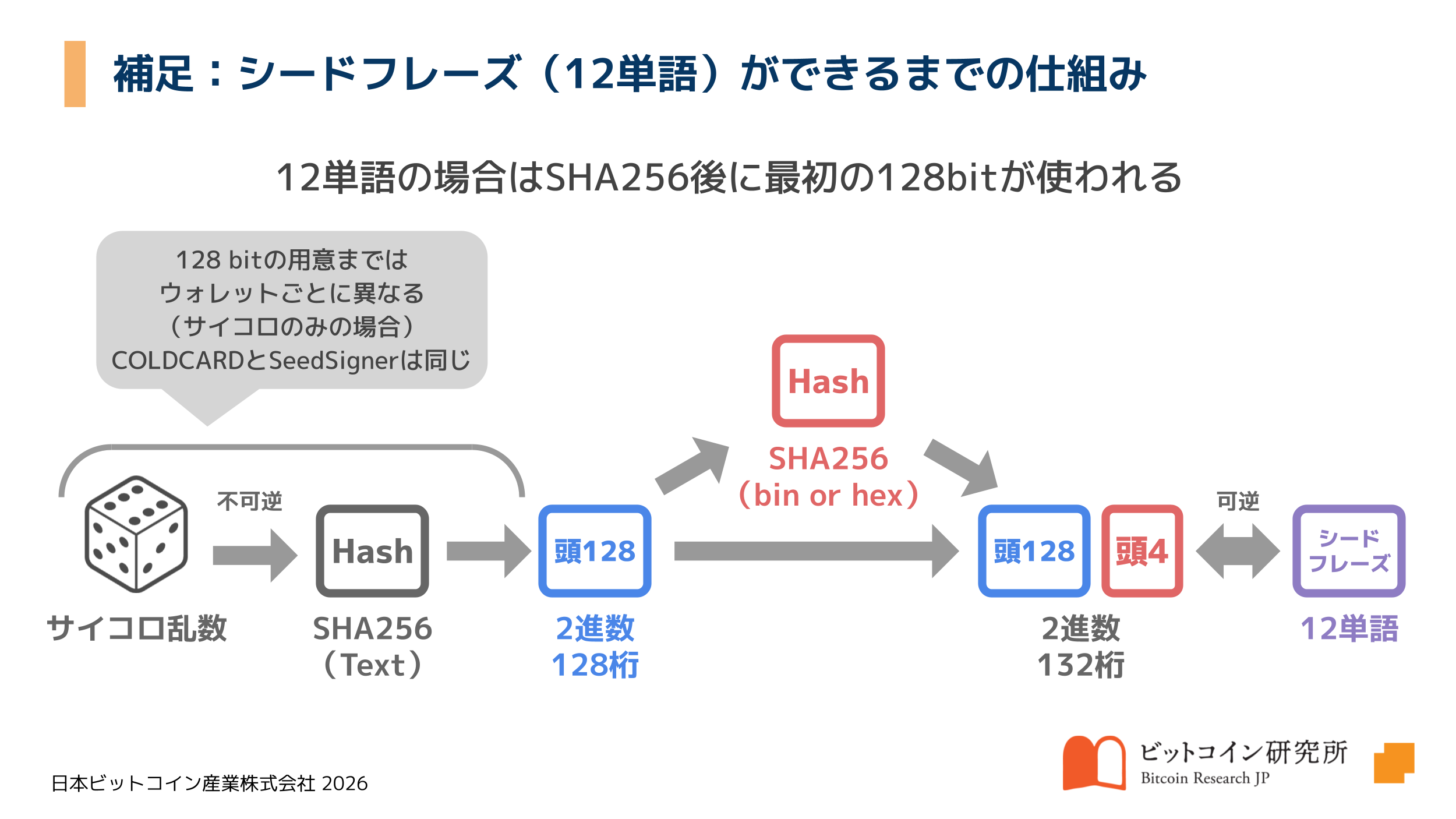
12 words use half: 128 digits
So far we've worked with 24 words. For 12 words, the first half of the SHA256 (Text) output is used. Since that means 128 bits are used, the maximum entropy of a 12-word phrase is 128 bits.
The rest of the process is the same.
I'll skip the actual verification here, but I encourage you to try a 12-word cross-check yourself.
Summary: Cross-check, then create your seed phrase from your own randomness
Once dice entropy passes through SHA256 inside SeedSigner or Coldcard, it becomes a black box, and you can't confirm after the fact whether your dice rolls were actually used. The cross-check introduced in this article is a procedure for checking that black-boxed part before you use a seed phrase for real.
The process itself is simple: enter the same dice entropy into both SeedSigner and a web app, and compare the seed phrases they output. Even the quick check with all "1"s works, so you can skip rolling a die 99 times and avoid the risk of typos.
This step doesn't affect the seed phrase you actually use, but if you run it once after every firmware update, you can keep confirming that no unintended changes have crept into the random number generation.
This article used SeedSigner as the example, but you can cross-check a Coldcard using the same approach. If you create seed phrases from dice entropy, try this once before using one for real.