How to Safely Store Your Bitcoin Seed Phrase: Dos and Don'ts

This article was translated from Japanese with AI. Read the original (日本語) · Report a translation issue
Plenty of people have set up a Bitcoin hardware wallet but still feel uneasy about how to store their seed phrase (also called a mnemonic phrase).
Even if the wallet itself is kept somewhere safe, losing your seed phrase or letting someone else see it could leave you unable to recover your funds, or let them be stolen. In other words, protecting the seed phrase matters just as much as protecting the wallet.
This article is a definitive guide to storing your seed phrase. We'll walk through the risks and introduce safe, practical storage methods step by step.
From the mistakes you should never make to paper, metal plates and the idea of distributed storage, everything is explained in a way beginners can follow.
What is a seed phrase?

A seed phrase is something like a password for restoring a Bitcoin wallet, typically made up of 12–24 English words.
This sequence of words acts as a kind of master key from which the wallet generates its private keys. That means if you enter the seed phrase into another device or another compatible wallet, it will generate the same private keys and restore your wallet.
Under the hood, a seed phrase is a random sequence of unique 11-bit numbers (entropy) converted into words using the BIP-39 standard. Each 11-bit number corresponds to one of 2,048 English words, so 128 bits = 12 words and 256 bits = 24 words.
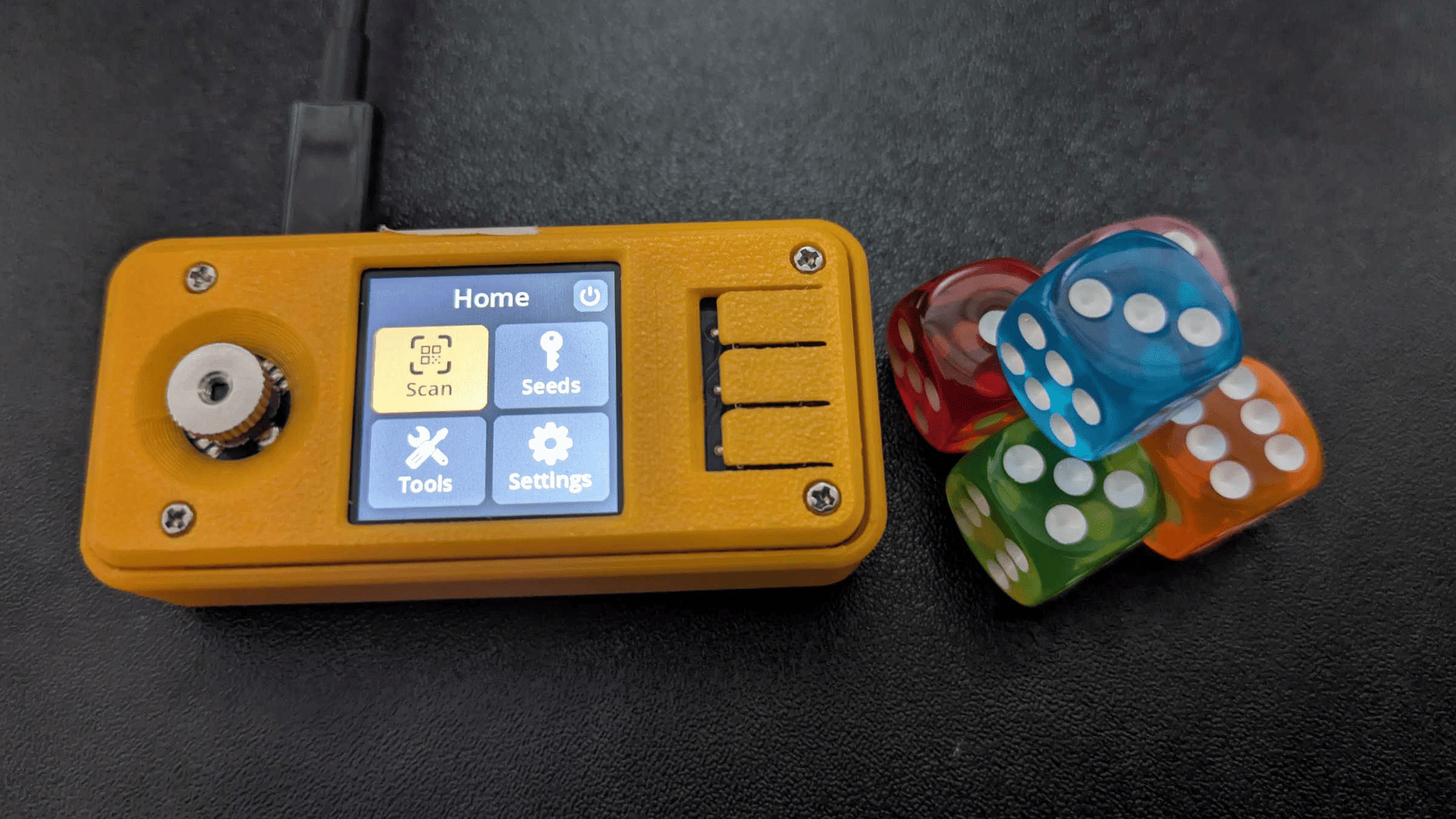
Bitcoin Research Lab has published related articles on seed phrases, including Kishin Kato's piece on the security of generating random numbers with dice and an article on the Milk Sad vulnerability, one of the vulnerabilities caused by insufficient entropy. Take a look if you want to dig deeper.
 加藤 規新
 加藤 規新

Best practices for storing your seed phrase
The basic principle of seed phrase storage is to break the risks down and eliminate them one by one. Your seed phrase is exposed to many threats, including loss, theft, disasters and scams, so the first priority is to follow the fundamentals in order.
Here are the best practices for storing your seed phrase.
- Write your seed phrase by hand on paper or metal
- Store things in physically separate places
- Protect the wallet itself with a PIN
- Never share your seed phrase with anyone, no matter what
1. Write your seed phrase by hand on paper or metal

When you create a Bitcoin wallet, the wallet first displays a 12- or 24-word seed phrase on screen. Copy this seed phrase onto paper or metal.
Paper is convenient, but it's vulnerable to fire, water and deterioration. If long-term storage and disaster risk are big concerns for you, a durable metal plate is a strong option. Whichever you choose, what matters is recording the words in the correct order and in a form that can't be misread. A single mistake in writing can lead to the worst possible outcome: being unable to recover your wallet. So take your time and do it carefully.
Also, storing your seed phrase online greatly increases the chance of it leaking, so digital storage is absolutely off-limits.
2. Store things in physically separate places

Once your seed phrase is recorded, the next step is to store things in physically separate places. A common mistake is keeping the wallet and the seed phrase together. That raises the risk that a single incident, such as a burglary, fire or flood, will cause you to lose both at once (or have both stolen).
The basic rule: don't keep everything in one place. If possible, consider storage locations outside your home for your seed phrase and hardware wallet, and at the very least keep the device and the seed in separate places.
If you store them at home, think about how sturdy your storage container is.
It must be something others can't easily carry off or find, and it should withstand fire and water to some degree. A lockable storage box or a fireproof, waterproof case will give you peace of mind on these points.
On the other hand, avoid leaving it as-is in a desk drawer or anywhere anyone can get to it. Hiding it somewhere safe is important, but making sure it survives accidents and disasters is just as important.
3. Protect the wallet itself with a PIN

Protecting your hardware wallet with a PIN is a basic must.
If the device ever leaves your hands, the PIN is your first line of defense. Avoid easily guessed numbers (birthdays, sequential digits and so on), and memorize it if at all possible.
If you do need to write down your PIN, it's essential not to keep it with the hardware wallet. If the device and PIN are stolen together, your protection drops dramatically. Keep the PIN backup alongside your seed phrase storage instead, in a way that others can't see.
4. Never share your seed phrase with anyone, no matter what
Finally, the cardinal rule of day-to-day use: never tell anyone your seed phrase. No exceptions.
The moment anyone claiming to be support staff or an acquaintance, or any website or software, asks you to "share your seed phrase for verification," you should suspect a scam. No one but you ever needs to know your seed phrase, and sharing it is the same as handing over control of your funds.
Why we recommend these best practices
The causes of losing bitcoin (what Japanese Bitcoiners call getting "GOXed," after the collapsed exchange Mt. Gox) fall into three broad categories, listed here from most to least common.
- Losing or forgetting
- Fire
- Theft
In other words, what trips most people up first isn't hacking but losing access through everyday carelessness or accidents. Next come cases where a single disaster wipes out the backup, and last is the risk of someone carrying it off and breaking in.
Thinking in terms of these priorities, the right way to store your seed phrase follows naturally. First, to avoid losing or forgetting it, you need to record the seed phrase reliably and in a form that will last. That's why writing it down on paper or metal is the foundation.
Next, to guard against fire, it's important to consider a durable medium rather than relying on paper alone, and above all not to keep everything in one place. That's why storing your hardware wallet and seed phrase in physically separate places is effective. And if you really can't store them separately, you'll want to record the seed on a metal plate.
Finally, to prepare for theft, protect the wallet with a PIN so it can't easily be used even if it leaves your hands (if you keep a written copy of the PIN, the rule is not to store it with the device). Your seed phrase can also be protected with an additional password called a passphrase, described below.
So when you rank the causes of loss from most to least likely and match a countermeasure to each, you arrive at these best practices: (1) record the seed on paper or metal, (2) keep the device and seed apart, and (3) protect the device with a PIN. There's nothing special about these techniques. It's simply the most rational and repeatable storage design, eliminating the most frequent accidents first.
Seed phrase storage methods to avoid

Storage methods you must never use
The one thing you must avoid is keeping your seed phrase in digital form because it's convenient or because you plan to sort it out later. Once a seed phrase passes through anything connected to the internet, even once, the risk of it leaking shoots up.
- Taking a photo with your phone
- Taking a screenshot
- Saving it to the cloud (Google Drive, iCloud, Dropbox, etc.)
Never do any of these. Lost devices, backup syncing, malware infections and account takeovers all create unexpected ways for others to see it.
Typing your seed phrase into a computer or phone to store it is also off-limits. Saving it in a notes app, Notion, a text file, an email draft, a chat app or a password manager is dangerous in every case. You may think encryption makes it safe, but if your device or account is compromised, it's game over instantly.
Commonly misunderstood methods we don't recommend
Some methods people believe keep their seed phrase safe actually raise the risk of being unable to recover it. Here are the three most common.
✓ Splitting the words (e.g., storing a 12-word phrase as two separate sets of 6)
At first glance this looks like safe distribution, but the moment you lose one half, you can't recover your wallet. Also watch out: the more places you split it across, the harder it becomes to manage, and the more likely you are to lose or forget something.
✓ Shuffling the words (storing them in a different order)
It's tempting to think a changed order keeps you safe even if it's stolen, but a seed phrase can't be restored unless the words are in the correct order. If you forget your own rule or your notes become unclear, you're the one who ends up stuck. This approach also holds up poorly when passing things on to family or in an emergency.
✓ Hiding only some of the words (e.g., leaving out two words or masking part of the phrase)
People often assume leaving blanks makes it safe, but if the hiding is half-hearted, there's still room for someone to guess. On the other hand, if you can't remember the hidden words yourself, your wallet is just as unrecoverable. In the end, this approach tends to give you neither solid security nor reliable access.
Extra protection for the more cautious (the standard approach and then some)
Even after covering the basics of writing the seed on paper or metal, storing things separately and using a PIN, some people will still feel "I'm scared that if anyone ever sees my seed phrase, it's all over" or "I want stronger protection against disasters and theft." For these more cautious users, the enhancements worth considering are:
- Passphrase
- Multisig
- Shamir's secret sharing
These are the main options.
All of them are powerful, but they make day-to-day management correspondingly harder, and configuration mistakes or lost pieces can become new ways to lose your bitcoin. The premise is to choose what fits your ability to manage it and your daily routine.
Passphrase (seed phrase plus an additional secret)

With a passphrase, the wallet can't be restored without an additional secret of your choosing on top of the 12- or 24-word seed phrase.
Using it is simple: you set a passphrase (which is separate from your PIN) when you create the wallet, and enter it when you use the wallet, for example when unlocking your hardware wallet.
The advantage is that even if your seed phrase leaks, the wallet is much harder to restore without the passphrase.
The downside is that if you lose the passphrase, even you can't restore the wallet, and your bitcoin is gone. That makes a backup essential. That said, a passphrase is just an ordinary password, so it's easy to manage in ways that suit your situation, such as memorizing it as well as noting it in a notebook or a password manager.
A few cautions: a typo or forgetting to enter it means you can't send or receive, which can give you a nasty scare. And if you use easily guessed words or a short string, it's vulnerable to brute-force attacks, which largely defeats the purpose.
Multisig

Next, multisig (multisignature) protects your funds with multiple signers (private keys). With 2-of-3, for example, nothing can be sent unless signatures from two of the three private keys are provided.
The idea in practice is simple: prepare three keys (or three devices), store them in separate places, and keep a record of the configuration information needed for recovery (the wallet's setup details) so you don't lose it. That way, if one key is stolen or lost, that alone isn't enough to send your funds, which greatly improves your resilience against theft, disasters and loss.
On the other hand, setup and management become somewhat more complex, and there are more storage locations and more items to manage. If your record of the configuration is incomplete or you forget the procedure, you also run the risk of being unable to recover the wallet yourself in an emergency. Multisig is powerful, but if you adopt it, make sure it's something you can comfortably manage yourself.
Shamir's secret sharing

We've also covered Shamir's secret sharing in a previous article, so see it below if you want more detail.
加藤 規新
Shamir's secret sharing is a way of splitting a seed phrase so that it can be cryptographically reconstructed, rather than simply "cutting it in half" or dividing up the words. Its defining feature is the T-of-M concept. With 2-of-3, for example, three shares are created (under Trezor's standard, each is a 20- or 33-word phrase), and any two of them can restore the wallet, while a single share is designed to be useless on its own. It's a kind of pseudo-multisig, but since it restores a single seed phrase, it's different from multisig transactions.
Roughly speaking, the original secret (the data equivalent to the seed) is processed mathematically to create shares, so that fewer than the required number (T) reveal nothing about it. This is the crucial difference from splitting words: even if some shares are stolen, the wallet isn't easily restored, and even if some are destroyed by fire or lost, you can still recover as long as the remaining shares meet the threshold. That makes it easier to improve resilience against disasters and accidents.
There are some caveats, though.
When a wallet uses Shamir's secret sharing, the backup may come in a different format from the usual 12/24 words (dedicated share mnemonics), so you need a wallet that supports it. And when restoring, you have to gather the required number of shares and enter them following the wallet's recovery procedure, so you end up with more storage locations and more complex management.
It's a powerful method, but the key is to plan it out before adopting it, including "how many shares to create and how many are needed to restore" and "whether you can set it up so recovery won't leave you confused."
Trezor's official explanation is also worth reading and easy to follow.


Comparison table, including the enhanced storage methods
| Home | Home seed + remote HWW | With passphrase (home seed + remote HWW) | Multisig (2-of-3: home + remote + remote) | Shamir (2-of-3: home + remote + remote) | |
|---|---|---|---|---|---|
| Recovery difficulty | Easy | Easy | Easy–Medium | Medium–Hard | Medium–Hard |
| Disaster resistance (resistance to destruction) How many lost before funds are gone |
1 | 1–2 | 1–2 (1 if the passphrase is lost) |
2 | 2 |
| Theft resistance How many compromised before funds are gone |
1 | 1 (home seed) |
2 Passphrase required |
2 | 2 |
| Storage locations needed | 1 | 2 | 2 + passphrase | 3 | 3 |
(HWW: hardware wallet)
Above is a table comparing the security of the seed phrase and hardware wallet storage methods covered so far, along with the extra-protection options.
The best practice we introduced at the start corresponds to the second column of this table: recording your seed phrase on a metal plate or similar at home, and storing your PIN-protected hardware wallet in a separate place.
Start with the best-practice method, then choose a storage approach that suits how much BTC you hold and your circumstances.
Summary: the key to protecting your seed phrase is spreading out the risk
Your seed phrase is the master key for restoring your wallet, and if it leaks or is lost, your funds may be gone for good. In other words, you can't relax just because you've set up a hardware wallet. How you store your seed phrase matters as much as the wallet itself, if not more.
The conclusion of this article is simple: "Before anything sophisticated, make your setup resilient to accidents." The causes of people losing bitcoin, from most to least common, are loss, disasters and theft. Phishing has also become very common recently. That's exactly why these four steps are all you need to start with.
- Write your seed by hand on paper or metal
- Keep the seed and the wallet in separate places
- Lock the wallet with a PIN
- Never enter your seed phrase anywhere
Conversely, digital storage such as photos, screenshots, the cloud or notes apps is off-limits. It may be convenient, but the moment your seed ends up on an internet-connected device, the risk of a leak shoots up. Under no circumstances should you type your seed phrase into anything other than a hardware wallet. (No matter what your computer screen tells you, never enter it into a computer.)
Be careful with homemade tricks like splitting the words, shuffling their order or masking some of them. You may think you're strengthening your defenses, but they tend to increase the risk of being unable to recover your wallet.
If you're especially worried, a passphrase, multisig or Shamir's secret sharing can make you more resilient, but they also add to the management burden, and mistakes become new ways to lose your bitcoin.
What matters isn't having the strongest setup but choosing one you can reliably maintain over the long term. Get the basics solid first, then add only as much extra protection as you need. The first step is to record your seed accurately and store it apart from your device. That alone realistically prevents most ways of losing your bitcoin.