How Samourai Wallet Worked: Whirlpool CoinJoin and the Charges

This article was translated from Japanese with AI. Read the original (日本語) · Report a translation issue
Over the past few years, legal action against on-chain privacy tools has led to the arrest of Tornado Cash's founder and to Wasabi Wallet shutting down its CoinJoin feature. As part of the same crackdown, the founders of Samourai Wallet were arrested and charged in the United States, where prosecutors are now seeking five-year prison sentences.
米国検察当局、ミキシングサービスSamourai Wallet創業者に懲役5年を求刑 | ビットバンクプラス
米国検察当局は、暗号資産ミキシングサービスを運営したとして、Samourai Wallet創業者Keonne RodriguezとWilliam Lonergan Hillにそれぞれ懲役5年を求刑した。検察は、2015年から2024年にかけて同ウォレットを通じ少なくとも2億3700万ドルの犯罪収益がマネーロンダリングされたと主張している。Rodriguezは11月6日、Hillは11月7日に判決予定。両名は無許可送金事業運営の罪を認めており、連邦量刑指針上は14〜17年相当だが、法定上限の5年が適用される見込み。
 マーケット速報

Personally, I always had the impression that Samourai Wallet fans and Wasabi Wallet fans were constantly arguing with each other. The same is true of the hardware wallet industry. To put it kindly, the Bitcoin community has a culture of pushing each other forward through mutual criticism. (To put it less kindly, some of that criticism is just wrong, so it may be best not to put too much stock in these disputes.)
One criticism I saw often was a startling one: that Samourai Wallet was designed to send users' wallet xpubs (extended public keys) to its servers. What kind of privacy tool sends a full picture of your wallet to a server? When I looked into it, I found that this criticism was partly legitimate and partly overblown.
In this article, I'll explain in plain terms how Samourai Wallet worked and what its privacy strengths and flaws were. I'll also question whether it is justified to treat running on-chain privacy tools like Samourai Wallet as illegal.
• How Whirlpool worked: users gathering to mix their UTXOs together, over and over
• Most users self-hosted, but the rest did in fact send their xpubs to the server to look up their wallet contents
• Isn't it a stretch to call a non-custodial system that is largely peer-to-peer, and poorly suited to fast money laundering, a money laundering operation or an unlicensed money transmitting business?
How Whirlpool worked: users gathering to mix their UTXOs together, over and over
Many of our readers are longtime Bitcoiners, so some of you have probably used a CoinJoin like Wasabi Wallet at least once, perhaps before paying someone in bitcoin. As you'll know, CoinJoin basically works by "mixing UTXOs of fixed amounts, such as 0.1 BTC or 0.01 BTC, in a single transaction shared with many other users."
Here's what that looks like in a diagram:
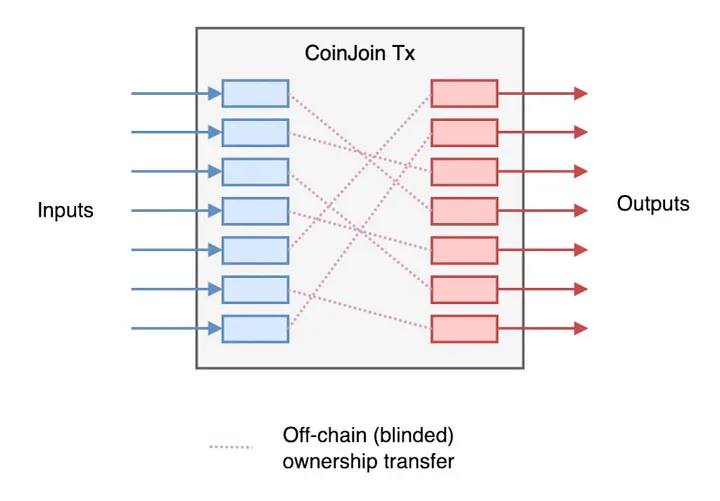
A single CoinJoin grows your anonymity set by the number of participating UTXOs, and doing several CoinJoins in a row multiplies it. That's why quite a few users kept doing CoinJoins over long periods. For example, when I tried out Wasabi, there was a setting to keep joining CoinJoins for as long as the wallet was running.
💡
An anonymity set is, in short, the set of TXOs that "might be the wallet this money came from." Chain analysis firms like Chainalysis use various heuristics to group funds together, but in the end it comes down to probabilities. CoinJoin makes that probability as small as possible by providing a large pool of candidates: the anonymity set.
Wasabi Wallet CoinJoins often had dozens of users participating at once, but Samourai's service, called Whirlpool, used a fixed number of participants, mixing five UTXOs at a time. Since each round yields only a limited anonymity set, many users took part multiple times, a practice called remixing, and Samourai's incentive design itself reportedly encouraged it. Of course, mixing again with the same participants achieves nothing, so improving privacy this way takes time.
💡
Remixing reportedly incurred neither Samourai's fee nor mining fees. In other words, only UTXOs entering for the first time bore the cost.
You can see that, aside from some differences in design philosophy, the core mechanics of the product were almost the same as Wasabi Wallet's.
Most users self-hosted, but the rest did in fact send their xpubs to the server to look up their wallet contents
So where does the criticism that "Samourai is collecting users' xpubs!" come from?
Both Wasabi Wallet and Samourai Wallet were purely services for coordinating CoinJoins, and neither took custody of user funds at any point. Signing transactions and checking funds happened inside the user's wallet software. However, if a user wasn't self-hosting a full node and Dojo (*), the wallet apparently queried Samourai Wallet's servers using the xpub to retrieve the balance.
💡
Dojo is Samourai's CoinJoin server, which runs peer-to-peer. By self-hosting it, users could apparently use the wallet without depending on Samourai's servers, keeping their privacy fully intact.
Admittedly, this does seem like a weak design for a privacy tool. It was probably meant to accommodate mobile users, but in CoinJoin, one user's loss of privacy also hurts everyone else's (the anonymity set shrinks), so I think the design deserves a certain amount of criticism.
That said, there's an interesting data point: while Samourai's servers were down for about 10 hours of maintenance, Whirlpool usage reportedly stayed at around 85–90% of its usual level. Based on this, some have suggested that perhaps 85% of Samourai Wallet users were self-hosting Dojo.
Dojo Sovereignty Confirmed 85% of Whirlpool Userbase
Vast Majority of Whirlpool users aren’t using Samourai’s public node.
 𝕂𝕐ℂ𝟛
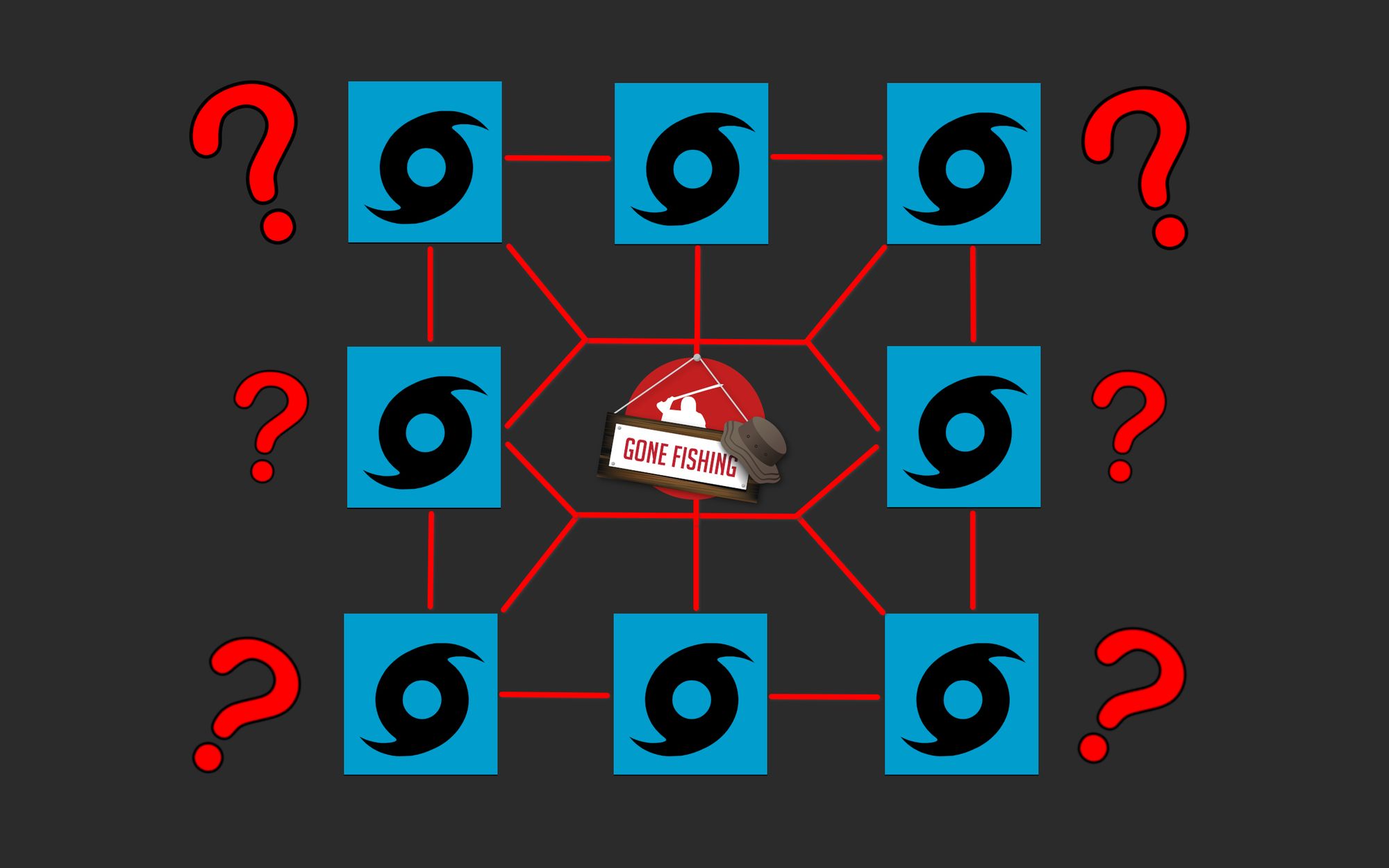
Remixing wasn't possible from mobile, so users who remixed necessarily self-hosted Dojo. I suspect the share wasn't this high among users who only joined their first CoinJoin, but looking at overall usage including remixing, it seems fair to say that users were highly privacy-conscious and avoided leaking their xpubs.
So the right answer is probably something like "it could be used safely if you had a reasonable level of privacy awareness and Bitcoin knowledge." Whether beginners even want CoinJoin is another question, but it certainly wasn't beginner-friendly.
Isn't it a stretch to call a non-custodial system that is largely peer-to-peer, and poorly suited to fast money laundering, a money laundering operation or an unlicensed money transmitting business?
Samourai also had many other features, including a Payjoin-style feature, a feature for "building up an anonymity set entirely on your own," and a feature for mixing coins with just one other user. For more on Payjoin, see our previous article.
CoinJoinの進化版としてのPayJoin
先日、コロナウイルスの影響もあってかVRが流行しているビットコイナーたち数十名が、Altspace VRというアプリを使って学会発表のようなものを行っていました。そこでのプレゼンテーションはPayJoinというCoinJoinの新形態についてでしたが、興味深い内容でしたので共有させていただきます。ちなみに、このようなイベントの企画が行われているBitcoin VR Degeneratesというテレグラムグループがあるので、参加したい方はどうぞ。 COINJOIN ご存知の方も多いかもしれませんが、CoinJoinとは複数の主体が1つのトランザクションに参加して、outputが誰のコインかわからなくする(混ぜる)ということが目的で行われます。プライバシーを向上することが目的の場合、inputとoutputの金額を比較されても完全には解析されないように、すべての参加者が一定の金額で行うことが多いです(0.1BTC単位のinputを任意の数追加して、出力として同じ数だけ受け取るなど)。そうすると、等しい金額のinputとoutputの対応は確率的にしか判断できません。この過程で問題視され
 加藤 規新

What all of these services have in common is that Samourai never held custody. In fact, most of the features let users running Dojo connect to each other directly over Tor. At most, Samourai served as little more than a bulletin board.
It has also been pointed out that Samourai Wallet's system took time to build up anonymity, which made it a very poor fit for most money laundering patterns in the crypto industry. Here's a summary of the views in the following thread on X:
A thread about this statement made in Samourai's indictment, from the perspective of a person who has extensively studied the design of zerolink implementations and who has also analyzed the on-chain activity of some crypto money launderers. pic.twitter.com/neOcWvjxyv
— LaurentMT (@LaurentMT) April 25, 2024
(Abridged translation of the thread) Laundering of stolen crypto typically involves dumping a large amount of funds into obfuscation tools in a sudden blitz, pulling them right back out, and then consolidating them afterward, which yields almost no privacy. The goal isn't real anonymization; it's to run the funds through as many anonymization methods as possible in as little time as possible to slip past exchanges' deposit screening, then rush to cash out through money mules or exchange accounts opened under fake names. The poor fit between this strategy and Whirlpool, which deliberately takes time to build privacy, is likely why the share of criminal funds was just 5%, low compared with similar tools.
So if Samourai didn't actually control any funds, users could use the tool among themselves on their own, and it was a poor fit for anonymizing the very kind of criminal funds at issue, I'm inclined to agree with the view that trying to prosecute it as money laundering is a stretch.
Privacy is an essential element that can't be overlooked when using "money" like Bitcoin, so I sincerely hope the authorities stop persecuting privacy tools.