What Trezor's Quantum-Resistant Hardware Wallet Really Means

This article was translated from Japanese with AI. Read the original (日本語) · Report a translation issue
This week, Trezor announced what it calls the industry's first "quantum-resistant hardware wallet." I was in the room for the announcement, and my first reaction was: "Wait, what does that even mean?" The quantum risk usually discussed for Bitcoin (and altcoins) isn't something a hardware wallet can address.
Listening more closely, though, I came to understand that hardware wallets have a separate quantum-related risk in how they work, and that this is what Trezor has addressed.
Today I'll explain what a "quantum-resistant hardware wallet" actually refers to.
• Bitcoin's "quantum risk" is not something a hardware wallet can fix
• Where in the hardware wallet did Trezor achieve "quantum resistance"?
• Necessary in the very long run, but not a reason to buy one now
Bitcoin's "quantum risk" is not something a hardware wallet can fix
How Bitcoin will cope with the era of quantum computers is a question that comes up periodically. The typical argument goes like this: ECDSA, the elliptic curve cryptography Bitcoin uses, can in theory be broken by a sufficiently large quantum computer running something called "Shor's algorithm." In other words, a private key could be recovered from its public key.
The general view is that a quantum computer large enough to make this practical won't exist for another 10–20 years or so. However, old Bitcoin addresses using P2PK, as well as P2PKH addresses that have been reused even once, already have their public keys exposed, so millions of BTC are vulnerable to this attack. In that sense, it is a real threat.
Personally, though, I'm optimistic that this problem can be dealt with. For my reasons, see the earlier article below:
ビットコインは量子コンピューター耐性をどうやって手に入れるのか
ここ数年、定期的に話題に上がる量子コンピュータのビットコインに対する脅威が今週もツイッターで話題になっていました。確かに量子コンピュータは進歩していますが、現時点で状況が大きくは変わっておらず、ビットコイン研究所のFAQにも簡潔な回答があります: 量子コンピューターが出てきたらビットコインは大丈夫なのか?豊かな知識とともに。ビットコイン研究所田中 芳治 また、4年近く前に有識者によってSpotlightに投稿された以下の記事もとても参考になるので、お時間のある方は読んでみてください。 ビットコイン vs 量子コンピュータ本記事では結局量子コンピュータはブロックチェーンに対してどのような影響があるのかをなるべく詳細に説明Spotlight😆 この話題が盛り上がるとき、多くの場合話題の中心は「量子コンピュータがどのようにビットコインに対して脅威なのか」「時期的にはいつくらいからリスクがあるのか」「自分が取れる対策は」というテーマになります。しかし重要なのはビットコインがどのようにして量子コンピュータ耐性を獲得するのか、そのプロセスなのではないでしょうか。 今日はビットコインが量
 加藤 規新

And as noted above, the problem is public key information exposed on the blockchain (or within transactions). That sits on an entirely different layer from whether or not you use a hardware wallet to manage your bitcoin.
Where in the hardware wallet did Trezor achieve "quantum resistance"?
So what is the "quantum resistance" Trezor is claiming for its hardware wallet? There are actually two quite different contexts here:
1. Protection against counterfeit firmware
Hardware wallets implement defenses against a variety of attacks, and one of them is detecting counterfeit firmware running on the device. If a quantum computer were used to forge Trezor's signatures on its firmware and other software, counterfeit firmware could, in theory, spread more easily.
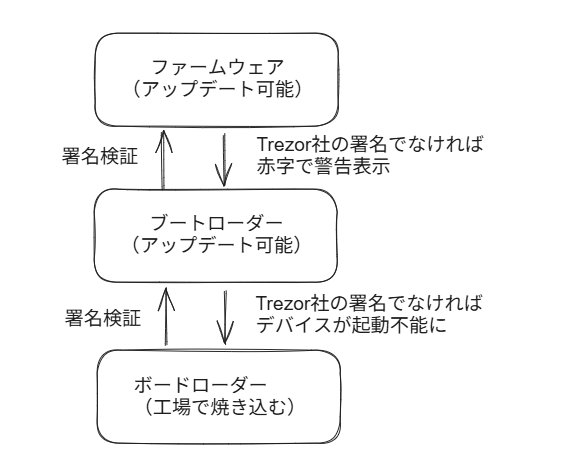
In Trezor's case, for example, the software running on the device has three layers: the boardloader (physically written at the factory), the bootloader (used to update the firmware), and the firmware (the wallet logic and UI). The latter two are signed with Trezor's private key. If the signature is invalid, a bad bootloader bricks the device, while bad firmware triggers a warning displayed in red on the screen.
💡
One situation where you might want to keep using the device despite the warning is the special case of running custom firmware you built yourself.
But if Trezor's private key were recovered using Shor's algorithm, devices running malicious software could show up as legitimate under the current signature verification. That would be expected, since the software really would be signed with Trezor's private key. The risk of supply chain attacks would then become very large.
For example, if malicious firmware were installed somewhere in the distribution chain, today the warning would let the user notice immediately. Without it, an attack that quietly leaks the seed without the user ever noticing would become possible. The first context, then, is that Trezor made it possible to use post-quantum cryptography for verifying the signatures on the bootloader and firmware to address this.
2. Signing with post-quantum cryptography
At this point, it's unclear which post-quantum cryptography Bitcoin and other cryptocurrencies will adopt. According to Trezor, however, the newly announced Trezor Safe 7 supports many of the candidate schemes at the hardware level.
So the value proposition seems to be that when Bitcoin eventually adopts post-quantum cryptography, there's a good chance you'll be able to keep using the same hardware wallet with just a firmware update. There's no guarantee, of course.
💡
As a side note, choosing post-quantum cryptography requires a great deal of care. In the past, the US government and others have secretly promoted cryptography containing backdoors, and we need to make absolutely sure Bitcoin never adopts anything like that.
Details on the cryptography Trezor adopted can be found in its official guide:
Going quantum: our choices for Trezor Safe 7’s quantum readiness
Trezor Safe 7 is quantum-ready from the core. Discover the cryptographic standards, hybrid verification, and authenticity measures that make it secure today and prepared for the quantum era.


Necessary in the very long run, but not a reason to buy one now
If you've read this far, this probably goes without saying: Trezor's effort is an industry first, and it's something every player will eventually have to think about. At the same time, it's "clearly still too early," and I don't see it as something to base a purchase decision on today. (That changes, however, if there are altcoins or the like that will support post-quantum cryptography in the near future.)
It is encouraging to see signs that the hardware wallet industry may be able to move to post-quantum cryptography relatively simply. We don't yet know whether the day this becomes necessary is 5, 10 or 20 years away, but why not simply switch when that time comes? To make that easy, use a hardware wallet that properly supports common standards, so you can move to another manufacturer if you need to.
ハードウェアウォレットはどんどん共通規格から離れていく?
今日はハードウェアウォレット(HWW)各社による製品改善や囲い込み目的の工夫が将来的に共通規格を廃れさせて行くのではないか?という話をします。 先週は他のHWWとはかなり違う、特殊な作りをしているTapsignerについて記事を書きましたし、今年のはじめにはTrezorが開発した20単語の独自シードフレーズ規格:SLIP39も取り上げました。 画面もなく、バックアップも単語型ではないカード型HWW:Tapsignerのクセはセキュリティ対策だったハードウェアウォレット(HWW))を選ぶ際の注意点として、ハードウェアウォレット自体に画面がついているものを選ぶというのがあります。ハードウェアウォレット側で実際に署名するトランザクションの内容を確認することで、スマホやPCに表示されているトランザクションとは別の、悪意のあるトランザクションに署名することを防げるためです。 2月に起きたBybitのコールドウォレットからの流出も、トランザクションの内容をHWW側で確かめることができなかったのが直接的な原因の1つとなっています。 不正なトランザクションに署名させる攻撃の手法と対策今週、Bybi
加藤 規新