Why Bitcoin's BIP-110 Data Soft Fork Is Likely to Fail

This article was translated from Japanese with AI. Read the original (日本語) · Report a translation issue
A factional dispute within part of the Bitcoin community has been smoldering for several years, flaring up as the Ordinals debate, the Knots debate and the OP_RETURN debate, all of which I've covered here. Now, at last, a soft fork proposal has appeared that would restrict data storage on Bitcoin at the consensus level: "BIP-110 Reduced Data Temporary Softfork."
I've summarized how the debate unfolded in the following articles.
OP_Return戦争再び:ブロックチェーンにデータを刻む機能について再燃する議論
今週、ビットコイン関係のツイッターがある話題で持ちきりになっています。GitHubのBitcoin CoreリポジトリにPeter Todd氏が提出した以下のプルリクエストです。 Remove arbitrary limits on OP_Return (datacarrier) outputs by petertodd · Pull Request #32359 · bitcoin/bitcoinAs per recent bitcoindev mailing list discussion.
Also removes the code to enforce those limits, including the -datacarrier and -datacarriersize config options.
These limits are easily bypassed by…GitHubbitcoin この提案は、現在Bitcoin
 加藤 規新
The person who proposed BIP-110 belongs to the Knots camp in this dispute (the faction strongly opposed to users writing arbitrary data to Bitcoin), and the proposal would ban several data storage methods that have so far been permitted at the consensus level.
The way it restricts data is particularly distinctive. It bans certain opcodes (functions in Bitcoin Script) that also have other uses, as well as the use of the Taproot annex, a section of a transaction with no defined purpose yet. With these measures it carefully targets the "tricks" that Ordinals Inscriptions and others have used to store arbitrary data. As a side effect, some "legitimate" transactions could become impossible to make, so the proposal takes the form of a temporary one-year measure, a first for a soft fork.
Being a soft fork doesn't mean it can't cause a chain split or confusion. I think the chances of BIP-110 actually activating are very low, but the debate is likely to heat up over the next six months or so. To help you make the right call when it does, today I'll go over BIP-110 as background and explain why I think it is likely to fail.
フォークする権利と、ビットコインの価値
本稿の読者の中にどれくらい視聴者がいらっしゃるかわかりませんが、今月からビットコイナー反省会のレギュラーになりました。先日の放送で視聴者から寄せられた質問に「国家等が51%攻撃して不正なトランザクションを含むチェーンを伸ばしたらハードフォークするのか?」というものがありました。 これは表面的には国家による攻撃ベクトルの検討、あるいはノードがトランザクションやブロックをどのように扱うかについての質問ですが、この質問への回答を考えるとビットコインの本質に突き当たるように感じたので今日はビットコインでなぜフォークが発生するのか、そしてフォークできることがなぜ本質的に重要なのかについて書きます。 💡ちなみに冒頭の質問に対する私の回答をまとめると「不正なトランザクションが含まれるのであれば正常なノードは認めないから国家のノードがハードフォークした形になる」になります。 Don’t Trust, Verify ビットコイナーがよく使うスローガンで一番有名なフレーズかもしれないDon’t Trust, Verifyというものがあります。和訳は「信用せず検証すべし」、でしょうか。 ビット
加藤 規新
It can also cause confusion, but one of Bitcoin's great strengths is that when opinions differ, people who agree with each other can change the rules among themselves through a soft fork or hard fork.
Being accepted as a BIP doesn't mean it will happen
First, let me clear up one premise that isn't widely understood.
Being accepted as a BIP doesn't mean a proposal will be adopted by Bitcoin. It doesn't even necessarily mean it's a good idea. The BIPs are simply a convenient repository for collecting Bitcoin-related specification proposals in one place, nothing more.
GitHub - bitcoin/bips: Bitcoin Improvement Proposals
Bitcoin Improvement Proposals. Contribute to bitcoin/bips development by creating an account on GitHub.
 bitcoin
There are also plenty of BIPs for increasing the block size
In fact, for several years now people have criticized the BIPs process for being slow and for depending on the likes and dislikes of the repository's maintainers (editors). For a while, for example, the only person maintaining the BIPs repository was Luke Dashjr, the developer of Bitcoin Knots and one of the Knots camp's leading figures. Perhaps for that reason, the Ordinals BIP still hasn't been accepted or assigned a number after three years.
As a result, more and more projects are publishing their specifications outside the BIPs.
BIPを通したビットコイン改善プロセスはもう終わり?BINANAとは
読者の皆さんのほとんどはBIPという用語をご存知かと思います。Bitcoin Improvement Proposal (BIP)とはビットコインに対してなにか変更(新しい機能や仕様など)を加えるためのプロセスで、誰でも参加できる状況で、慎重にゆっくりとその是非を検討するための仕組みとなっています。 ところが、近年このBIP採択パイプラインが非常に遅いことに不満を持つ開発者が増えています。また、昨年注目を集めていたコベナンツに関連してソフトフォークをSignetで実際に動かしてみて評価するためのクライアント:Bitcoin Inquisitionというものも生まれています。このBitcoin InquisitionにおいてBINANAというBIPを置き換える仕様追加プロセスが導入されました。 今日はBINANAがBIPプロセスとどう異なるのか、そしてBitcoin InquisitionとBINANAが描くビットコイン開発の今後のあり方を解説していきます。 ・BIPプロセスの問題点 ・BINANAとBitcoin Inquisition ・これからのビットコイン開発はどうなる
加藤 規新
💡
That said, there are now many more BIP editors, and the new BIP process, BIP-3, reduces how much is left to the editors' judgment, so the BIPs process itself has been improving.
BIP-110's aim is to "make storing data on Bitcoin harder"
Now let's look at the purpose and content of BIP-110. It even has an official website.
BIP-110: Temporarily Limit Arbitrary Data in Bitcoin
A one-year consensus soft fork to limit arbitrary data storage in Bitcoin, protecting its purpose as sound, permissionless money.

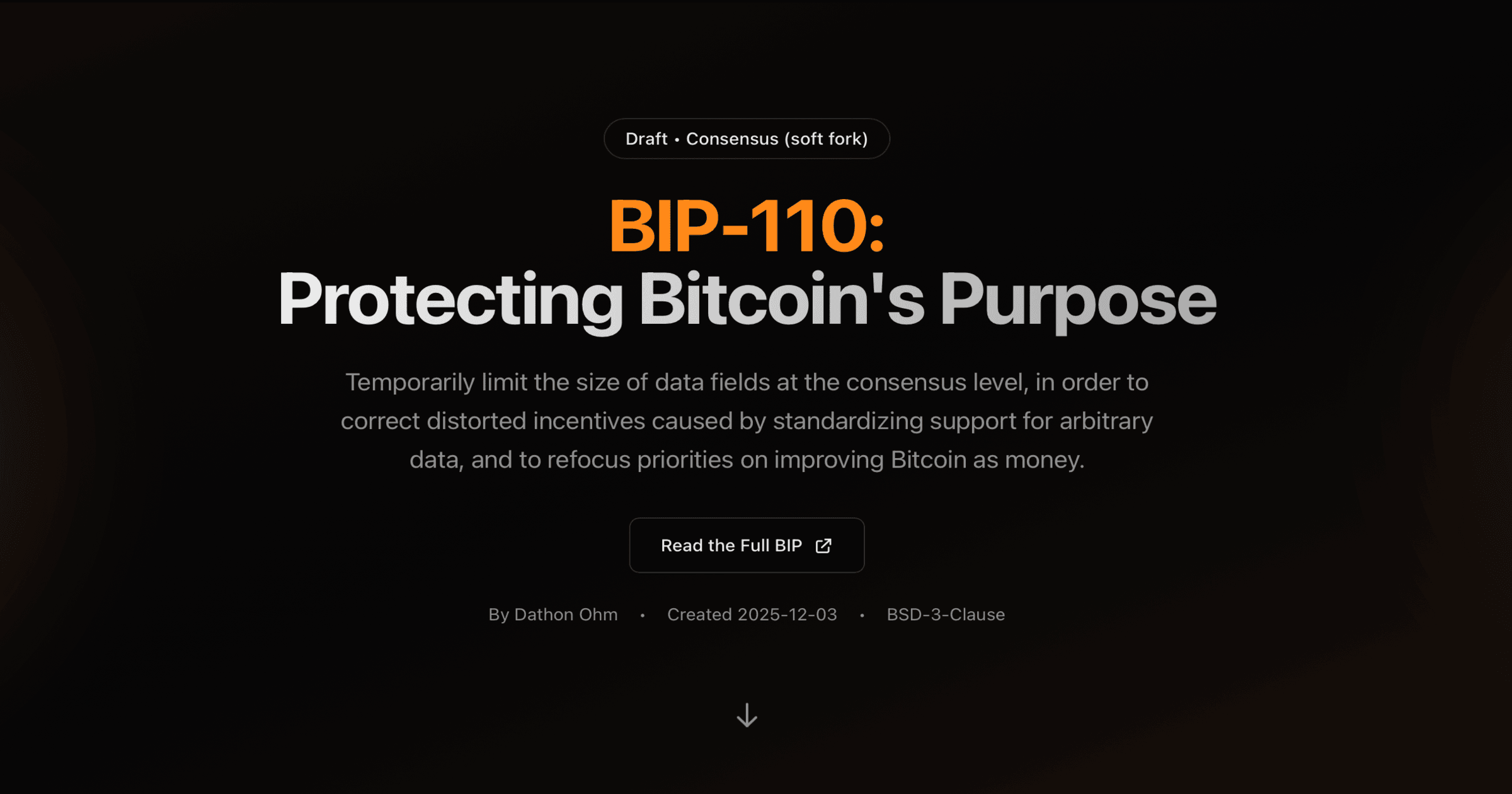
"Restrict arbitrary data storage at the consensus level and refocus Bitcoin on its purpose: sending money." Put like that, I suspect many Bitcoiners would agree. I also believe Bitcoin's true calling is as a monetary network.
As I mentioned at the start, the background to this proposal is 2023–2024, when the Ordinals and BRC-20 craze repeatedly sent Bitcoin transaction fees soaring. Some people who sent bitcoin or closed a Lightning channel during that period probably paid close to 10,000 yen. That is clearly bad for Bitcoin's usability as money.
Whether or not you agree with BIP-110, I think the proposal itself is made in good faith, out of a need to keep Bitcoin usable as money.
Why it isn't gaining support the way past soft forks did
On social media, BIP-110 seems to have no shortage of supporters, but in reality I think the odds of it being successfully activated are low. There are several reasons, which I'll summarize briefly here:
1. Bitcoin isn't currently facing any real problem
Protocols that store arbitrary data on Bitcoin were mainly popular in 2023, and today that kind of activity isn't busy enough to push fees up. The number of unconfirmed transactions has fallen to its lowest level in years. As a result, fees have dropped, and it is actually cheaper than ever to make a Bitcoin transaction.
オンチェーンの送金手数料がさらに安くなった理由とその影響は?
最近mempool.spaceをご覧になった方は気づいているかもしれませんが、ビットコインの手数料相場がこれまでより1桁安くなっていることが出てきました。従来であればトランザクション手数料の下限は1 sat/vbyteだったので、どれだけトランザクション需要が少ないタイミングでもそれだけ手数料を払う必要がありました。しかし、最近では0.1 sat/vbyteのトランザクションすら見られます! 今日はこの変更がどういう経緯で行われたのか、そしてどういう影響が見込まれるかを解説します。 ・Bitcoin Core 30において規定値が変更予定。それに先立ち対応するマイナーも ・1 sat/vbyteが手数料相場の「下限」だった理由と、制限緩和のメリットデメリット ・前もって対応しているマイナーは損をしているのではないか? Bitcoin Core 30において規定値が変更予定。それに先立ち対応するマイナーも 10月にリリースが予定されているBitcoin Core 30をめぐる議論はこれまでOP_Returnの上限解放に関するものがほとんどで、本稿でも取り上げていました。
加藤 規新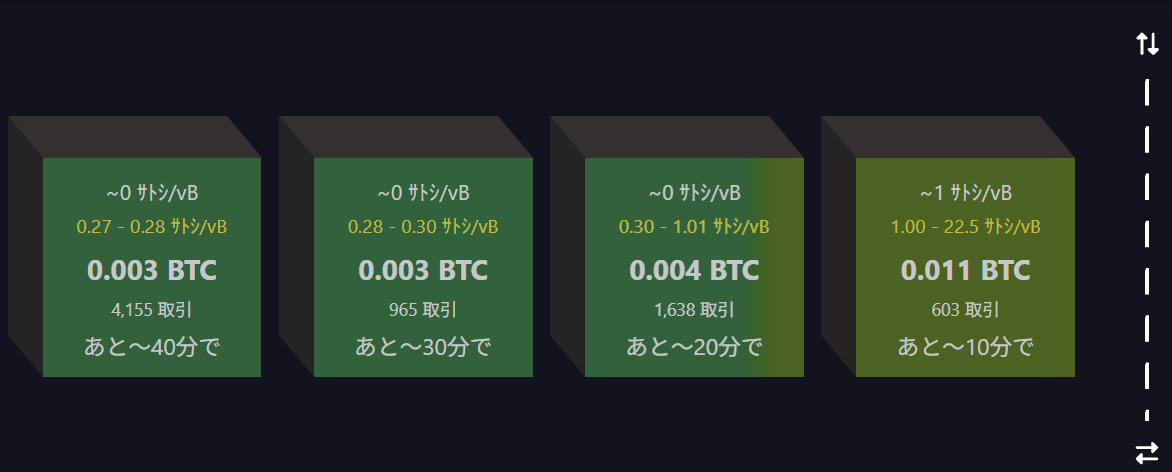
BIP-110's text says, in effect, "Because urgent action is needed, this may inconvenience some users until a better approach is found, so in exchange it will be a temporary one-year measure." Reading that, and what its supporters say on social media, you'd think Bitcoin faced an existential crisis that will break it unless we act quickly, but right now that crisis just isn't felt.
Looking at recent "spam TX" data, one estimate puts them at about half of all transactions by count but only 4% of fees. That tells us many of them are very low-urgency transactions (mined only when there are hardly any other transactions).
Maybe around half of tx count, and around a third of blockspace, but about 1/25th of fees. pic.twitter.com/ehUUiiPSxS
— Murch (@murchandamus) February 18, 2026
We can't know whether these transactions would still exist if fees were high. It's even possible that removing them would make ordinary payments easier in the future. But since they aren't currently creating much fee pressure, they are unlikely to be a reason for people to back BIP-110.
2. A fundamental fix is impossible without bending Bitcoin's principles
There is also the problem of how to identify a "spam TX." Without consensus on that, spam can't be eliminated at the consensus level.
Yet as long as Bitcoin stores transaction data, eliminating every arbitrary data storage protocol is difficult. You could ban (that is, effectively freeze) the specifications of particular protocols that ran rampant, such as Inscriptions and Runes, but it's easy to see this ending in a game of whack-a-mole, with new workarounds appearing each time.
Of course, I think the risk of being banned could itself act as a deterrent, dampening speculative pressure and curbing the shitcoin speculation that drives these protocols. But introducing something like new ban rules through a soft fork every few months to achieve that would go against Bitcoin's libertarian principles, and it also seems hard both logistically and in terms of technical debt.
Personally, I worry it would also nip new technologies in the bud.
3. The activation method is poorly conceived
How to activate soft forks on Bitcoin has long been a contentious topic.
In 2017 there was a bitter fight over SegWit. Various activation methods were devised in light of that experience, but no good one emerged, and in the end Taproot in 2021 was activated with the same method as SegWit, one that relies too heavily on miners' good faith. (It cannot activate unless 90% of the hashrate agrees.)
Later, when Jeremy Rubin proposed a similar activation method for OP_CTV, he was heavily criticized for moving too soon and ended up retiring from Bitcoin development.
OP_CTVとソフトフォーク導入方法
先週は寄稿をお休みさせていただいたので前回から間隔が空いてしまいましたが、その間にビットコインの世界は一大論争が巻き起こっています。本稿でも何度か登場している独創的なビットコイン開発者、Jeremy Rubin氏が自身の提案するOP_CTVという機能のソフトフォークによる導入をSpeedy Trial方式で目指すと発表したのです。 ところが同じくSpeedy Trial方式で導入されたTaprootと異なり、まだユーザーやビットコイン開発者の中でOP_CTVに対して広く支持が得られていないこと、Speedy Trial自体がソフトフォークの導入方法として好ましくないことが意見の対立につながっています。 今日はOP_CTVの概要と論争となっているポイントを整理し、個人的な意見も交えながら現在の論争がビットコインの将来にどのような影響を与えうるかを考察します。 TAPROOT導入時のおさらい Taprootの導入にあたって、2017年にユーザーの大半が支持したSegwitの導入にマイナーが抵抗したことを踏まえ、導入に際してマイナーに依存しないソフトフォークのアクティベーション方法
加藤 規新
Soft fork activation, then, is a difficult topic, yet BIP-110 has set its hashrate threshold at 55% with no regard for the risk of a chain split, declaring that it intends to push through a soft fork unilaterally. Going by past examples, this is the pattern that fails because of community opposition.
💡
And although the activation method depends on miners in the first place, I can't really imagine why miners, who earn fees from "spam TXs," would agree to BIP-110.
4. The market puts the probability of activation by September 1 at around 3%
For objective data, we should also look at how the market assesses it.
With past Bitcoin soft forks and hard forks, whenever a chain split was a real possibility, prediction markets opened in advance and made the post-fork value of the coins visible. In the fall of 2017, during SegWit2x, the post-fork coin's value fell to nearly zero, which is thought to have led to the hard fork's cancellation.
This time the market isn't on the value of a fork coin, but on whether BIP-110's activation condition will be met by September 1, 2026 (whether 55% of blocks within a difficulty adjustment period signal readiness for BIP-110), and it is currently trading at around 3%.
Will BIP-110 activate and be enforced on Bitcoin by Sept 1, 2026?
Definition of ActivationThis market resolves to “Yes” if, at 11:59:59 PM PT on September 1, 2026 (06:59:59 UTC on September 2, 2026), the Bitcoin blockchain with the greatest cumulative proof-of-work is fully compliant with BIP-110 consensus rules.“Compliant with BIP-110” means that, at the snapshot time:The heaviest proof-of-work chain contains no blocks that violate BIP-110 constraints from the BIP-110 activation point onward, including (but not limited to):The 34-byte ScriptPubKey limitThe 83-byte OP_RETURN limitFailure ConditionThis market resolves to “No” if, at 11:59:59 PM PT on September 1, 2026 (06:59:59 UTC on September 2, 2026), the Bitcoin chain with the greatest cumulative proof-of-work:Includes one or more blocks that violate BIP-110 rules.ExclusionsNo consideration is given to:Earlier temporary forks or violationsWhether BIP-110-enforcing nodes are following a different chainMiner intent, signaling behavior, or future scheduled enforcementOnly the state of the heaviest chain at the deadline is relevant.Chain Selection Rule“Bitcoin” is defined strictly as the chain with the most cumulative proof-of-work at the deadline.Software versions, exchange listings, ticker symbols, or economic signaling are irrelevant to resolution.Lock-In and SignalingSignaling or lock-in without actual enforcement by the heaviest chain at the deadline results in a “No” resolution.Implementation FailureIf BIP-110 is not enforced by the heaviest chain at the deadline due to:Software bugsPartial or incomplete deploymentMiner non-adoptionthe market resolves to “No.”Temporary Nature of BIP-110Because BIP-110 is a temporary soft fork, a “Yes” outcome requires only that the heaviest chain enforces BIP-110 at the deadline. Continued enforcement after the deadline is not required.Verification SourcesResolution will be determined using:Public Bitcoin block explorers to identify the heaviest chain and inspect block contentsChainwork data to confirm cumulative proof-of-workThe Bitcoin BIPs GitHub repository as the authoritative source for BIP-110 rulesDetailed Market TitleWill BIP-110 (Reduced Data) be consensus-enforced on the Bitcoin mainnet by the chain with the greatest cumulative proof-of-work by September 1, 2026?


Of course, it isn't a highly liquid market, but intuitively the figure seems about right to me.
For these reasons, I believe BIP-110 is almost certain to fail.
Even a soft fork carries big risks if it fails
This is another commonly misunderstood point: even a soft fork, if it is a "minority soft fork," will cause a chain split and can easily fail. That is why BIP-110 cannot set its miner signaling threshold below 50% of the hashrate.
A chain split causes confusion everywhere: at exchanges, wallets, merchants and beyond. Even when a fork was bound to happen, the confusion itself does the ecosystem no good.
Of course, the ability to fork is itself a very important safety mechanism for Bitcoin. Because you have the option, if necessary, to split the chain and use a currency run under different rules, you don't have to worry about others changing the rules on you.
フォークする権利と、ビットコインの価値
本稿の読者の中にどれくらい視聴者がいらっしゃるかわかりませんが、今月からビットコイナー反省会のレギュラーになりました。先日の放送で視聴者から寄せられた質問に「国家等が51%攻撃して不正なトランザクションを含むチェーンを伸ばしたらハードフォークするのか?」というものがありました。 これは表面的には国家による攻撃ベクトルの検討、あるいはノードがトランザクションやブロックをどのように扱うかについての質問ですが、この質問への回答を考えるとビットコインの本質に突き当たるように感じたので今日はビットコインでなぜフォークが発生するのか、そしてフォークできることがなぜ本質的に重要なのかについて書きます。 💡ちなみに冒頭の質問に対する私の回答をまとめると「不正なトランザクションが含まれるのであれば正常なノードは認めないから国家のノードがハードフォークした形になる」になります。 Don’t Trust, Verify ビットコイナーがよく使うスローガンで一番有名なフレーズかもしれないDon’t Trust, Verifyというものがあります。和訳は「信用せず検証すべし」、でしょうか。 ビット
加藤 規新If BIP-110's backers are truly prepared to go that far, reputational risk included, I'd genuinely like to see them push ahead with the soft fork. What bothers me is that, to my eyes, they don't seem to have that level of resolve.
There are many more constructive and important technical challenges to tackle than the never-ending "spam" debate, and I hope we get to a point where we can focus on those.