New Liberty Standard: How Bitcoin Got Its First Price

This article was translated from Japanese with AI. Read the original (日本語) · Report a translation issue
When people talk about the world's first cryptocurrency exchange, the name that usually comes up is "Bitcoin Market," which is listed in Guinness World Records.
First cryptocurrency exchange
The first cryptocurrency exchange was BitcoinMarket, which began operations on 17 March 2010. The site was founded by Bitcoin early adopter Dustin Dollar (USA), who proposed the idea on BitcoinTalk forum on 15 January 2010.
 Guinness World Records

However, another site published a Bitcoin-to-dollar exchange rate and handled trades before Bitcoin Market did.
That site was called "New Liberty Standard." It is remembered as a phantom exchange that supported Bitcoin in its earliest days and then vanished without a trace after about a year.
This article looks at what New Liberty Standard actually was and pieces together the story of how bitcoin first got a price and began to be traded.
We also cover this in a video, so please give it a watch.
Let's get straight into it.
What was New Liberty Standard?
New Liberty Standard was the world's first Bitcoin trading site. On October 5, 2009, it calculated and published an exchange rate between bitcoin and the dollar, roughly nine months after the genesis block was mined.
The site offered a service for buying and selling bitcoin for dollars via PayPal.
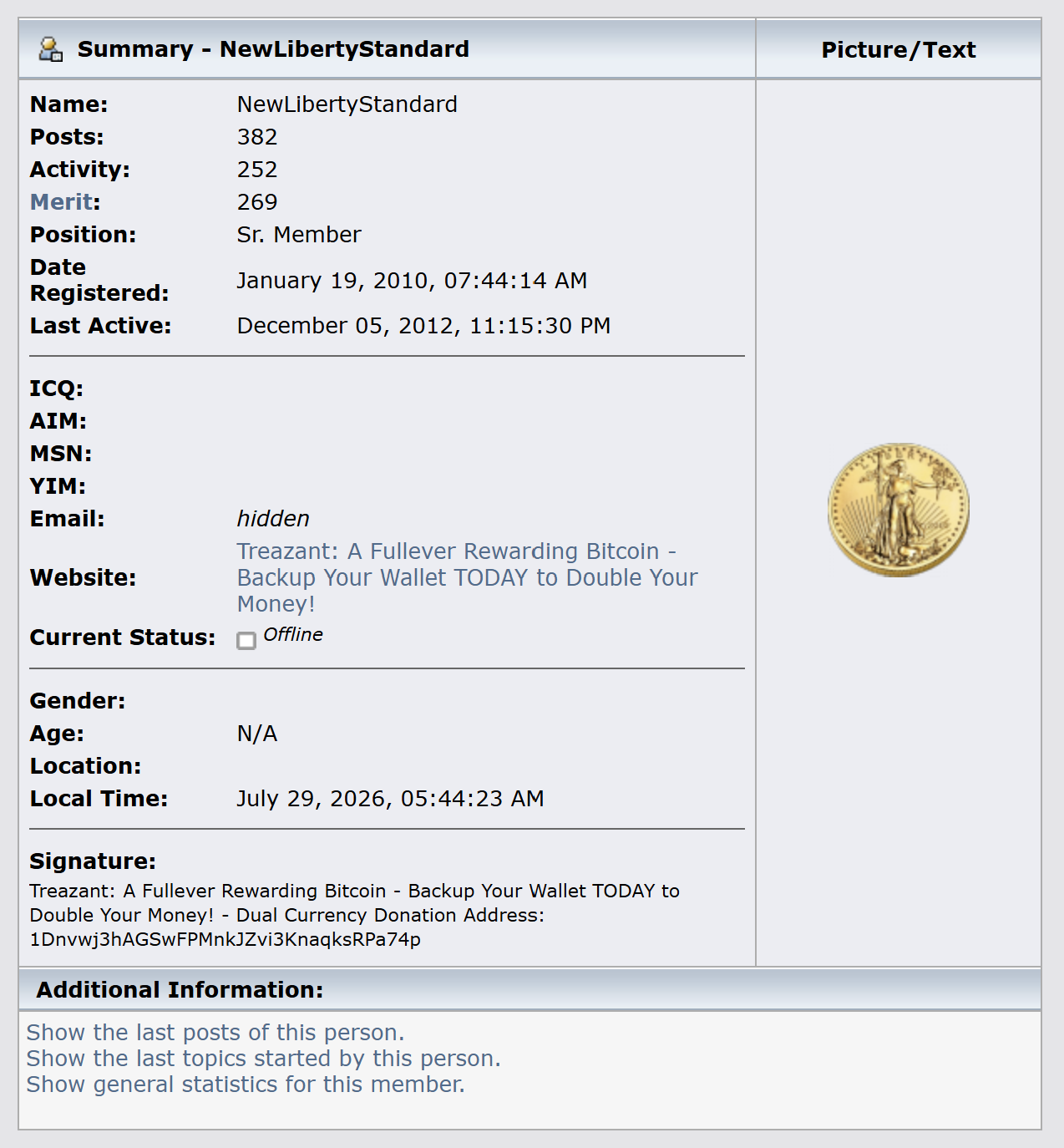
The operator was anonymous, and their identity is still unknown, but they were active on the Bitcoin forum bitcointalk under the name "NewLibertyStandard."
💡
On the forum, profile URLs include a number such as u=26. This is the member ID, assigned automatically in order of registration. (Reference: https://bitcointalk.org/index.php?action=profile;u=26)
Since NewLibertyStandard is u=26, they appear to have been one of the earlier members. For comparison, Satoshi Nakamoto is u=3.
The image below shows the first Bitcoin-to-dollar rates that New Liberty Standard published.
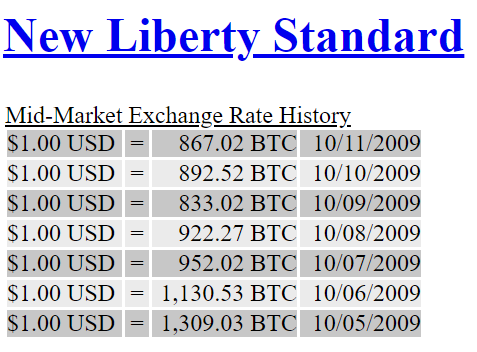
The service launched on October 5, 2009, so the first rate was $1 = 1,309.03 BTC, and you can see the rate was updated daily.
So how do you calculate a rate in an era when bitcoin had no price and nobody was setting one through supply and demand the way markets do today?
Valuing bitcoin by the cost of electricity
Remarkably, bitcoin's very first rate was based on the cost of electricity. Specifically, it appears the New Liberty Standard operator used the electricity cost of their own mining.
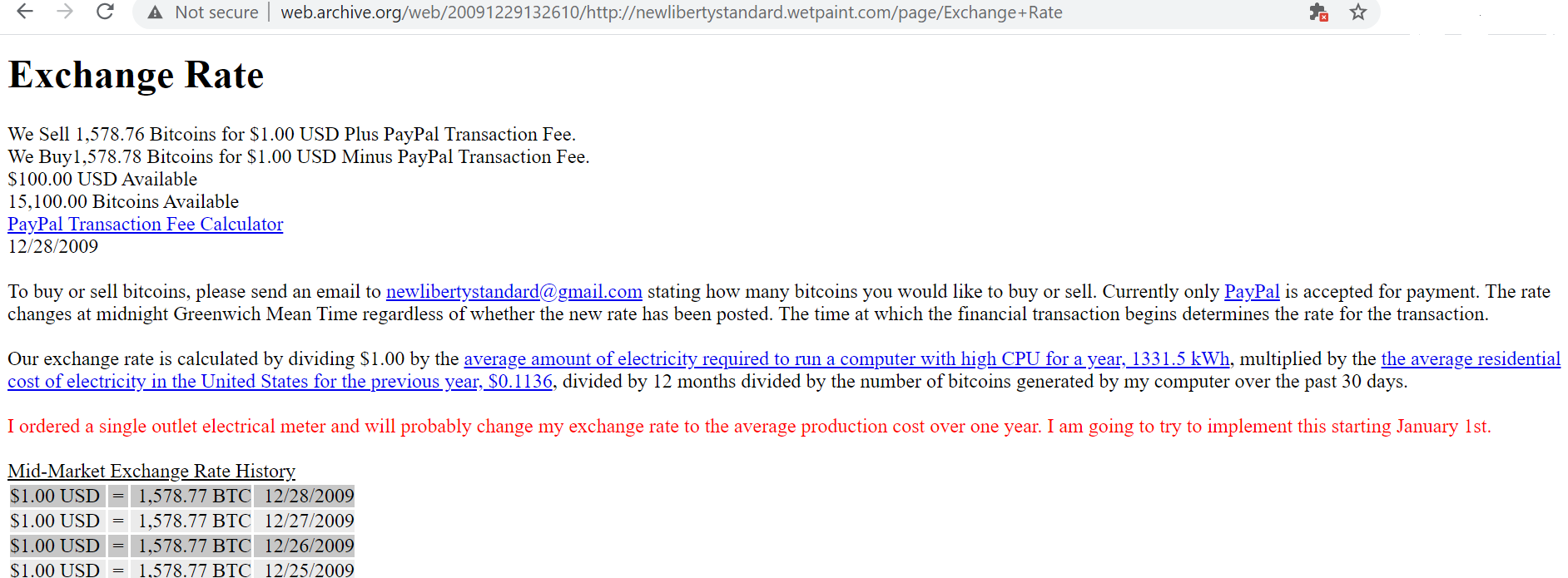
This is New Liberty Standard's archived page, viewable through web.archive.org, a service that preserves and publishes past versions of websites.
According to the archive, the site spelled out in detail how the bitcoin rate was defined in terms of electricity costs at the time.
Our exchange rate is calculated by dividing $1.00 by the average amount of electricity required to run a computer with high CPU for a year, 1331.5 kWh, multiplied by the average residential cost of electricity in the United States for the previous year, $0.1136, divided by 12 months divided by the number of bitcoins generated by my computer over the past 30 days.
Note that this method became more complicated in 2010, when items such as a moving average and broadband costs were added, so the definition above applies only to 2009.
Next, let's use this definition to formalize how the rate was calculated in 2009. If math isn't your thing, feel free to skip ahead to the next section.
First, let \(X\) be the number of BTC per dollar, and \(N\) the number of bitcoin the operator generated through mining over the past 30 days. Writing the sentence out literally as a formula gives the following.
\[
X=(\frac{\$1.00}{1331.5kWh}×\$0.1136)÷12÷N
\]
If we track the units through this formula, though, something looks off.
\[
X=(\frac{\$}{kWh/year}×\$/kWh)÷12÷BTC/month=\$^2\cdot month^2/(kWh^2 \cdot BTC)
\]
Why doesn't the final unit come out in BTC? The original sentence allows the multiplications and divisions to be read in more than one order, so it seems we shouldn't have naively built the formula word for word.
To find the correct formula, let's introduce some variables.
- \(E\) = 1331.5 kWh/year (annual electricity consumption)
- \(p\) = $0.1136/kWh (average electricity price in the previous year)
- \(N\) = BTC generated over the past 30 days (unit: BTC/month)
I'll skip the details of the derivation, but by using these variables and making the units line up, we get the following formula.
\[X=\frac{\$1.00}{\frac{E×p}{12×N}}=\frac{12N}{E×p}\]
Let's track the units to check.
| Operation | Unit |
|---|---|
| E×p (annual electricity cost) | kWh/year × $/kWh = $/year |
| ÷12 (convert to monthly) | $/month |
| ÷N (BTC mined per month) | ($/month)/(BTC/month) = $/BTC (= electricity cost per BTC) |
| $1.00 ÷ the above | $ ÷ ($/BTC) = BTC |
The final unit is BTC, which confirms that this is the correct formula for the exchange rate.
Working backward: estimating the operator's mining output from the published rates
We now know that the 2009 exchange rate \(X\) was calculated with the following formula.
\[X=\frac{12N}{E×p}\]
Rearranging the formula and plugging in the published exchange rates, we can solve for \(N\), the number of bitcoin the operator mined over the past 30 days.
\[N=\frac{X(E×p)}{12}\approx 12.6049×X\]
- \(E\) = 1331.5 kWh/year (annual electricity consumption)
- \(p\) = $0.1136/kWh (average electricity price in the previous year)
Since \(E\) and \(p\) are fixed values, the formula can be reduced to a simple form. Applying it to the published rates for October 5, 2009 and December 7–20, 2009 gives the table below.
| Date | Published rate (BTC/$1) | Back-calculated N (BTC/30 days) | Blocks (÷50 BTC) |
|---|---|---|---|
| 10/05 | 1,309.03 | 16,500 | 330 |
| 12/07 | 1,392.33 | 17,550 | 351 |
| 12/08 | 1,428.03 | 18,000 | 360 |
| 12/09 | 1,455.80 | 18,350 | 367 |
| 12/10 | 1,491.50 | 18,800 | 376 |
| 12/11 | 1,503.40 | 18,950 | 379 |
| 12/12 | 1,562.90 | 19,700 | 394 |
| 12/13 | 1,618.43 | 20,400 | 408 |
| 12/14 | 1,626.37 | 20,500 | 410 |
| 12/15 | 1,626.37 | 20,500 | 410 |
| 12/16 | 1,606.53 | 20,250 | 405 |
| 12/17 | 1,630.33 | 20,550 | 411 |
| 12/18 | 1,622.40 | 20,450 | 409 |
| 12/19 | 1,586.70 | 20,000 | 400 |
| 12/20 | 1,594.63 | 20,100 | 402 |
Dividing \(N\) by the block reward (50 BTC) also gives the number of blocks mined per month (the rightmost column).
Here's a quick summary of what the table tells us.
- As of December 2009, the operator could mine about 12 blocks a day on their own
- Since about 130 blocks were being mined per day at the time, this suggests a mining share of about 9.2%
- Mining output rose about 25%, from 330 blocks in October to 411 blocks in December
- Given that mining difficulty did not change even once until December 30, 2009, this suggests the operator added more computing resources to mining
- The more they mined, the higher the rate (BTC/$) went, meaning bitcoin became cheaper
Trading was done over a Gmail address
Let's also look at how bitcoin was actually traded on New Liberty Standard.
First, here's the original text from the site.
To buy or sell bitcoins, please send an email to newlibertystandard@gmail.com stating how many bitcoins you would like to buy or sell.
Currently only PayPal is accepted for payment. The rate changes at midnight Greenwich Mean Time regardless of whether the new rate has been posted.
The time at which the financial transaction begins determines the rate for the transaction.
So the world's first Bitcoin trading site worked in a very simple way: you emailed newlibertystandard@gmail.com and said how many coins you wanted to buy or sell.
The rate calculation was probably not automated. The operator likely calculated and posted it by hand, which would explain why the new rate sometimes hadn't been posted even after the update time had passed.
Today, with regulations such as Japan's Payment Services Act (Japan's main law covering crypto exchanges, with crypto set to move under the Financial Instruments and Exchange Act during fiscal 2027) and the EU's MiCA in place, many people may be surprised that bitcoin was once traded by email with no KYC.
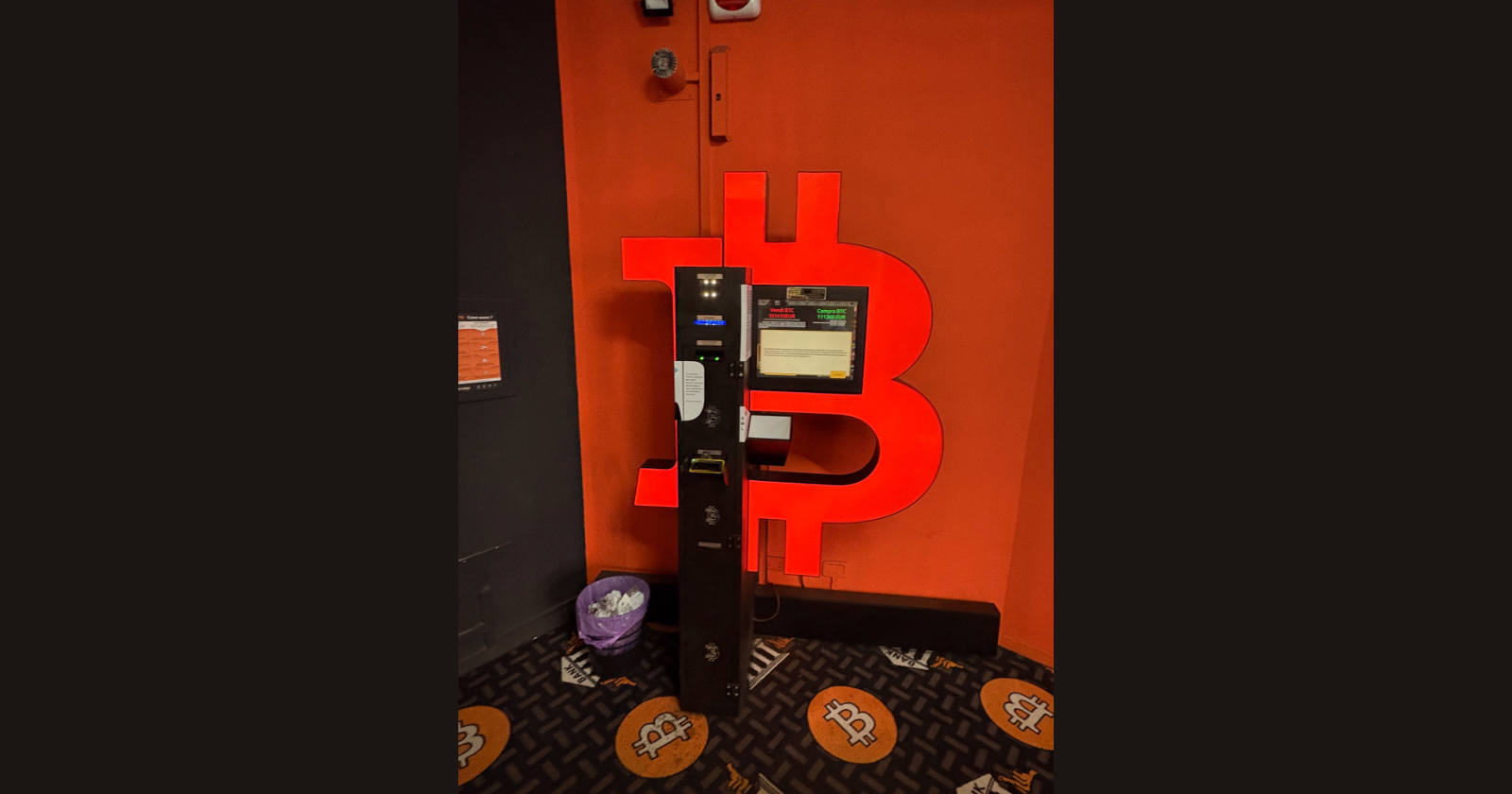
Bitcoin Research Lab has covered parts of MiCA (Markets in Crypto-Assets Regulation) in past articles, so take a look if you're interested.
イタリアでのビットコインATM体験記|MiCA規制とKYCの現実
イタリアのビットコインATMでKYCの壁にぶつかった体験記を書きます。また、ビットコインATMの操作感と日本でのビットコインATM事情についても触れます。
 押川 拓夢
Early trades were about support, not business
New Liberty Standard launched on October 5, 2009. Did you know that the details of a trade made seven days later, on October 12, are public?
In this well-known trade, Finnish programmer Martti Malmi (forum name Sirius) sold 5,050 BTC for $5.02, partly to support New Liberty Standard's Bitcoin trading service.

Among known Bitcoin-for-dollar trades, it is famous as the world's first trade between crypto and fiat currency (an off-ramp).
The transaction is here.
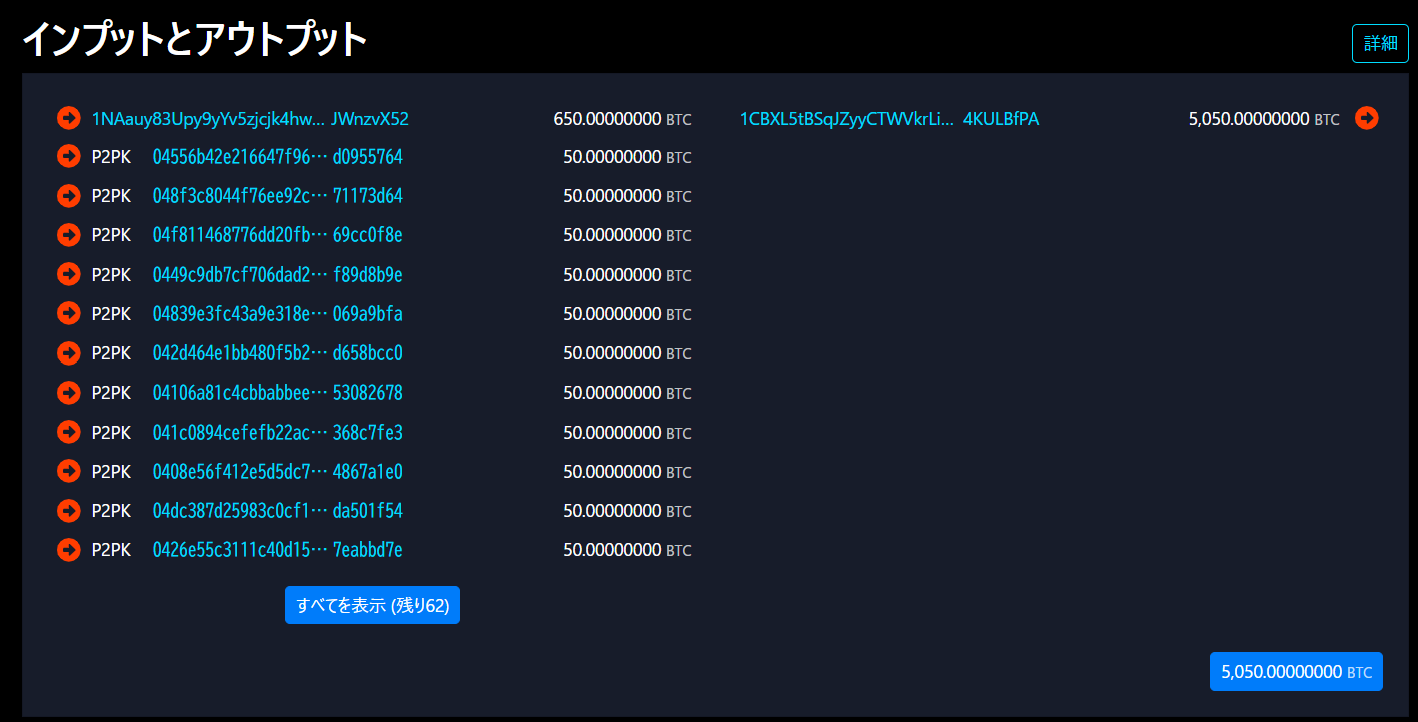
Looking at the outputs, you can see that 5,050 BTC was sent. Martti himself recovered the emails and identified this transaction, so it's almost certainly the right one.
Martti's and NewLibertyStandard's (the operator's) relationship with Satoshi Nakamoto
Martti Malmi and NewLibertyStandard (the operator) were early users of the Bitcoin forum, and the following thread shows they interacted with Satoshi Nakamoto there.
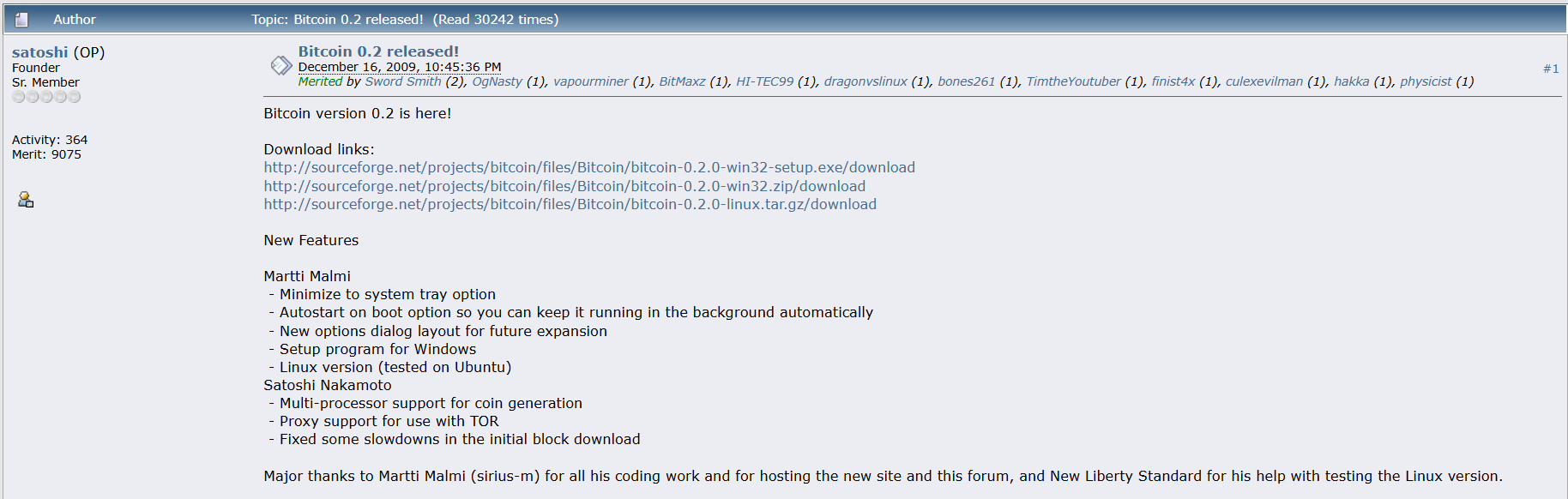
According to the thread, for the Bitcoin 0.2 release Martti did some of the coding and NewLibertyStandard (the operator) tested the Linux version, and Satoshi Nakamoto thanked them both.
What happened to New Liberty Standard
Nobody knows exactly when New Liberty Standard shut down. People gradually forgot about it and the website eventually went offline, but no primary sources record how it declined, so there's no way to know why or when the service ended.
Still, it's not hard to imagine that problems with its pricing method and the arrival of new exchanges played a part.
At the same time, the operator went on to fork Bitcoin and create an altcoin, which suggests someone with a pioneering spirit.
Criticism of New Liberty Standard's pricing method
On February 10, 2010, a user named "m0mchil" posted a thread titled "NewLibertyStandard's methodology."

I am just seeking your opinion on some thoughts I had recently. NLS [NewLibertyStandard] states that he/she calculates how much energy is spent for daily BC [bitcoin] production. If more and more BC users are involved in generation, the number of BC NLS produces will go down, for the same amount of energy spent. Hence, the price is bound to go up.
I mean, NLS methodology is wrong 🙂
(m0mchil)
m0mchil's criticism was that as more people join mining, each participant should get fewer BTC for the same electricity (that is, the real cost of mining rises with competition), yet NLS's method didn't adequately reflect this.
NewLibertyStandard (the operator) replied to this criticism as follows.
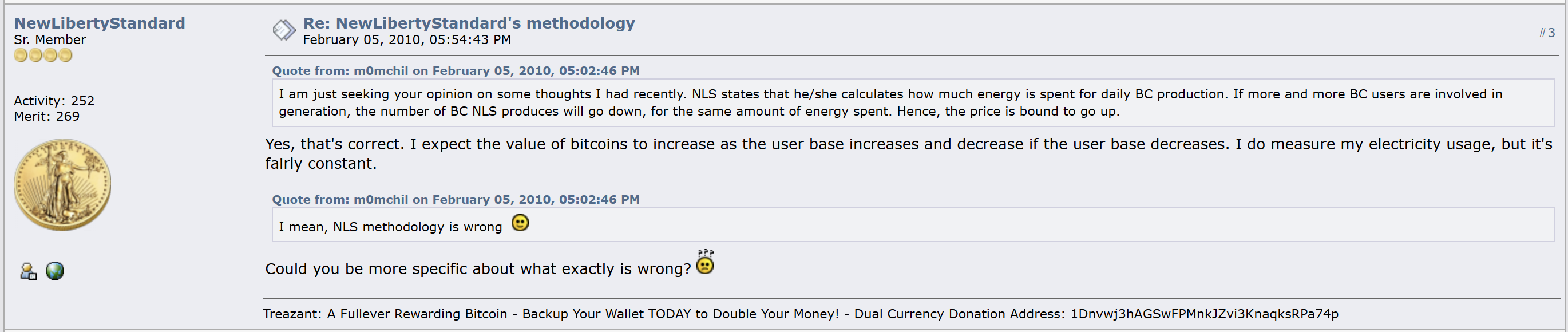
Yes, that's correct. I expect the value of bitcoins to increase as the user base increases and decrease if the user base decreases. I do measure my electricity usage, but it's fairly constant.
Could you be more specific about what exactly is wrong?
The operator agreed with m0mchil's point but didn't address the flaw in the method. The fact that they asked back "what exactly is wrong" suggests they hadn't grasped the quantitative, structural problem: the formula couldn't account for intensifying mining competition.
The operator didn't comment further in the thread, but a user named "riX" stepped in to clarify things, and that post is worth sharing.
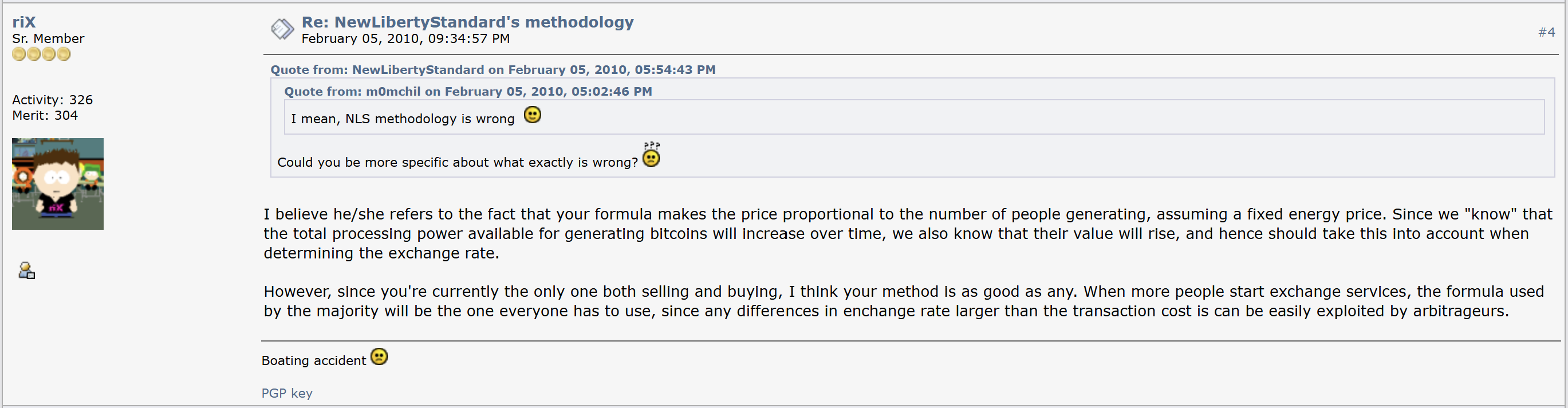
I believe he/she refers to the fact that your formula makes the price proportional to the number of people generating, assuming a fixed energy price. Since we "know" that the total processing power available for generating bitcoins will increase over time, we also know that their value will rise, and hence should take this into account when determining the exchange rate.
However, since you're currently the only one both selling and buying, I think your method is as good as any. When more people start exchange services, the formula used by the majority will be the one everyone has to use, since any differences in enchange rate larger than the transaction cost is can be easily exploited by arbitrageurs.
What's interesting about this post is that it recognizes the market was effectively being made by the operator alone, and it values the fact that the method worked well enough for now over theoretical precision.
Taken as a whole, the thread is arguably valuable as a record of one of the earliest discussions of a fundamental question about bitcoin as money: what should determine its price?
I also think the flaw in the method discussed in this thread may have been one of the reasons New Liberty Standard shut down.
New exchanges arrive
Whereas New Liberty Standard priced bitcoin by the electricity cost of mining, exchanges that set prices through supply and demand, the way trading works today, began appearing in the 2010s.
"Bitcoin Market," said to be the world's first exchange, was announced as a concept by a user named "dwdollar" on January 15, 2010.
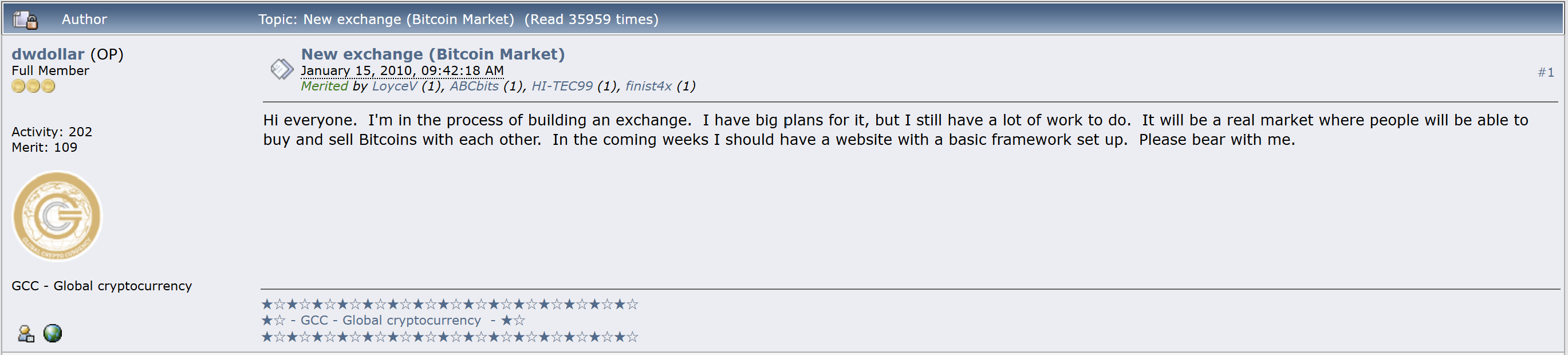
Hi everyone. I'm in the process of building an exchange. I have big plans for it, but I still have a lot of work to do. It will be a real market where people will be able to buy and sell Bitcoins with each other.
Bitcoin Market officially launched on March 17, 2010, accepting PayPal as the means of exchanging BTC for fiat currency. The key point is that a public BTC price was formed through actual buy and sell orders, not private deals or quotes at a fixed rate.
Around the same time, Mt. Gox, the exchange infamous for having its funds hacked, made its announcement and launched on July 18, 2010.
With the arrival of exchanges like Bitcoin Market and Mt. Gox, New Liberty Standard presumably faded from view and wound down.
Bitcoin Research Lab has a detailed explanation of why Mt. Gox was hit, so check out the past article below if you're interested.
トランザクション展性(マリアビリティ)とはなにか?何故問題か?Segwitでどう解決するのか?
今回のレポートは、先週に引き続きまして、ビットコインのスクリプトにまつわる話をしたいとおもいます。テーマは、トランザクション・マリアビリティです。トランザクション・マリアビリティというのは、ビットコインの実装における最大の欠陥とも指摘されていたものです。 Mt.Gox事件を当時体験しているひとだったら、かならずや聞いたことのある言葉とおもいます。マーク・カルプレス元CEOの「システムに弱いところがあって、ビットコインがなくなってしまいました」という言葉は記憶に新しいとおもいます。この「システムの弱いところ」というのが、トランザクション・マリアビリティの欠陥をついたバグということなのです。コインが盗まれた原因だとされていました(が、事件の顛末としてはCEOによる内部犯罪の線が濃厚です)。 トランザクション・マリアビリティがある限り、取引所などのシステムにもややこしい対応が必要になりますし、ライトニングネットワークやサイドチェーンといったものが開発できないといわれています。 なんとかして、マリアビリティ問題を解決できないか? 実は、Segwitというのが、このマリアビリティ問題の
 大石 哲之

The operator's fork coin
You might assume the operator went quiet after the trading service ended, but their forum profile includes a GitHub link.
NewLibertyStandard (the operator) described this project on the forum.
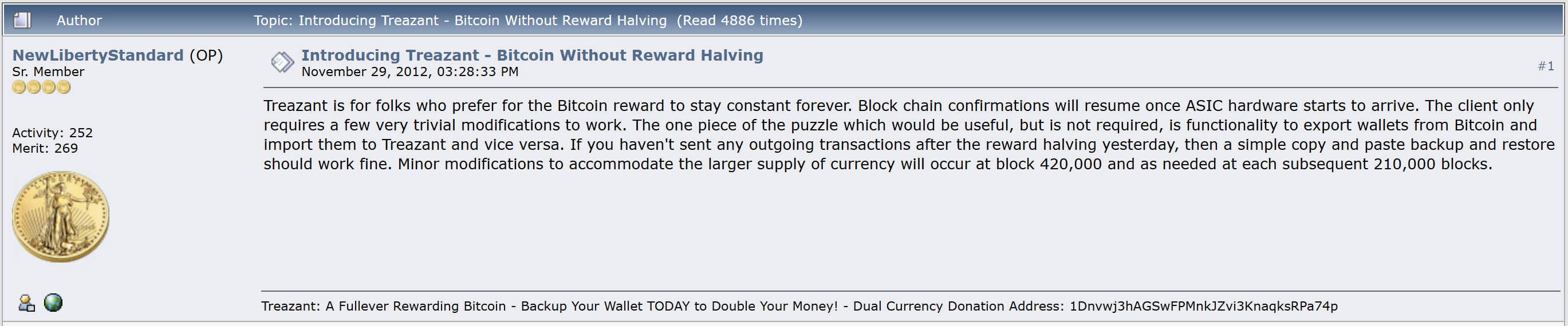
Treazant is for folks who prefer for the Bitcoin reward to stay constant forever. Block chain confirmations will resume once ASIC hardware starts to arrive. The client only requires a few very trivial modifications to work. The one piece of the puzzle which would be useful, but is not required, is functionality to export wallets from Bitcoin and import them to Treazant and vice versa. If you haven't sent any outgoing transactions after the reward halving yesterday, then a simple copy and paste backup and restore should work fine.
This shows it was a fork coin launched to coincide with the first-ever Bitcoin halving on November 28, 2012 (block 210,000, when the reward dropped from 50 BTC to 25 BTC), designed to keep the reward constant instead of halving it.
The community criticized it ("Another shitcoin born."), and the project was withdrawn after just one day, citing technical flaws.
The episode leaves the impression that NewLibertyStandard (the operator) was something of an engineer type with a pioneering spirit who liked to experiment, and it shows they stayed active after the trading service ended.
Bonus: the Bitcoin symbol "₿"
To finish, here's one more major contribution from NewLibertyStandard (the operator).
The "₿" symbol (a B with two vertical strokes) used for Bitcoin today is well known, but few people know that its prototype (a B with a single stroke) was proposed by NewLibertyStandard (the operator) on February 5, 2010.
There's a thread showing that the operator's proposal is what started the discussion of a symbol for Bitcoin.

I propose that we adopt the Thai baht currency symbol, ฿, as the official bitcoin currency symbol and BTC as the official bitcoin three letter currency code.
So the prototype of the Bitcoin symbol appears to have been the Thai baht sign.
There was also criticism that borrowing an existing currency's symbol could be confusing, and a user named "Sabunir" commented as follows.

I think that using any existing currency's symbol will cause potential confusion. Another disadvantage of that symbol is that it is not a key on most keyboards, so it would not be able to be typed easily. I would think that the ampersand (&) would be a better choice.
I agree that its three-letter code could be BTC.
NewLibertyStandard (the operator) pushed back on this comment as follows.

There's nothing wrong with multiple currencies using the same symbol. Many different currencies use the dollar sign, $. The ampersand, &, already has many very well defined meanings, including multiple uses as a prefix. It absolutely is not a currency symbol and using it as such would cause a lot more confusion than using an already existent obscure currency symbol. There is a generic currency symbol, ¤, which I considered using until I noticed the very beautiful ฿. You can type ฿ in Ubuntu by pressing Ctrl-Shift-U 0E3F and in Windows by pressing Alt 0E3F. I will be using it and I hope it catches on.
The thread shows many users debating the symbol. Here are some of the other proposals.
- &
- ¤
- ฿₡
- bc
- B
- ❂
- Ⓑ
It's fun to think that bitcoin might have ended up with one of these unfamiliar symbols.
Hal Finney, the first person to receive bitcoin from Satoshi Nakamoto, also joined the discussion of these proposals.

Interestingly, the dollar sign originated with two vertical bars rather than one, according to several theories.
http://en.wikipedia.org/wiki/Dollar_sign
http://en.wikipedia.org/wiki/Cifrão
Also, supposedly Unicode allows the character to be rendered either with one line or two, entirely depending on the taste of the font designer.
Satoshi updated the Bitcoin symbol on February 24, 2010 (post), and Hal Finney's comment seems to have contributed significantly.
In short, it appears NewLibertyStandard (the operator) proposed the prototype for the Bitcoin symbol, various users debated it, and Satoshi settled on the symbol.
The Bitcoin symbol has changed a little over the years, and the current one was designed by someone called Bitboy. The site below covers this in detail.
Origin of the Bitcoin logo and its history
Discover the funny story behind the bitcoin logo and learn about the designs prior to the current logo.


Summary
New Liberty Standard was a trading service that, on October 5, 2009, became the first in the world to publish and offer an exchange rate between bitcoin and the dollar. The operator was anonymous ("NewLibertyStandard" on bitcointalk), calculated the rate by hand from the electricity cost of mining, and handled trades in a simple way via PayPal and Gmail. Seven days later, on October 12, 2009, Martti Malmi sold 5,050 BTC for $5.02 to support the service, which is considered the world's first known trade between fiat currency and bitcoin.
In 2010, the community pointed out theoretical flaws in its pricing method (such as its failure to account for intensifying mining competition), and new exchanges like "Bitcoin Market" and Mt. Gox emerged with prices set by supply and demand. New Liberty Standard gradually lost its presence and quietly shut down at some point.
The operator stayed active afterward, launching "Treazant," a fork coin timed to the 2012 halving, and is also known as the person who proposed adopting the Thai baht sign "฿," the prototype of today's Bitcoin symbol "₿."