Do Data Centers Really Use Water? Lessons for Bitcoin Mining

This article was translated from Japanese with AI. Read the original (日本語) · Report a translation issue
Data centers are being built all over the world as part of the wave of AI-related capital investment. They seem to be facilities that local residents tend to dislike, and opposition campaigns against their construction are common.
電気代267%値上がりしんど…データセンター建設の反対運動、アメリカで急増のワケ
AI時代到来で、急速に需要が高まるデータセンター。アメリカ国内ではデータセンター建設計画が数多く持ち上がっています。が、クリーンエネルギーやデータセンターに関するプラットフォームの「Heatmap Pro」の調査によれば、2025年中に少なくとも25件のデータセンター建設計画が、地元コミュニティからの強い反対によって白紙となりました。25という件数だけ見ると多くないものの、2024年の建設キャン
 そうこ
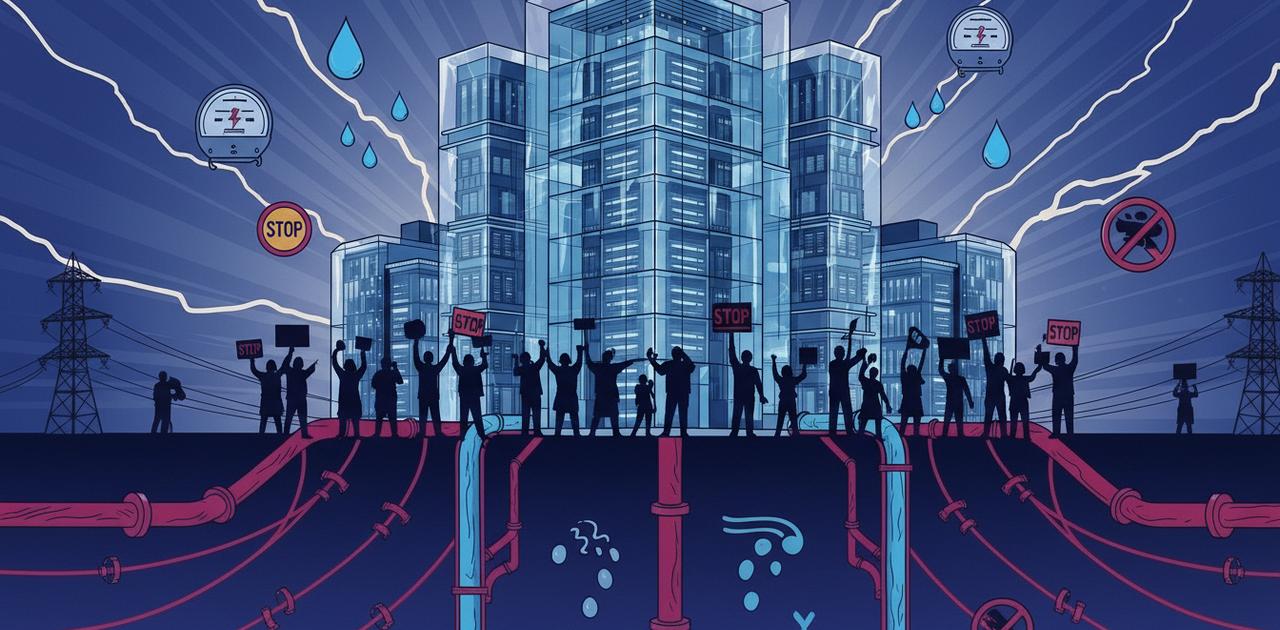
As the article above notes, opposition campaigns tend to cite three main reasons:
• Concern that heavy power consumption will drive up electricity bills
• Concern that water consumption will cause water shortages
• Secondary environmental pollution such as air pollution and noise
You may have heard about power consumption and noise in the context of Bitcoin mining, but "water consumption" isn't something most people associate with data centers, so it may come as a surprise to many. Yet claims like "every email you have ChatGPT write consumes 500 ml of water" really do circulate online:
‘Thirsty’ ChatGPT uses four times more water than previously thought
The massive computer clusters powering artificial intelligence consume vast quantities to answer the world’s queries, but how is Big Tech redressing the balance?
 Mark Sellman, Technology Correspondent | Adam Vaughan, Environment Editor

What exactly does it mean for a data center to consume water? Today I'll sort out the truth from the exaggeration in this claim, so that if similar criticism is ever aimed at Bitcoin mining, we're prepared and won't get swept up in emotional arguments.
💡
Incidentally, in Japan one common reason for opposing data centers seems to be an aversion to "sterile facilities that few people come and go from." It's interesting that when data centers are built in relatively densely populated places, such as Inzai and Nagareyama in Chiba Prefecture, objections arise on urban planning grounds like this.
What does "water consumption" mean? The problem with the water footprint
Have you ever heard the argument that producing a single hamburger takes 2,000 liters of water, so hamburgers aren't eco-friendly? I remember hearing it around elementary school age and thinking it was amazing, yet somehow it never quite made sense to me.
This idea is called the water footprint, an attempt to quantify how much water is used across a product's life, from sourcing raw materials to final disposal of waste. It applies to water the older concept of the carbon footprint, which similarly quantifies how much carbon dioxide is emitted over a product's life cycle so that the figure can be used to combat global warming.
ウォーターフットプリント算出事例集
環境省のホームページです。環境省の政策、報道発表、審議会、所管法令、環境白書、各種手続などの情報を掲載しています。


Japan's Ministry of the Environment page on water footprints
In the hamburger example, most of that water is rain that fell on pastures and on farmland growing grain for cattle feed, plus water used for irrigation. Add the relatively small amount of water used in distribution and processing, and you arrive at the figure of 2,000 liters per burger.
The carbon footprint is a reasonably rational idea in that any net increase in carbon dioxide emissions stays in the atmosphere more or less permanently. Unless the amount absorbed by plants also increases on net, atmospheric levels won't start to fall. Applying this idea to water, however, is deeply problematic, because water keeps cycling.
Obviously, a hamburger doesn't contain 2,000 liters of water. The water "consumed" during production is in reality returned to the atmosphere through transpiration by plants, or becomes fertilizer in the form of cattle manure. Grazing can lead to local environmental problems such as groundwater contamination, but on a global scale water resources aren't decreasing; all that happens is that a fictional number called the "water footprint" keeps piling up.
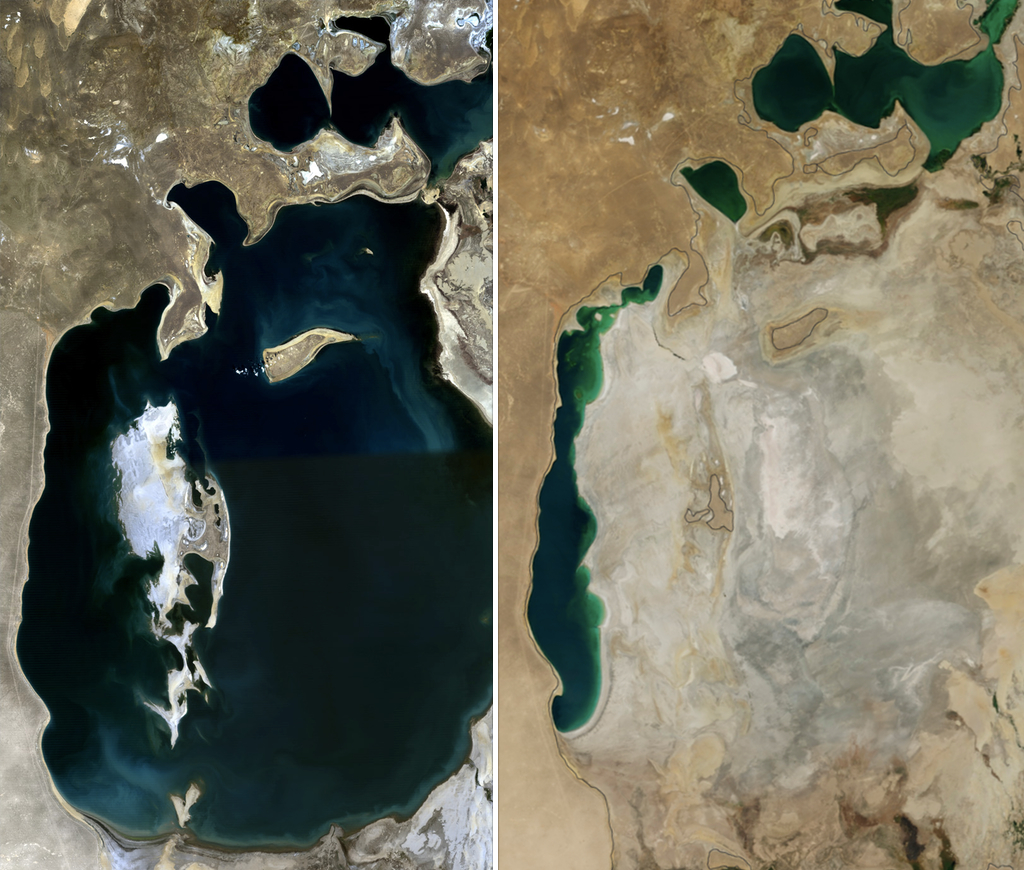
Beyond water pollution from livestock waste, pumping large amounts of groundwater can deplete an aquifer. Irrigating so heavily that low-flow rivers run dry can cause major environmental problems, as with the Aral Sea. But these are ultimately questions of local water resource management, and there are plenty of regions where the environmental burden of hamburger production is negligible.
To generalize the problem with the water footprint concept: it is reasonable to think about water resources as a local concern, but generalized figures like "2,000 L of water per hamburger" or "having ChatGPT write an email consumes so much water" are sensationalist performance and not constructive.
So at the local scale, how much water do AI data centers use, and how?
💡
This is something of a digression, but if we're going to treat the water footprint as a global rather than local metric, shouldn't the KPI we actually want to minimize be the concrete "emissions of environmental pollutants" rather than a vague "water consumption"? That becomes obvious when you consider the merits of a water-saving method that cuts water use to 1/10 but increases environmental pollution 100-fold.
How data centers actually use water
If you apply the water footprint concept to data centers, the breakdown can be roughly divided into "water used in manufacturing the equipment," "water used at power plants," and "water used in operating the data center." The first two concern how much water goes into making semiconductors and how much is used to cool power plants, but those processes happen far from the data center, so the figures have nothing to do with the environment where it is built. This article therefore focuses on water use related to running data centers.
Almost all of the water used by AI data centers goes to cooling. As with Bitcoin mining, nearly all the electricity consumed by AI computation on servers and GPUs is ultimately released as heat. I recently wrote about a product that turns this to its advantage by marketing itself as a "heater that can also mine."
マイニング排熱の活用事例 | 家庭用マイニングヒーターは採算が取れるのか?
ビットコインのマイニングで発生する排熱を、産業用途や家庭用に活用している事例を紹介。排熱を他の用途に使うことでマイニングの収益性を改善できることを、実際の計算とともに解説しています。
 加藤 規新
Whether for AI or mining, there are essentially only two options for where to dump the massive heat a data center generates: release it into the air, or release it into water such as the sea, a lake or a river.
Releasing heat into the air
The simplest method is to blow air with powerful fans over the heat-generating devices themselves, or over a radiator that collects heat from the devices, letting the heat escape into the air. For example, the Bitaxe I've covered before dissipates heat by blowing air directly onto its ASIC chip with a fan.
ホビーマイニングの最先端?BitAxeシリーズが面白い
皆さんは「ホビーマイニング」と聞いてどんな光景を想像しますか? 一昔前であれば家にグラフィックボード数台を用意してアルトコインをマイニングしている人がいましたが、最近でも古めのASIC(Bitmain Antminer S9など数世代前のもの)を買って冬場にヒーター代わりに稼働しているビットコイナーの姿をときどき見ます。 ただ、日本だとS9を1台稼働させるのも難しいかもしれません。まず、消費電力が1500Wほどあるため、24時間稼働させるには家の電気容量がそこそこ大きい必要があります。 例えば私が以前暮らしていた単身者向けアパートだと電気容量は20Aだったため、S9を稼働させると他にほとんど家電製品を使えないことになります。今の家は30Aなのでもう少し余裕がありますが、エアコンなどと合わせるとかなり厳しいです。 さらに騒音の問題があります。大型のASICはかなり発熱するため、冷却のために高速回転するファンが付属しています。これが非常にうるさいため、家の狭い日本では置き場所に困ります。(海外だとガレージや地下室、庭の小屋などに置かれがちなイメージです。)生活スペースに置くとしても
加藤 規新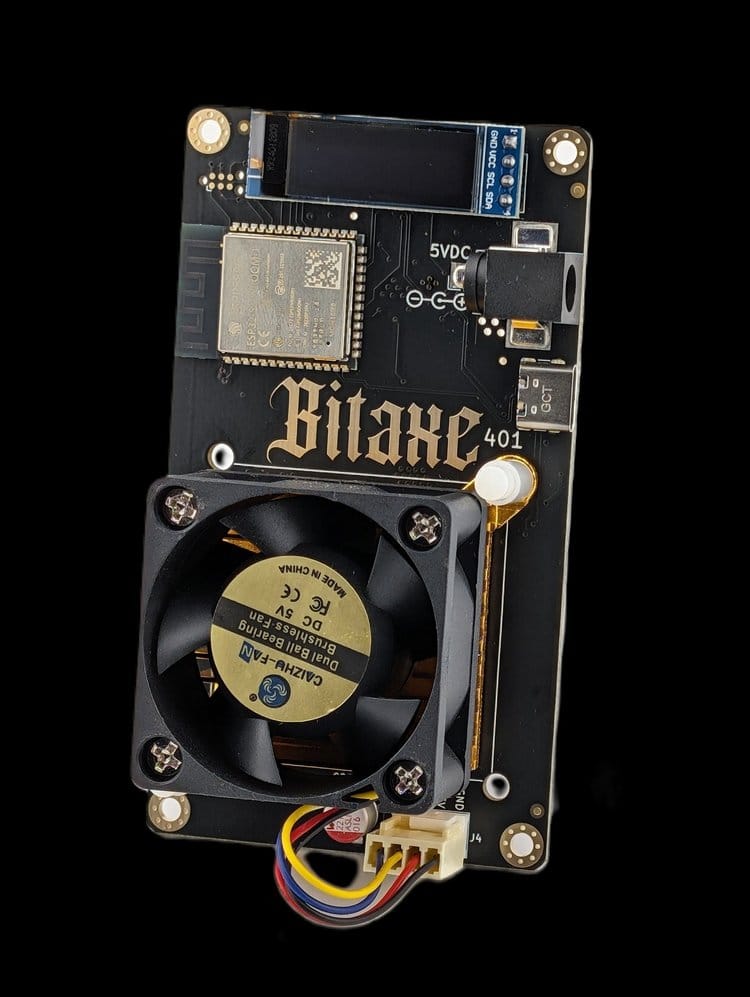
More sophisticated data centers use specialized equipment to carry heat from the machines to radiators, where it is discharged. It's the same mechanism as the radiator in a gasoline car. Because air is a good insulator, expelling a large amount of heat requires a great deal of airflow.
💡
Older cars overheated easily in traffic jams because they couldn't shed heat unless air was blowing over the engine itself (air cooling). Today almost all cars are water-cooled, with a radiator and a fan.
One way to make this mechanism more powerful is to use the heat of vaporization of water to release heat into the atmosphere more efficiently. By continuously evaporating a small amount of water at the radiator, much more heat can be released into the air. It costs no extra electricity, but uses water instead.
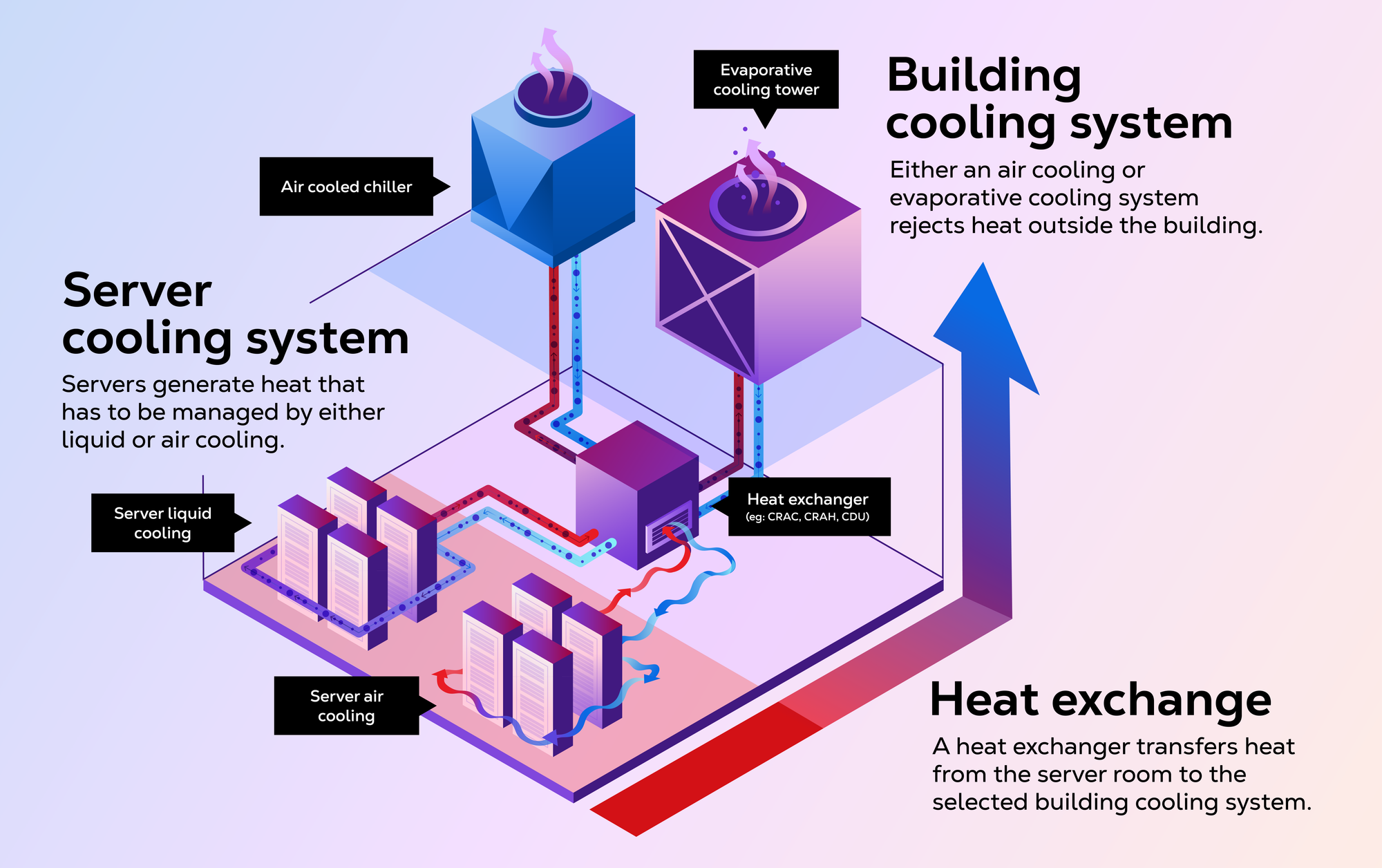
Alternatively, you can use a heat pump, in other words, an air conditioner. It costs more in electricity, but it can be an alternative in environments where water use is restricted. Conversely, it may be hard to adopt in places where electricity is expensive.
Releasing heat into water
Water has far higher thermal conductivity than air and is liquid at ordinary temperatures, making it well suited for cooling. Simply replacing the air in the air-cooling setup above with water dramatically increases cooling capacity. That's why Microsoft has been testing data centers placed underwater.
マイクロソフト、海底データセンターの信頼性、実用性、エネルギー消費の持続可能性を実証 - News Center Japan
日本マイクロソフト株式会社 最新企業情報
 Japan News Center 15 9月, 2020

If the data center itself isn't placed underwater, its heat is transferred to water that has been pumped in, which is then either discharged as is or evaporated as described earlier. The nuclear power plants in Fukui Prefecture, for example, are cooled this way, and because their warm discharge water is about 6–9°C warmer than the surrounding water, concerns have been raised about its effects on ecosystems (PDF). If a data center did the same thing, the amount of water would not decrease since it is returned to where it was drawn from, but one could imagine criticism that the rising water temperature affects ecosystems. In any case, the amount that can be drawn would likely be limited by its environmental impact.
There is also a more granular estimate of actual usage. According to it, about 97% of the figures commonly cited is water used at power plants (more than 90% of which goes straight back to its source), while only about 3% is evaporated for heat exchange at the data center itself. Some of that falls as rain in the same region, so the consumption of that region's water resources is probably even smaller.
As we've seen, a data center's heat removal relies on a combination of "power consumption (fans, air conditioning)" and "water consumption (heat of vaporization, heat exchange with a water source)," and the mix can be chosen freely depending on location. We've also found that the numbers actually being thrown around are dozens of times the water actually "consumed" through evaporation. And since careful environmental assessments are needed when building a data center for the sake of business continuity as well, my impression is that the likelihood of a data center causing major problems for the local environment tends to be overestimated.
💡
Of course, it's case by case, so it's not as though there can be no impact at all. But since the data center business model depends on a stable power supply and reliable heat removal, it's natural to assume that a data center won't be built if there are realistic factors threatening those. In fact, data centers sometimes build their own facilities for power supply and freshwater supply when needed.
Criticism that will eventually reach Bitcoin mining?
Until a few years ago, Bitcoin mining was frequently criticized for its power consumption. Much of the criticism was fairly crude, with people seriously claiming that if Bitcoin kept growing at its current pace it would contribute a full 2°C of warming by 2050. Even now, I feel like I still occasionally see claims along the lines of "each Bitcoin transaction emits X kg of CO2."
Bitcoin Energy Consumption Index - Digiconomist
The Bitcoin Energy Consumption Index provides the latest estimate of the total energy consumption of the Bitcoin network.


Digiconomist's deeply flawed article criticizing mining, which used to be cited frequently
Since then, there have been more and more cases, mainly in the United States, of Bitcoin mining contributing to a stable power supply, and perhaps because it has gained a degree of public recognition, the criticism seems to have calmed down. Mining also helps increase the global supply of renewable energy by putting otherwise wasted energy to use and by acting as a buyer when renewable sources, whose output fluctuates widely, produce a surplus. I've listed a few past articles on this below for anyone interested.
複雑化するマイニング戦略と、電力会社との協力関係の模索
マイニング業の成熟について今週読んで大変気に入った記事(英語)がありました。内容は自然エネルギー発電の増加による電力網への影響と、電力先物を利用したマイニング業のヘッジについてです。これまでに研究所内で話した電力の特徴やハッシュレート先物などとともに、これからのマイニング業界を理解するために重要になってくる要素がてんこ盛りだったので抄訳するとともに、一般的な話を含めて解説します。 記事の著者も言う通り、今はまだとてもシンプルなモデルで営業しているマイニング業者が多いと考えられていますが、市場環境がよりシビアになる中でリスクを制限するヘッジ方法などが取り入れられていくと、それを理解していることがトレードなどに役立つようになるかもしれません。 用語の定義:
電気料金 = すべてコミコミの消費者向けの料金
電力価格 = 業者間で電力そのものが取引される価格 記事の内容:抄訳 ・電力は貯蔵が難しく、常に発電量≒消費量になる必要がある
・自然エネルギー発電は気まぐれなので、火力発電で発電量を調整する
・自然エネルギーが豊富で火力発電が発電していないときも、待機のためのコストを払っている(
加藤 規新
ストランデッドガス田とマイニング
ビットコインのマイニングの話をする上で、電力源の検討は外せません。ASICが消費する電力を安く入手するためには、エネルギーの需給が崩れている土地・環境を見つける必要があります。そしてその環境は大規模な設備投資が難しい僻地や、土地の限られた施設内にあることも多いでしょう。 今回の記事は、“Ohmm”というコンテナ型のマイニングファームを製造・販売するUpstream Data社の取り組みと、彼らが有望な電力源の1つとしているストランデッドガス田の収益化が可能か見ていきます。 ストランデッドガス田とは 天然ガスは液体である石油と比べて保管・輸送にコストがかかるため、採算が取れないガス田は多く存在し、推定で地球上の天然ガスの埋蔵量の1/3は「ストランデッドガス田」と呼ばれる、現在の需要では開発が現実的でない場所に埋蔵されていると言われます。 天然ガスの輸送は主にパイプラインか、冷却・加圧する液化プラントと液化天然ガス専用のタンカーの組み合わせで行われており、採算を取るにあたって「消費地からの距離」が非常に大きな要素となります。例えば近距離であればパイプラインにつないで直接発電所などに
加藤 規新
マイニングとエネルギー問題
こんにちは。AndGoのハードウェア担当の片山です。 実は僕は本職ではエネルギー分野に関する研究者をやっているということもあり,本日はマイニングとエネルギーについてお話していきたいと思います。 マイニングについて復習 まずマイニングの復習からしていきたいと思います。ビットコインのトランザクションは約1MBごとにブロックとしてまとめられます。さらにブロックに「ある値」を付け加えたものからハッシュ値というものを計算します。このときハッシュ値がある特定の値以下になるようにしなければいけません。ハッシュ値は付け加えた「ある値」によって不規則に変化するので,「ある値」を無作為に選んで,適切なハッシュ値が出るまで,何度もトライアルアンドエラーを繰り返す必要があります。これがマイニングで行われている計算です。(手動でやってみたい方向けに注釈*に方法を記しておきます。) この無駄な計算を全力で行うことがまさに Proof of Work でブロックチェーンの正当性を担保する作業です。 マイニングに必要なエネルギーを計算してみる 皆さんマイニングに必要なエネルギーってどのくらいか見積もって
AndGoハードウェア担当
Now, compared with ordinary data centers, the Bitcoin mining world was still largely immature, so many operations were simply air-cooled, and many were small data centers that couldn't install complex equipment. Recently, with more specialized hardware appearing, mining is moving closer to more advanced data centers, but it will probably be a while before its operations reach the level of AI data centers.
Block社が発表した米国製マイニング機材:Protoは何が特別なのか
マイニングの分散性に関してよく懸念されるのはマイニングプールの寡占化ですが、もっと上流の部分だとマイニングに使われる機材であるASICの生産は中国・Bitmain社がマーケットの8割を占めているという状況です。もちろんASICの生産も普通に商売として行うのが(ビットコインを攻撃するよりも)儲かるのですが、逆に言えば政府の圧力などで生産設備を徴用されるリスクもあるということになります。 また、Bitmainは多くのマイニングプールとも関係が深く、そちらの問題も悪化させてしまう可能性があります。 8月にBlock社がついに発表した米国製マイニング機材であるProtoは業界標準となっているBitmainの機材とどう差別化するのでしょうか?今日はProto以前の新興ASICメーカーの戦略やProtoの戦略について取り上げていきます。 HomepageProto is decentralizing bitcoin mining by increasing access to tools for builders. We believe this is the best way to cre
加藤 規新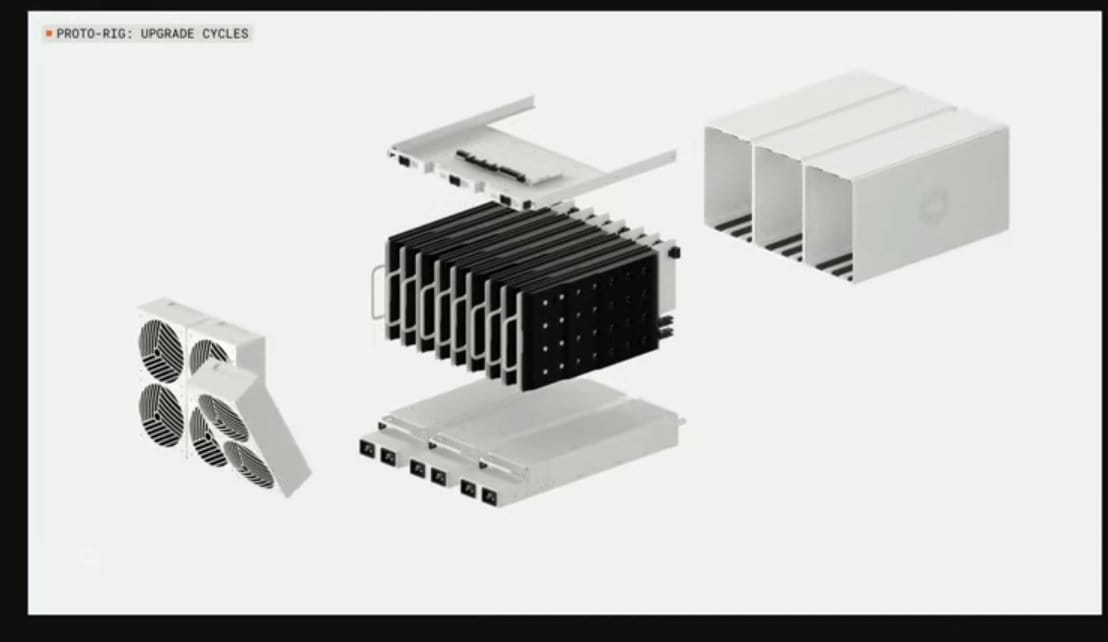
On top of that, the water footprint concept only began to be applied to data centers relatively recently. With that in mind, Bitcoin mining may start to face similar criticism in the future.
When that happens, it will help to know three things: that water footprint figures are largely meaningless; that the actual environmental impact differs from one data center to another; and that, given the long-term operation and cost-effectiveness of data centers, a business plan that would damage a region's water resources is unlikely to hold up. Knowing this will keep you from being misled by emotional arguments.