Bitcoin Pizza Day: The Story of the First Bitcoin Payment
This article was translated from Japanese with AI. Read the original (日本語) · Report a translation issue
Did you know that on May 22, 2010, exactly 16 years ago today, a programmer named Laszlo Hanyecz bought two pizzas with bitcoin?
He paid a whopping 10,000 BTC.
The purchase went down in history as the world's first Bitcoin payment, and every May 22 is now celebrated around the world as "Bitcoin Pizza Day." Plenty of you probably eat pizza on this day too.
Laszlo later said that in roughly the year following that fateful day (May 22), he spent around 100,000 BTC, reportedly on pizza trades and on giving bitcoin away (a common practice at the time).
In this article, I look at how Laszlo came to buy those pizzas, walking through the background and what the purchase meant.
As a bonus, I also cover two lesser-known contributions Laszlo made that have been overshadowed by his famous pizza feat.
💡
The pizzas are said to have come from Papa John's, an American chain. As of 2026 it doesn't operate in Japan, so I'd love to try it the next time I'm in the US.
The forum post and the pizza purchase: "Pizza for bitcoins?"
On May 18, 2010, a new thread appeared on Bitcointalk, the forum Satoshi Nakamoto had set up. Its title was "Pizza for bitcoins?"
The post asked whether anyone would sell him pizza for bitcoin. Let's look at exactly what it said.
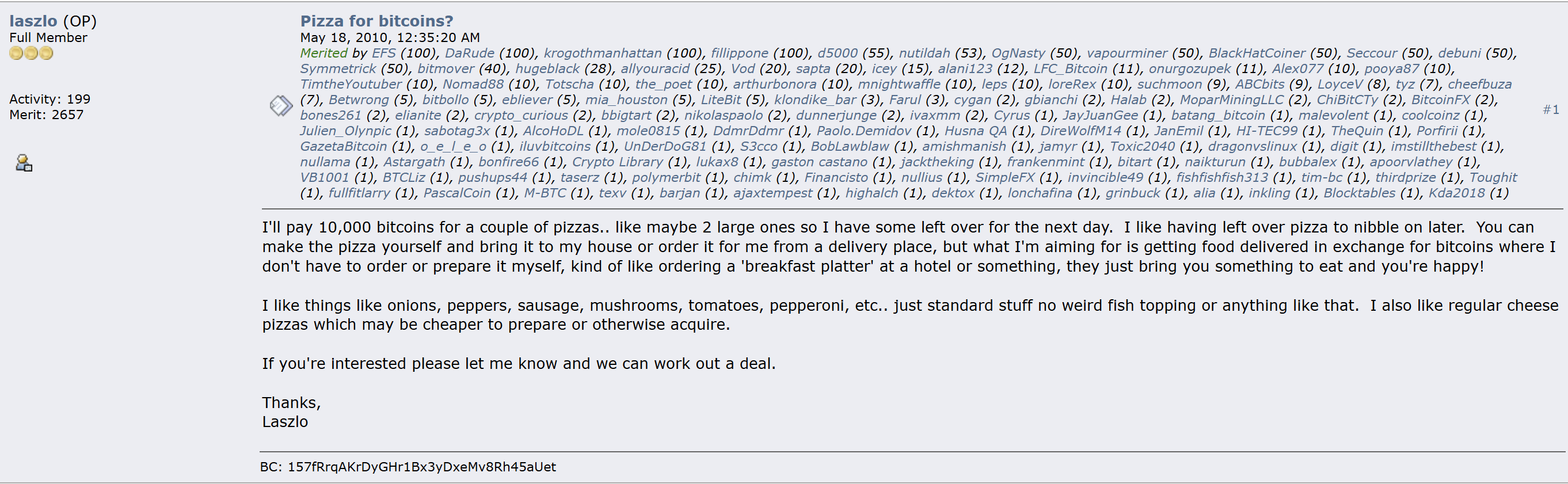
I'll pay 10,000 bitcoins for a couple of pizzas.. like maybe 2 large ones so I have some left over for the next day. I like having left over pizza to nibble on later. You can make the pizza yourself and bring it to my house or order it for me from a delivery place, but what I'm aiming for is getting food delivered in exchange for bitcoins where I don't have to order or prepare it myself, kind of like ordering a 'breakfast platter' at a hotel or something, they just bring you something to eat and you're happy!
I like things like onions, peppers, sausage, mushrooms, tomatoes, pepperoni, etc.. just standard stuff no weird fish topping or anything like that. I also like regular cheese pizzas which may be cheaper to prepare or otherwise acquire. If you're interested please let me know and we can work out a deal.
Thanks,
Laszlo
About five users replied to the post on the forum, with exchanges like "What country do you live in?" and "If I can figure out how to pay from Europe, I'll buy you a Domino's."
The mood of the time and what bitcoin was worth
Here is a post that caught my attention because of what it reveals about the mood back then. It was written by a user called ender_x.

Thats quite a bit.. you could sell those on https://www.bitcoinmarket.com/ for $41USD right now.. good luck on getting your free pizza.
(ender_x)
The link pointed to a site called Bitcoin Market, where at the time you could trade bitcoin for US dollars via PayPal. (After a wave of PayPal-related fraud, the site stopped accepting PayPal and shut down shortly afterward.)
Two things about this post stand out. First, it puts a concrete price on the deal: 10,000 BTC for two pizzas = $41. It's a valuable record that gives us today a vivid sense of what bitcoin was worth back then.
Second, ender_x seems to have seen it as Laszlo getting "free pizza," which conveys how, at the time, the idea of using bitcoin as money hadn't really taken hold yet.
Why did Laszlo want to use bitcoin?
There's one more interesting exchange worth sharing, between a user named BitcoinFX and Laszlo.
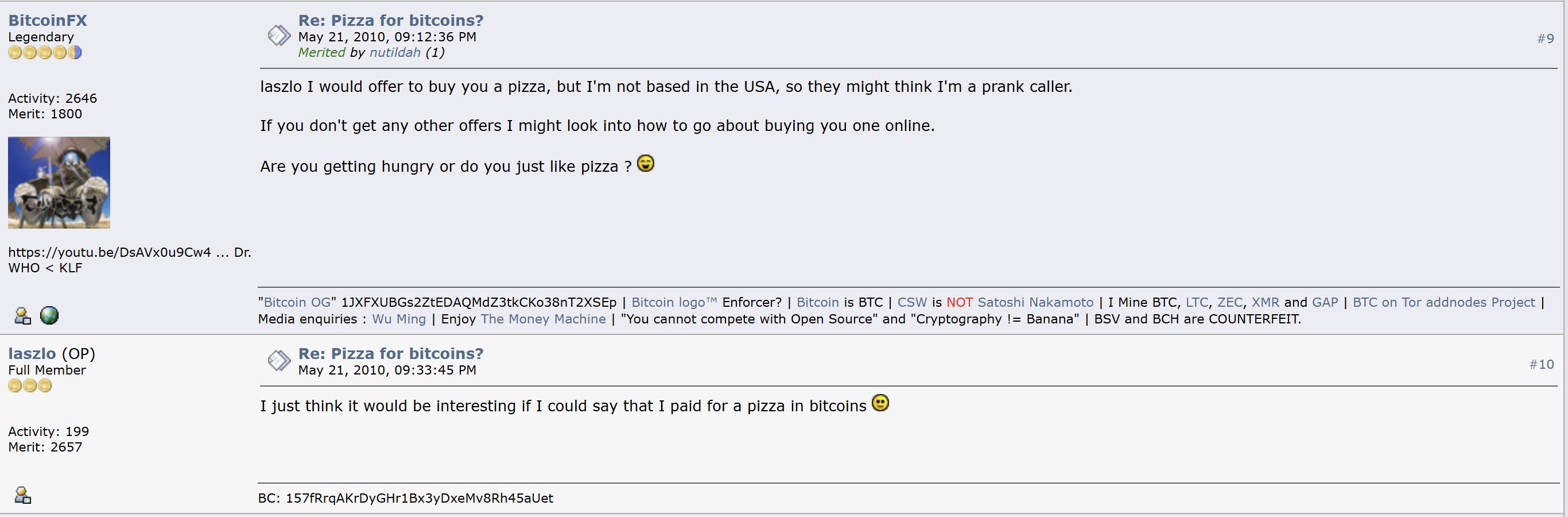
laszlo I would offer to buy you a pizza, but I'm not based in the USA, so they might think I'm a prank caller. If you don't get any other offers I might look into how to go about buying you one online. Are you getting hungry or do you just like pizza ? 😄 (BitcoinFX)
I just think it would be interesting if I could say that I paid for a pizza in bitcoins 😊 (Laszlo)
This shows that Laszlo bought the pizza out of curiosity, wanting to use bitcoin as a means of payment.
I personally believe that bitcoin's essence is as a means of payment (money), and I think Laszlo's pizza purchase was an important milestone on the road to bitcoin being adopted as a means of payment.
As a postscript, Laszlo has said he has "no regrets" about the purchase. (More on this later.)
Buying pizza with bitcoin
On May 22, 2010, four days after his first post, Laszlo announced on the forum that he had successfully bought the pizzas.

I just want to report that I successfully traded 10,000 bitcoins for pizza.
Pictures:
http://heliacal.net/~solar/bitcoin/pizza/ (the photos at this link are no longer available, but you can find them by searching online)
Thanks jercos!
What is believed to be the transaction from that day can be viewed on mempool.space.
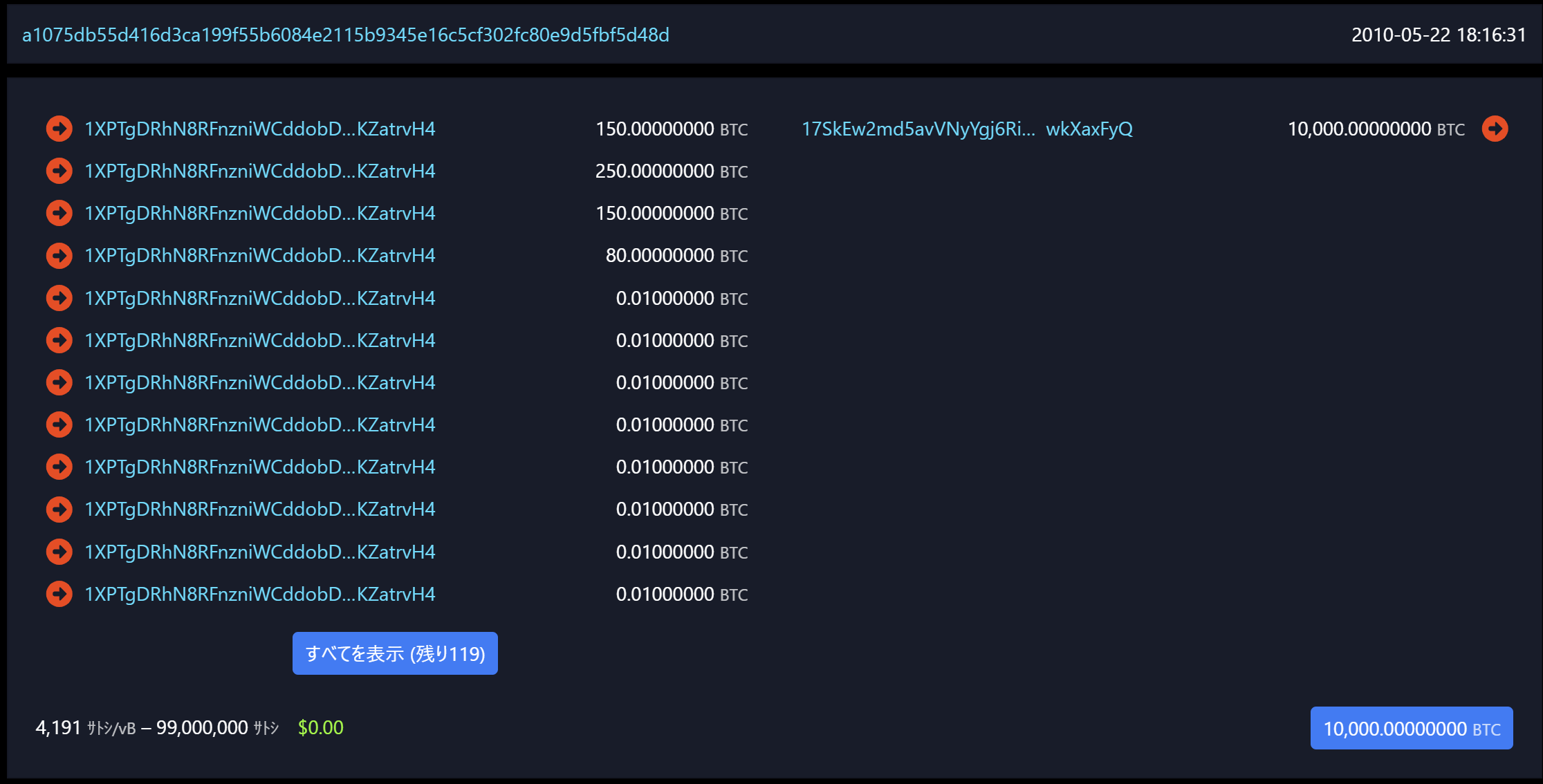
Since some of you may be seeing a transaction page like this for the first time, here's a quick guide to reading it.
The left side shows the sender's (Laszlo's) addresses and their bitcoin balances, and those funds were used to send 10,000 BTC to the recipient's (jercos's) address on the right.
We can't say for certain that this transaction is the pizza purchase, but since the amount matches at exactly 10,000 BTC and the transaction time (2010-05-22 18:16) is close to when he posted on the forum that the purchase had gone through (2010-05-22 19:17), I think it almost certainly is.
"jercos," the mysterious figure who received the 10,000 BTC
The spotlight tends to fall on Laszlo, who bought the pizza with bitcoin, but shouldn't jercos, the mysterious figure who accepted the bitcoin, get some credit too?
His real name is known to be Jeremy Sturdivant, and he was a 19-year-old Bitcoin enthusiast at the time. He reportedly answered Laszlo's call on Bitcointalk and carried out the trade over IRC (Internet Relay Chat).
Whereas Laszlo was trying to explore bitcoin's potential as a means of payment, Jeremy apparently saw it as a good opportunity to take part in the growing Bitcoin experiment.
In a later interview, Jeremy said that he spent the bitcoin he received on travel and personal expenses, but that he has no regrets.
Where the name "Bitcoin Pizza Day" came from, and why it matters
Digging through the forum history, I found the following post.
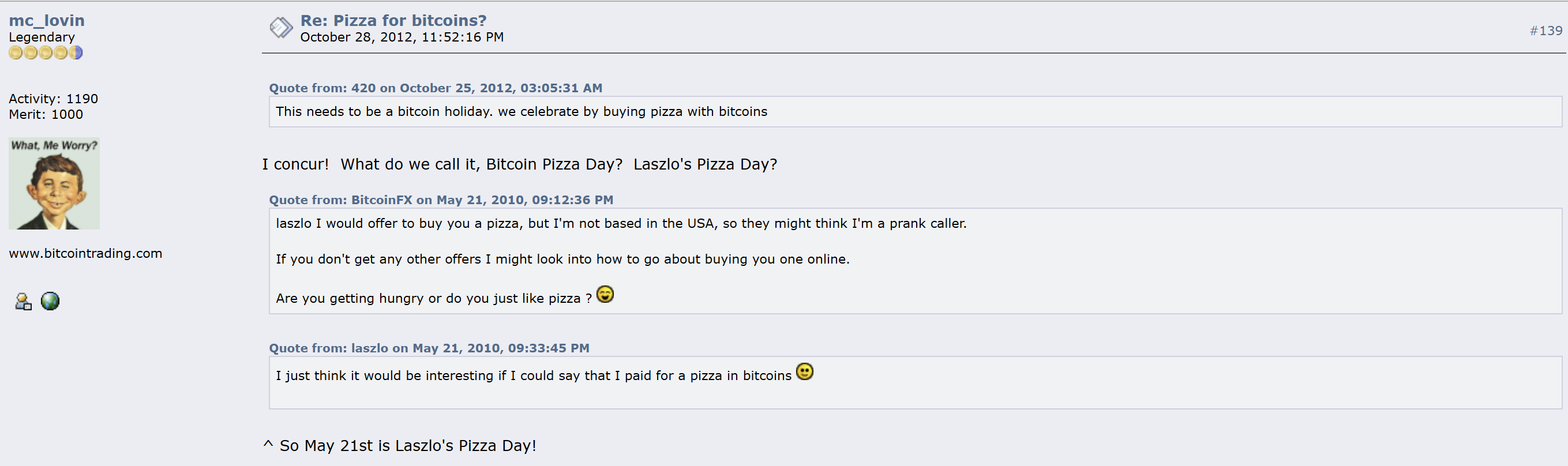
"What do we call it, Bitcoin Pizza Day? Laszlo's Pizza Day?"
I believe this one line, posted by a user named mc_lovin on October 28, 2012, is the origin of the name "Bitcoin Pizza Day."
💡
As an aside, the pizzas were delivered on mc_lovin's birthday, so you could also read this as him wanting to make the day a celebration.
Why Laszlo's bitcoin pizza purchase matters
So what impact and value did Laszlo's purchase of pizza with bitcoin have for society?
This is my own view, but the first point is that it was a milestone for Bitcoin payments. Before this payment, developers and enthusiasts had only sent bitcoin among themselves; nobody had actually exchanged it for real goods.
Satoshi himself described Bitcoin as "the P2P cryptocurrency," and you could say this was the moment that data in code first functioned as "money."
Conversely, without the pizza purchase, it's possible that bitcoin might never have been used for payments and would not have the value it has today. Laszlo's pizza purchase is also an example of how important it is for a community to take action in the earliest days of a new technology.
Laszlo may also have preferred spending his bitcoin, then worth $41, and thereby getting it into people's hands, over simply holding it. According to one study that examined Laszlo's Bitcoin addresses in May 2010, he held as much as 20,962 BTC at his peak. And he was apparently mining at such a pace that he could earn back the bitcoin he spent on the pizza with just one week of mining.
The other point, I believe, is atonement to Satoshi Nakamoto and a contribution to Bitcoin. This is my hypothesis that, feeling he had damaged Satoshi's project by mining with GPUs, Laszlo may have kept doing pizza trades as a way to contribute to Bitcoin. I explain this in more detail in the next section.
To close this section, here is an excerpt from Laszlo's 2019 interview with Bitcoin Magazine.
"A trade happens because both parties think they're getting a good deal. I felt like I was beating the internet, getting free food. I was like, 'Man, I got these GPUs linked together, now I'm going to mine twice as fast. I'm just going to be eating free food; I'll never have to buy food again.'... I mean, I coded this thing and mined bitcoin and I felt like I was winning the internet that day. I got pizza for contributing to an open-source project. Usually hobbies are a time sink and money sink, and in this case, my hobby bought me dinner."
Bonus: Laszlo Hanyecz's two hidden contributions
With all the attention on his famous pizza trade, few people know that Laszlo also made major contributions to Bitcoin's development. Here they are.
1. Making Bitcoin software run on macOS
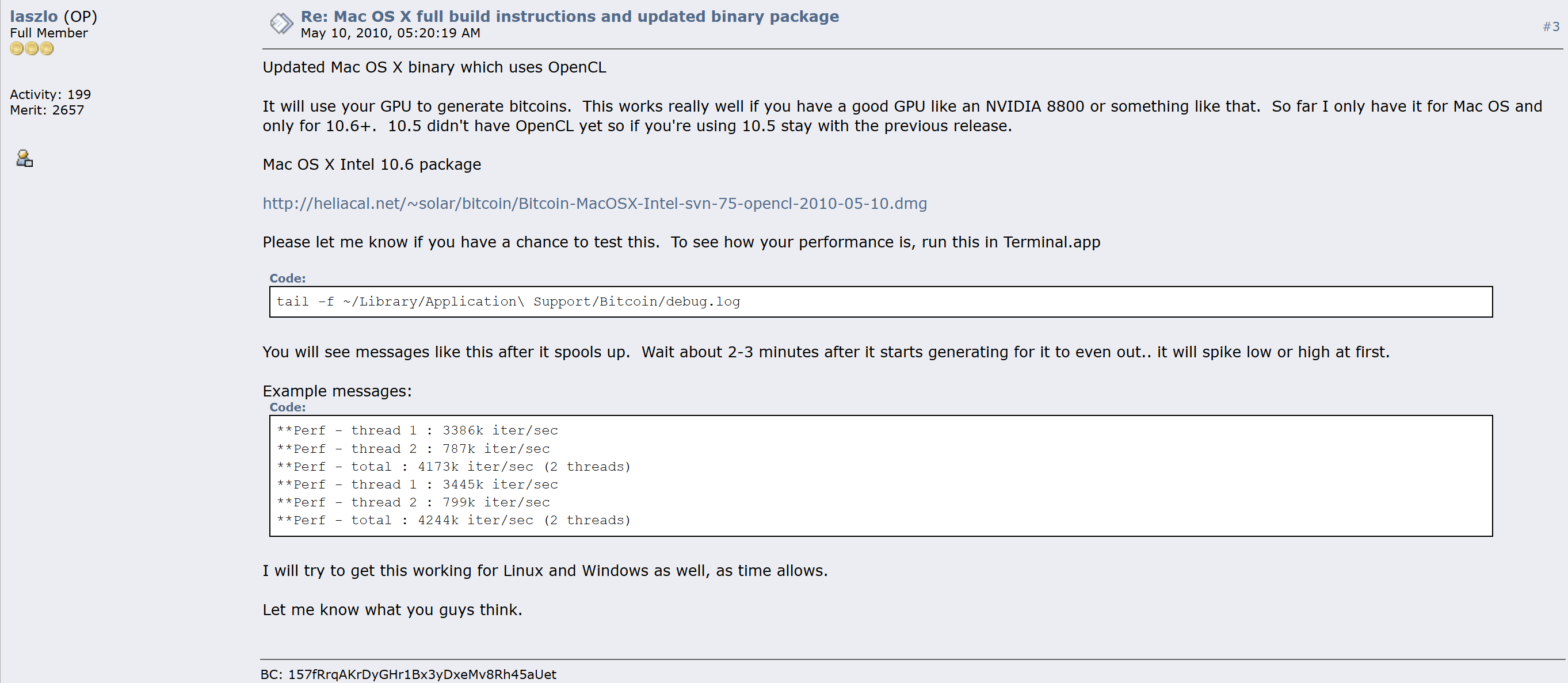
Satoshi had originally written Bitcoin for Windows and Linux, so Bitcoin Core (the first and still dominant software implementation for the nodes that keep the Bitcoin network running) couldn't run on macOS.
Laszlo's May 10, 2010 post above made it possible to run the software on macOS. This was a major contribution to Bitcoin, and it's an important fact that it laid the groundwork for the macOS-compatible Bitcoin apps and wallets that followed.
2. Discovering that you could mine with GPUs
In 2010, most miners mined with CPUs.
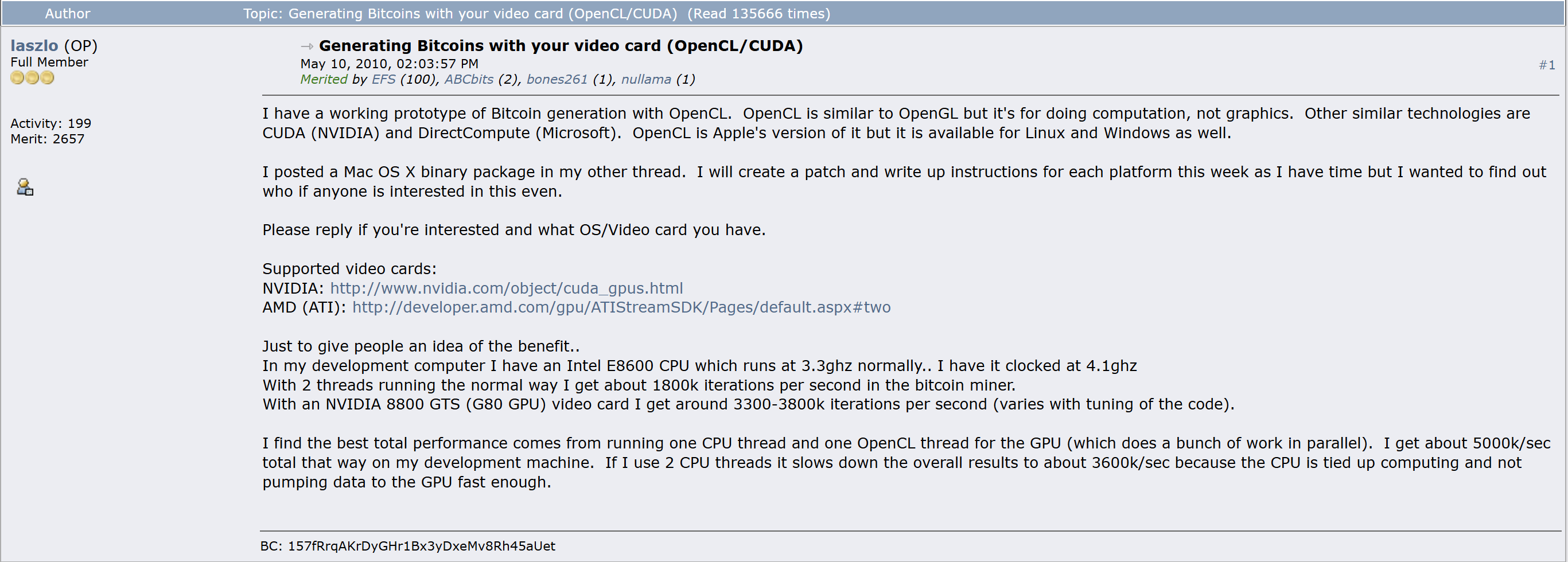
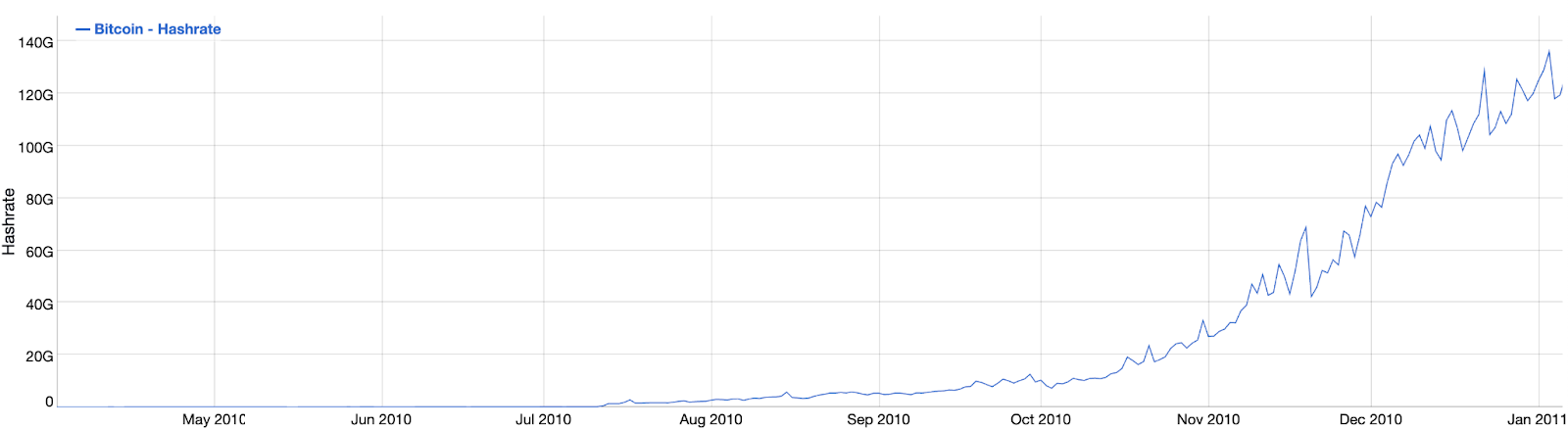
Laszlo discovered that bitcoin could be mined using a computer's graphics card (GPU) and posted about it on the forum on May 10, 2010. Because GPUs were orders of magnitude more powerful than CPUs at mining, they accelerated Bitcoin mining far beyond the pace Satoshi had anticipated.
What followed was Bitcoin's first digital gold rush, with the hashrate rising 130,000% by the end of 2010. As difficulty climbed, miners reportedly began building small mining farms in basements, garages and attics. These setups are said to have been the prototypes of today's large-scale industrial mining farms.
Satoshi's email about GPU mining
It's known that one day Laszlo, who had been spreading the word about GPU mining, received an email from Satoshi Nakamoto. In it, Satoshi asked him to hold off on posting about GPU mining, saying that while he knew people would eventually mine with GPUs, "I don't want to hasten that day."
At the time, only about one year and four months had passed since Bitcoin launched on January 3, 2009. Satoshi wanted Bitcoin to scale properly, and he is thought to have deliberately controlled his own hashrate (so that coins would be distributed fairly among miners).
At a time when any new miner with just a computer could easily mine and earn bitcoin, GPUs carried a risk: miners who owned these expensive pieces of hardware could monopolize the coins, concentrating them in a few hands.
Here is the full text of Satoshi's email to Laszlo.
A big attraction to new users is that anyone with a computer can generate some free coins. When there are 5000 users, that incentive may fade, but for now it's still true. GPUs would prematurely limit the incentive to only those with high end GPU hardware. It's inevitable that GPU compute clusters will eventually hog all the generated coins, but I don't want to hasten that day. If the difficulty gets really high, that increases the value of each coin in a way since the supply becomes more limited. The supply is the same: 50 coins every 10 minutes. But GPUs are much less evenly distributed, so the generated coins only go towards rewarding 20% of the people for joining the network instead of 100%. I don't mean to sound like a socialist, I don't care if wealth is concentrated, but for now, we get more growth by giving that money to 100% of the people than giving it to 20%. Also, the longer we can delay the GPU arms race, the more mature the OpenCL libraries get, and the more people will have OpenCL compatible video cards. If we see from the difficulty factor that someone is using too much GPU, we can certainly pick this OpenCL stuff up again then. Maybe my effort to maintain GPU innocence is running out of time. It's worked out so far.
Laszlo has said that after receiving the email, he stopped promoting GPU mining. According to the 2019 Bitcoin Magazine interview, he said, "That's when I was like, 'Man, I feel like I crapped up your project. Sorry, dude.' He [Satoshi] was concerned that some people might be discouraged because they can't mine a block with a CPU."
Given all this, perhaps Laszlo kept using bitcoin as a way of atoning to Satoshi and contributing to Bitcoin's growth.
Conclusion: the pizza trade was a big step for Bitcoin payments
Laszlo Hanyecz's purchase of two pizzas for 10,000 BTC on May 22, 2010 is more than just the story of "the world's most expensive pizza." It was the moment that bitcoin, until then nothing more than data in code, was first exchanged for real goods and functioned as "money," a decisive step toward the Bitcoin payments that followed.
Laszlo's contributions also go beyond the pizza trade. By releasing a macOS client, he expanded the range of environments that could run Bitcoin, and by discovering GPU mining, he dramatically boosted the network's computing power. At the same time, the way the spread of GPU mining raised concerns for Satoshi may help explain why Laszlo himself later insisted on "continuing to use" bitcoin.
Converted to today's prices, the two pizzas bought with $41 worth of bitcoin would be worth an astronomical sum. But as Laszlo himself says, he has "no regrets." Without this trade, bitcoin might never have taken its first step as a means of payment, and its value today might not exist.
I believe that when people around the world gather over pizza every May 22, it's not just a commemoration, but a celebration of how a community's willingness to "actually try out" a new technology opened up the future. This Bitcoin Pizza Day, why not grab a slice and reflect on what that small trade 16 years ago really meant?