Why Japan Ranks Last in Global Bitcoin Perception Surveys

This article was translated from Japanese with AI. Read the original (日本語) · Report a translation issue
As of 2026, 17 years after its launch, Bitcoin has been approved as a spot ETF in the United States and is increasingly recognized as one of the world's digital assets.
In Japan, however, perceptions of Bitcoin have barely shifted, and my impression is that it is still widely seen as something shady. In fact, international perception surveys (by the Cornell Bitcoin Club and Block) put Japan dead last in the world for trust in and outlook on Bitcoin.
It is tempting to conclude from these results that "the Japanese don't trust Bitcoin," but I suspect they simply don't know much about it.
In this article, I use international perception surveys to examine how Japanese people think about Bitcoin, look at the social structures and cultural barriers specific to Japan, and consider how Bitcoin adoption could be spread in Japan.
How Japan Sees Bitcoin Today: An Analysis of International Comparison Data
Two country-by-country surveys of attitudes toward Bitcoin have been conducted (by the Cornell Bitcoin Club and Block).
Although the reports come from different organizations, both place Japan at the bottom for perceptions of Bitcoin.
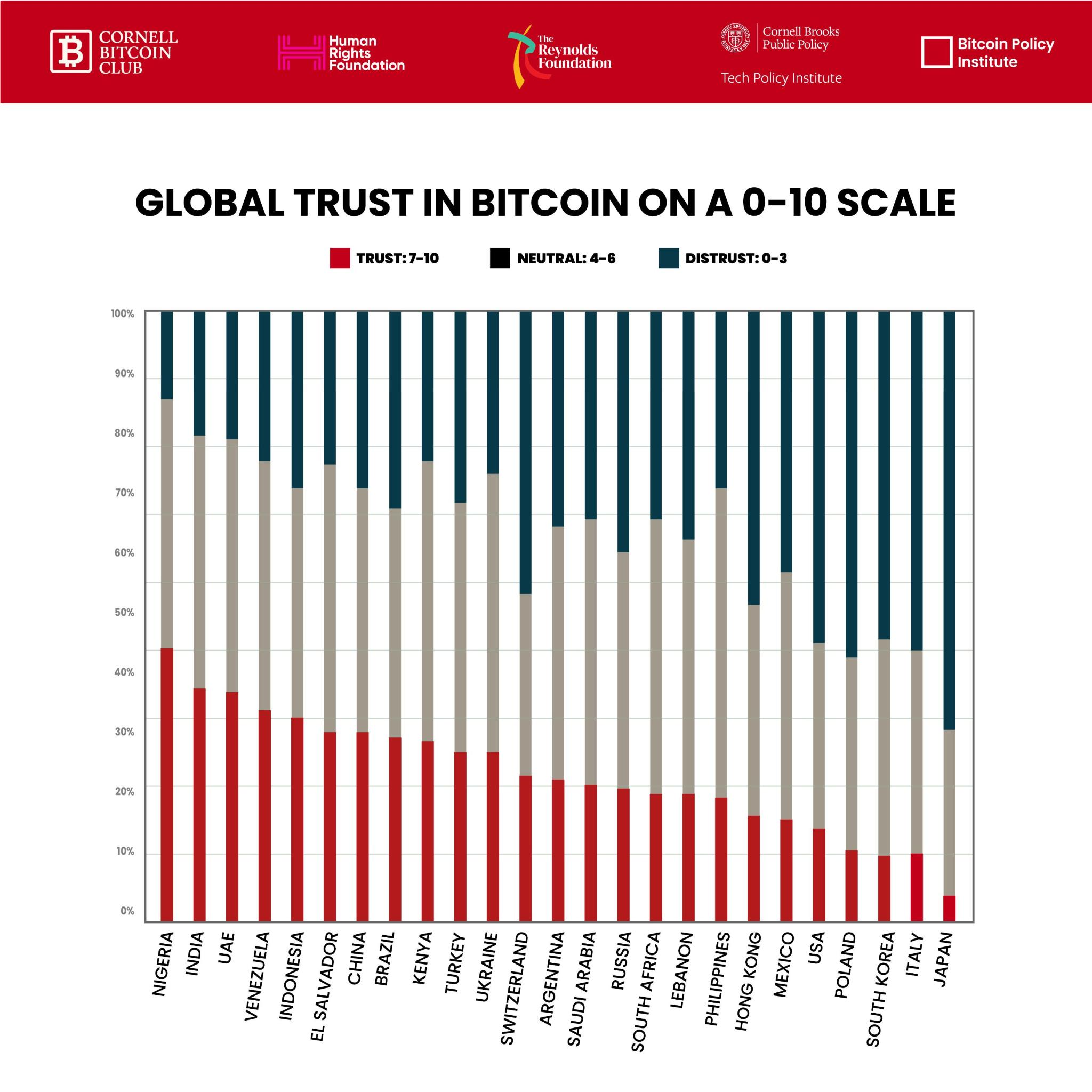
In the Cornell Bitcoin Club report, Japan sits at the far right, in last place out of 25 countries.
What's more, its trust score is far lower than that of Italy in 24th place. Over 70% of respondents distrust Bitcoin, while fewer than 5% trust it.
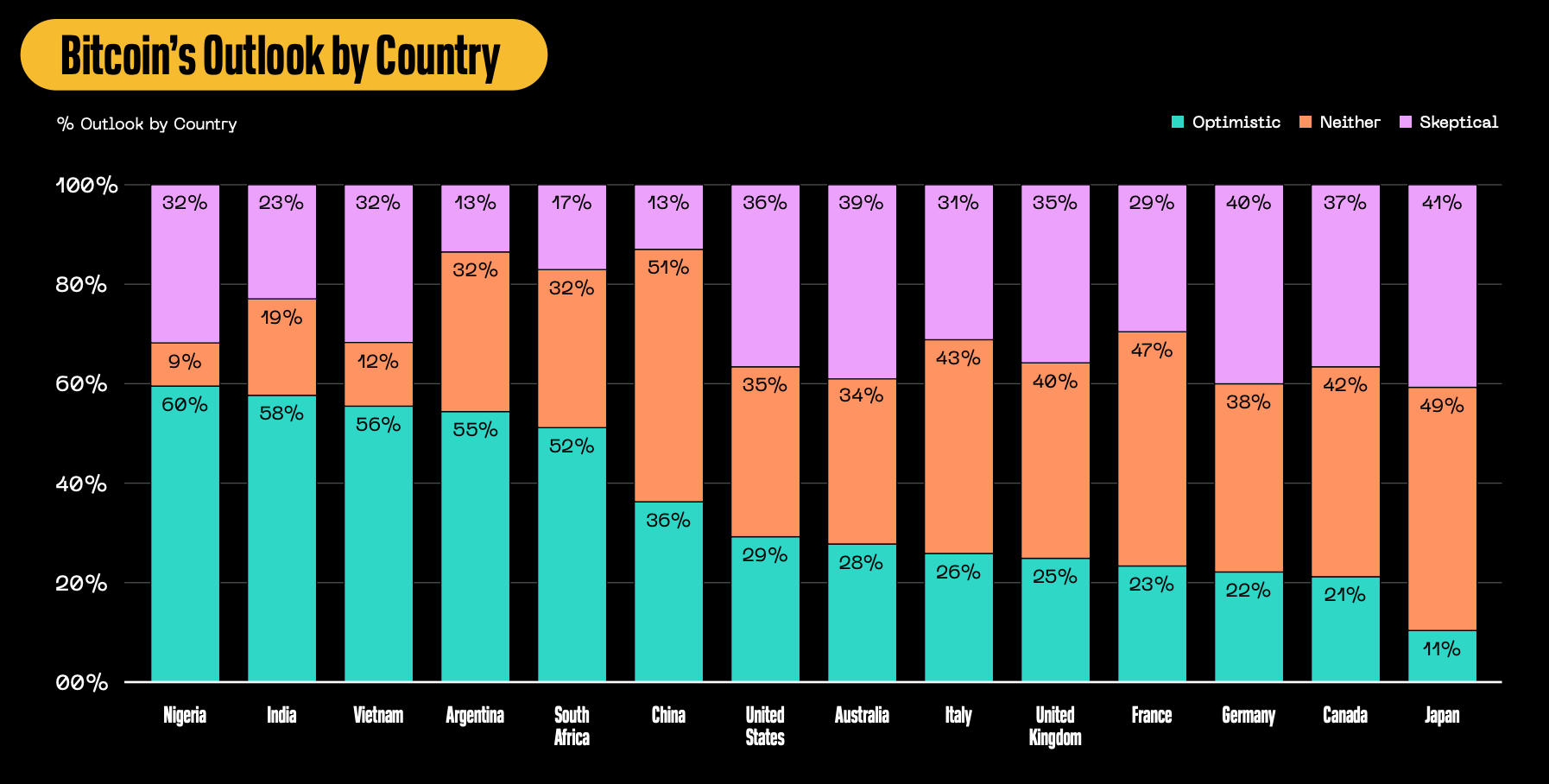
Block's report also ranks Japan last, out of 14 countries. The share of optimists is extremely low, the share of neutral respondents is large, and the share of pessimists is about average.
In both reports, Japan not only comes in last but seems to trail the other countries by a wide margin.
That said, do most Japanese people actually reject Bitcoin outright?
A Hypothesis: The Japanese Don't Distrust Bitcoin, They Just Don't Know It
It seems likely that Japanese people aren't rejecting Bitcoin so much as simply not knowing about it.
This is anecdotal, but when I bring up Bitcoin with people around me, the reactions I hear most are "I've heard the name" and "I don't really get it" or "I don't know anything about it." Many times, people hadn't even heard of the Mt. Gox incident and didn't have so much as a negative image of Bitcoin.
Of course there are some passionate Bitcoin detractors, but those who keep attacking it with real conviction are few, and I think the vast majority simply have no opinion.
In the data above, the Cornell Bitcoin Club survey measured whether respondents felt Bitcoin could be trusted. In Japan, more than 70% gave it a score of 0–3. The idea that "I can't trust it because I don't know it" seems quite plausible. I would also find it hard to give something I know nothing about a trust score of 5 or higher.
Block's survey, meanwhile, measured respondents' outlook on Bitcoin, and in Japan the neutral share was the largest at 49%. The idea that "I'm neutral because I don't know it" also seems reasonable. The pessimistic share is sizable too, of course, but it doesn't look very different from other countries. (The market mood in 2022 was also likely pessimistic.)
The data, then, suggests that many Japanese people quite likely don't know Bitcoin well.
And yet Japan does have some ties to Bitcoin: Mt. Gox was based there, Satoshi Nakamoto is a Japanese name, and the country has many regulated crypto exchanges.
So why do Japanese people know so little about Bitcoin compared with people in other countries?
3 Reasons Japanese People Don't Know Bitcoin

I think there are several reasons Japanese people don't know about Bitcoin. Here I'll explain the three that strike me as most important.
- In safe, stable, secure Japan, people don't feel a need for Bitcoin
- Fear of the unknown and conformist thinking
- A "shady" atmosphere shaped by experts and the media
Reason 1: In safe, stable, secure Japan, people don't feel a need for Bitcoin
In everyday life in Japan, there are almost no situations where you feel you need Bitcoin.
Nearly every Japanese person can open a bank account, and if something like embezzlement occurs, strict regulations ensure losses are compensated. The Japanese yen is one of the most trusted fiat currencies in the world, and it's hard to imagine it suddenly becoming unusable.
Besides cash, there's a wide range of digital payment options such as credit cards and QR code payments. And even if you lost everything, the public assistance (welfare) safety net would let you keep living.
Japan truly is a "safe, stable, and secure" country.
Because Japan already has well-developed financial infrastructure and regulation, there's no occasion to feel a need for Bitcoin. And precisely because it is such a safe, stable, and secure country, people can live without any trouble even without thinking deeply about money.
In many other countries, by contrast, social systems are not as well developed as in Japan, and if you don't protect your own money and think and act for yourself, you could end up homeless or, in the worst case, dead. Being able to get by without a sense of urgency is a kind of peace, but there's no guarantee that today's peace will last forever.
Inflation has recently, at last, come to be seen as a problem, but the focus is on rising prices rather than on the declining value of money. Even among those who invest, index investing in the stocks of companies that provide goods and services is becoming the norm, on the reasoning that it will keep pace with rising prices. There seems to be little questioning of the yen itself as money; people only seem to pay attention to how it moves against the US dollar.
So in Japan, there are few occasions to feel a need for Bitcoin.
Reason 2: Fear of the unknown and conformist thinking
Humans have a survival instinct to protect themselves by first being suspicious of anything they can't identify.
With no administrator and nothing you can physically touch, Bitcoin is unprecedented and departs from common sense. Because it's hard to understand within existing frameworks, the brain may be automatically filing it under "dangerous" or "something like a scam."
On top of that, in Japan, conformist group thinking is trained from a fairly young age through things like group activities and collective responsibility. If you stray from the group as an individual, you risk becoming a victim of bullying or ostracism (known in Japanese as murahachibu).
So when others say "Bitcoin is shady," fear of the unknown and conformist thinking together push Bitcoin even further away. Staying away from things that seem shady or dangerous is considered the sensible thing to do.
Looking into Bitcoin despite all this takes a great deal of persistence. Ideally, you would research Bitcoin critically and draw your own line between what is and isn't a risk, but in reality, people dismiss the research itself with black-and-white thinking.
Reason 3: A "shady" atmosphere shaped by experts and the media
Even if someone overcomes the fear of the unknown and conformist thinking and finally starts researching Bitcoin, I think the reality is that it's hard to find accurate information about it.
My sense is that among the people regarded as "experts" and "influencers" in Japan, very few are positive about Bitcoin. If anything, many seem negative about it.
In February 2026, in collaboration with Kenja no Ryugi, a creator who shares content on saving money and investing, a Bitcoin explainer video was posted featuring Kishin Kato, a familiar face at Bitcoin Research Lab.
People like Kenja no Ryugi, who have researched Bitcoin themselves and speak about it positively, are extremely rare.
So-called "experts" are knowledgeable in particular fields, but that doesn't mean they know Bitcoin. Many of them have succeeded within the current system, and they tend to hold a negative bias that labels anything outside existing frameworks, like Bitcoin, as "dubious."
What's more, these "experts" are good at doing their own research, so they can dig up reasons Bitcoin will fail and other negative information. It would be fine if they evaluated it with an open mind, but the more successful someone is, the stronger their bias that they're right, and they end up building whatever logic suits them.
The situation in which smart people find reasons for Bitcoin to fail precisely because they are smart can be seen not only in Japan but around the world. The article below shows how intelligence itself can keep people away from Bitcoin.
Related article: Why the World's Most Elite Groups Keep Ignoring Bitcoin
Another likely reason is that when experts and the media publish content, negative takes on Bitcoin match what their audiences want.
Content that dismisses Bitcoin or paints it as "shady" grabs viewers' interest more than content about Bitcoin gaining recognition as a global digital asset.
"The Vanished 47 Billion Yen: A Massive Bitcoin Theft," broadcast by NHK in January 2026, is one example of content that reinforces the impression that Bitcoin is shady. It gives many viewers the information they want to see, and viewers end up seeing the world they want to see.
As a result, information that matches the image of Bitcoin many Japanese people already hold (something shady) is everywhere. And because of conformist thinking, the perception that Bitcoin is simply shady and dangerous grows stronger not only among viewers but among content creators themselves.
3 Ways to Spread Bitcoin Adoption in Japan

I've explained why it's hard for Bitcoin to be properly understood in Japan.
Is it okay for Bitcoin to remain misunderstood in Japan? I don't think so.
As various fiat currencies lose value, Bitcoin is money that can be used and serve as a store of value globally. I believe that in the long run, it can help many Japanese people and Japan as a country.
People don't necessarily need to be positive about Bitcoin. What matters is first helping them learn about it neutrally, creating an environment in which, when the time comes, they can accept Bitcoin without being misled by negative narratives.
I've considered three approaches to spreading Bitcoin in Japan and things we can do.
1. Adoption that fits Japanese culture
I think the root cause of Bitcoin not being properly understood in Japan lies in Japan's particular culture and social structure. In other countries, there's an emphasis on self-sovereignty and a sense of urgency that you'll end up in danger if you don't think and act for yourself, which makes for an environment where Bitcoin is easier to understand than in Japan.
But I think it's premature to give up by saying, "It fits culturally in other countries, but culturally it's impossible in Japan."
Japan is an island nation with no land borders, and its legal framework, environment, and culture differ from other countries'. So the standard approaches used to spread Bitcoin elsewhere probably won't work here.
The first step is recognizing that what works in other countries won't work here, and then carrying out outreach adapted to Japanese culture. Concrete methods are still being worked out, but the approaches below, along with steady, persistent effort, will likely be needed.
2. Increasing understanding among experts
As with Kenja no Ryugi mentioned above, people who come to recognize Bitcoin's importance on their own are extremely rare.
Since many experts hold a negative bias toward Bitcoin from the start, I think the important first step is getting them to learn about Bitcoin from a neutral standpoint.
If you're an expert or influencer who wants to learn about Bitcoin or address any concerns or worries, please reach out via Bitcoin Research Lab's contact form or X. Referrals are welcome too.
Whether or not anyone holds Bitcoin, I believe simply helping people understand what Bitcoin is would be a small but important step for Japan's future.
3. Let people hold and use it for free first
Because Bitcoin can't be physically touched, it can be hard to understand. I think understanding only really takes hold through the experience of actually receiving bitcoin and sending it.
For example, Japan Bitcoin Industry Inc. offers services called "Yap Island" and "UseBitcoin."
Yap Island is a rewards app (similar to the points-earning apps popular in Japan, known as poikatsu) where you can learn about Bitcoin and receive bitcoin for free, funded by sharing advertising revenue with users. The only difference from a typical points app is whether you earn points or bitcoin.
Until now, to get your hands on bitcoin, you first had to open an exchange account and buy some. People are very reluctant to buy something they think is shady, so I see apps that let you get bitcoin for free as a first step toward adoption.
UseBitcoin, meanwhile, is a service that lets you buy gift cards (such as V-Preca Gift and Kyash Gift) with bitcoin. Many services accept Bitcoin payments, but UseBitcoin lets you try a Bitcoin payment with a small amount, and you can use the gift cards you get in everyday life.
Besides UseBitcoin, there are several other places where you can use Bitcoin. See the article below.
【初心者向け】ビットコインの使い道まとめ|satsで今すぐできる体験9選
ビットコイン(sats)の使い道を紹介。ライトニングネットワーク対応の決済サービスやギフトカード購入など、ウォレットに眠ったままのsatsを活用する具体的な方法を解説します。
 ごっつ
Personally, I also make a point of giving people some bitcoin when they show interest after I talk to them about it. Honestly, just hearing about it doesn't give people a clear picture, so I believe the experience of actually handling it changes their impression of Bitcoin.
Through conformist thinking, the perception has spread that Bitcoin is shady and something you shouldn't touch. Flip that around, and if you can shift even one person around you to a neutral view, that neutral view may spread as well.
Conclusion: Accept Japanese Culture and Keep Spreading the Word Anyway
Japan ranked last in both international surveys of Bitcoin perceptions. I hypothesized that rather than strongly rejecting Bitcoin, many Japanese people simply don't know about it.
Japan's social structure and culture also seem to keep it distant from Bitcoin.
Even so, I think there are several ways, slow as they may be, to help people in Japan learn about Bitcoin. What matters is adapting to Japanese culture, first removing negative bias, and shifting perceptions from something unknown to something known, and from something untouched to something people actually handle.
Changing how people see things takes time and effort. But if we leave things as they are, Japan alone may stay frozen in time, with Bitcoin seen as something obscure and shady, and the country could miss out on Bitcoin as money.
I believe that if people recognize that Bitcoin already exists as an economic backup, many of them may be able to avoid a critical transition period when an emergency strikes, whether a fiat currency collapse, a deposit freeze, or some other crisis.
Starting from the premise that Japan lags behind in its understanding of Bitcoin, I believe there is real value in continuing to spread the word about Bitcoin.