Bitcoin and Trust: From Trustless Ideal to Partial Trust

This article was translated from Japanese with AI. Read the original (日本語) · Report a translation issue
This article looks at what "trust" means in Bitcoin and tries to sort out the concept. It also looks back at where early Bitcoin's emphasis on running full nodes and self-custody came from, and how that emphasis has changed over time.
I also offer my own view on why wallet services in recent years have put more weight on the payment experience and are moving toward models that assume partial trust.
Defining trust
What exactly is "trust"?
In everyday language it sounds like a vague, abstract word. Yet trust is also a term that computer science has recently begun to re-examine as an important concept.
Trust is studied in many fields, including philosophy, psychology and economics, and each field defines it a little differently, so it is hard to pin down in a single phrase. In this article I won't attempt my own definition of trust itself.
In academic work, Roger Mayer's definition of trust seems to be the one most often cited.
The definition of trust proposed in this research is the willingness of a party to be vulnerable to the actions of another party based on the expectation that the other will perform a particular action important to the trustor, irrespective of the ability to monitor or control that other party.
Trying to define trust precisely is a rabbit hole, so for this article I'll work with a rough definition: "a state of implicitly depending on a third party."
💡
When I reread Mastering the Lightning Network after a long break, I was surprised to find that its opening section already lays out the question of trust. Among other things, it notes that we inevitably trust the software and the mathematical proofs behind the cryptography, so I won't keep pointing out those foundational layers in this article either.
Bitcoin and trust: considering the influences
Let's look at where trust sits in Bitcoin. While writing this article, I searched for source material or discussions giving a clear definition of trust within the Bitcoin Core community, but I couldn't find any. So instead, I'll think it through using the ideas and keywords that probably shaped the relationship between Bitcoin and trust.
The influence of the cypherpunk movement
It is well known that the cypherpunk movement had a major influence on Bitcoin's design philosophy. The cypherpunk movement was a 1990s movement that championed cryptography and privacy technology with the aim of protecting individuals from surveillance and centralized control by governments and corporations. Teruko Neriki of Fulgur has written an article on the cypherpunks in detail, so please refer to it.
サイファーパンクとデジタルキャッシュの歴史①
ビットコインは彗星の如く現れた革新的技術、サトシ・ナカモトという天才がゼロから生み出したシステムと思っている人は多いのではないでしょうか? ビットコインにつながる技術を1970年代から列挙したAnsel Lindner 氏による “Bitcoin Prehistory”(ビットコイン前史)というタイムラインを見れば、そうでないことがよくわかります。以下、Lindner 氏がタイムラインに添えたメッセージです。 ビットコインは突然現れたわけでも、偶然の産物でもない。デジタルキャッシュの必要性を痛感した先人たちによる40年間の研究開発の賜物なのだ。 本コラムでは、ビットコイン誕生に寄与したサイファーパンクと彼らの偉業を Bitcoin Magazine が先週公開したAlex Gladstein 氏の寄稿記事 “The Quest for Digital Cash”(デジタルキャッシュを追い求めて)を基に振り返ります。 https://bitcoinmagazine.com/.../bitcoin-adam-back-and... *************** サイファーパ
 練木 照子

サイファーパンクとデジタルキャッシュの歴史②
本コラムは【2021/10/22】サイファーパンクとデジタルキャッシュの歴史①の続きです。 サイファーパンクとデジタルキャッシュの歴史①ビットコインは彗星の如く現れた革新的技術、サトシ・ナカモトという天才がゼロから生み出したシステムと思っている人は多いのではないでしょうか? ビットコインにつながる技術を1970年代から列挙したAnsel Lindner 氏による “Bitcoin Prehistory”(ビットコイン前史)というタイムラインを見れば、そうでないことがよくわかります。以下、Lindner 氏がタイムラインに添えたメッセージです。 ビットコインは突然現れたわけでも、偶然の産物でもない。デジタルキャッシュの必要性を痛感した先人たちによる40年間の研究開発の賜物なのだ。 本コラムでは、ビットコイン誕生に寄与したサイファーパンクと彼らの偉業を Bitcoin Magazine が先週公開したAlex Gladstein 氏の寄稿記事 “The Quest for Digital Cash”(デジタルキャッシュを追い求めて)を基に振り返ります。 https://bitcoinma
練木 照子
Because the movement pushed back against surveillance, censorship and control by intermediaries, and aimed to build systems that don't depend on a central authority by using cryptography and open source code, we can reasonably infer that it shaped Bitcoin's approach to trust.
"Don't Trust, Verify"
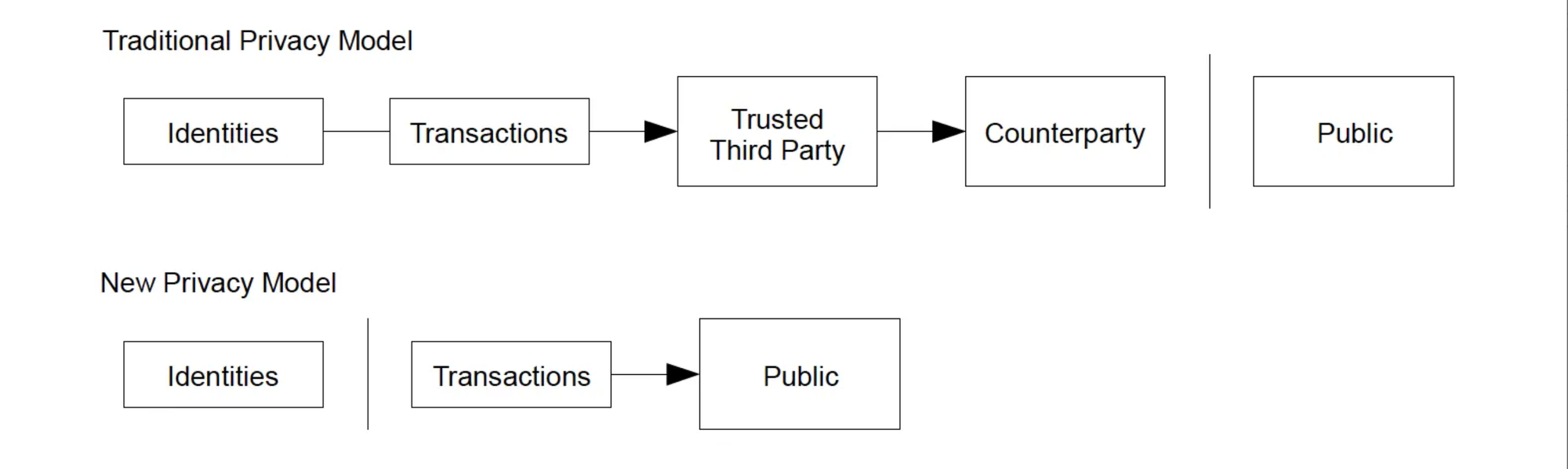
If you've spent any time around Bitcoin, you've probably heard the phrase "Don't Trust, Verify." It's usually used to mean that you shouldn't implicitly trust your peers in Bitcoin but should verify things yourself. However, the phrase doesn't appear in the Bitcoin white paper, and its exact origin seems to be unknown.
That said, the white paper's Introduction opens by pointing out the problems with transactions in traditional finance that rely on a trusted intermediary, and then explains that cryptography makes it possible for two parties to transact without needing to trust a third party.
What is needed is an electronic payment system based on cryptographic proof instead of trust, allowing any two willing parties to transact directly with each other without the need for a trusted third party.
You can see the motivation, as an antithesis to traditional finance, to minimize the "trust" that arises when a third party mediates payments. It's easy to infer that this is why a structure like proof of work (PoW), which settles payments without going through a central party, was adopted.
"Trustless Trust"
In discussions of blockchain systems like Bitcoin, LinkedIn co-founder Reid Hoffman proposed a concept called "Trustless Trust," which has since been widely referenced.
The word "trustless" is often misunderstood: it does not mean that trust becomes completely unnecessary. In Bitcoin, "trustless" can describe a state in which payments work without having to trust the other participants in the blockchain network.
Trustless mechanisms in Bitcoin
Here is a brief look at a few design and operational mechanisms that make specific parts of Bitcoin trustless. (Since most of this is well known, I'll keep it short.)
Self-custody and self-hosting
Individuals each run their own node and can check the history of transactions themselves. And because individuals hold their own private keys, the payment system ensures that no one else can move their funds.
Consensus through proof of work
Rather than a majority vote, finality, meaning that "a payment is ultimately complete and cannot be reversed," comes from a computational competition among an open, unspecified set of participants. Consensus on transaction data isn't reached through the authority of people or organizations; software run by individuals also contributes to forming it. In that sense, Bitcoin achieves trustless transactions that remove intermediaries.
Use of the blockchain and cryptography
The hash chain linking blocks, together with digital signatures on the transactions inside them, makes the record tamper-resistant. Inconsistent or malicious transactions can be validated and rejected, so anyone can confirm what happened without trusting others.
Is the Lightning Network trustless? Lightning's centrality problem and trust
Can the Lightning Network (LN) be called trustless?
The Lightning protocol was designed and implemented with trustlessness in mind. It builds on the properties of the base layer blockchain and is designed around exchanging transactions written in Bitcoin Script, Bitcoin's programming language. This makes atomic transactions possible, meaning payments can't end up in an inconsistent state, without requiring trust in a third party. So as long as you run your own full node, Lightning node and wallet, trustlessness can be preserved.
But as Lightning spreads, has the environment around Lightning payments stayed trustless? My view is that trust has been minimized, but the current reality falls short of the trustlessness of the base layer.
One reason is Lightning's centrality problem. I wrote about this problem in a previous article.
Bitcoinのスケーラビリティ問題とLightningの成功: 次のL2へ
Bitcoin が初期から抱えてきたスケーラビリティ問題にどのように向き合い、Lightning Networkが生まれ、普及してきたのかの過程。その延長線上にある Ark や Spark といった新しいオフチェーンプロトコルが、なぜ現在注目を集めているのか、その背景を整理します。
 押川 拓夢

Lightning nodes with huge capacity act as liquidity hubs, and since those hubs keep Lightning payments running reliably, one could argue that the hub nodes are being trusted.
Also, since routing nodes can halt or delay payments, denial-of-service attacks are possible. In that sense too, I think one can argue that trust arises, because the reliability of payments depends implicitly on the existence of liquidity hubs.
On the other hand, whether to route through a liquidity hub is ultimately a choice, and some argue that reliability, in the sense of "does it work as expected," is a better word than trust. Even if a liquidity hub suddenly disappeared, the Lightning protocol would still let you protect your funds in the end, and payments wouldn't stop entirely. By Mayer's definition, then, you aren't exposing yourself to a "vulnerable state" at the hands of others.
🤔
This is just my own view, but I think discussions of Layer 2 protocols as payment layers in general could more openly start from the assumption of trust. Because the standard for trust remains vague, the discussion and design end up only half-heartedly aiming for trustlessness, and to me that feels inconsistent.
Where the Lightning Network stands: just one option
So where does Lightning, whose trustlessness is open to debate as described above, fit in the Bitcoin ecosystem? In short, I believe the community sees it this way: Lightning is one application of Bitcoin, and nothing more than one option.
Using Lightning is optional. Each node can choose whether to join, and the system is designed so that no one is barred from using or holding bitcoin just because they don't use Lightning.
The spread of LSP-integrated wallets
LSP-integrated wallets emerged as a way to lower one of Lightning's big hurdles: how hard it is to run a node.
A Lightning Service Provider (LSP) is a company or other organization that gives Lightning users stable peer connections between nodes, simplified channel management and liquidity.
In an LSP-integrated wallet, a wallet service offered by an LSP, users hold their own private keys while the company running the service takes care of the tedious work of managing channels and providing liquidity. Because this approach still delivers self-custody, users can protect their funds even if the operator goes bankrupt or acts dishonestly, and they can restore their ability to send payments by connecting to another Lightning node. Examples of LSP-integrated wallets include Phoenix Wallet and Breez.
Kishin Kato, Koji Higashi and others have previously written articles on Lightning wallets, including LSP-integrated ones.
セルフカストディ型のライトニングウォレットのスケーラビリティを補完できる技術は出てくるのか
ライトニングでセルフカストディをしようと思うと、最低でも自分でチャネルを保有する必要があり、よりトラストレス性を高めようと思えば自分のノードを立てることになります。したがって、世の中にあるセルフカストディ型のライトニングウォレットはこのいずれかの形をとっています。 しかし、この使い方にはコストがつきものです。例えばチャネルの開設には今のオンチェーン手数料が低迷している環境でも数十円、場合によっては数千円以上になることも考えられます。ライトニングノードの維持も無料ではありません。(趣味で維持している場合は無料のように考えてしまいますが) ライトニングはカストディ型で普及する、という今では主流の主張はこれらのコスト面と、それに関連したユーザーエクスペリエンスの問題を根拠にしています。コストやUXの課題を軽減しつつ、セルフカストディを捨てない折衷案はないのでしょうか? 今日はその折衷案として考えられる、ライトニングが使えるセルフカストディ型のウォレット方式を2つ考えてみます。 ・現行のセルフカストディ型ライトニングウォレットは大別して2種類に分かれ、それぞれに課題がある ・Muti
加藤 規新
Lightning Network Walletの分類と進化
Lightning Networkのウォレットの分類とそろぞれの特徴、メリット、デメリットなどについて簡単な比較表を作りました。(添付画像参照) こちらのURLからも確認可能↓ https://datawrapper.dwcdn.net/Wj608/3/?fbclid=IwAR3tcGugpxtncAENGYaZeBfyS_us-p0CIFbY67E4Iunda43b-eAPKkTVMeU 基本的には比較表を見てもらえれば、最新のLN Walletの特徴とメリット、デメリットをわかるようにまとめたのでそちらをご確認ください。以下いくつか重要ポイントを手短に補足します。 フルカストディアル こちらはすでにBluewalletなど過去のコラムで解説しており特に理解は難しくないので割愛します。カストディアルウォレットは資金を持ち逃げされる可能性/リスクがありますが、取引所ユーザーなど含め大部分のユーザーは単純に楽なUXを求めてこちらのタイプを使っていく可能性が高そうです。 HOSTED CHANNEL こちらはフルカストディアルウォレットのプライバシーと検証性の課題を解決し
東 晃慈
Before Lightning took off, the ideal was for every user to run a full node, and I think any compromise short of that, LSP-integrated wallets included, would have been an unacceptable option in early Bitcoin culture.
From "Don't Trust, Verify" to accepting partial trust
I see the arrival and spread of LSP-integrated wallets as starting to change how trust works in Bitcoin.
Confidence in the reliability of on-chain transfers has gradually built up, and as the interests of different players in the Bitcoin ecosystem become clearer than before, a culture is emerging in which users choose for themselves which services to trust. That's how it feels to me, at least.
On top of that, a full node now takes up close to 700 GB, so running one on a low-powered device is no longer realistic. As a result, maintaining the ideal of running absolutely everything yourself requires considerable cost and the right setup, and users are increasingly forced to make compromises and choices. I think this is another factor driving the trend.
The defining feature of LSP-integrated wallets is that users trust the service provider for part of the payment experience, yet can leave the service at any time and keep their own funds safe. This feature appears to have influenced the adoption of the protocols that followed, Ark and Spark.
New off-chain protocols and a shifting trust model: Ark and Spark
That brings us to the growing attention to and adoption of new off-chain protocols such as Ark and Spark. Wallets for Ark are being developed by Arkade, Second and others, and Spark has been adopted by Wallet of Satoshi. Kishin Kato has written about Ark and Spark in detail, so I'll skip the details here.
ビットコインで話題の新レイヤー2「Ark」はどのような技術なのか
読者の皆さんはちょうど昨年のこの時期にBurak Keceli氏がBitcoin 2023カンファレンスで「Ark」として正式に発表したレイヤー2の話題を覚えていらっしゃるでしょうか? 今年の5月29-31日に開催されたBitcoin SeoulカンファレンスでArkの開発者のうちの1人(Steven Roose氏)による発表と質疑応答の時間があり、ようやく自分の中で内容の整理がつきました。発表当初と少しデザインが変わった部分もありますが、今日はArkの仕組みについて軽く解説してみようと思います。 ・コベナンツを前提としたArkの仕組み(図説) ・少し仕組みを変えて現在稼働しているArkもある ・おまけ:コベナンツではないが、相続を念頭に置いたウォレットLianaが面白い
加藤 規新
Lightsparkが発明した新しいレイヤー2:Spark
ノンカストディアルなライトニングをエンドユーザー向けにスケールさせることの難しさはウォレット事業者が一番痛感しています。これが最近の記事でも取り上げた「Nodeless Lightning(Liquid Networkを使わせるライトニングウォレットのバックエンド実装)」のようなアイデアにつながっています。 セルフカストディ型のライトニングウォレットのスケーラビリティを補完できる技術は出てくるのかライトニングでセルフカストディをしようと思うと、最低でも自分でチャネルを保有する必要があり、よりトラストレス性を高めようと思えば自分のノードを立てることになります。したがって、世の中にあるセルフカストディ型のライトニングウォレットはこのいずれかの形をとっています。 しかし、この使い方にはコストがつきものです。例えばチャネルの開設には今のオンチェーン手数料が低迷している環境でも数十円、場合によっては数千円以上になることも考えられます。ライトニングノードの維持も無料ではありません。(趣味で維持している場合は無料のように考えてしまいますが) ライトニングはカストディ型で普及する、という今では主流の
加藤 規新
Ark and Spark share the same concern as the LSP model: delivering fast, cheap payments without requiring users to run a full node or manage channels.
Both protocols are designed so that users' funds can ultimately be protected, while greatly improving the user experience by assuming partial trust in a service provider.
At the recent Bitcoin Japan 2025 Dev Day, Ark and Spark came up again and again. And a term often used alongside them was "market-driven."
Bitcoin has entered its adoption phase, and for it to be used more widely in everyday life, products built from the user's point of view are needed.
Still, I believe partial trust in service providers is something early Bitcoin would never have accepted. And it's a fact that some Bitcoiners today react with outright rejection to these new protocols.
New protocols like Ark and Spark simply offer new options. Those who can't accept them can keep choosing Lightning wallets, and users worried about Lightning's centralizing structure can keep choosing on-chain transfers.
More options also means users spread out across them. Optimistically, you could also see this as a sign that, unlike in the early days, a diverse range of users has become interested in Bitcoin and joined in.
Summary: trust in Bitcoin is changing
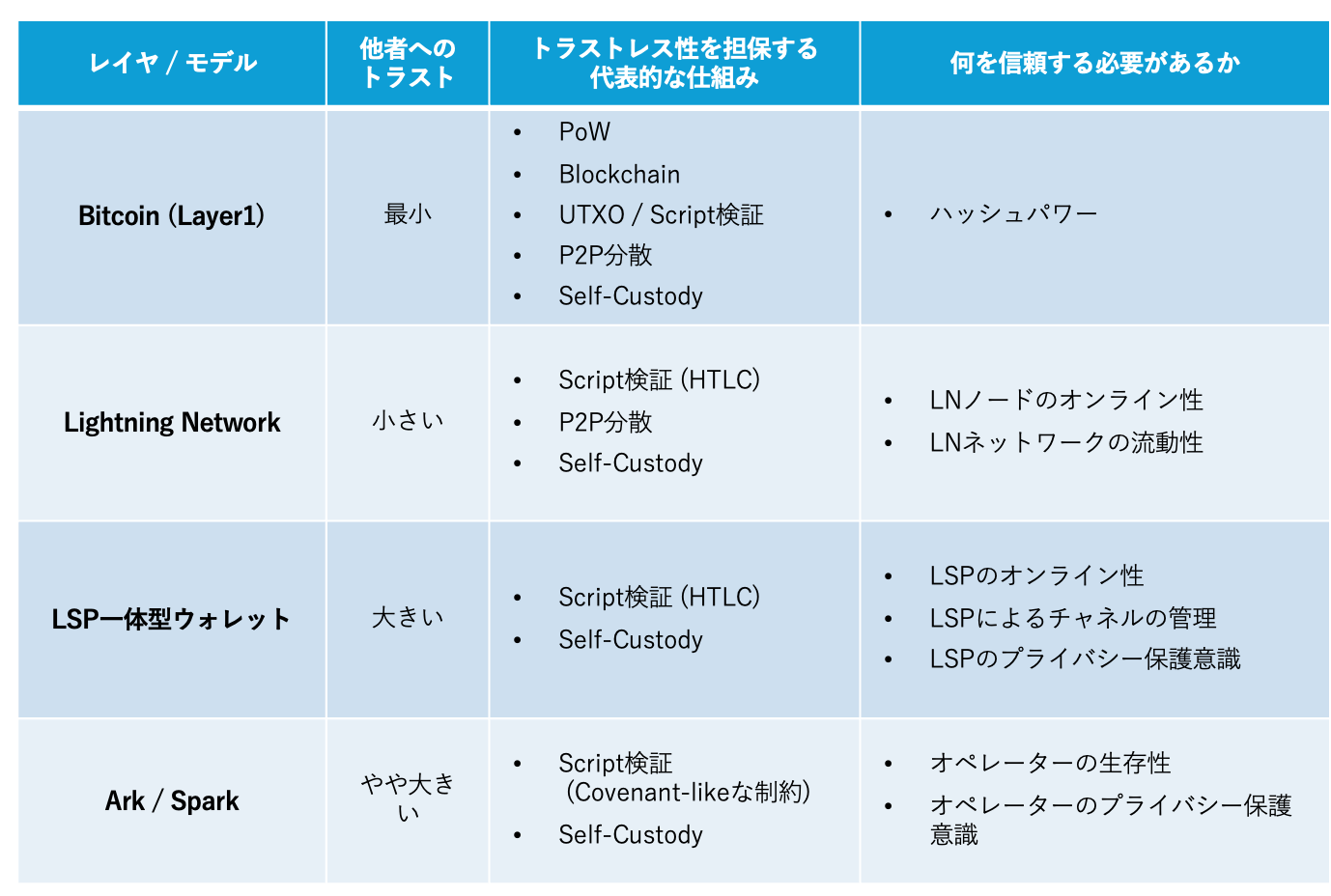
In the beginning, Bitcoin put "Don't Trust, Verify" into practice through running full nodes and self-custody, prioritizing trustlessness that minimizes dependence on third parties. But with growing node storage requirements, the operational burden of the Lightning Network and demand for a better payment experience, it is becoming harder and harder to live up to that ideal.
LSP-integrated wallets and new off-chain technologies such as Ark and Spark have emerged to address this challenge. They are approaches that try to combine convenience with self-sovereignty, and designs that accept partial trust are spreading.
Whether centered on-chain, on Lightning or on emerging protocols, the growing number of options now lets users choose how much trust they are willing to accept.
Overall, Bitcoin can be said to be moving from "the ideal of complete trustlessness" to "a practical phase in which users actively choose whom to trust."
Closing thoughts: hoping for a more mature discussion of trust
This article is a fairly abstract discussion of a topic without a clear definition, so many points are open to interpretation. Critical feedback is welcome.
These days, governments and Big Tech increasingly dictate, almost by force and with no right of refusal, which institutions, systems and other things we can or cannot trust. In the Bitcoin ecosystem, by contrast, communities and individuals can choose what to trust for themselves, and can change what they trust and their standards for trust as times change. I believe this is Bitcoin's true strength.
Yet although trust is an important theme in Bitcoin, I believe one major issue is that organized discussion hasn't accumulated and the standards have become vague. I'd be glad if this article helps get that discussion started.
I deliberately left it out this time, but I plan to cover "the existence of Bitcoin's DNS seeds," an important topic when talking about Bitcoin and trust, in my next article.
BitcoinのDNSシードはトラストレス性における懸念点なのか
BitcoinのDNSシード(DNS seed)とは、端的にいうとBitcoinフルノードの同期開始時にブロックデータを取得するために、最初にピアとして接続するノードの候補を返すシステムです。
押川 拓夢
References
[1] Hideyuki Nakashima (ed.), Shinrai wo Kangaeru: Leviathan kara Jinko Chino made (Thinking About Trust: From Leviathan to Artificial Intelligence). Tokyo: Keiso Shobo: https://www.keisoshobo.co.jp/book/b371303.html
[2] Masanori Kurita et al., Blockchain Gijutsu Gairon: Riron to Jissen (An Introduction to Blockchain Technology: Theory and Practice). Tokyo: Kodansha Scientific: https://www.kodansha.co.jp/book/products/0000353684
[3] A. M. Antonopoulos, Mastering Bitcoin: https://github.com/bitcoinbook/bitcoinbook
[4] A. M. Antonopoulos, O. Osuntokun, et al., Mastering the Lightning Network. O'Reilly Japan (Japanese edition). https://www.oreilly.co.jp/books/9784814400140/
Other references are linked in the text.